Key Takeaways
- John Browning developed and patented the pistol’s basic locked-breech mechanism, but Dieudonné Saive completed the production design after Browning’s death.
- FN began regular production in Belgium in 1935 under the name Grande Puissance, meaning High Power.
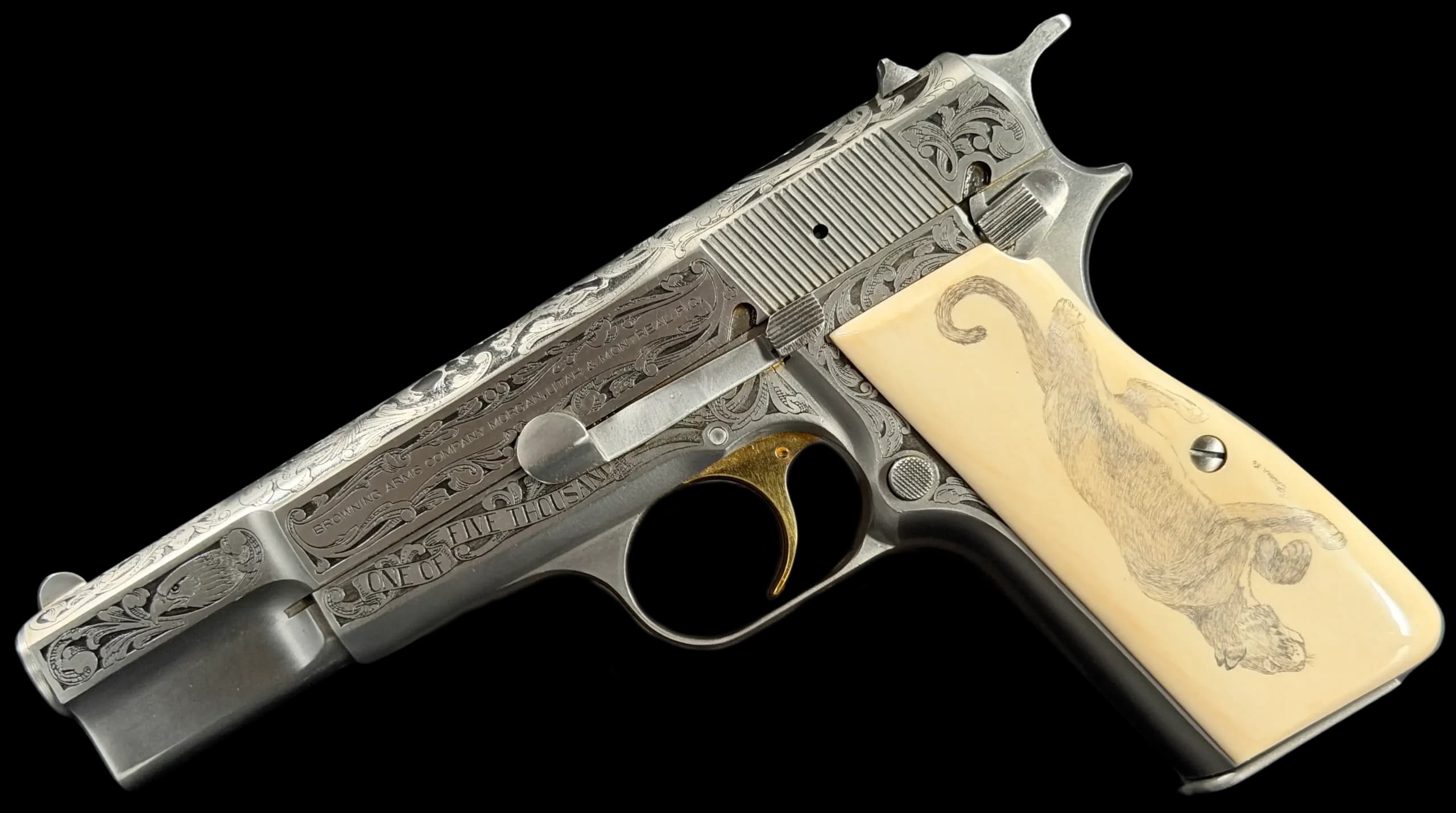
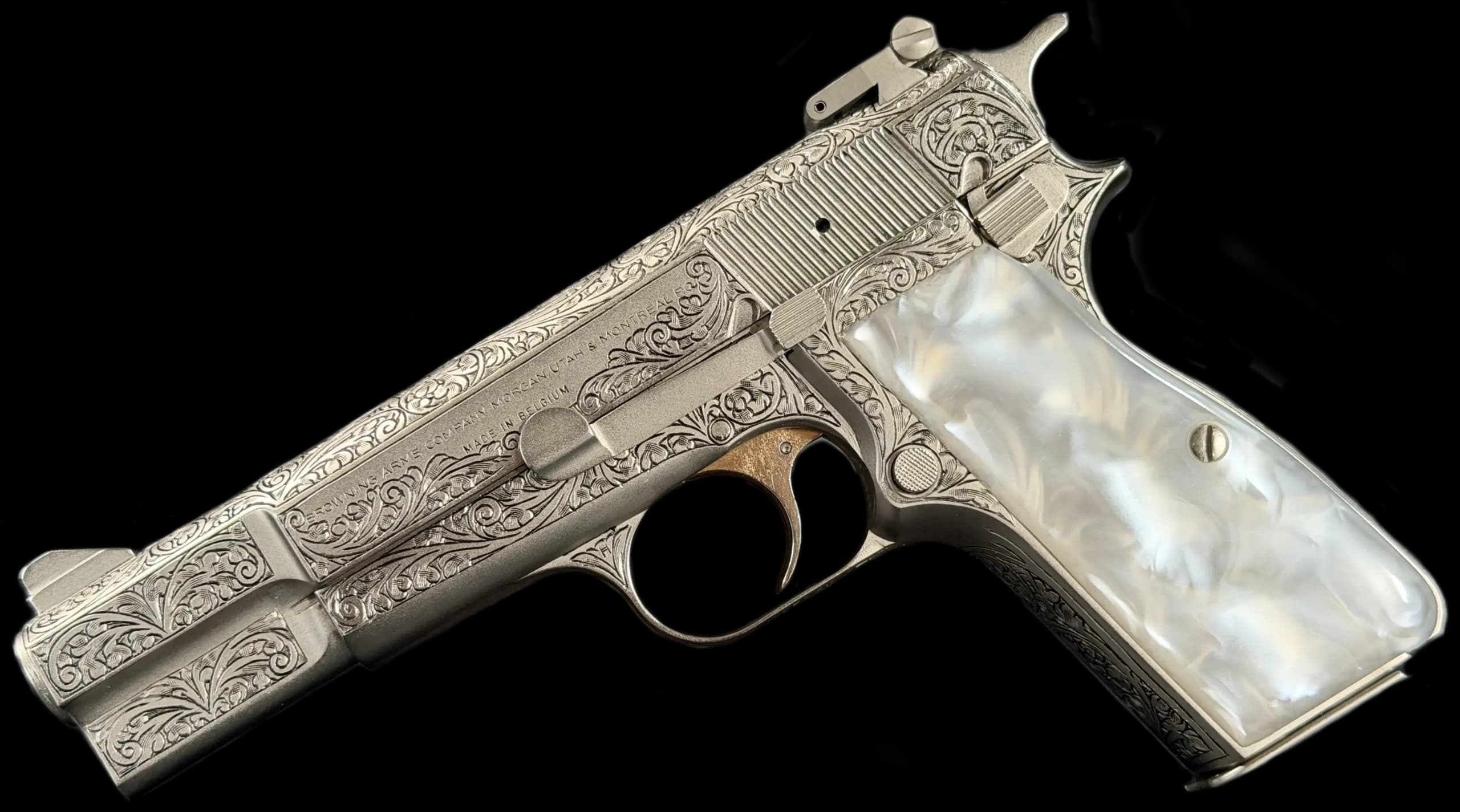
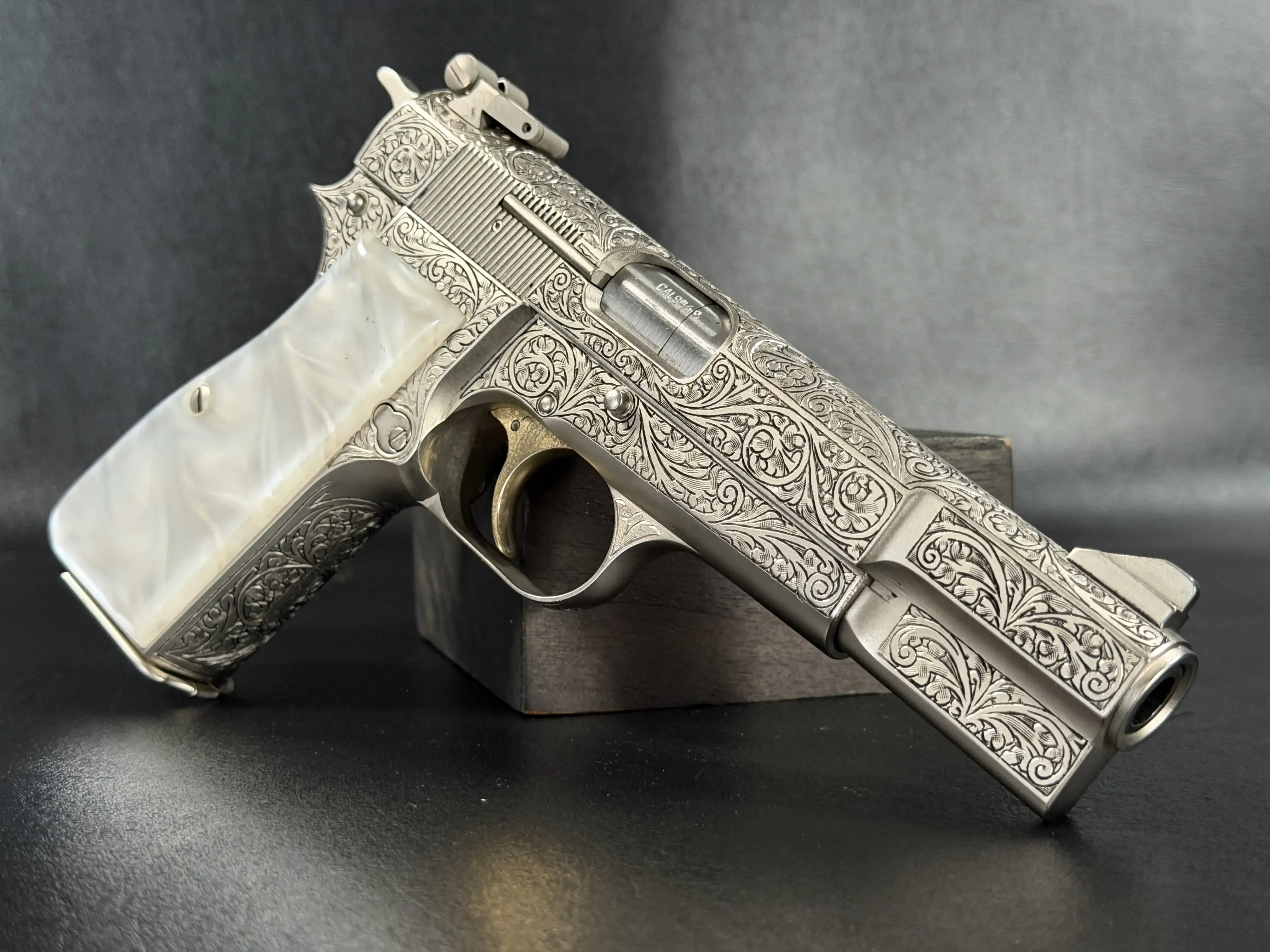
- Manufacturer markings, serial numbers, proofs, sights, grips, ejection-port shape, and stock cuts should be evaluated together when identifying a collectible example.
The Browning Hi-Power originated in a French military-pistol competition, but the design that entered production in Belgium in 1935 was the product of an extended collaboration between John Moses Browning and Fabrique Nationale designer Dieudonné Saive. Browning established the basic locked-breech mechanism. Saive developed the magazine and transformed Browning’s prototype into the production pistol.
Development in Belgium and the United States
FN began the project during the early 1920s in response to a French request for a new military handgun. The French requirements included compact dimensions, a magazine holding at least 10 cartridges, straightforward disassembly, a manual safety, and a device preventing the pistol from firing without its magazine installed.[1]
Saive, then working at FN, modified an earlier pistol to accept a double-column magazine. Browning subsequently developed two prototypes in Ogden, Utah, between 1921 and 1922. One used simple blowback operation; the other employed a short-recoil, locked-breech action. The locked-breech version was selected for continued development.[1][2]
Browning filed a United States patent application for the recoil-operated pistol on June 28, 1923. The patent described a design intended to be strong, mechanically simple, accurate, reliable, safe, and economical to manufacture. It also emphasized reducing the number of components and permitting disassembly without special tools.[2]
The pistol’s locking system departed from that of Browning’s earlier M1911. The M1911 used a pivoting link beneath the barrel to control its vertical movement during unlocking. Browning’s new pistol used a cam surface incorporated into the barrel assembly. After the barrel and slide recoiled together for a short distance, the cam lowered the barrel and disengaged its locking surfaces from the slide.[2][3]
Browning died in Liège, Belgium, on November 26, 1926. His patent was issued posthumously on February 22, 1927.[2][3] Saive continued the development program at FN. He replaced the prototype’s internal striker with an external hammer, added a manual thumb safety, refined the grip frame, and reduced the magazine capacity from 15 to 13 cartridges.[3]
This division of work matters. Describing the Hi-Power solely as Browning’s final pistol obscures the extent of Saive’s contribution. Browning supplied the essential short-recoil mechanism and prototype. Saive developed the staggered-column magazine and completed the changes required to turn that prototype into the pistol manufactured in 1935.[1][3]
From Grand Rendement to Grande Puissance
The developing pistol was initially called the Grand Rendement, or High Efficiency. FN demonstrated it to the Belgian military in 1931, after which Belgium ordered 1,000 pistols for field trials. FN produced approximately 1,100 preproduction examples for testing and international demonstrations.[1]
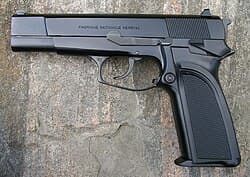
These trial pistols commonly had tangent rear sights, and most were machined at the rear of the grip to accept a detachable shoulder stock. Their most recognizable feature was an oval ejection port. Collectors later applied the name “Oval Port High Power,” but this was not FN’s contemporary model designation.[1]
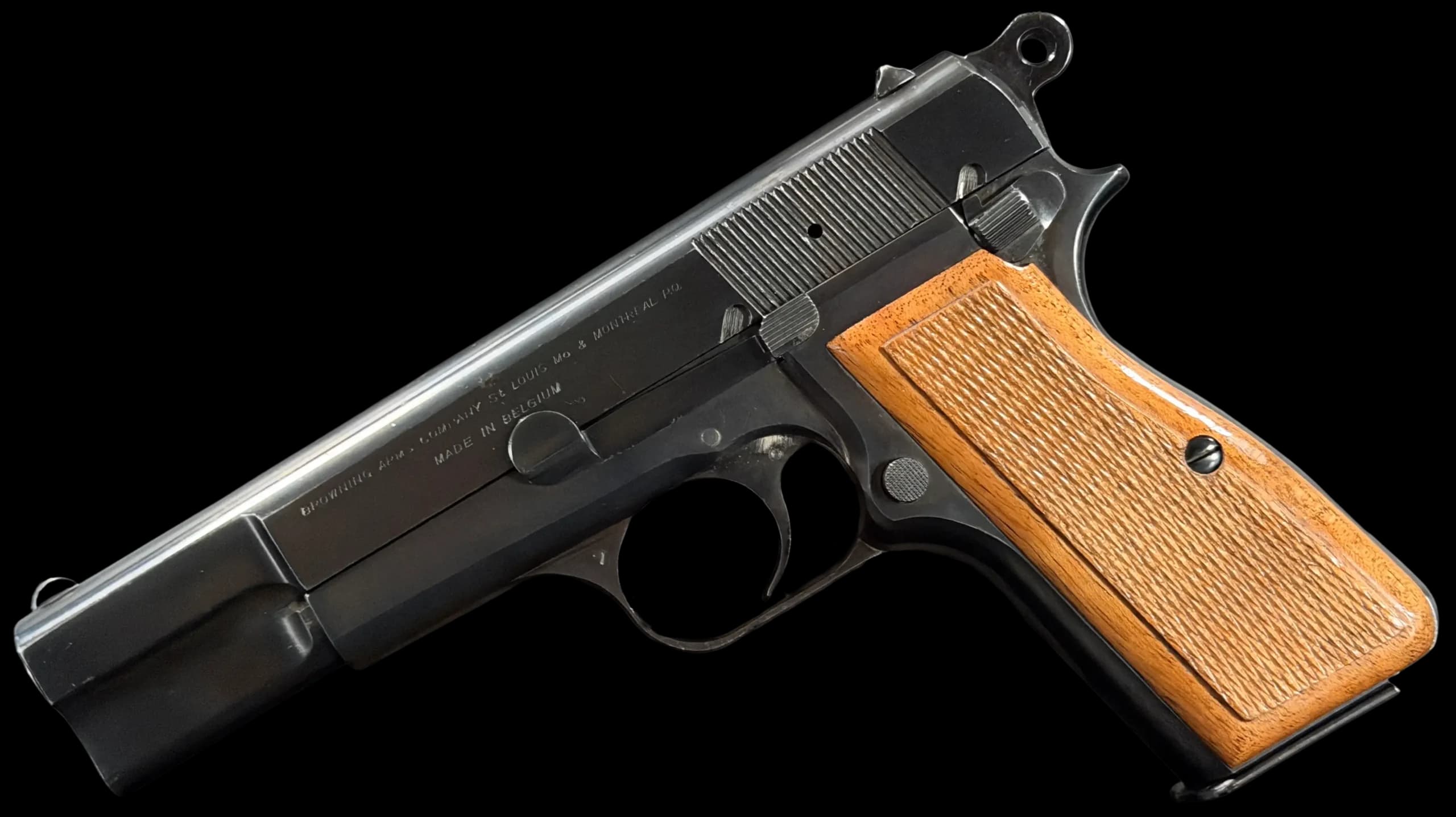
Belgian testing led to the adoption of a rectangular ejection port. FN began regular production after receiving an order for 10,000 pistols, with the first completed in March 1935. The company renamed the model Grande Puissance, meaning High Power. Belgian terminology also included G.P. and Model of 1935.[1]
The French government did not adopt the pistol that its requirements had helped initiate. Belgium did, and Belgian military production established the basic form by which the early High Power is recognized: a steel-frame, single-action pistol chambered for 9×19mm ammunition and fed from a 13-round, double-column magazine.[1][3]
Mechanical Characteristics
The production High Power is a recoil-operated, single-action semiautomatic pistol with an exposed hammer. Pulling the trigger releases the cocked hammer but does not cock it. After the final cartridge is fired, the magazine follower operates the slide stop and holds the slide open.[4]
The standard 9mm magazine holds 13 cartridges. Browning’s later manual specifies 9mm Luger, also called 9×19mm Parabellum, for 9mm pistols. It also documents reduced-capacity 10-round magazines and a later .40 S&W version with a 10-round magazine.[4]
A magazine-disconnect mechanism prevents the trigger from releasing the hammer when the magazine is removed. The manual safety can be engaged only when the hammer is cocked. Older pistols generally have a safety lever on the left side, while later commercial versions use an ambidextrous arrangement.[4]
Although the High Power and M1911 share a short-recoil operating principle, exposed hammer, manual safety, and tilting barrel, they are distinct designs. The High Power’s linkless barrel-cam system, staggered-column magazine, magazine disconnect, and trigger linkage separate it mechanically from the M1911.[2][4]
Production During World War II
Germany occupied Belgium in 1940 and took control of the FN factory. High Power production continued under German authority, and the pistol received the German designation Pistole 640(b), with the suffix denoting Belgian origin.[3]
Wartime Belgian production changed as the occupation continued. Finish, machining quality, grips, and inspection markings can therefore help place a pistol within the occupation period. These characteristics must be considered together. A German acceptance mark alone does not establish that every component is original to the pistol.
High Power production also began in Canada. After the occupation of Belgium, Saive and FN drawings reached Britain and ultimately supported manufacture by John Inglis and Company in Toronto. Inglis produced fixed-sight and adjustable-sight pistols, including examples equipped to accept detachable shoulder stocks. Canadian-made pistols supplied Allied requirements while FN remained under German control.[3]
The concurrent production histories make the High Power unusual among major Second World War handguns. Closely related versions were manufactured in occupied Belgium for German forces and in Canada for the Allied side.[3]
Postwar Production and Commercial Variants
FN resumed its position as the principal manufacturer after the war. The pistol subsequently appeared in military, police, and commercial configurations across a wide geographic range. Osprey Publishing’s history of the model reports that military and law-enforcement organizations in more than 90 countries issued the High Power.[5]
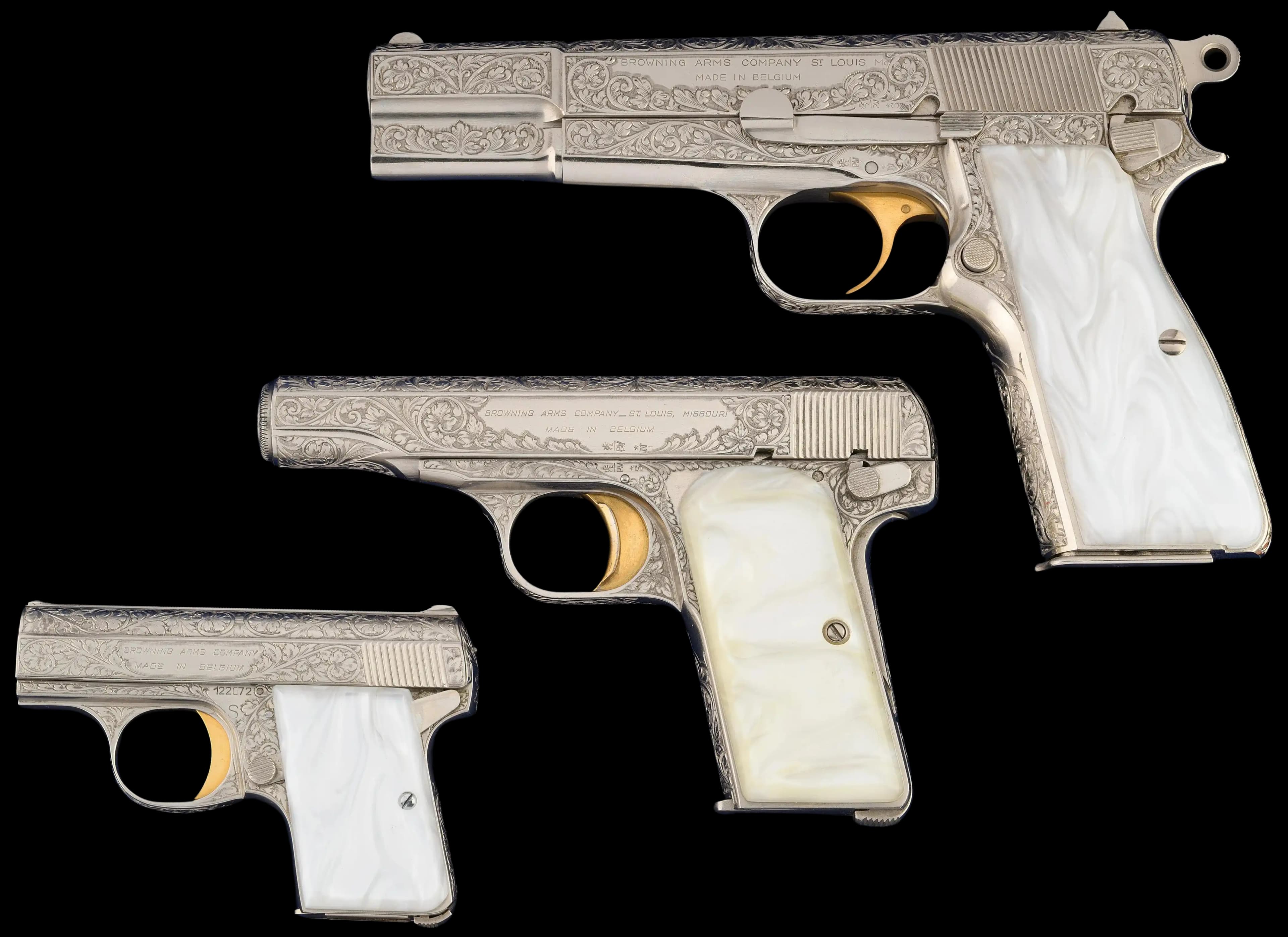
Browning Arms Company introduced the 9mm Hi Power to the United States market in 1954. The spelling “Hi Power” is associated particularly with Browning-marketed commercial pistols, while FN and military references also use High Power, Grande Puissance, G.P., and Model of 1935.[1][6]
Browning introduced the .40 S&W version in 1994. The company’s manual records a 10-round magazine for this chambering, compared with the traditional 13-round magazine for standard 9mm examples.[4][6]
The original FN production lineage continued from 1935 through 2017. During those 82 years, the pistol acquired different sights, safeties, extractors, finishes, grips, markings, and chamberings. Its fundamental architecture remained recognizable: an exposed-hammer, single-action mechanism combined with a linkless tilting barrel and staggered-column magazine.[4][5]
Identifying a Collectible Hi-Power
Correct identification begins with the manufacturer and markings rather than the general outline. Prewar Belgian, German-occupation, Canadian Inglis, postwar FN, and Browning-marketed commercial pistols can appear similar while belonging to materially different production periods.
Tangent sights and a shoulder-stock slot are associated with several early and military configurations, but neither feature independently proves a particular contract or date. Developmental Grand Rendement pistols, Belgian service models, and wartime Canadian versions may share some of these characteristics.[1][3]
An oval ejection port is a significant feature of the preproduction Grand Rendement pattern. Production pistols adopted a rectangular opening. Collectors should nevertheless evaluate the entire pistol, including its markings, proofs, serial numbers, finish, sights, grips, and frame machining, before assigning a developmental or military classification.[1]
Browning’s serial-number guide is useful for American-market examples but carries an explicit limitation. The company describes serial ranges from 1954 through 1957 as estimates and reports that better records begin in 1958. The letter “T” became the product code in 1964.[6]
Beginning in 1969, Browning used a two-digit year followed by the letter “C” and a serial sequence. Under the system used from 1976 through 1997, code 245 identified a 9mm Hi Power and code 2W5 identified a .40 S&W version. Browning revised the system again in 1998, using code 510 for the Hi Power.[6]
The Hi-Power’s historical identity rests on two documented stages of development. Browning patented the short-recoil, linkless prototype. Saive supplied the high-capacity magazine and completed the production design adopted by Belgium in 1935.[1][2][3]
Frequently Asked Questions
Who designed the Browning Hi-Power?
John Browning developed the original short-recoil prototype. Dieudonné Saive refined the magazine, controls, grip, and other features needed for production.
When did FN begin producing the Hi-Power?
FN began completing regular production pistols in March 1935. Belgium was the first country to adopt the finished design.
Why is it called the Hi-Power?
FN named the production pistol Grande Puissance, or High Power. The name reflected its 13-round magazine capacity, which was substantial for a service pistol of its period.
How does the Hi-Power differ from the M1911?
The Hi-Power uses a linkless barrel-cam system, a staggered-column magazine, and a magazine disconnect. The M1911 uses a barrel link and was originally designed around a single-column magazine.
What should collectors examine when identifying a Hi-Power?
Collectors should examine the manufacturer’s markings, proofs, serial numbers, sights, grips, finish, ejection port, and any shoulder-stock slot. No single feature establishes a pistol’s date, configuration, or provenance.
Sources
[1] Vanderlinden, Anthony. “80 Years of the Belgian High Power.” American Rifleman, September 23, 2015.
[2] Browning, John M. “Automatic Firearm.” U.S. Patent No. 1,618,510, filed June 28, 1923, issued February 22, 1927, pp. 3-14.
[3] Campbell, Dave. “A Look Back at the Browning High Power Pistol.” American Rifleman, October 24, 2017.
[4] Browning. Browning Hi Power Autoloading Pistol Owner’s Manual. Browning, n.d., pp. 10-21.
[5] Thompson, Leroy. The Browning High-Power Pistol. Osprey Publishing, 2020.
[6] Browning. “Hi Power Pistol.” Browning, n.d.
As a firearms enthusiast with a background in website design, SEO, and information technology, I bring a unique blend of technical expertise and passion for firearms to the articles I write. With experience in computer networking and online marketing, I focus on delivering insightful content that helps fellow enthusiasts and collectors navigate the world of firearms.
Comments
Be the first to leave a comment.
Be the first to read new editorial features, collector guides, and brand spotlights.