Key Takeaways
- Evaluate the entire revolver; matching serial numbers or a correct marking alone cannot prove originality.
- Treat undocumented ownership stories and historical associations as attributions, not established provenance.
- Avoid irreversible restoration because polishing, refinishing, and unnecessary disassembly can destroy historical evidence and collector value.
A collectible percussion revolver should be judged as a complete object. Its configuration, markings, serial numbers, finish, mechanical condition, and provenance must support the same conclusion. No single correct feature can compensate for several contradictions.
Before handling any antique firearm, assume it is loaded. Do not cock, cycle, or disassemble an unfamiliar revolver until a qualified person has confirmed that it is safe.
Identifying the Principal Models
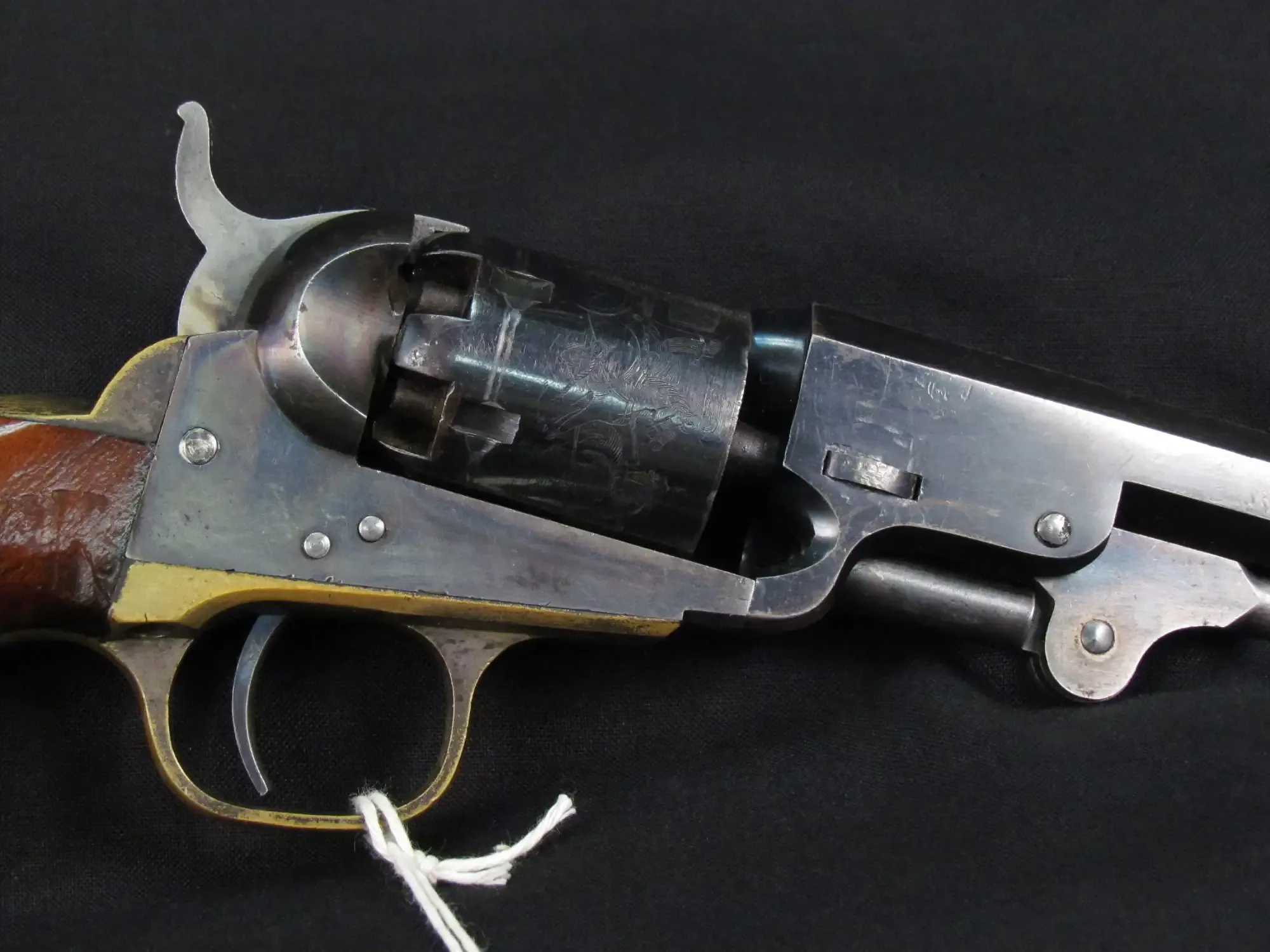
Colt Model 1849 Pocket
The Model 1849 Pocket is a compact, open-top percussion revolver in .31 caliber. Standard examples have an octagonal barrel and a cylinder roll-engraved with a stagecoach-holdup scene. Colt offered four-, five-, and six-inch barrel lengths.
The Metropolitan Museum of Art dates the model’s introduction to 1848 and continued production through 1872. More than 300,000 were manufactured, making it one of Colt’s most successful percussion firearms.[1]
High production does not mean that every surviving configuration is common or correct. Barrel length, address, cylinder scene, serial placement, grip profile, and finish must still be evaluated together.
Colt Model 1851 Navy
The Model 1851 Navy is a six-shot, .36-caliber revolver with an open frame, octagonal barrel, and naval-battle cylinder scene. Standard examples have a 7½-inch barrel. The Metropolitan Museum dates production from 1851 through 1873.[2]
The cylinder scene depicts the May 16, 1843, naval engagement between vessels of the Republic of Texas and Mexico. Waterman Lilly Ormsby designed the image, which was normally applied by roll engraving.[2]
Although the Model 1851 shares recognizable elements with Colt’s pocket revolvers, describing it simply as an enlarged Model 1849 is too crude for serious identification. The models use different frame sizes and were intended for different market roles.
Colt Model 1860 Army
The Model 1860 Army is a six-shot, .44-caliber percussion revolver with an eight-inch barrel. Contemporary terminology included “New Model Army” and “Holster” pistol. The model is readily distinguished from the Model 1851 Navy by its round barrel and streamlined loading-lever assembly.
The Metropolitan Museum of Art reports that the Colt factory manufactured the Model 1860 Army through 1873, with total production of approximately 200,500 revolvers.[3]
Variations exist, particularly among early-production and military-contract examples. Identification should therefore rest on the complete configuration rather than a single feature.
Remington New Model Army
The Remington New Model Army is a six-shot, .44-caliber percussion revolver with an eight-inch octagonal barrel and a solid frame extending over the cylinder. Its standard three-line barrel marking ends with “NEW MODEL.” That inscription is important because the frequently used name “Model 1858” refers to Fordyce Beals’s patent date, not the New Model Army’s model designation.[4]
Beals received U.S. Patent No. 21,478 on September 14, 1858. His design used the loading lever to retain the cylinder pin.[5] The patent relationship does not mean that every Remington revolver bearing the 1858 date is a New Model Army. Earlier Remington-Beals and Model 1861 revolvers must be distinguished by their markings and mechanical details.[4]
Inspect the Complete Configuration
Begin with the revolver’s basic architecture:
- Caliber
- Frame type
- Barrel profile and length
- Loading-lever design
- Cylinder capacity
- Cylinder scene or fluting
- Grip shape
- Trigger guard
- Sight arrangement
- Factory markings
A major mismatch may indicate a replacement part, later alteration, reproduction, or incorrect identification. Some genuine revolvers acquired replacement parts during service, but that history must be demonstrated rather than assumed.
Do not rely on the informal model name supplied by a seller. Record the exact markings and compare the firearm with authenticated examples and period documentation.
Serial Numbers
Matching serial numbers are desirable, but they do not independently establish originality. Record every visible number without aggressively disassembling the revolver.
Compare:
- Typeface
- Character size
- Spacing and alignment
- Stamp depth
- Wear within the numerals
- Finish immediately around the stamp
- Evidence of displaced or dressed metal
Uneven spacing, incorrect fonts, fresh impressions in worn metal, or disturbed surfaces can indicate renumbering. Conversely, minor differences in depth do not automatically prove alteration; nineteenth-century hand stamping was not mechanically uniform.
A serial-number table can provide an approximate production range, but it should not be treated as proof of an exact assembly, inspection, or shipment date. A factory record tied to the individual serial number carries substantially more weight.
Markings and Military Inspection
Record the complete barrel address, patent legend, cylinder inscription, caliber marking, proof marks, inspection initials, and grip cartouches. Partial transcription creates errors.
Military revolvers may bear small sub-inspection letters on metal components and acceptance cartouches on their grips. Those marks varied by maker, contract, inspector, and production period.
Neither the presence nor absence of a cartouche is conclusive by itself. Grips were replaceable, markings could disappear through wear or refinishing, and fraudulent cartouches exist. An inspector attribution should be accepted only when the initials, script style, location, production period, and firearm configuration all agree with documented practice.
Proof marks must be interpreted just as carefully. A British proof establishes proofing under the applicable British system. It does not, standing alone, prove that the complete revolver was manufactured or assembled at Colt’s London factory.
Original Finish and Honest Wear
Originality is best evaluated through consistency. Factory-polished flats should retain their geometry, while lettering and serial numbers should remain properly defined.
Common evidence of refinishing includes:
- Rounded edges
- Dished screw holes
- Thinned or incomplete lettering
- Abrasive marks beneath a later finish
- Finish pooled around stamps
- Unnaturally sharp markings surrounded by polished metal
- Mismatched surface texture between adjoining components
Compare the barrel, frame, cylinder, loading lever, screws, grip straps, and wood. Different materials age at different rates, so perfectly uniform wear is not expected. Sharp conflicts, however, require an explanation.
A faint cylinder scene is not automatic evidence of refinishing. Use, corrosion, repeated cleaning, and polishing can all weaken a roll-engraved image. Judge the scene in relation to the surrounding metal, markings, and remaining finish.
Screws deserve close attention. Damaged slots, incorrect head profiles, mismatched finishes, and ill-fitting replacements often reveal earlier disassembly or repair.
Mechanical Condition
Mechanical inspection should be performed by a qualified specialist if the revolver’s safety status is uncertain.
Potential problems include:
- Peened or broken nipples
- Corroded chambers
- Cracks in the cylinder, frame, or loading lever
- Damaged wedge or arbor components
- Excessive cylinder movement
- Improper timing or lockup
- Loose or replaced internal parts
- A bore that has been relined or aggressively refinished
Mechanical function and collector originality are separate questions. A revolver assembled from unrelated parts may operate correctly, while an original example may be mechanically unsafe after more than a century of corrosion or neglect.
Avoid repeated cocking and dry firing during evaluation. Unnecessary manipulation can damage nipples, internal components, and fragile surfaces.
Cartridge Conversions
Charles B. Richards received U.S. Patent No. 117,461 on July 25, 1871. The patent describes improvements for adapting Colt-system percussion revolvers to rear-loaded metallic cartridges. It also covers an ejector arrangement using the former loading-lever area.[6]
A converted revolver should be classified from its actual construction rather than automatically labeled a “Richards-Mason.” Relevant features may include:
- A conversion ring or breech plate
- Loading gate
- Altered cylinder
- Modified hammer or rear-sight arrangement
- Ejector rod and housing
- Plugged or repurposed loading-lever cuts
- Added or altered patent markings
Factory conversion, period commercial conversion, later gunsmith alteration, and modern reproduction are materially different categories. The mere presence of a loading gate and ejector does not establish who performed the work or when it was completed.
Earlier percussion-era inspection marks may remain on components of a legitimately converted military revolver. They document those components, not necessarily the date or source of the conversion.
Provenance and Documentation
Provenance must be tested, not admired. A family story, name scratched into a grip, old holster, or handwritten label may provide a research lead, but none proves ownership by a particular soldier or historical figure.
Strong evidence may include:
- Factory letters
- Military issue or inventory records
- Unit rosters
- Pension and service files
- Period correspondence
- Estate inventories
- Dated photographs
- Contemporaneous bills of sale
- Earlier auction records identifying the same firearm
Each document should identify the revolver unambiguously. A record naming “one Colt revolver” is rarely sufficient unless other evidence connects it to the specific serial number.
A compelling story without a documented chain of custody remains an attribution, not established provenance.
Preservation
The National Park Service recommends that historic firearms be stored unloaded, secured, and supported with stable materials. Firearms should be stored separately from ammunition and leather accessories. Leather can contribute to metal deterioration, while buckles and fittings can scratch the firearm.[7]
Avoid:
- Aggressive polishing
- Cold bluing
- Stock refinishing
- Routine disassembly
- Dry firing
- Unnecessary screw removal
- Abrasive rust treatment
- Heavy or indiscriminate oiling
The National Park Service recommends applying only a small amount of lightweight, non-drying oil to moving metal parts and removing the excess with a clean cloth.[8] Decorated metal, fragile wood, active corrosion, and historically important finishes should be evaluated by a qualified conservator.
The soundest collectible percussion revolver is not necessarily the cleanest example or the one accompanied by the best story. It is the firearm whose construction, markings, condition, and documented history remain consistent under close examination.
Frequently Asked Questions
What features help identify a Colt Model 1849 Pocket?
The Model 1849 Pocket is a .31-caliber, open-top percussion revolver commonly identified by its octagonal barrel and stagecoach-holdup cylinder scene.
How does a Colt Model 1860 Army differ from a Model 1851 Navy?
The Model 1860 Army is a six-shot .44-caliber revolver with a round barrel, while the Model 1851 Navy is a six-shot .36-caliber revolver with an octagonal barrel.
Does a matching serial number prove that a revolver is original?
No. Matching numbers are useful evidence, but their typography, placement, wear, and surrounding finish must also be examined for alteration.
What makes firearm provenance credible?
Credible provenance requires documentation that connects the specific firearm to its claimed history. Family stories, inscriptions, and old accessories are research leads, not proof by themselves.
Should an antique percussion revolver be refinished?
Generally, no. Polishing, rebluing, stock refinishing, and other irreversible work can remove historical evidence and reduce collector value.
Sources
- The Metropolitan Museum of Art, “Gold-inlaid Colt Model 1849 Pocket Revolver, Serial No. 63306.”
- The Metropolitan Museum of Art, “Gold-inlaid Colt Model 1851 Navy Revolver, Serial No. 20133, with Case and Accessories.”
- The Metropolitan Museum of Art, “Notable Acquisitions, 1983–1984.”
- Bruce N. Canfield, “Remington Revolvers in the Civil War,” American Rifleman, January 23, 2020.
- Fordyce Beals, “Improvement in Firearms,” U.S. Patent No. 21,478, September 14, 1858.
- Charles B. Richards, “Improvement in Revolving Fire-Arms,” U.S. Patent No. 117,461, July 25, 1871.
- National Park Service, “Museum Handbook, Part I, Appendix G: Museum Firearms, Small Arms Ammunition, Munitions, and Artillery,” 2022.
- National Park Service, “Caring for Historic Longarms: Storage and Handling,” Conserve O Gram, 10/1.
As a firearms enthusiast with a background in website design, SEO, and information technology, I bring a unique blend of technical expertise and passion for firearms to the articles I write. With experience in computer networking and online marketing, I focus on delivering insightful content that helps fellow enthusiasts and collectors navigate the world of firearms.
Comments
Be the first to leave a comment.
Be the first to read new editorial features, collector guides, and brand spotlights.