Key Takeaways
- Type 14 date markings and physical features should agree with the pistol’s production period.
- Late-war Type 94 pistols may show rough machining, but wartime workmanship should not be confused with later damage.
- A cocked Type 94 can discharge if its exposed sear bar is pressed, making professional inspection essential.
The Type 14 and Type 94 are the most accessible Japanese Nambu-pattern military pistols for many collectors. Although they share the 8 mm Nambu cartridge, they are distinct designs with different configurations, production histories, and inspection concerns.[1]
The Nambu Line
Japan’s earlier Nambu self-loading pistols included the full-size Type A and the smaller Type B, commonly called the Baby Nambu. The Type B appeared by 1909 and used a proprietary 7 mm cartridge. Production ended in 1923, although pistols continued to be assembled from existing parts as late as 1929.[1]
The Type 14 followed as a less costly military design. Introduced in 1925, it retained the 8 mm cartridge used by the earlier full-size Nambu. It was adopted for issue to noncommissioned officers three years later, while Japanese officers generally remained responsible for purchasing their own sidearms.[1]
The Type 94 was a more compact 8 mm pistol associated particularly with aircrews and armored-vehicle personnel, although it eventually saw use across the Japanese military. Production ran from 1935 through 1945, with approximately 71,000 pistols manufactured.[1][2]
Reading a Type 14
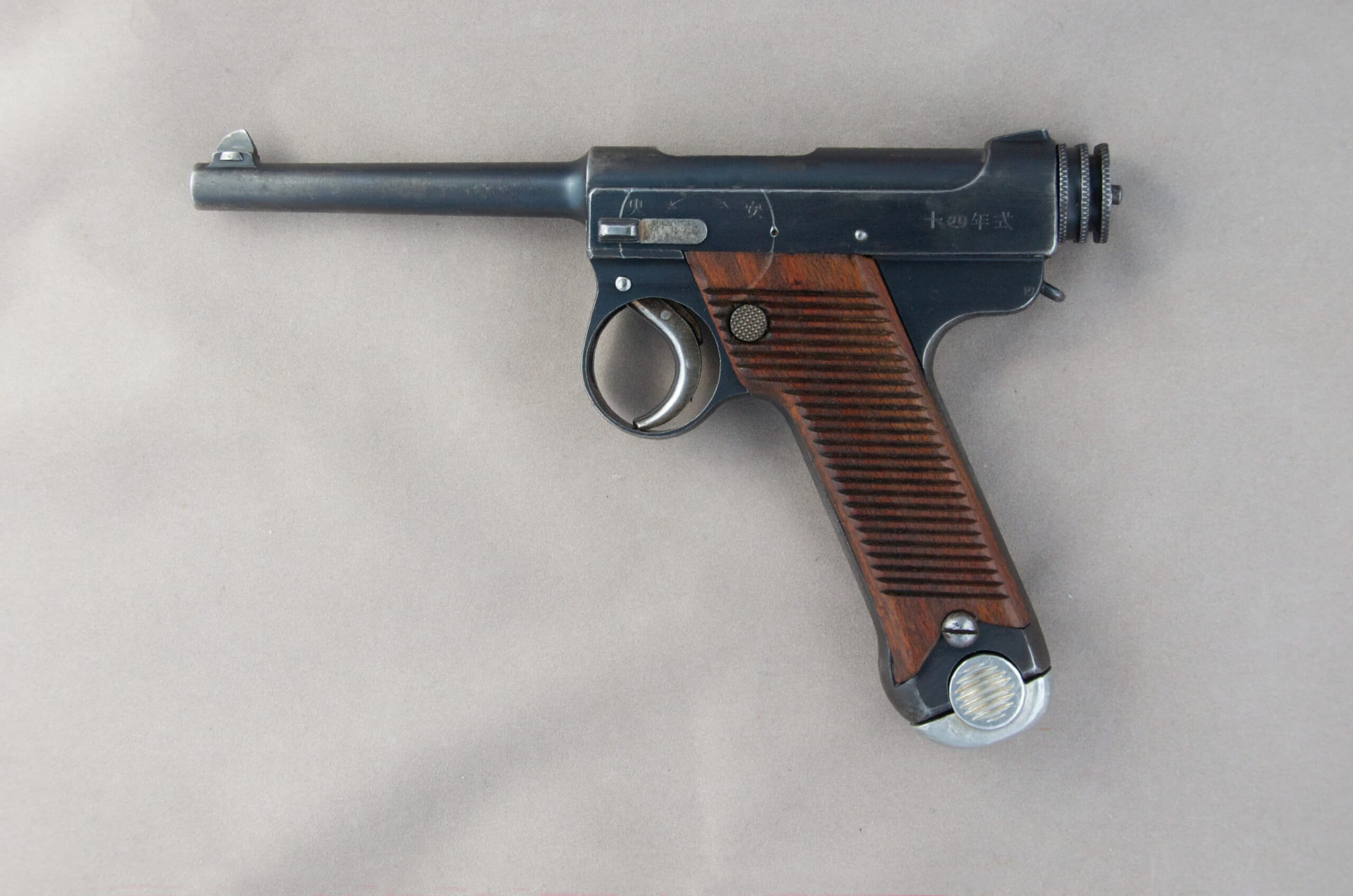
Type 14 pistols were marked with their month and year of manufacture using the regnal year of Emperor Hirohito. These date markings are central to evaluating whether a pistol’s visible features are consistent with its production period.[1]
Several changes occurred during Type 14 production. Early examples had a slotted cocking piece, while later pistols used a knurled pattern. Later examples also received an elongated trigger guard intended to provide more room for a gloved finger. Finish quality generally declined as wartime production pressures increased.[1]
The Type 14 uses an eight-round magazine and incorporates a magazine safety that prevents firing when the magazine is removed. It also has a retention device that prevents the magazine from dropping freely when the release is pressed. The magazine must instead be pulled from the grip. Its bolt remains open on the magazine follower after the last round, further complicating rapid magazine changes.[3]
When examining a Type 14, compare the date marking with the cocking piece, trigger guard, grips, machining, and finish. These features should form a plausible period configuration. They should not be judged individually.
Numbered parts also require close attention. Record the frame serial number and compare it with every accessible numbered component, including the magazine. Do not describe a pistol as “matching” unless the relevant parts have actually been inspected. Similar wear or stamp style may support an assessment of originality, but neither proves that two differently numbered parts belong together.
Reading a Type 94
The Type 94 is smaller than the Type 14 and uses a six-round detachable magazine. It has a short grip, a rear cocking piece, a manual safety, and an exposed sear bar on the left side of the frame.[1][2]
Early Type 94 pistols generally exhibit better workmanship than late-war examples. As production conditions deteriorated, machining became rougher and tool marks more conspicuous. Very late examples may have plain wooden grips in place of the earlier checkered grip panels.[2]
Rough machining can be appropriate on a late-war Type 94, but it should not be confused with later neglect or alteration. Active corrosion, rounded edges, blurred markings, damaged screws, or polishing around stamped characters point to condition problems that wartime production alone does not explain.
The Type 94 Sear Hazard
The Type 94’s exposed sear bar creates a genuine mechanical hazard. When the pistol is cocked, sufficient pressure on the forward portion of the bar can release the firing mechanism without the trigger being pulled. A published examination and live-fire test demonstrated this behavior on an original example.[2]
The manual safety blocks the sear bar when functioning correctly, but the condition of a surviving pistol cannot be assumed. A damaged, worn, altered, or improperly assembled safety may not provide the intended protection.[2]
For this reason, a Type 94 should be treated as mechanically suspect until examined by a qualified gunsmith familiar with the design. It should never be tested by pressing the sear bar. Before any inspection, confirm that the chamber and magazine are empty and remove all ammunition from the immediate area.
A Practical Inspection Method
Begin by documenting the pistol before cleaning or disassembly. Photograph both sides, the complete serial and date markings, inspection stamps, grips, magazine, safety, cocking piece, and visible finish.
On a Type 14, concentrate on the relationship among the date, cocking-piece pattern, trigger-guard form, grips, magazine, and overall workmanship. Confirm that the magazine safety operates correctly and remember that the magazine-retention system is designed to resist free removal.[1][3]
On a Type 94, examine the safety, exposed sear bar, grip material, magazine, markings, and machining. Do not assume that crude workmanship automatically identifies a late-war pistol. Date markings and the complete physical configuration must support that conclusion.[1][2]
Inspect the finish under strong, neutral light. Original wear usually appears on exposed edges, contact points, and projecting controls. Refinishing may leave rounded edges, softened markings, polishing waves, dished screw holes, or an excessively uniform surface. A rough but untouched wartime finish is generally more historically informative than a polished restoration.
If disassembly is permitted, record every accessible number exactly, including leading zeros and suffixes. Do not force tight or unfamiliar components. If internal parts cannot be examined, describe their status as unverified.
Provenance should be evaluated separately. Documents can strengthen a pistol’s history only when they can be connected to the firearm through serial numbers, photographs, names, dates, or other specific evidence. An undocumented account may be sincere, but it is not documented provenance.
The strongest collectible example is the pistol whose markings, period features, numbered components, finish, and supporting history agree. With Nambu pistols, consistency matters more than a seller’s description—and originality matters more than cosmetic perfection.
Frequently Asked Questions
What is the primary difference between the Type 14 and Type 94 Nambu pistols?
The Type 14 is the larger military design with an eight-round magazine. The Type 94 is more compact and uses a six-round magazine.
When was the Type 14 Nambu introduced?
The Type 14 was introduced in 1925. It was adopted for issue to Japanese noncommissioned officers three years later.
When was the Type 94 Nambu produced?
Type 94 production ran from 1935 through 1945. Approximately 71,000 pistols were manufactured.
Are rough machining marks normal on a Type 94?
Rougher machining and conspicuous tool marks can be appropriate on late-war examples. The date and complete configuration should support that conclusion.
Why is the Type 94 considered mechanically hazardous?
Pressure on the exposed sear bar can discharge a cocked pistol without the trigger being pulled. Any surviving example should be inspected by a qualified gunsmith familiar with the design.
Sources
- American Rifleman, “The Japanese Nambu: A Look Back,” December 24, 2015.
- Will Dabbs, “The Nambu Type 94—A Basic Treatise on the Worst Combat Handgun in Military History,” Small Arms Review, originally published August 2018.
- Bob Campbell, “Firing the Nambu Type 14, Japan’s Service Pistol,” Small Arms Review, December 1, 2000.
As a firearms enthusiast with a background in website design, SEO, and information technology, I bring a unique blend of technical expertise and passion for firearms to the articles I write. With experience in computer networking and online marketing, I focus on delivering insightful content that helps fellow enthusiasts and collectors navigate the world of firearms.
Comments
Be the first to leave a comment.
Be the first to read new editorial features, collector guides, and brand spotlights.