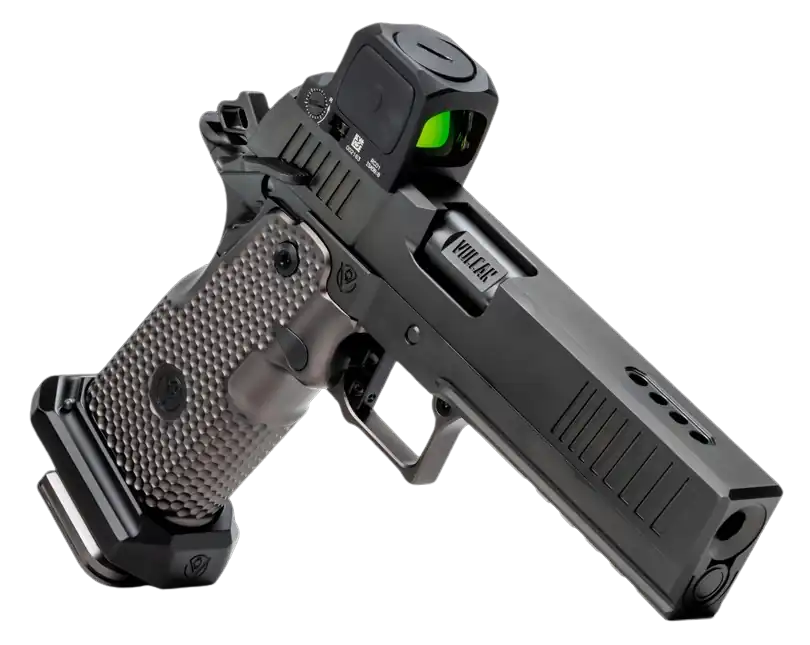
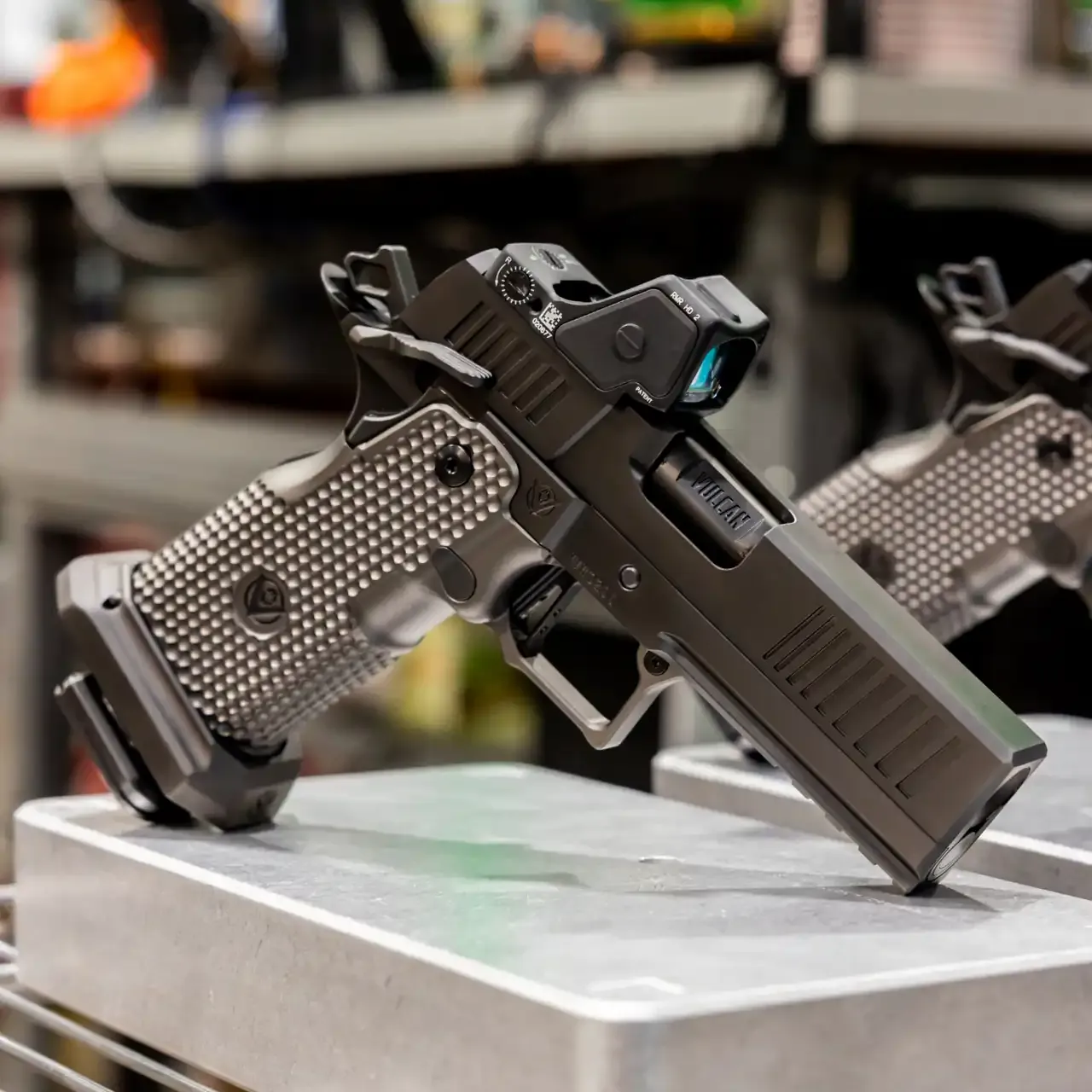

The problem, as Vulcan Machine Werks framed it internally, was the optic plate. Every red-dot mounting system on the double-stack 1911 platform relied on adapter plates between the slide and the optic, adding a failure point and raising the sight above the bore. In November 2021, the shop began sketching an alternative: a slide machined with a direct-mill cradle cut, so the optic sits straight into the steel with no plate between them. The project needed a name. The team kept returning to "11," an homage to the 1911 lineage the gun was built from, and settled on a leetspeak rendering that also nodded to the owner's background in IT: 3L3V3N.
Before that project, Vulcan was already known within a narrower world, the community of shooters who send Staccato 2011-pattern pistols out for slide milling, optic cuts, porting, and Cerakote work. Operating from Plano as an FFL-licensed, Advanced Certified Cerakote applicator with in-house laser marking, the shop built a reputation among 2011 owners for slide work and finish quality, the kind of reputation that circulates on enthusiast forums rather than in trade press.
The 3L3V3N changed the shop's position in that world. It is not a modification of someone else's frame; it's a ground-up, patent-pending design, a full-length, five-inch double-stack 1911 machined from 4140 heat-treated steel, finished in DLC, built around a Bar-Sto match barrel and a 7075 billet aluminum grip module co-engineered with an outside precision shop. It ships without iron sights. That's a deliberate bet: the gun is built for a dot, not as a backup to one, and it asks the owner to commit to that choice. It's offered in a full-size configuration and a compact variant, the 3L3V3N-C. Enthusiast reaction split along familiar lines: some shooters praised the trigger and tracking, while others found the boxy slide too close to a striker-fired pistol's lines for a 1911 derivative. The first production run reportedly sold through quickly, though that detail comes from forum accounts rather than the company's own sales figures.
Alongside the 3L3V3N, Vulcan continues its original business: customized Staccato 2011 pistols released in limited numbered batches under a "Limited Drops" program, plus a standing menu of porting (marketed under the name Ignis Porting System), optic cuts, trigger and grip work, and coatings sold as discrete services rather than catalog models.
For a collector, Vulcan sits closer to a contemporary custom shop than to a manufacturer with a traceable lineage. There's no ownership history to research, no interrupted production run from a world war, no contested provenance. What there is instead is a specific, recent design decision, the direct-mill optic cradle, made by a shop that had spent years learning the 2011 platform from the outside before deciding to build one from scratch. That's a smaller story than the template for a brand history usually assumes, but it's the accurate one.
History & Milestones
Texas entity registration filed
Vulcan Machine Werks, Inc. appears in Texas state filings as of this date, with Christian S. Nielsen listed as the registered agent. This is the earliest documented date for the company; it is not confirmed as the operational founding date.
Shop builds reputation on Staccato 2011 work
Operating from Plano as an FFL-licensed machine shop, Vulcan became known within the 2011 enthusiast community for slide milling, optic cuts, and Cerakote finishing, ahead of any of its own product lines.
Design work begins on the 3L3V3N
The shop starts developing a direct-mill optic cradle for the double-stack 1911 platform, the mechanical idea that becomes its first ground-up pistol.
3L3V3N reaches the market
The patent-pending 3L3V3N debuts publicly, in full-size and compact configurations, built around a co-engineered 7075 billet aluminum grip module and a Bar-Sto match barrel.