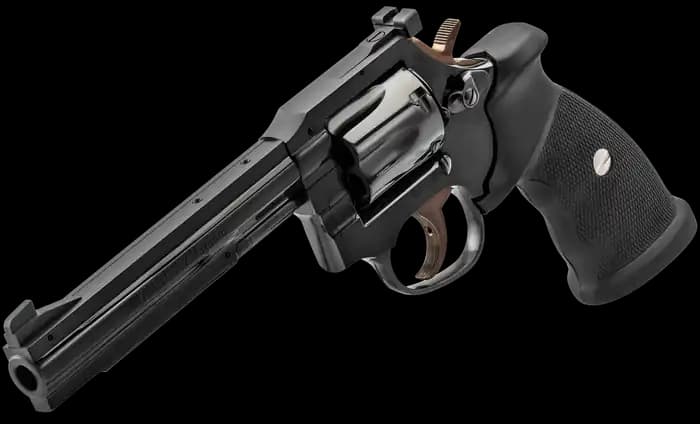

Inside a Manurhin MR 73, the rebound slide runs on rollers. Gilbert Albert René Maillard first filed the design in France in May 1973. His U.S. patent, granted in June 1976, describes a slider carried on two rollers. A leaf-type spring returns it, and the spring’s bearing point moves as the slide travels so the return force stays nearly constant. American Rifleman credits Maillard, a company engineer, with the revolver’s design. It also notes that the double-action pull weight, rebound weight, and overtravel can all be adjusted. Most of the MR 73’s reputation rests on this mechanism. It came from a company whose main business was building machinery, not guns.
The Manufacture de Machines du Haut-Rhin was established in Mulhouse in 1919. France Inter’s 2018 history of the firm names the founder as Jules Splenger. In the company’s own account, its first products were ammunition production lines, ammunition, and gauges. France Inter dates small-caliber ammunition production at Mulhouse to 1922 and an ammunition plant at Le Mans to 1928. Mulhouse’s municipal heritage trail places the works at Bourtzwiller on a site left empty when the aircraft maker Aviatik stopped production. Ammunition machinery is still the firm’s core business. The company says it has supplied more than 13,000 machines, and that over 5,000 remain in service in more than 60 countries.
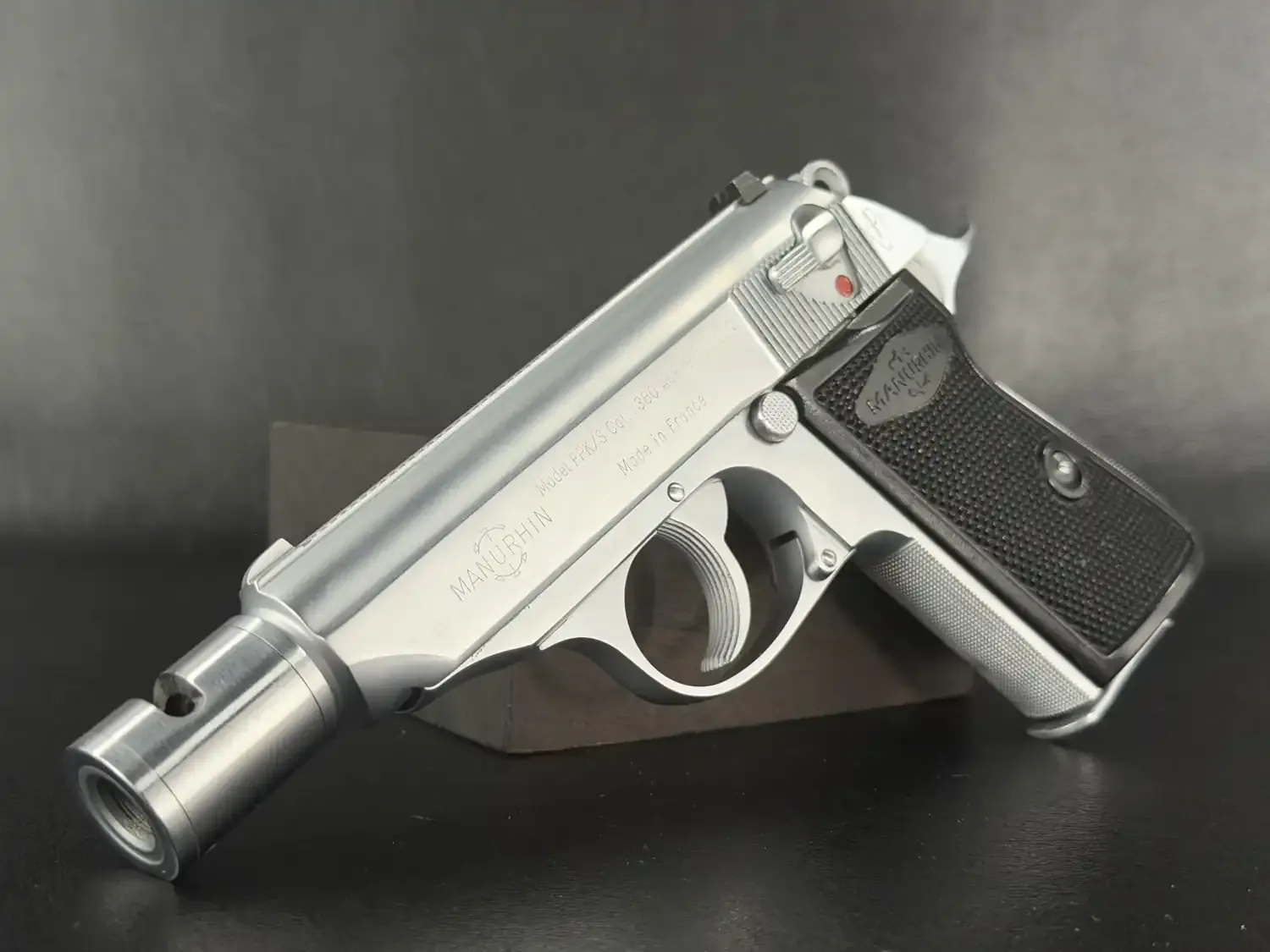
The company dates its move into small arms, food-processing machinery and scooters to 1945. In 1952 Walther licensed production of its PP and PPK pistols to Manurhin to raise capital for a new plant, and the contract ran until 1986. American Rifleman adds P38-pattern pistols to the postwar license work. France Inter describes the 1960s and 1970s as the company’s peak, with about 4,000 employees and 20 subsidiaries; over that period, it says, military production grew to include Manurhin revolvers and SIG automatic rifles. The Small Arms Survey lists Manurhin as a licensed maker of the SIG SG 540, SG 542 and SG 543 rifles.
American Rifleman reports that the MR 73 was the first handgun chosen by the GIGN, the gendarmerie intervention unit formed in the early 1970s. The unit settled on .357 Magnum, specified a 5.25-inch barrel, and adopted grips designed by Jacques Trausch. Shooting Illustrated also describes the GIGN working with Manurhin on the revolver. La Croix links the MR 73 to French police service in the 1970s and to the RAID and GIGN units, and notes that Jean-Paul Belmondo carried one in Henri Verneuil’s “Peur sur la ville”. A second Maillard patent, granted in 1977, covers a cylinder that ejects rimless cases, with 9 mm Parabellum as the example. According to Maxim Popenker, Manurhin and Sturm, Ruger & Co. produced a lower-cost “Special Police” revolver around 1979, using Ruger frames and lockwork with French cylinders and barrels. An all-French F1 version followed, and the commercial MR 88 in 1988.
Ownership changed several times. Matra bought 34 percent of the company in 1978. In 1983, it became the sole shareholder and split the business in two: medium-caliber ammunition near Vichy, and arms and cartridges at Mulhouse. La Croix reports that Manurhin sold its revolver business in the late 1990s and concentrated on ammunition machinery. American Rifleman dates the transfer of MR 73 rights to Chapuis Armes to 1998 and says the original tooling moved to Saint-Bonnet-le-Château. Chapuis states that it has built Manurhin revolvers there since 1998. Beretta Holding acquired a majority stake in Chapuis Armes in March 2019. The Mulhouse company went into receivership on 13 June 2018. On 1 August 2018, the Mulhouse court awarded it to Emirates Defense Industries Company (EDIC). It was reincorporated as Manufacture du Haut-Rhin and, according to the company, was authorized to use the Manurhin brand again in 2022.
For collectors, the 1998 transfer splits the MR 73 into two production histories: revolvers made at Mulhouse from the early 1970s, and those made at Saint-Bonnet-le-Château since. The current Chapuis catalog lists Gendarmerie models with 3- and 4-inch barrels, Sport models with 4- to 8-inch barrels, and the MR 32 Match and MR 38 Match target revolvers. Beretta USA imports the line into the United States. Chapuis describes forged frames, cold-hammer-forged barrels, and hand fitting. These are the maker’s own claims.
History & Milestones
Machine-builder founded in Mulhouse, Upper Rhine
The Manufacture de Machines du Haut-Rhin was established in Mulhouse, initially to produce ammunition production lines, ammunition, and gauges. The machinery business it began with still continues today.
Small-calibre ammunition production begins at Mulhouse
The company began producing small-caliber ammunition at Mulhouse, and its cartridge-making machinery grew alongside it. This linked the firm’s engineering work to ammunition manufacture from its early years.
Walther licenses PP and PPK production
Walther licensed the PP and PPK to Manurhin to raise capital for a new plant, and the contract ran until 1986. It was the company’s first substantial handgun work.
MR 73 revolver and Maillard patent
Maillard filed the French application for his roller-borne rebound-slide revolver in May 1973, and the matching U.S. patent was granted in 1976. American Rifleman dates the start of MR 73 production to late 1972, and the GIGN chose the revolver as its first handgun.
Matra acquires a 34 percent stake
The Matra group bought 34 percent of Manurhin as an economic downturn led to subsidiary closures. It was the first step toward Matra’s full ownership.
Matra takes full control, splits activities
Matra became the sole shareholder and divided the business into medium-caliber ammunition near Vichy and arms and cartridges at Mulhouse. The company dates a reorganization and a sharper focus on ammunition-line production to the same year.
MR 88 introduced as commercial service revolver
According to Popenker, the MR 88 was a commercial version of the F1 service revolver and cost less than the MR 73. It is still made by Chapuis Armes.
Revolver production passes to Chapuis Armes
Manurhin left the firearms business, and the MR 73 rights and original tooling went to Chapuis Armes at Saint-Bonnet-le-Château. Since then the Manurhin revolver name and the Mulhouse company have been separate.
EDIC acquires the Mulhouse company
After receivership began on 13 June, the Mulhouse court awarded the company to Emirates Defense Industries Company on 1 August. It was reincorporated as Manufacture du Haut-Rhin.
Beretta Holding takes majority of Chapuis
In March 2019 Beretta Holding acquired a majority stake in Chapuis Armes, which builds the Manurhin revolvers. Beretta USA now imports the line into the United States.