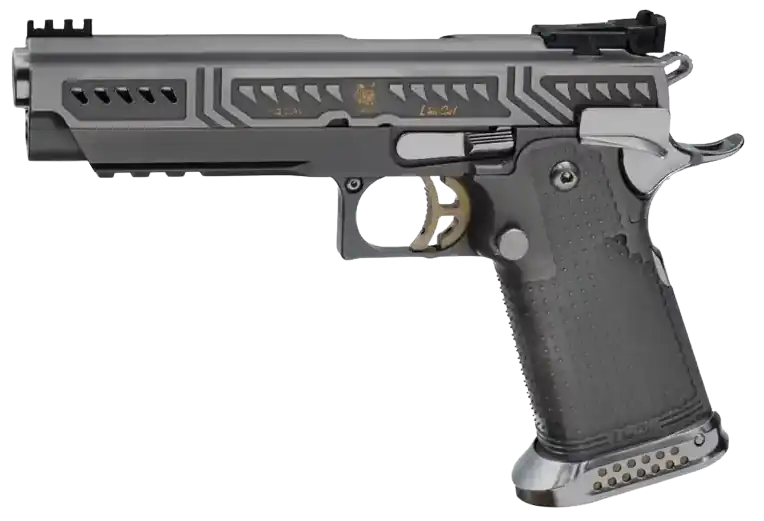
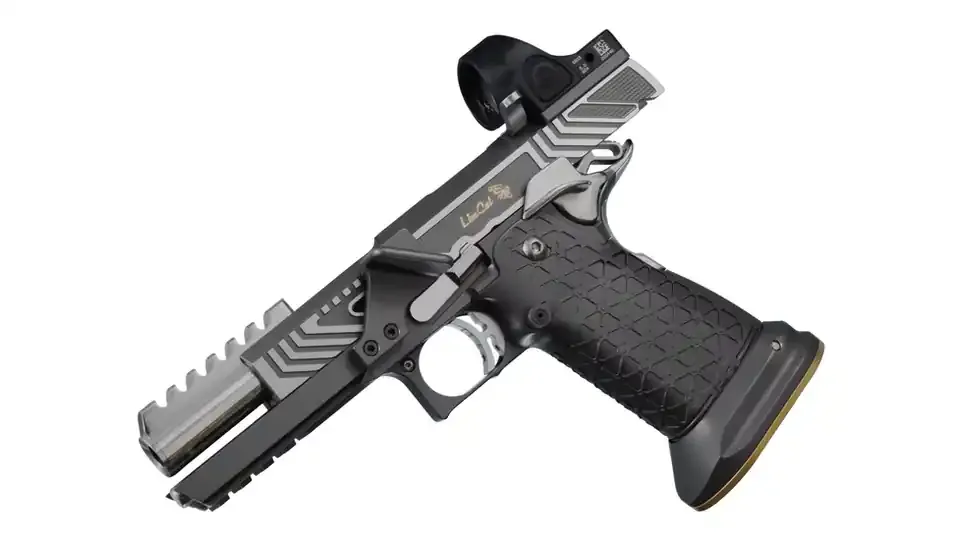

In 2009 Limcat published an unusually candid explanation of its own compensator. The Turbocomp fitted to that year’s Dragoncat Open pistol, the company wrote, routes gas from the first expansion chamber into a tube running beneath the compensator and vents it through four holes at the front sides, while six angled ports in the barrel and a stepped “L-Cut” slide shorten the moving mass and lengthen the barrel thread. The same post says Johnny Lim had designed the bypass system more than ten years earlier and left it undeveloped. That claim has some support: a “Limcat Turbo Compensator” already appears on the shop’s parts list as captured in February 1998.
That 1998 website is the earliest primary record of the business located in this research. It gives the name as Limcat Custom Products and Hi-Tech Competition Pistols, places the shop in Fremont, California, and states that every gun was built by hand by Lim, whom it styles a master pistol gunsmith. The catalogue was already organised around cats. The Panther, Cheetah and Tiger were compensated, optic-sighted pistols in 9mm-family and .38 Super chamberings, built on STI, SV, Caspian or Para-Ordnance frames. The Wildcat was the iron-sighted Limited gun, in .40 S&W or .45 ACP, and a Lion series appears in the price list for assembly work. None of these pages gives a founding date, and the company’s own later statements about its age do not agree with one another.
The shop moved three times in roughly a decade. Its website lists a Hayward, California address by March 2000 and a Reno, Nevada address by September 2001; by June 2010 it was in neighbouring Sparks, where it now trades as LimCat Custom International LLC and sees customers by appointment only. The Philippine connection is visible early. The 2002 homepage lists a contact in Cebu City, and by mid-2003 it carried a video of J.J. Racaza discussing the shop’s brass base pads.
Racaza’s name is attached to the model that defines the modern catalogue. Limcat described the RazorCat in 2010 as an Open pistol built to his preferences: short, quick-cycling, with a long-threaded compensator and the L-Cut slide, in 9mm Major or .38 Super and Super Comp. The model was in circulation well before that description. Italy’s Interior Ministry approved Limcat Custom Razorcat pistols for its national firearms catalogue in a decree of 8 January 2007, on the application of the Latina dealer A.P.G. Armeria Patria Giorgio. Limcat announced Racaza’s appearance on the History Channel’s Top Shot ahead of its June 2010 premiere, and that October K.C. Eusebio and Racaza, both identified as Team Limcat shooters, finished first and second in Open at the USPSA National Handgun Championships in Las Vegas. A year later the Shooting Wire’s editor noted that most of the Filipino competitors at the Nationals wore Limcat shirts, and that Lim both built the guns and shot them.
The line continued to change. RECOIL previewed the Flashcat in its second issue as the newest Open model, describing a slant-cut slide intended to shift weight forward to the compensator. The company’s guidance on dating used pistols says it built on Tripp Research, Strayer-Voigt, STI and Phoenix Trinity frames in successive periods and has used frames of its own since about 2014. The current catalogue lists the RazorCat and SaberCat for Open, the Wildcat for Limited, an optics-ready Wildcat Tracker and the Tron pistol-calibre carbine. A 2020 Guns.com review attributed the work to Lim and his two sons. In Shooting Sports USA’s equipment survey of Open competitors at the 2020 USPSA Nationals, LimCat accounted for 8 percent, fifth among the custom platforms listed.
For collectors, the practical consequence of this history is that a LimCat is dated by its frame maker and configuration, not by a factory record. The company describes its frame-era dates as approximate, warns that it has seen pistols advertised under its name that it did not build, and states that it makes no airsoft products. Lim’s own account of his career and the shop’s corporate history are thinly documented in public sources, which is typical of a builder whose reputation was made on match results and at the bench.
History & Milestones
Fremont shop and catalogue documented online
The earliest archived copy of the company website, from February 1998, shows a Fremont, California shop with Johnny Lim as gunsmith and a range of Panther, Cheetah, Tiger and Wildcat pistols. It is the earliest primary record found, not a founding date.
Shop relocates from California to Nevada
By September 2001 the homepage gave a Reno, Nevada address and showed photographs of a new Wildcat. The company has remained in the Reno area since.
RazorCat approved for Italian national catalogue
An Interior Ministry decree of 8 January 2007, published that April, entered Limcat Custom Razorcat pistols in Italy’s catalogue of common firearms on a Latina dealer’s application. It is the earliest dated record of the model located.
Dragoncat introduces revised Turbocomp and L-Cut
The company described the 2009 Dragoncat’s gas-bypass compensator and stepped slide in detail, and announced a Caspian-framed hybrid accepting STI and SVI magazines that December.
Team Limcat takes top two in Open
K.C. Eusebio won Open and J.J. Racaza placed second at the USPSA National Handgun Championships in Las Vegas, held 9 to 16 October. By that year the shop’s address was in Sparks, Nevada.
LimCat begins using its own frames
The company’s used-pistol guidance dates Limcat-made frames from about 2014, after periods building on Tripp Research, Strayer-Voigt, STI and Phoenix Trinity frames. The company calls these dates approximate.