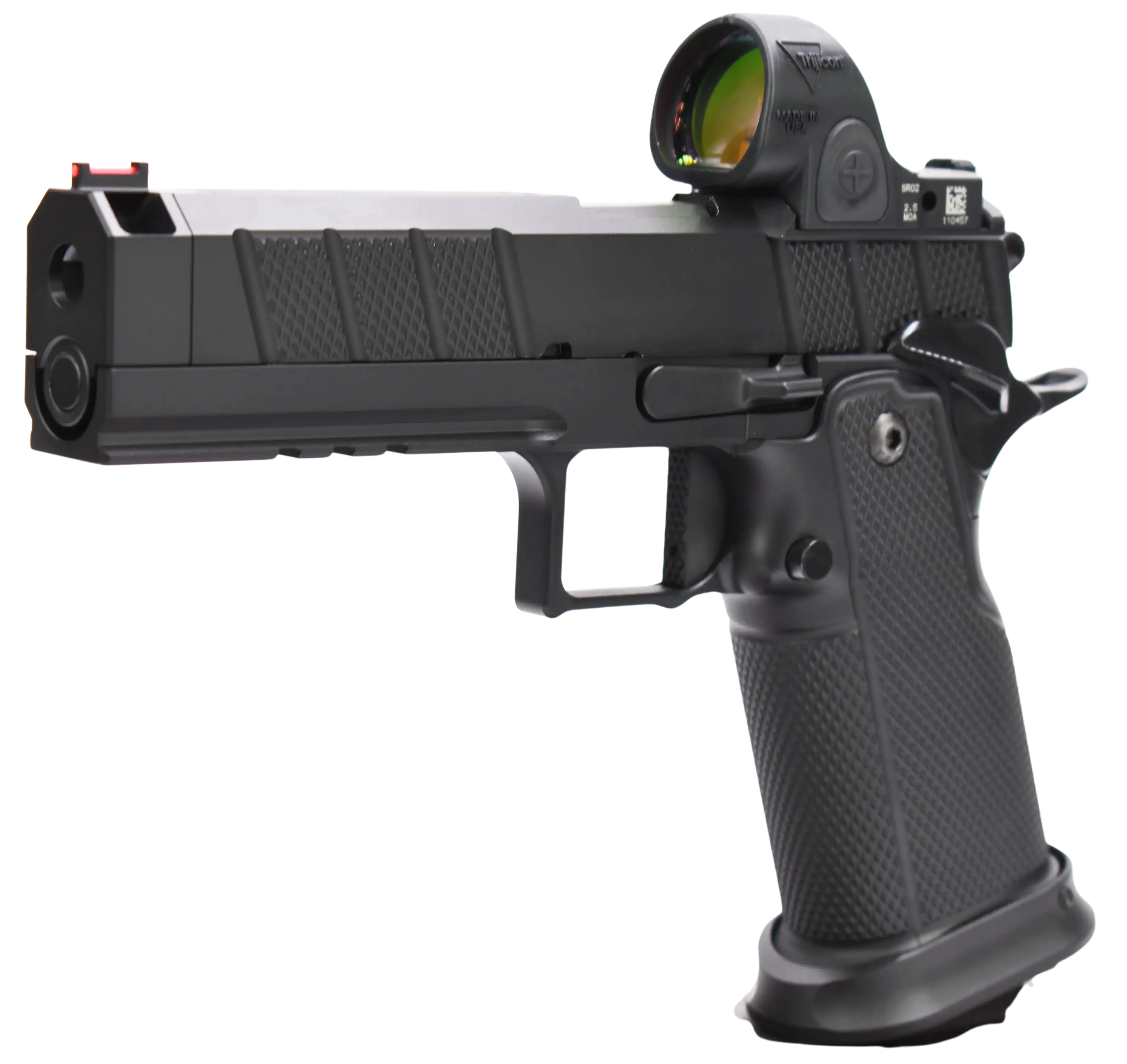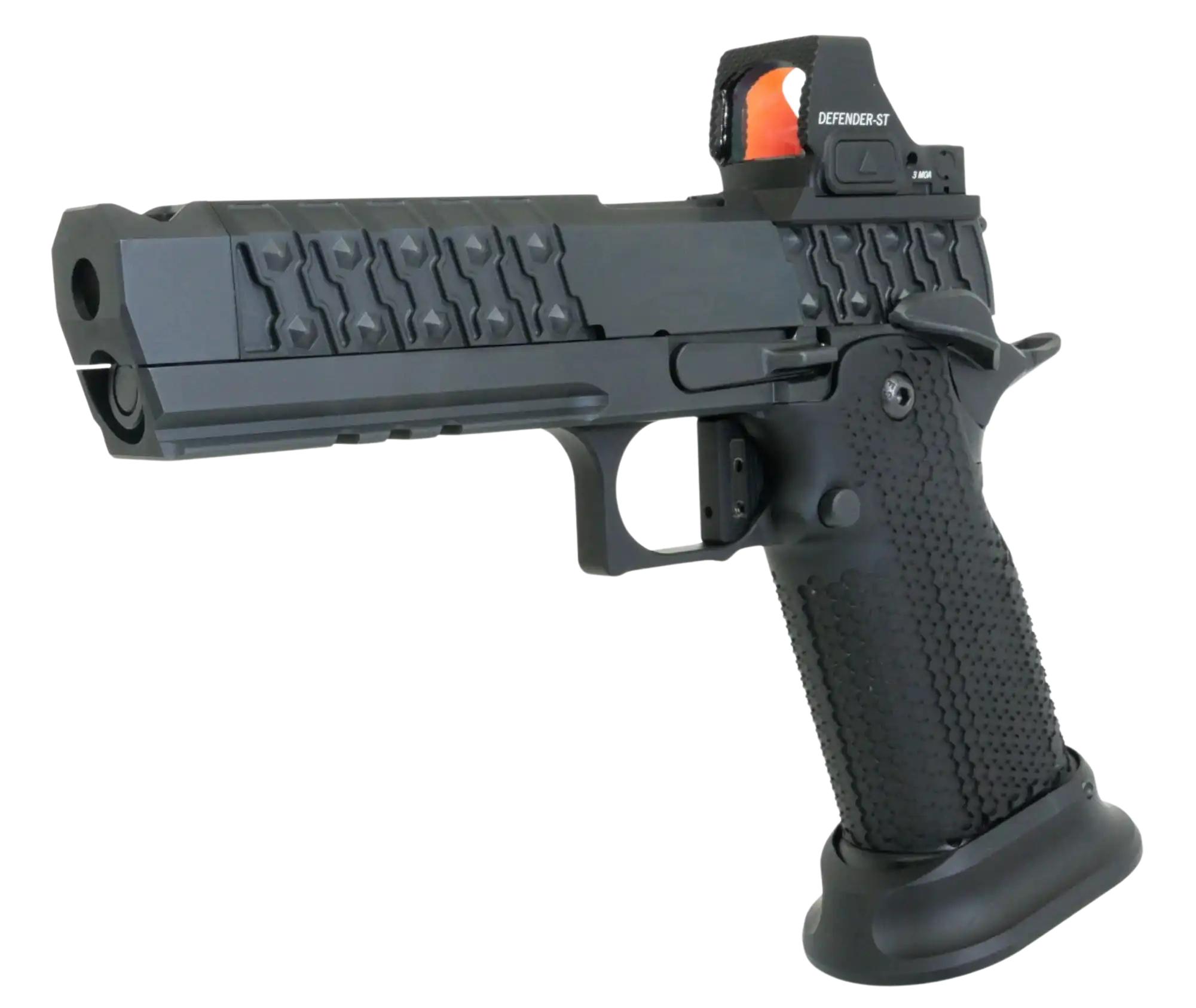

In January 2018, Phoenix Trinity opened orders for a new competition pistol and capped the first run at 28 guns. The model, called the Honcho, replaced the 1911's century-old swinging-link barrel lockup with a linkless system and paired it with an interchangeable breech block, letting a single frame cycle 9mm, .40 S&W, and .38 Super Comp without a drop of Loctite. USPSA shooters had been running the company's parts for years by then; this was the first time Phoenix Trinity put its name on the whole gun.
The company itself dates to 2011, when Brian and Tiffany Williams set up a CNC shop in Hudson, Florida. Their background was in precision machining for aerospace and industrial clients, not firearms, and it shaped how Phoenix Trinity built guns from the start: parts cut from certified bar and plate stock in-house, not sourced as castings, forgings, or metal-injection-molded components from outside vendors. That distinction, common in aerospace tolerances and rare in the double-stack 1911 market, became the company's working method rather than a marketing point.
Phoenix Trinity's first widely recognized product was a grip, not a gun. The EVO, developed in 2013, machined a palm swell directly into a one-piece aluminum grip at a time when most double-stack 1911 shooters were choosing between stock polymer grips and aftermarket wood grips. It circulated through USPSA Open and Limited divisions well before the Honcho existed, and it is still sold today as an upgrade for other manufacturers' frames.
The Honcho's barrel and locking-block design was patented in two stages: U.S. Patent 10,753,691, issued in August 2020, followed by U.S. Patent 11,029,118, issued in June 2021, both listing Brian and Tiffany Williams as inventors. The pistol is built for Open, Limited, Steel Challenge, and 3-Gun divisions, and its ability to swap calibers and barrel configurations on the same frame, without refitting or adhesive, is its defining mechanical claim in a category where most competitors specialize in a single caliber per build.
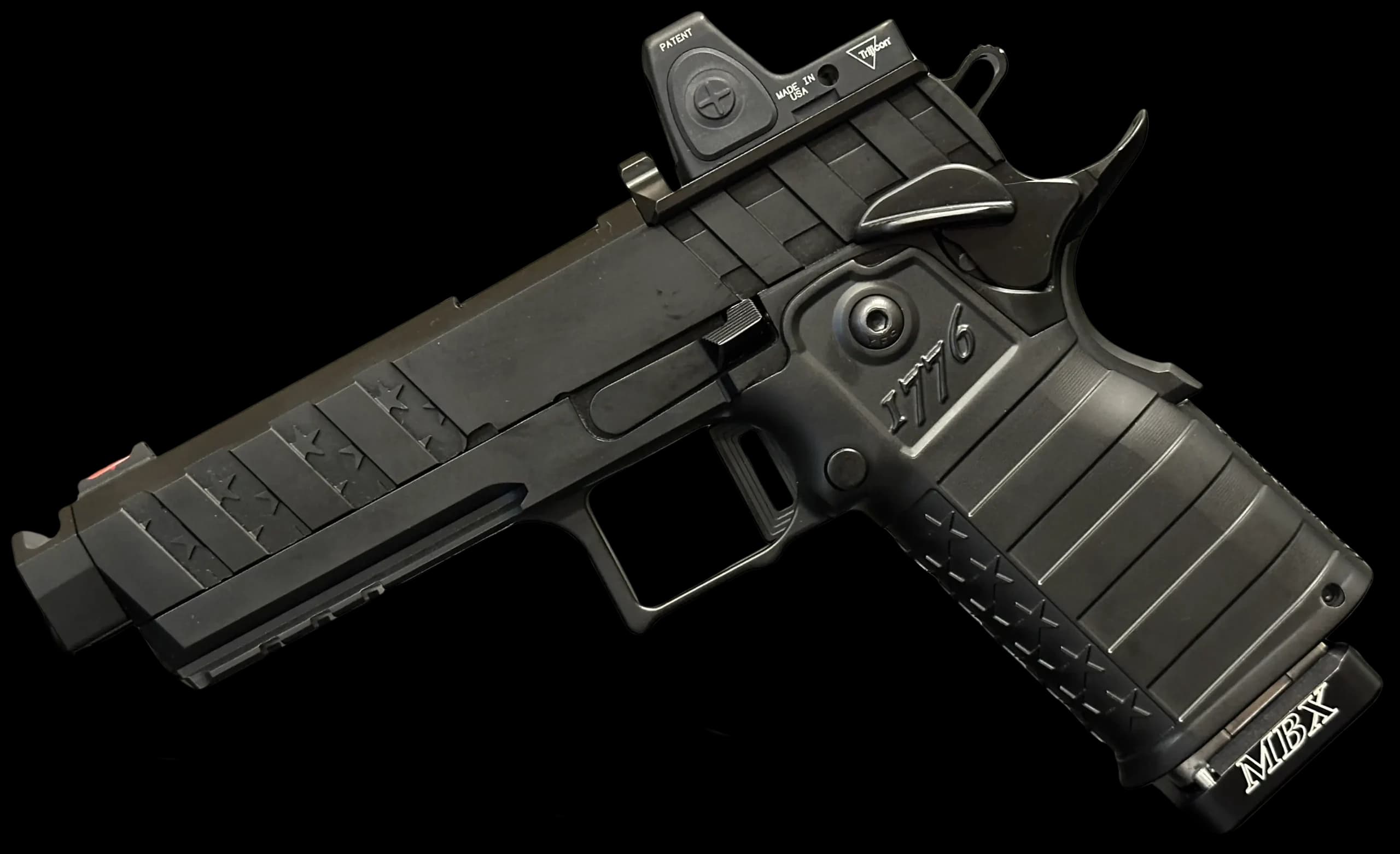
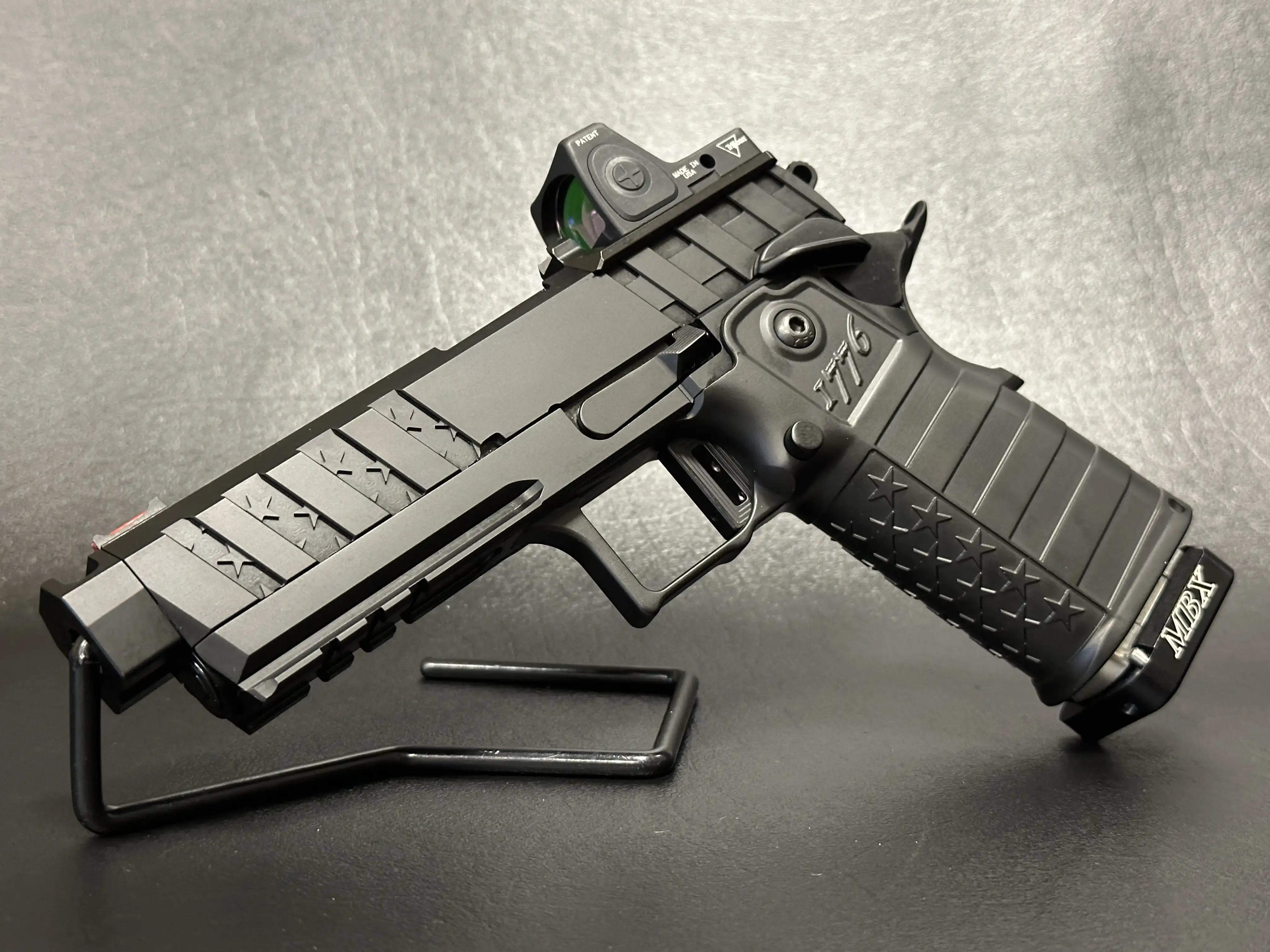
Around 2020, the H-Series (H-Pro, H-Tac, and H-Duty) extended the same linkless platform beyond competition into personal defense and duty-oriented configurations, differing mainly in barrel porting, grip texture, and sighting options. A commander-length carry line, the Morph, followed in 2021 by the Morph Switch and the patriotically finished Morph 1776; both have since been discontinued. More recently, Phoenix Trinity has worked with individual dealers, among them Not Just Guns, on small-batch limited editions such as the Lo Pro, Desert Pro, EXO Pro, and Ascension, each produced in short, non-repeating runs.
Phoenix Trinity remains based at its original Hudson, Florida, facility and continues to describe itself as family-owned. For a collector, the appeal sits less in scale (production runs are small and dealer allocations are common) and more in the mechanical record: two issued patents behind a barrel system that few other 1911/2011 double-stack makers have attempted to replicate, and a decade-plus of continuous use in USPSA and 3-Gun competition. The current flagship, the H2, was introduced in 2026 and represents the newest iteration of that same platform.
History & Milestones
Phoenix Trinity founded in Hudson, Florida
Brian and Tiffany Williams start the company as a CNC machining operation, applying an aerospace-parts background to firearms components.
EVO Grip introduced
A one-piece, palm-swell aluminum grip becomes a known name in USPSA double-stack circles years before the company builds complete pistols.
Honcho race gun released in a 28-gun first run
The Honcho debuts a linkless barrel and interchangeable breach block, letting one frame run multiple calibers and competition divisions.
First locking-block patent issued
U.S. Patent 10,753,691 grants protection for the locking block and slide design behind the Honcho's barrel system.
H-Series introduced
H-Pro, H-Tac, and H-Duty extend the linkless-barrel platform into competition, personal-defense, and duty-oriented configurations.
Second locking-block patent issued
U.S. Patent 11,029,118 broadens the protected claims covering the firearm's locking block and slide assembly.
Morph carry line launched
The Morph Switch and Morph 1776 bring quick-change barrel technology to a commander-length concealed-carry pistol; both are later discontinued.
Dealer-collaboration limited editions begin
Small-batch runs such as the Lo Pro and Desert Pro are produced with retail partners, including Not Just Guns.