Why the First CZ 75s Went Abroad
Czechoslovakia developed the CZ 75 in the 1970s to earn convertible currency in Western markets, and chambered it for a cartridge its own Warsaw Pact forces did not use. The pistol reached the Czechoslovak civilian market in 1985, and the armed forces officially adopted it in 1989.
Key Takeaways
- The Uherský Brod plant began developing the CZ 75 in 1969 as an export pistol. Czechoslovakia needed convertible currency, and the 9 mm Parabellum chambering suited Western buyers, not Warsaw Pact forces, which used Soviet pistol cartridges.
- Early pistols were made for buyers abroad. Slides were marked in English, and a short-rail example marked "79" came in a box printed in English and French. Western shooters learned of the pistol through Guns & Ammo in February 1977, American Rifleman in September 1981, and advertisements in German and Swiss gun magazines.
- The pistol reached its home market late. It went on civilian sale in Czechoslovakia in 1985, the armed forces officially adopted it in 1989, and it entered wider Czech army and police service after 1989.
The CZ 75 began as an export product. In 1969 the Uherský Brod plant, then the national enterprise Přesné strojírenství, set out to add a modern 9 mm Parabellum defensive pistol to its range. It had no pistol for that cartridge, and it wanted one that would sell chiefly in Western markets. [1] The reason was currency. Czechoslovakia needed convertible foreign exchange to import industrial goods that the Soviet-bloc economic community (Comecon) did not make, or made to different standards, and most of the country's sporting and hunting arms were already sold outside the socialist bloc. [1]
From Export Brief to Production
Representatives of the foreign-trade corporations Merkuria and Omnipol had reported that the factory lacked a modern product able to compete in the West. [1] The first concept was a small pistol with a single-column, eight-round magazine. At the request of the Ministry of Foreign Trade, a working sample followed with a double-column magazine that fed through a single-column mouth, still with a single-action trigger. [1]
The designer was František Koucký (1907 to 1994), who had retired in December 1967. His prototype 002 of spring 1972 set the pattern for the final trigger mechanism, and the pistol reached its production form at the end of 1973. [1] In 1975 Koucký received four secret author's certificates on the design; the key one, No. 1316/1975, covered a double-action trigger mechanism. Because those certificates were never moved into the public patent series, the design was later copied freely. [1]
Series production began in 1975, but the plant built only 72 pistols in the first two years. Real output started in 1977, with 1,634 pistols. [1] Pistols made from 1975 to 1980 have shorter slide guides inside the frame and prominent slide flats. Lengthened guides, which improved accuracy and slide life, entered series production at the end of the first quarter of 1980. [1]
The cartridge that suited Western buyers kept the pistol out of domestic service. Warsaw Pact forces used standardized Soviet pistol cartridges, 7.62×25 mm Tokarev and later 9×18 mm Makarov, and neither the Czechoslovak People's Army nor the National Security Corps adopted the CZ 75 when it appeared. [2] Writing in 1997, Jim Thompson described the pistol as conceived, designed, and sold with virtually no domestic civilian or military market. [3]
How It Was Presented Abroad
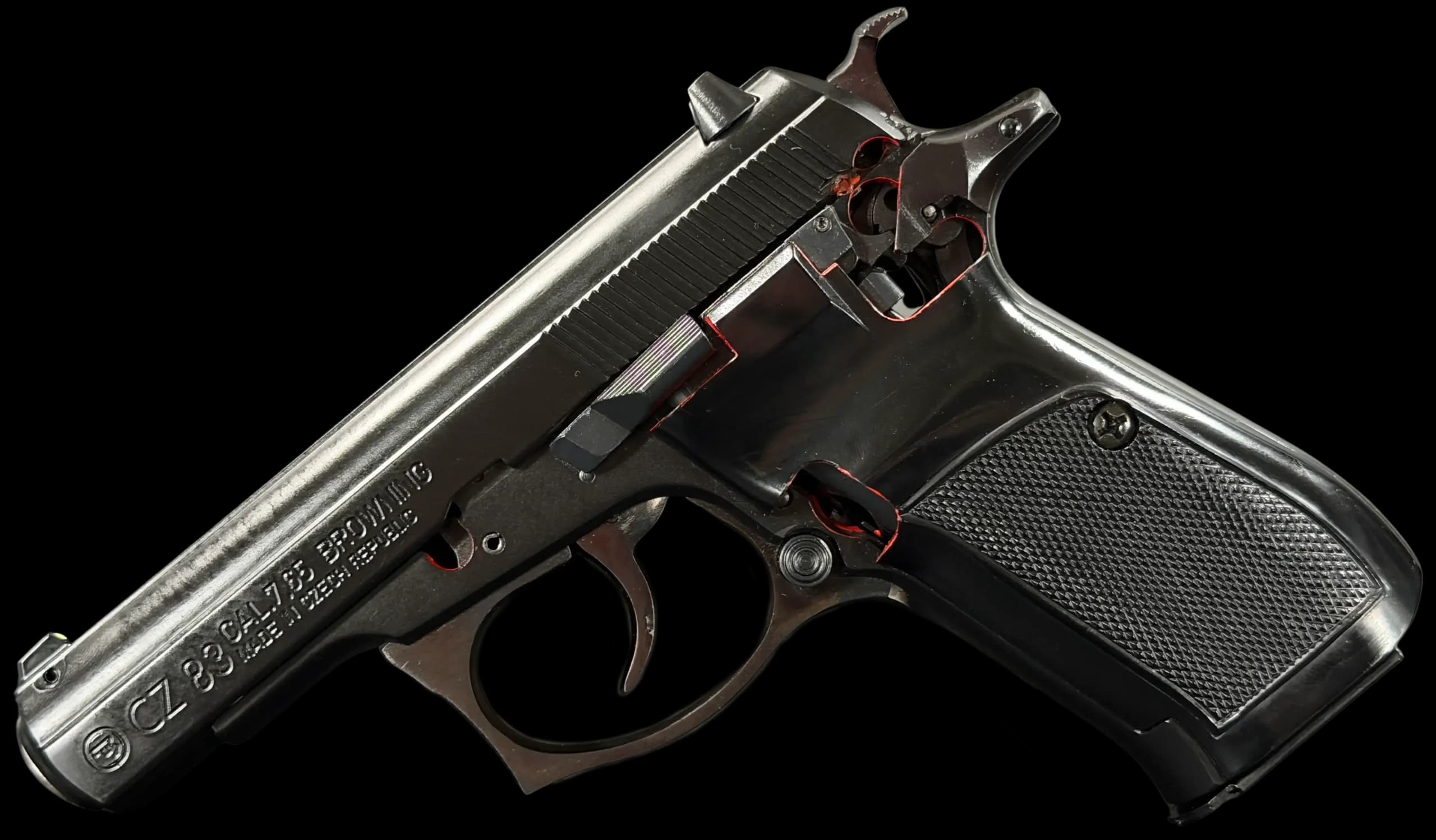
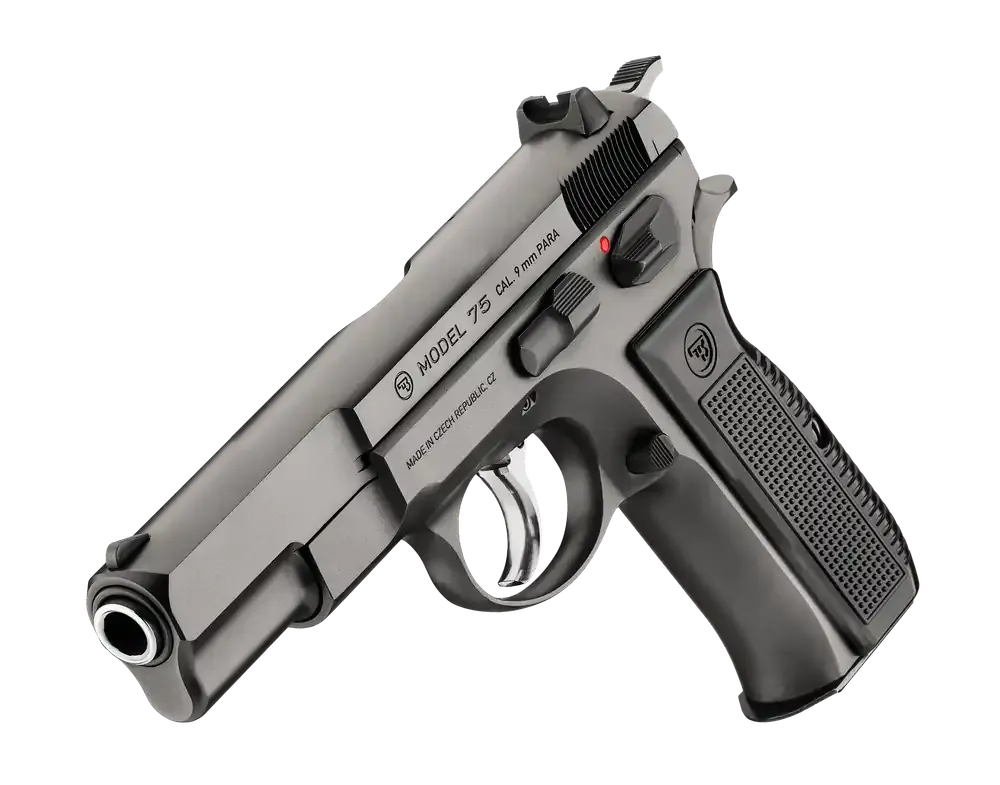
Early pistols address their buyers in English. The slide carries the CZ logo and "MODEL 75 CAL. 9 PARA," and the frame "MADE IN CZECHOSLOVAKIA." [4][5]
The packaging did the same in two languages. A short-rail pistol, serial number 19023, marked "79" beside its Czech proofs and sold by Morphy Auctions in July 2022, came in a printed box whose lid is in English and French. It advertises "15 SHOT," gives the caliber as both 9 mm and .38, and names the producer as Přesné strojírenství, Uherský Brod, under "Producer" with "Czechoslovakia" and under "Producteur" with "Tchécoslovaquie." [4] The box held a spare magazine, a manual, a guarantee certificate, a test target, and a cleaning rod. [4] Přesné strojírenství was the plant's name as a national enterprise from 1950 until 1983, when it was folded into the Agrozet concern; it became the state enterprise Česká zbrojovka in 1988 and a joint-stock company in 1992. [6]
Thompson recalled advertisements for the pistol in the German Deutsches Waffen Journal and the Swiss Waffen Digest, at less than half the wholesale price he later paid in the United States, and he identified Merkuria as the exporter. [3]
Sales were not limited to Western civilians. A CZ 75 in the Imperial War Museums, serial number 52770, is catalogued with associations to the Iraqi Army, the British Army's 16th/5th Lancers, and the Gulf War. [5]
Western Reviews and the American Market
Jeff Cooper introduced the CZ 75 to Guns & Ammo readers in a one-page article in the February 1977 issue; he had not fired one for that piece. [7] American Rifleman praised the 15-round, short-recoil double-action pistol in September 1981 (p. 48), but did not expect it to arrive in large numbers because of import restrictions on Communist Czechoslovakia. [8] For U.S. buyers, the usual route was through Canada. [8]
Thompson's own first CZ 75 arrived in 1986 through P.I.M.C. It carried a baked-enamel finish and came from a batch imported by and marked "Bauska." [3] Copies filled much of the remaining demand. From Switzerland, with early assistance from CZ, came the ITM AT-84 and the Sphinx line; Italy's Tanfoglio produced the TZ-75. [8] In 1992, after Czechoslovakia gained most-favored-nation trading status, the Czech-made pistol became readily importable through Action Arms. [8]
Domestic Sale and Service
The Czechoslovak People's Army chose a different pistol from the same factory. In 1982 it adopted the 9 mm pistol vz. 82, chambered for the Warsaw Pact's 9 mm Makarov cartridge. [9]
The CZ 75 did not reach the Czechoslovak civilian market until 1985, and the country's armed forces did not officially adopt it until 1989. [10] After 1989, the CZ 75 and its modernized variants entered service with the Army of the Czech Republic and the Police of the Czech Republic. [2] A 2007 Ministry of Defense handbook listed the ČZ 75 B and BD among the army's standard weapons, issued to special units and the Military Police. [11] Česká zbrojovka supplied the Czech police with CZ 75 D Compact pistols. [12] When the army began issuing the CZ 75 Phantom in 2012, a brigade chief of staff compared it with the army's earlier vz. 75 and vz. 82 pistols. [9]
The CZ 75 was the only pistol in its caliber produced in series in socialist Czechoslovakia. [1]
Frequently Asked Questions
Why was the CZ 75 built for export?
Czechoslovakia needed convertible foreign currency to buy industrial goods, and the Uherský Brod plant wanted a modern pistol that would sell in Western markets. Its 9 mm Parabellum chambering suited Western buyers rather than Warsaw Pact forces.
When did CZ 75 production begin?
Series production began in 1975, but the plant built only 72 pistols in the first two years. Output reached 1,634 pistols in 1977.
How can an early CZ 75 be identified?
Pistols made from 1975 to 1980 have shorter slide guides inside the frame, and the lengthened guides entered series production in early 1980. Early slides are marked "MODEL 75 CAL. 9 PARA," and frames are marked "MADE IN CZECHOSLOVAKIA."
When did American gun magazines first cover the CZ 75?
Jeff Cooper introduced the pistol in a one-page Guns & Ammo article in February 1977. American Rifleman praised it in September 1981.
When did the CZ 75 enter domestic sale and service?
The CZ 75 reached the Czechoslovak civilian market in 1985, and the armed forces officially adopted it in 1989. After 1989, it and its modernized variants entered service with the Czech army and police.
Sources
[1] Skramoušský, Jan. "Pistole ČZ model 75." Vojenský historický ústav Praha, September 25, 2018.
[2] Kalousek, Robin. "Utajený patent i sovětský zákaz. Končí výroba legendární české zbraně. Dobyla Západ." Aktuálně.cz, September 5, 2026.
[3] Thompson, Jim. "Complete History of the CZ-75 and Its Early Clones." Gun Digest, June 10, 2009. First published in Gun Digest 1997.
[4] Morphy Auctions. "Lot 3080: Extremely Early First Model CZ 75, Known as the 'Short Rail,' 9mm Semi-Automatic Pistol with Early Czech Picture Box." July 12-14, 2022 Collectible Firearms & Militaria, lot closed July 14, 2022. Estimate $1,500 to $3,000; realized price $4,788 including buyer's premium.
[5] Imperial War Museums. "CZ M75." Catalogue number FIR 10526, Imperial War Museums, n.d.
[6] Česká zbrojovka a.s. "Historie, proměny, programy." Česká zbrojovka a.s., n.d.
[7] Sweeney, Patrick. "CZ 75 B 50th Anniversary Model in 9mm: Full Review." Guns & Ammo, November 7, 2025.
[8] NRA Staff. "CZ Model 75 Pistol." American Rifleman, May 12, 2009.
[9] Haladová, Olga. "Česká armáda a české pistole - svazek, který přežil desetiletí." Armáda České republiky, February 6, 2012.
[10] Castiglione, Alexander. "The Czech CZ 75: Past, Present And Future." Gun Digest, February 21, 2024.
[11] Ministerstvo obrany České republiky, AVIS. Ruční zbraně AČR. ISBN 978-80-7278-388-5, 2007, p. 12.
[12] Ministerstvo vnitra České republiky. "Dohoda Ministerstva vnitra a České zbrojovky." Ministerstvo vnitra České republiky, n.d.
Browse our current CZ inventory, available for purchase.