Christensen Arms' First Carbon Rimfire: The 10/22 Series and the Patent Behind It
Roland Christensen filed his composite barrel patent in December 1995, and by September 1999 his company's website described a graphite-barreled rifle built on a Ruger 10/22 action. Dated patents, a 1999 newspaper interview, and archived company pages show how the carbon rimfire became a product.
Key Takeaways
- Roland Christensen filed his barrel patent application on December 18, 1995, and it issued as U.S. Patent 5,692,334 on December 2, 1997. His design left the steel liner and the composite casing largely unbonded so that the two materials could expand at different rates without warping the barrel.
- A Christensen Arms web page captured on September 22, 1999, describes the "10\22 Series," a carbon-cased barrel on a Ruger 10/22 Model 1103 action. By 2001 the company listed it as the Carbon Challenge, and in 2002 it was offered in .22 LR and .22 Magnum.
- In the 1999 Deseret News interview, the rifle business began with a talk around a table, not in a garage. The Sanpete Messenger's 2022 account ties the Fayette garage to Christensen's 1984 prosthetic-foot production.
Roland Christensen came to rifle barrels from aerospace composites. He first worked with graphite epoxy as a rocket scientist at Hercules Inc. in Magna, Utah, earned his Ph.D. at the University of Utah, and went on to found a series of companies, among them Applied Composite Technology (ACT) in Fayette, Sanpete County. When the Deseret News profiled him in November 1999, ACT had been in business for 15 years and had partnered with Flex-Foot on prosthetic feet. Christensen Arms was then four years old and specialized in graphite-barreled rifles for big game, competition, tactical and sniper use. Both companies were headquartered in Fayette and together employed 50 people. [1]
In that interview, Christensen described the rifle company as a way to diversify, so that a downturn in one market would not leave the business idle. "We were sitting around the table talking and decided to make these guns," he said. He explained that the barrels used the same materials as the prosthetic feet in a different configuration. That configuration was meant to make the barrel lighter and stiffer, reduce vibration, and keep the point of impact steady as the barrel heats. [1]
The garage that appears in accounts of the family's businesses belongs to the prosthetics work. The Sanpete Messenger's 2022 history of the Christensen companies states that he began producing prosthetic feet in his garage in Fayette in 1984. It says he later came up with the idea of manufacturing high-tech hunting rifles together with others. The same account says the aircraft-parts side of the business developed into ACT Aerospace in Gunnison, and that Christensen Arms moved to the Gunnison site in 2009. [2] ACT Aerospace builds composite components for military helicopters and for larger aircraft, including Boeing's 787. [3]
The Patent
Christensen filed his barrel patent application on December 18, 1995. It issued on December 2, 1997, as U.S. Patent 5,692,334, "Primarily Independent Composite/Metallic Gun Barrel." The patent names Christensen as sole inventor and is assigned to the Roland J. Christensen Family Limited Partnership. [4] A continuation, U.S. Patent 5,915,937, was filed on June 16, 1997, and issued on June 29, 1999. [5]
The patent's background treats steel-lined composite barrels as established practice and addresses a specific flaw. Steel and composite expand at different rates as a barrel heats, and a liner bonded to its casing along its full length can break free unevenly and warp the barrel. Christensen's solution left the steel liner and the composite casing largely unbonded. The two were joined only by a short bonding layer near one end (the patent suggests no more than four inches on a conventional rifle barrel) or by a pin that keeps the two parts from rotating. The text describes a barrel for small arms and is not tied to any cartridge. [4][5]
The company's website, as captured in 2000, credited the graphite barrel jointly to Christensen and Evan Mitchell and dated the invention to 1995. [6]
The 10/22 Series
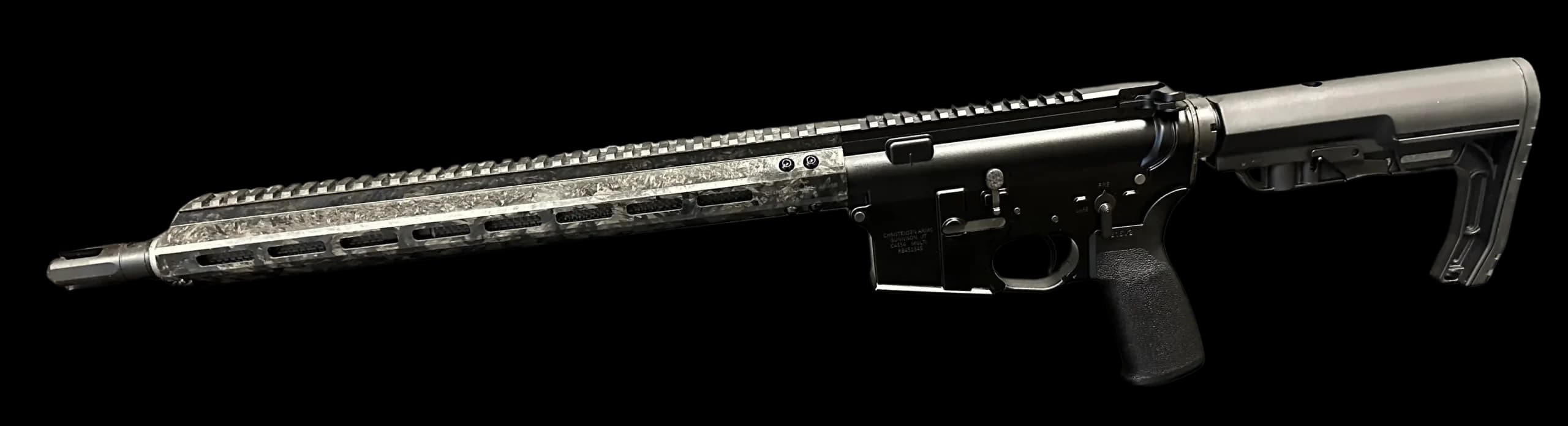
A Christensen Arms web page captured on September 22, 1999, describes the company's rimfire under the heading "10\22 Series." The rifle used a graphite/epoxy casing over a match-grade stainless steel barrel blank. The barrel was mounted on a Ruger 10/22 Model 1103 action fitted with a Christensen bolt release and a trigger sear that reduced pull to 2 pounds. The barreled action was bedded, with the barrel free-floating, in a composite or laminated wood stock. The page listed a weight of 3 to 5 pounds, accuracy of three shots in 1/2 inch or less at 50 yards, and an introductory price of $2,950 and up, scope and mounts not included. [7]
By February 2001, the company's rifle index listed the same page as the Carbon Challenge, alongside the Carbon One Custom, Carbon One Hunter, Carbon Ranger and Carbon Tactical. [8] The October 2002 Carbon Challenge page priced the rifle at $1,199 in .22 LR and $1,250 in .22 Magnum. It listed accuracy as five shots in 1/2 inch or less at 50 yards and offered a stainless action with a screw-in barrel on request. [9]
Two Company Accounts of the Starting Point
In 2005, the company's About Us page dated Christensen Arms to 1995. It stated that Christensen started with a .22-250 rifle called the Carbon One before expanding to the Carbon One Custom, Carbon One Hunter, Carbon Ranger, Carbon Challenge and Carbon Tactical. [10] The .22-250 is a centerfire varmint cartridge developed from the .250 Savage case; Remington added its name to the cartridge and chambered the Model 700 for it in 1965. [11]
The company's current history also gives 1995 as the founding year, but credits carbon-wrapped .22 LR barrels with turning the composite idea into Christensen Arms. It dates the barrel concept to 1993 and places the Carbon Cannon, a large-caliber hunting rifle, in 1998. [12]
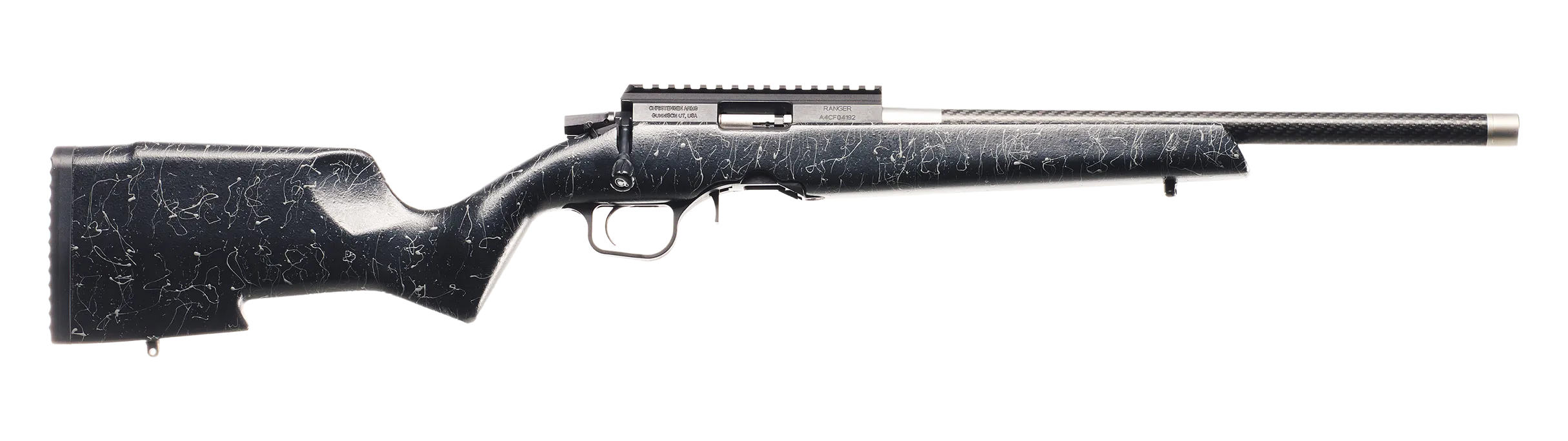
The rimfire line continues in the Ranger 22, which American Rifleman reviewed in July 2022. It is a bolt action with an 18-inch free-floated, tensioned carbon-fiber-wrapped barrel and Remington 700-pattern bolt and trigger components, and it takes Ruger 10/22-compatible magazines. [13]
Frequently Asked Questions
When did Roland Christensen file his carbon barrel patent?
He filed the application on December 18, 1995. It issued as U.S. Patent 5,692,334 on December 2, 1997, and a continuation, U.S. Patent 5,915,937, issued on June 29, 1999.
What was Christensen Arms' early rimfire rifle?
It was the 10/22 Series, later named the Carbon Challenge. It used a graphite/epoxy casing over a stainless steel barrel blank on a Ruger 10/22 Model 1103 action.
What did the Christensen barrel patent cover?
It covered a steel-lined composite barrel in which the liner and casing are largely unbonded and joined only by a short bonding layer or a pin. The design addressed warping caused by steel and composite expanding at different rates as the barrel heats.
Where did Christensen Arms begin?
The company was headquartered in Fayette, Sanpete County, Utah, alongside Christensen's composites firm, Applied Composite Technology. Christensen Arms moved to Gunnison in 2009.
What was the Carbon One?
In 2005, the company's About Us page said Christensen started with a .22-250 rifle called the Carbon One. The .22-250 is a centerfire varmint cartridge, not a rimfire.
Sources
[1] Nii, Jenifer. "Arms Began with a Foot in the Door: Utahn Has Unlikely Pair of Companies." Deseret News, November 19, 1999.
[2] Dean, Suzanne. "Composite Business Makes Gunnison Home: Has 100 Employees with Capacity for 300." Sanpete Messenger, July 12, 2022.
[3] Clarke, Kaitlyn. "ACT Aerospace: Big-Time Success in a Small Rural Utah Town." Utah Governor's Office of Economic Development, December 4, 2019.
[4] Christensen, Roland J. "Primarily Independent Composite/Metallic Gun Barrel." U.S. Patent 5,692,334, filed December 18, 1995, issued December 2, 1997.
[5] Christensen, Roland. "Primarily Independent Composite/Metallic Gun Barrel." U.S. Patent 5,915,937, filed June 16, 1997, issued June 29, 1999.
[6] Christensen Arms. "About Us." Christensen Arms, n.d. Internet Archive capture of April 9, 2000.
[7] Christensen Arms. "10\22 Series." Christensen Arms, n.d. Internet Archive capture of September 22, 1999.
[8] Christensen Arms. "Carbon Rifles." Christensen Arms, 2000. Internet Archive capture of February 10, 2001.
[9] Christensen Arms. "Carbon Challenge 10\22 Series." Christensen Arms, n.d. Internet Archive capture of October 19, 2002.
[10] Christensen Arms. "About Us." Christensen Arms, 2005. Internet Archive capture of December 26, 2005.
[11] Campbell, Dave. "The .22-250 Remington: History and Performance." American Rifleman, July 8, 2021.
[12] Christensen Arms. "About." Christensen Arms, July 1, 2026.
[13] Horman, B. Gil. "Review: Christensen Arms Ranger 22 Rifle." American Rifleman, July 13, 2022.
Browse our current Christensen Arms inventory, available for purchase.