
The Fairchild ArmaLite AR-10 Trials: What Reached Springfield Before Colt
Before Colt licensed the design in 1959, the AR-10 was a Fairchild property developed in ArmaLite’s small Hollywood shop and tested by Springfield Armory. This is the Fairchild-era record in order: the prototypes, the trial specimens, and the changes made before the license.
Key Takeaways
- Eugene Stoner designed the AR-10, Springfield Armory tested it, and Fairchild Engine and Airplane Corporation held the rights. Stoner’s 1956 patent applications assign his work to Fairchild.
- Springfield began testing the AR-10 in the second half of 1956, using two hand-built rifles with composite aluminum-steel barrels. Rifle No. 1002’s barrel burst after 5,564 rounds, and ArmaLite replaced it with an all-steel barrel.
- Before the 1959 Colt license, Fairchild had licensed AR-10 production to Artillerie-Inrichtingen in the Netherlands in 1957. ArmaLite engineers had also scaled the rifle down into the AR-15.
Until 1959, the AR-10 was owned by an aircraft company and developed in a small design shop in Hollywood, California. Three parties have to be kept separate. Eugene Stoner designed the rifle. Springfield Armory tested it for the Army. Fairchild Engine and Airplane Corporation, which owned ArmaLite, held the rights.
Designer and Rights Holder
George Sullivan, patent counsel for Lockheed Aircraft Corporation, set up ArmaLite in a small Hollywood building with funding from Fairchild president Richard Boutelle. On October 1, 1954, ArmaLite became a division of Fairchild. ArmaLite was not meant to be a manufacturer. It was set up to design new firearms, build prototypes and license them to manufacturers. Sullivan hired Eugene Stoner as chief design engineer after meeting him at the Topanga Canyon shooting range. [1]
The patent records show who owned Stoner’s work. Two applications name Stoner as inventor and assign the rights to Fairchild Engine and Airplane Corporation of Hagerstown, Maryland:
- A cartridge magazine of aluminum or magnesium, filed February 21, 1956 [2]
- A gas-operated bolt and carrier system, filed August 14, 1956 [3]
Fairchild kept those rights. In March 1956 the Army Ordnance Corps offered to acquire the AR-10’s development and production rights and pay ArmaLite a royalty on each rifle built. ArmaLite turned the offer down. In 1956 the company had a workforce of about a dozen. [4]
From X-01 to AR-10B
- X-01: Stoner’s first step was the X-01, which grew out of his earlier M-8 “autorifle.” It was a .30-06 rifle of stamped steel with wooden furniture. It already had the features that defined the later rifles: the in-line layout, the rotating bolt and the direct gas system. [4]
- X-02: The first prototype chambered for the T65 cartridge, the future 7.62x51mm NATO. It introduced fiberglass and plastic furniture developed by Tom Tellefson. [4]
- X-03 (renamed AR-10A): Added forged aluminum receivers and the forged carrying handle. It still had a right-side charging handle and a gas tube running along the side of the barrel. [4]
C. Reed Knight Jr. gives weights for these rifles. The second prototype, in stamped steel, weighed 8 lb. 4 oz. The AR-10A, with an all-aluminum receiver, weighed 6 lb. 11 oz. The AR-10A also had a combination flash hider and compensator, sights built into the carrying handle, and a steel-lined aluminum barrel. [5]
The AR-10B appeared in April 1956. It introduced:
- Upper and lower receivers joined by two pins and hinged to open
- A separate buffer in the buttstock
- A charging handle that did not move with the bolt, placed on top of the receiver inside the carrying handle [4]
It kept a barrel made of steel and aluminum, which Stoner feared could separate or burst under rapid fire. [4]
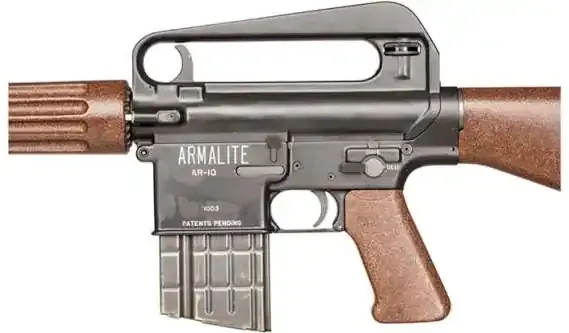
Serial number 1001 was the first pre-production AR-10B, also called the “Hollywood AR-10.” After serial number 1005 the “B” was dropped. Later rifles were marked simply AR-10, in a different typeface, with ArmaLite’s Pegasus logo. [5] Fewer than 50 AR-10s were made in ArmaLite’s Hollywood workshops. [4]
What Springfield Tested, in Date Order
Springfield had already tested an ArmaLite rifle with a lined aluminum barrel before the AR-10 arrived:
- July–December 1955: Springfield’s semiannual activity summary records tests of an ArmaLite Parasniper. It was chambered for the NATO cartridge and had a steel-lined aluminum barrel, a special compensator, a plastic stock and a telescope sight. The rifle had frequent extractor failures and poor accuracy. [6]
- January–June 1956: The next summary notes that Aberdeen Proving Ground sent unofficial results from its tests of two rifles supplied by the Armory. Aberdeen also sent a photographic print showing where the steel liner did and did not touch the aluminum barrel. [6]
Parasniper serial number 044, now in the Springfield collection, is marked ARMALITE/HOLLYWOOD, CA. on the barrel. [6]
The AR-10 followed. Springfield’s summary for July to December 1956 states: “Tests were initiated of the Fairchild Armalite AR-10 Rifle.” [7] The tests were part of the Army’s Lightweight Rifle Program. [4] ArmaLite entered two hand-built rifles. Both had in-line stocks, aluminum flash suppressors and composite aluminum-steel barrels. Nicaragua also examined these early rifles, and the hurried production led to failures in both countries’ tests. [8]
Three photographs record the specimens in order:
- The 1956 Aberdeen print of a Parasniper barrel liner [6]
- A Springfield Armory file photograph of an AR-10B taken apart during the 1956 evaluation [4]
- A Springfield photograph of the burst barrel of rifle number 1002 [4]
During endurance firing, a compensator failed and the heat of sustained fire warped the gas tube. Later, the composite barrel of rifle number 1002 burst in the middle of the handguard. The rifle had fired 5,564 rounds in the test program, and the operator was not hurt. ArmaLite quickly made an all-steel replacement barrel, and testing resumed a week later. Springfield’s final report, issued in February 1957, found the rifle unsatisfactory for military service. [4] The Army adopted the T44 instead, and the M14 was adopted in 1957. [1][9]
Changes Recorded Before the Rights Passed to Colt
The all-steel barrel. The replacement barrel fitted at Springfield was the first change after the trials. A contemporary American Rifleman report later described the design lesson: “A composite steel-aluminum barrel and a complicated flash suppressor originally used in the AR-10 proved unsuccessful. The AR-15 has an all-steel barrel and a short form of the Army-developed bar-type flash suppressor instead.” [9]
The Dutch license. In June 1957 Fairchild sold a production license to Artillerie-Inrichtingen (A.I.) in the Netherlands. [4] The license ran for five years. [8] The Dutch rifles carry different receiver markings from the Hollywood rifles. Serial number 003769 at Springfield is marked PATENTS PENDING/ARMALITE/AR10/MFD BY AI (in a triangle)-NEDERLAND. International Armament Corporation donated it to the Armory museum on January 3, 1961. [7]
The AR-15. ArmaLite engineers Robert Fremont and L. James Sullivan scaled the AR-10 down into a .22-caliber rifle. [1][4] Fairchild-era AR-15s carried the Hollywood address. Serial number 000006, now at Springfield, is marked ARMALITE/AR-15/HOLLYWOOD, CALIF. U.S.A./PATENTS PENDING. [10]
The Colt license. By 1959 AR-10 sales were limited and Fairchild was short of cash. In early 1959 ArmaLite licensed the rights to both the AR-10 and AR-15 designs to Colt for $75,000 and a 4.5 percent royalty. [1] Bobby MacDonald of Cooper-MacDonald helped arrange the deal, and Colt then concentrated on the AR-15 rather than the AR-10. [4]
The magazine patent was issued to Fairchild on September 15, 1959. [2] The bolt-and-carrier patent behind both rifles was issued to Fairchild on September 6, 1960, more than a year after Colt took its license. [3]
Frequently Asked Questions
Who designed the AR-10?
Eugene Stoner designed it while serving as chief design engineer of ArmaLite, a division of Fairchild Engine and Airplane Corporation. His patents name him as inventor and assign the rights to Fairchild.
Which AR-10s were tested at Springfield Armory?
ArmaLite sent two hand-built rifles, and Springfield began testing them in the second half of 1956. Springfield photographs record an AR-10B taken apart during the evaluation and the burst barrel of rifle No. 1002.
Why did the AR-10’s barrel fail in testing?
The trial rifles had barrels made of steel and aluminum, a construction Stoner feared could separate or burst under rapid fire. Rifle No. 1002’s barrel burst after 5,564 rounds, and ArmaLite fitted an all-steel replacement within a week.
What is a Hollywood AR-10?
The name refers to the AR-10B and the early AR-10s built at ArmaLite’s Hollywood workshops, beginning with pre-production serial number 1001. Fewer than 50 AR-10s were made there, and the “B” was dropped from the markings after serial number 1005.
When did Colt obtain the AR-10 rights?
In early 1959, ArmaLite licensed both the AR-10 and AR-15 designs to Colt for $75,000 and a 4.5 percent royalty. Colt then concentrated on the AR-15.
Sources
[1] McElrath, Daniel T. “The ArmaLite Story.” American Rifleman, July 29, 2021. First published in American Rifleman, December 2004, as “ArmaLite Turns 50: Golden Days at ArmaLite.”
[2] Stoner, Eugene M. “Cartridge Magazine of Aluminum or Magnesium.” U.S. Patent 2,903,809, filed February 21, 1956, issued September 15, 1959. Assignor to Fairchild Engine and Airplane Corporation.
[3] Stoner, Eugene M. “Gas Operated Bolt and Carrier System.” U.S. Patent 2,951,424, filed August 14, 1956, issued September 6, 1960. Assignor to Fairchild Engine and Airplane Corporation.
[4] American Rifleman. “The AR-10 Story.” American Rifleman, October 2, 2018.
[5] Knight, C. Reed, Jr. “Eugene M. Stoner Designs and Guns Before the M16.” American Society of Arms Collectors Bulletin, no. 125, Spring 2022, pp. 59–68.
[6] National Park Service, Springfield Armory National Historic Site. “SPAR 4456: ArmaLite Rifle AR-1 Parasniper 7.62mm, SN 044.” NPS Museum Collections, n.d.
[7] National Park Service, Springfield Armory National Historic Site. “SPAR 1371: Netherlands Rifle AR10 7.62mm, SN 003769.” NPS Museum Collections, n.d.
[8] America’s 1st Freedom. “The Amazing AR-10.” America’s 1st Freedom, July 1, 2014.
[9] Howe, Walter J., and E.H. Harrison. “The First Colt AR-15 Rifle.” American Rifleman, May 1962 (posted online February 27, 2014).
[10] National Park Service, Springfield Armory National Historic Site. “SPAR 8367: U.S. Assault Rifle AR15 .223, SN 000006.” NPS Museum Collections, n.d.
Browse our current ArmaLite inventory, available for purchase.