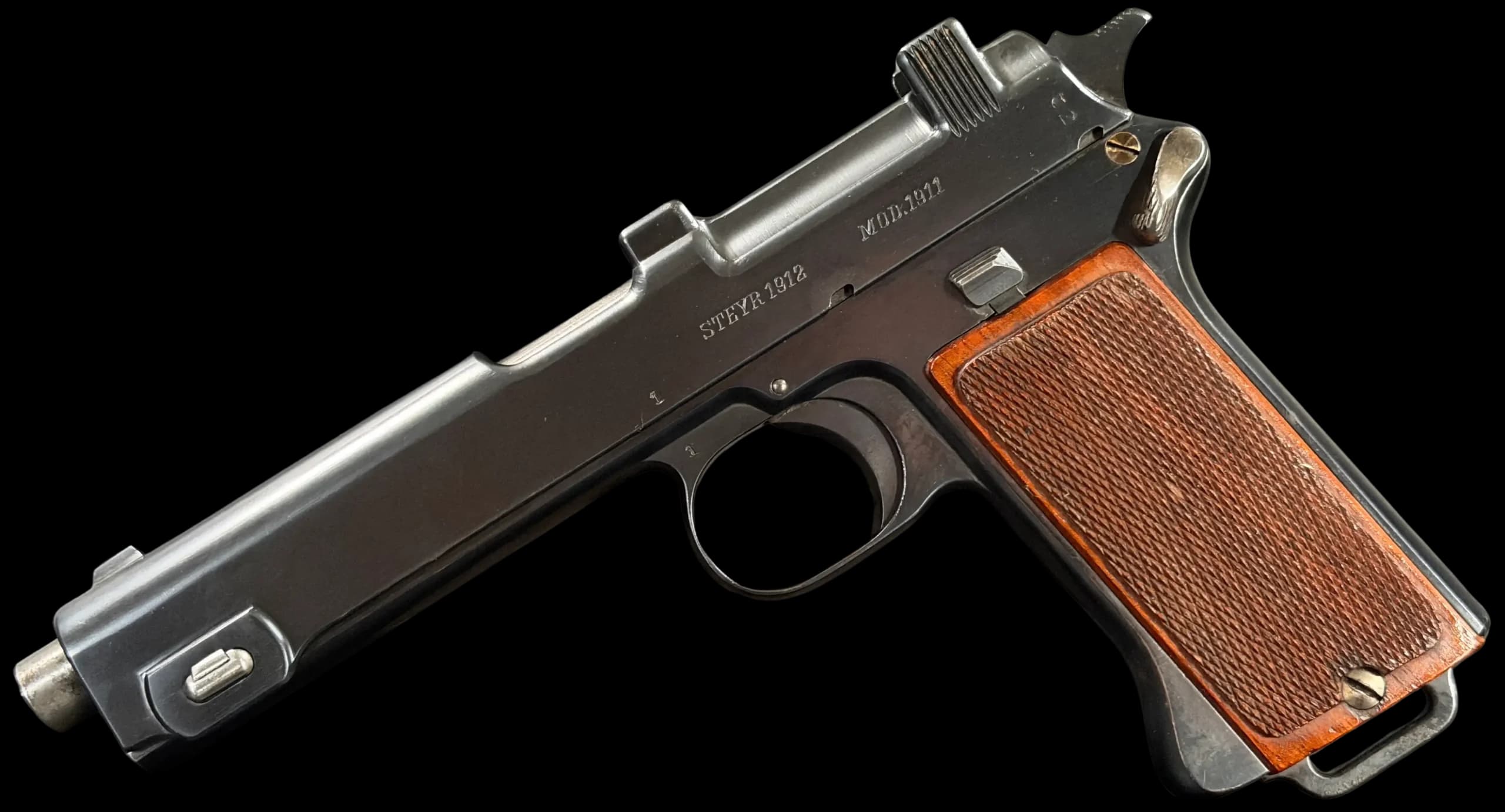
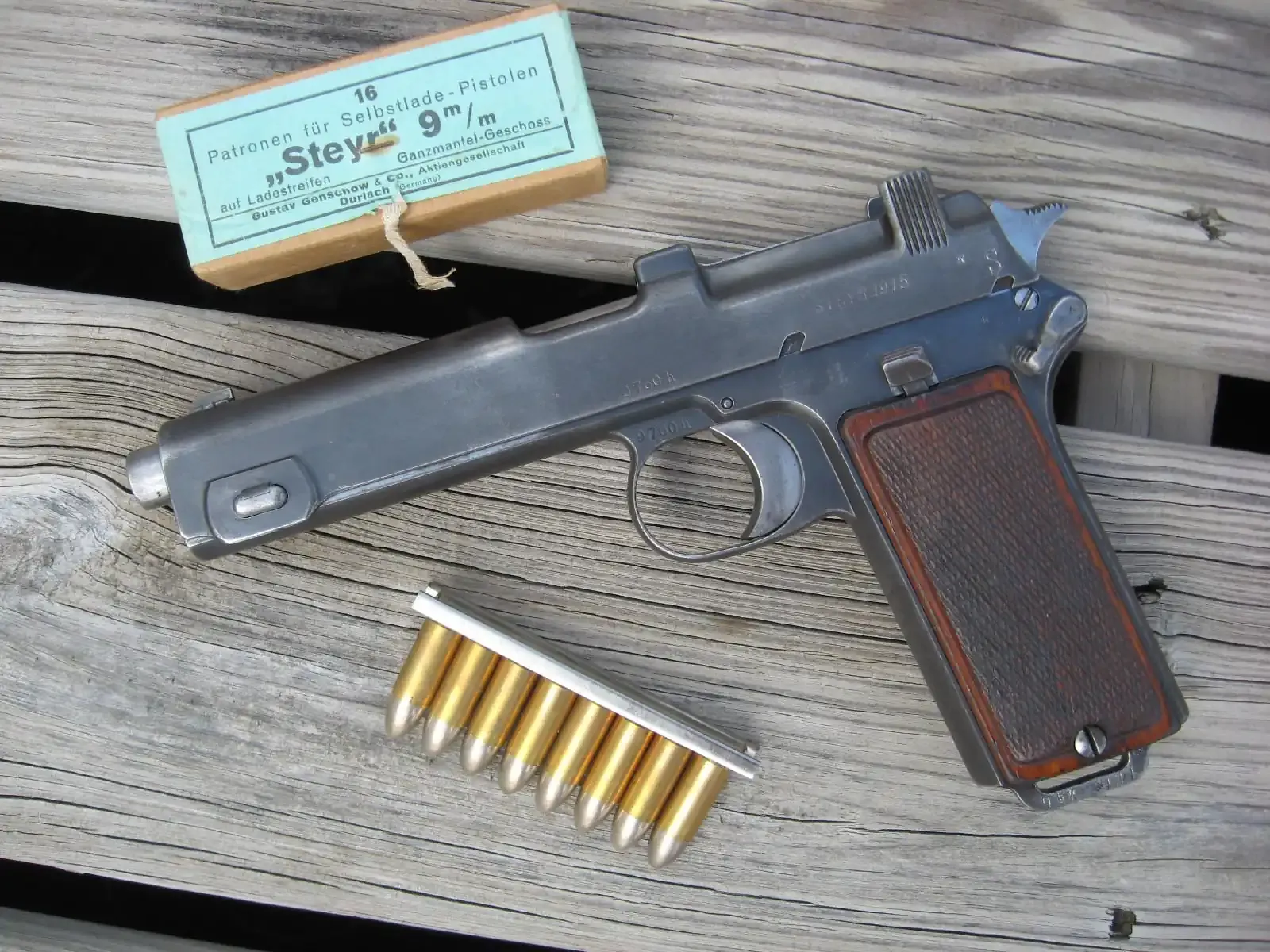

On 14 January 1911, Österreichische Waffenfabriks-Gesellschaft filed an Austrian patent for a self-loading pistol whose barrel turned to unlock from the slide; the same convention date was claimed in Britain, where the specification describes a helical rib on the barrel running in a matching groove in the frame. A companion British patent of the same date covers the trigger mechanism, with a disconnector between trigger and sear and an external hammer. The Historical Breechloading Smallarms Association (HBSA) describes the sequence in the finished pistol: barrel and slide stay locked for the first 8 mm of recoil, after which the barrel rotates 20 degrees and releases the slide. That hammer gave the pistol its name. “Hahn” is German for hammer, and the nickname separated it from the earlier, striker-fired Roth-Steyr M1907. The patents were filed in the company’s name, and the individual designer is not firmly established.
The company behind it was already half a century old. Josef Werndl and his brother Franz founded a weapons factory and sawmill at Oberletten, near Steyr, in April 1864, and in 1869 Werndl converted the business into the joint-stock Österreichische Waffenfabriks-Gesellschaft. Its Werndl-Holub breech-loader became the Austrian army’s standard rifle in 1867, and the Mannlicher straight-pull rifles followed from 1885. Between 1912 and 1914 the factory moved to a larger site in Steyr. Writers on the pistol place it in direct descent from the Roth-Steyr, combined with features of the early Browning-designed Colt pistols.
Steyr sold the design commercially and abroad before the Austro-Hungarian Army took it up in quantity. Maxim Popenker dates production from 1911 and records Chile as the first customer, under the designation Model 1911; W.H.B. Smith also gives 1911 as the year of introduction. Chilean pistols are dated 1912 yet marked “Mod. 1911,” and Romania ordered 50,000 in December 1912, according to Royce Wilson, of which about 37,000 had been delivered when the First World War began. The war ended deliveries to Romania. Inside the Dual Monarchy the pistol became the Repetierpistole M.12, firing the 9x23mm Steyr cartridge from an eight-round magazine fixed in the grip and filled from the top with a charger. Sources disagree on whether formal adoption came in 1912 or 1914.
In wartime service the M.12 became the standard Austro-Hungarian sidearm, issued alongside older Roth-Steyr M7 pistols and Rast & Gasser revolvers. Bavaria bought it from 1916: John Walter puts the Bavarian purchase at about 20,000 pistols, while Wilson gives 16,000 delivered between 1916 and 1918. The Australian War Memorial holds a pistol stamped “Steyr 1916” that Lieutenant Edward Vivian Smythe of the 24th Battalion captured at Bullecourt on 3 May 1917, and the Memorial’s catalogue notes that limited issue to German units made the M1912 rare on the Western Front. Steyr also built a select-fire version with a 16-round magazine and a detachable stock-holster. Total production estimates run from about 250,000 to more than 300,000. Firearms manufacture at Steyr was prohibited after the war, and the HBSA dates the end of M.12 production to 1919.
The pistol’s second career followed the Anschluss in 1938, when Steyr-Daimler-Puch (the company’s name since a 1934 merger) was absorbed into the Reichswerke Hermann Göring. Austrian M.12 pistols in storage were fitted with new barrels for the 9x19mm Parabellum cartridge and marked “08” on the slide; the HBSA gives the number as 60,000, and the German designation was P12(ö). The maker itself has since become Steyr Mannlicher (independent again from 1989), then Steyr Arms from 1 January 2019, with headquarters at Kleinraming in the Raming valley. The Czech group RSBC bought all of its shares in April 2024.
For collectors the M.12 family is read largely through its markings. Chilean pistols carry the “Mod. 1911” designation and Romanian pistols “Mod. 1912” with the national arms, while the converted pistols carry “08” and German proofs. Bavarian purchases are harder to separate, since Walter records that no distinctive Bavarian mark has been identified. Ammunition is a practical consideration: 9x23mm Steyr has been loaded commercially by Fiocchi and Hornady, but supply has narrowed. A 1913 example in the Deutsches Historisches Museum measures 20.5 cm overall with a 12.9 cm barrel and weighs 980 g, close to the figures Popenker publishes for the type.
History & Milestones
Werndl brothers found the Oberletten works
Josef and Franz Werndl established a weapons factory and sawmill at Oberletten, near Steyr, on 16 April 1864. It is the firm that later made the Steyr-Hahn.
Werndl firm becomes a joint-stock company
Josef Werndl converted the business into the Österreichische Waffenfabriks-Gesellschaft (ÖWG). The pistol’s patents were later filed under this name.
Rotating-barrel pistol patented and put into production
ÖWG filed its Austrian patent for the rotating-barrel pistol on 14 January 1911, with British filings claiming the same date. Popenker dates the start of production to the same year.
Chile takes first export deliveries
Chile was the first customer, receiving pistols dated 1912 and marked “Mod. 1911”. The export trade preceded large Austro-Hungarian orders.
Austro-Hungarian designation as Repetierpistole M.12
The pistol took the army designation M.12, though sources differ on whether formal adoption came in 1912 or 1914. It became the standard Austro-Hungarian sidearm of the First World War.
Romania places a 50,000-pistol order
Romania ordered 50,000 pistols in December 1912 and added 5,000 in June 1913. About 37,000 were delivered before the war cut off the contract.
Bavarian Army begins buying the M.12
The Bavarian Army bought Steyr pistols from 1916, in a quantity Walter puts at about 20,000. One captured at Bullecourt in May 1917 is now in the Australian War Memorial.
Postwar ban halts Steyr firearms production
Firearms manufacture at Steyr was prohibited after the First World War, and the Historical Breechloading Smallarms Association dates the end of M.12 production to 1919. The company turned to cars and, from 1926, trucks.
Anschluss brings the 9mm Parabellum conversion
After the Anschluss, Steyr-Daimler-Puch was absorbed into the Reichswerke Hermann Göring, and stored M.12 pistols were re-barrelled for 9x19mm and marked “08”. Wilson notes the new barrels and German proof marks on these pistols.
RSBC acquires the renamed Steyr Arms
The company, renamed Steyr Arms on 1 January 2019, was bought outright by the Czech RSBC group in April 2024. It remains based at Kleinraming, Austria.