
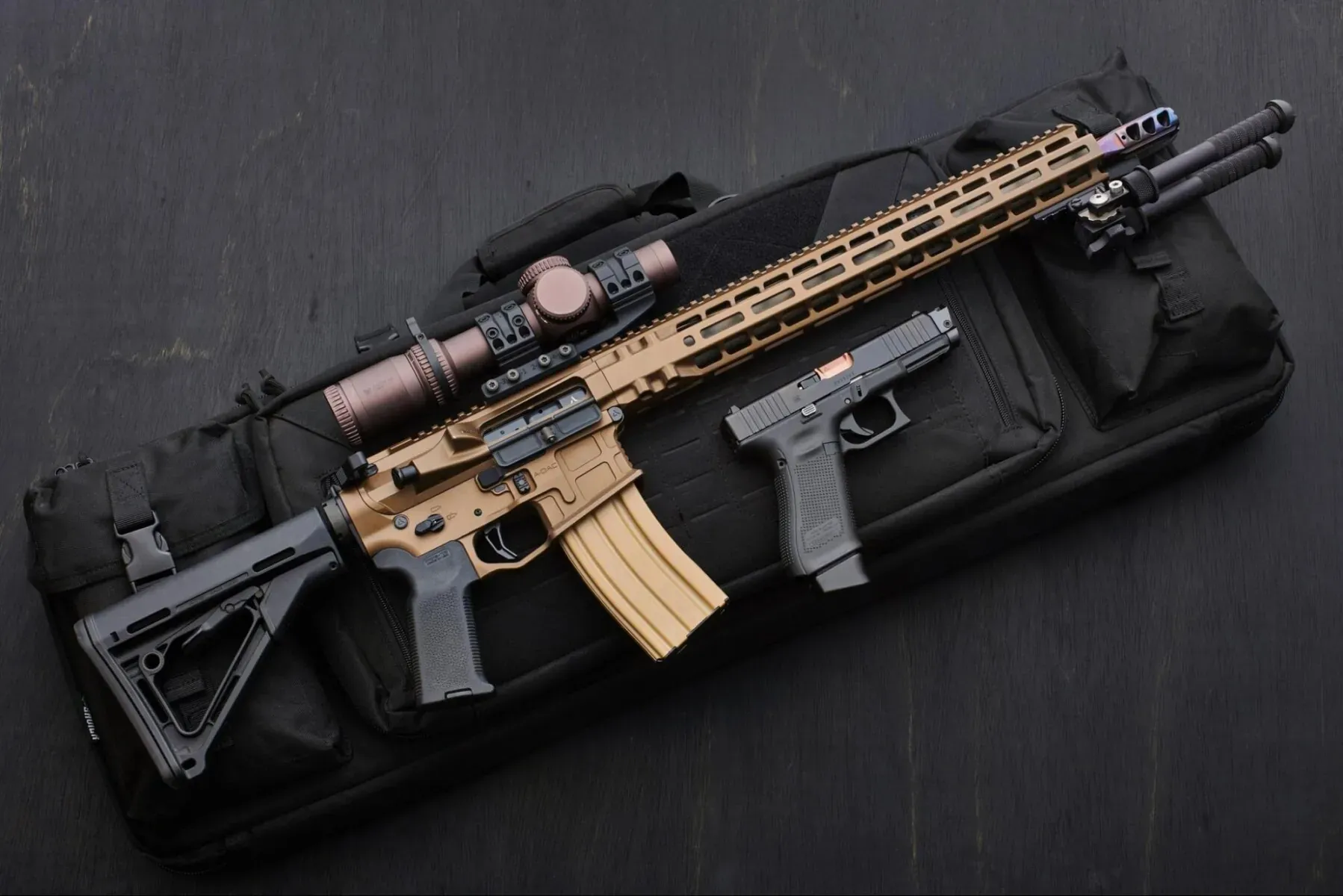

In 2008, a client looked at Josh Underwood's first AR-15 lower receiver and told him it wasn't enough. Underwood was running a small machine shop in Salem, Oregon, filling contract work for aerospace and firearms clients, and he had just shown the receiver to Dave Johnson, founder of accessory maker Boonie Packer. Johnson liked the machining but pointed out that a plain lower would get lost among the many firearms companies that had launched around the 2008 election cycle. He gave Underwood a specific problem to solve instead: find a way to clear a double-feed malfunction without taking a hand off the grip.
Underwood spent months working out a mechanism that let the same button release the magazine and drop the bolt, a design he eventually patented as the A-DAC, or Ambidextrous Dual Action Catch. Around the same time, the US Army had circulated a request for ambidextrous receiver features, including a left-side magazine release and an ambidextrous safety. Underwood built those requirements into his own design and added the right-hand bolt catch nobody else had solved. The receiver reached the market in 2009 under a new company name, AXTS, which Underwood has described in interviews as standing for Arms of Extreme Tyranny Suppression. AXTS showed the resulting AX556 and AX762 ambidextrous lowers publicly at SHOT Show in 2011.
The business nearly didn't survive to see that debut pay off. A client failed to pay for contract machining work, leaving Underwood roughly $50,000 short, and he turned to a charging handle design he had been developing on the side. Working late into the night for months, he refined an ambidextrous charging handle that let a shooter cycle the bolt from either side of the rifle. Rainier Arms agreed to distribute it starting in 2012, with AXTS's name on the latch, before Underwood began selling directly to dealers. The Raptor became the company's best-known product and, later, its most litigated one: AXTS sued Stag Arms in late 2018 for patent and trade dress infringement over a similar charging handle sold at a fraction of the price, a case that ended in a settlement in 2019.
By the mid-2010s, AXTS had extended its ambidextrous approach into a modular safety selector, the Talon, which lets a shooter switch between a 90-degree and a 45-degree throw without removing it from the lower. In 2016, Underwood took the company in a new direction, building and selling complete rifles rather than only parts. He also renamed the business Radian Weapons, partly because customers kept mispronouncing the AXTS acronym. The first complete rifle, the Model 1, debuted at SHOT Show 2016 and remains the company's flagship, billet-machined from 7075-T6 aluminum with a 416R stainless-steel barrel and a sub-MOA accuracy guarantee on match ammunition. Two years later, Radian moved its headquarters and production out of Underwood's pole barn and house in Salem and into an 18,000-square-foot facility in Redmond, Oregon.
Radian's product line stayed almost entirely within the AR platform for most of its history, with the Raptor charging handle branching into lightweight, suppressor-optimized, and platform-specific variants, and the Talon and Vertex trigger rounding out the lower receiver. That changed in 2023, when the company introduced its first dedicated pistol components at SHOT Show: the Guardian optic mount and guard for slide-mounted red dots, and the Afterburner and Ramjet compensator-and-barrel combination for the Glock 19, which the company says cuts felt recoil by about 44 percent. Both lines expanded the following year to cover more optics and platforms, including the Walther PDP.
For a collector, Radian's appeal sits less in any single product than in the fact that nearly everything the company sells still runs through the same ambidextrous logic Underwood worked out in 2008. The current Model 1 receiver is, by Underwood's own account, about 95 percent unchanged from that original design. The company remains privately held and run by Underwood from Redmond, and it has continued to source its raw materials domestically as it has grown from a one-man machine shop into a rifle- and pistol-accessory manufacturer with a national dealer network.
History & Milestones
Underwood opens a Salem machine shop
Josh Underwood begins contract machining for aerospace and firearms clients out of Salem, Oregon, the operation that eventually becomes AXTS and then Radian Weapons.
Ambidextrous receiver concept takes shape
After a client warns that a plain lower receiver would get lost in a crowded market, Underwood works out the A-DAC mechanism, letting one button operate both the magazine release and the bolt catch.
AXTS Weapons Systems is founded
The A-DAC lower receiver reaches the market under the company's original name, AXTS, which Underwood has described in interviews as standing for Arms of Extreme Tyranny Suppression.
A-DAC lowers debut at SHOT Show
AXTS shows its AX556 and AX762 ambidextrous lower receivers publicly at SHOT Show, its first appearance in the trade press.
Raptor charging handle reaches dealers
Developed after a cash shortfall nearly closed the business, the ambidextrous Raptor charging handle launches through a distribution deal with Rainier Arms and becomes AXTS's signature product.
Company renamed Radian, Model 1 debuts
AXTS rebrands as Radian Weapons and introduces its first complete rifle, the Model 1, at SHOT Show, shifting the company from parts maker to rifle builder.
Production relocates to Redmond, Oregon
Radian moves its headquarters and manufacturing from a home workshop in Salem into an 18,000-square-foot facility in Redmond, expanding its production capacity.
Patent suit against Stag Arms settled
Radian sues Stag Arms over a charging handle it says infringes Raptor patents and trade dress; the case is settled in 2019 with Stag admitting the infringement.
Guardian and Afterburner launch for pistols
Radian enters the pistol accessory market for the first time with the Guardian optic mount and the Afterburner and Ramjet recoil-reduction system for the Glock 19.
Guardian mount expands to more platforms
Radian broadens the Guardian optic mount to additional Glock red-dot footprints and to the Walther PDP line, its first non-Glock pistol platform.