
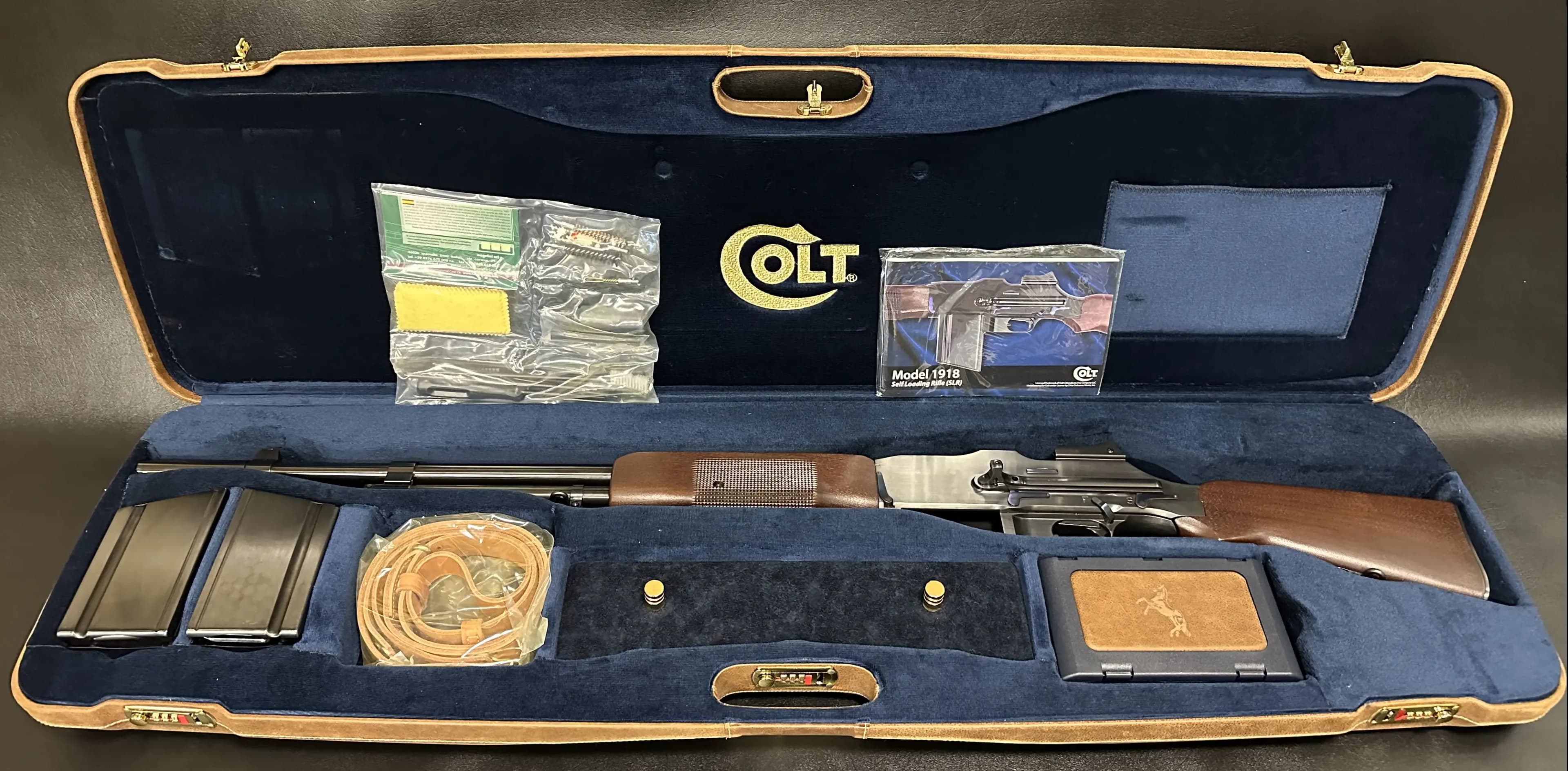

When Ohio Ordnance Works shipped its first 1918A3-SLR in 1996, the Browning Automatic Rifle had been out of production for decades, and the only way to own one was a transferable machine gun on the NFA registry. Bob Landies took a different route. His company machined a new receiver from 4140 steel billet, redesigned the trigger group and operating parts to fire from a closed bolt, and completed early rifles with surplus USGI components. The result was a BAR that could be bought like any other rifle. Thirty years on, it is still the only BAR reproduction in series production anywhere.
Landies came to gunmaking sideways. He started at TRW in 1964, first in the jet engine division and later on Navy torpedo programs, and served seven years as a U.S. Army armor officer. He was also a collector and gunsmith of military firearms, and in 1981 he turned that into a full-time business in Chardon, Ohio, east of Cleveland. Through its first decade the company traded in military firearms, parts, and accessories, built out a repair operation, and took on small custom builds. The machinery, licensing, and institutional knowledge accumulated in those years set up everything that followed.
In 1990 Ohio Ordnance began manufacturing firearms for government customers, and that side of the business has defined it since. The company is a Class 3 manufacturer producing belt-fed machine guns in M240, M249, and M2 configurations for U.S. forces and approved foreign militaries, working under an ISO 9001:2015 quality system certified by TUV Rheinland. Its own materials list the Department of State, the U.S. service branches, and training simulator manufacturers among its customers. This matters to a collector for a simple reason: the semi-automatic rifles in the civilian catalog come from the same shop, using the same drawings and the same inspection regime as the military guns.
The civilian line grew around platforms with no practical transferable equivalent. The M240-SLR, a patented closed-bolt, semi-automatic version of the M240 introduced around 2009, is dimensionally identical to the machine gun and drops into any M240 mount. The M2-SLR followed in 2022, applying the same approach to the Browning .50. Transferable M240s are all but absent from the civilian registry, and original M2s trade at full machine gun prices, so the SLR versions are the realistic path to both platforms for most collectors.
The HCAR came from the second generation. Conceived by Robert W. Landies III, the founder's son and a Marine Corps Reserve officer, the Heavy Counter Assault Rifle takes the 1918A3 receiver, thins it where strength allows, and rebuilds the BAR as a contemporary rifle: hydraulic buffer, 30-round proprietary magazines, rail interfaces, adjustable gas regulator, a 16 or 20 inch barrel, still chambered in .30-06. Shown in prototype form in 2013 and unveiled at SHOT Show in January 2014, it began shipping later that year at roughly eight pounds lighter than the original rifle. Landies III now leads the company as president.
The current program is the REAPR, a belt-fed machine gun chambered in .338 Norma Magnum with a 7.62 NATO conversion, developed from around 2020 in response to U.S. Special Operations Command and Marine Corps requirements for a lightweight medium machine gun. Teased under a cover at SHOT Show 2022 and shown openly in January 2024, it puts a family firm from Geauga County in direct competition with SIG Sauer for a significant small arms program. That is the context that separates Ohio Ordnance from the reproduction houses. The semi-automatic BARs and belt-feds on the civilian side are the visible edge of an active defense manufacturer, not a nostalgia business.
History & Milestones
Bob Landies founds Ohio Ordnance Works
Robert I. Landies, a former TRW engineer and U.S. Army armor officer, turns his trade in military firearms and parts into a full-time business in Chardon, Ohio.
Company shifts from trading to manufacturing
Ohio Ordnance begins building firearms for domestic and foreign government customers. This is the start of the military production business that still anchors the company.
The 1918A3-SLR brings back the BAR
The closed-bolt, semi-automatic BAR reproduction debuts. For the first time, collectors have a non-NFA route to John Browning's automatic rifle.
M240-SLR reaches the civilian market
The patented semi-automatic M240 gives collectors access to a platform absent from the transferable registry. Auction records date the introduction to around 2009; the exact year should be confirmed.
HCAR shown in prototype form
The modernized BAR appears at the SHOT Show and at a live-fire demonstration in North Carolina while development continues.
HCAR unveiled and first rifles ship
Formally introduced at SHOT Show in January, the HCAR opens for orders in May, with first deliveries late in the year.
M2-SLR arrives; a covered prototype appears
The semi-automatic Browning .50 enters the catalog, and a new belt-fed design is shown at SHOT Show concealed under a cover.
REAPR unveiled at SHOT Show
The .338 Norma Magnum machine gun is shown openly in January, developed for SOCOM and Marine Corps lightweight medium machine gun requirements.
