Key Takeaways
- The Mark V uses either a nine-lug or smaller six-lug action, depending on the rifle and chambering.
- Freebore formed part of Weatherby’s system for increasing velocity potential while controlling pressure.
- Mark V production moved from California to West Germany, Japan and later back to the United States.
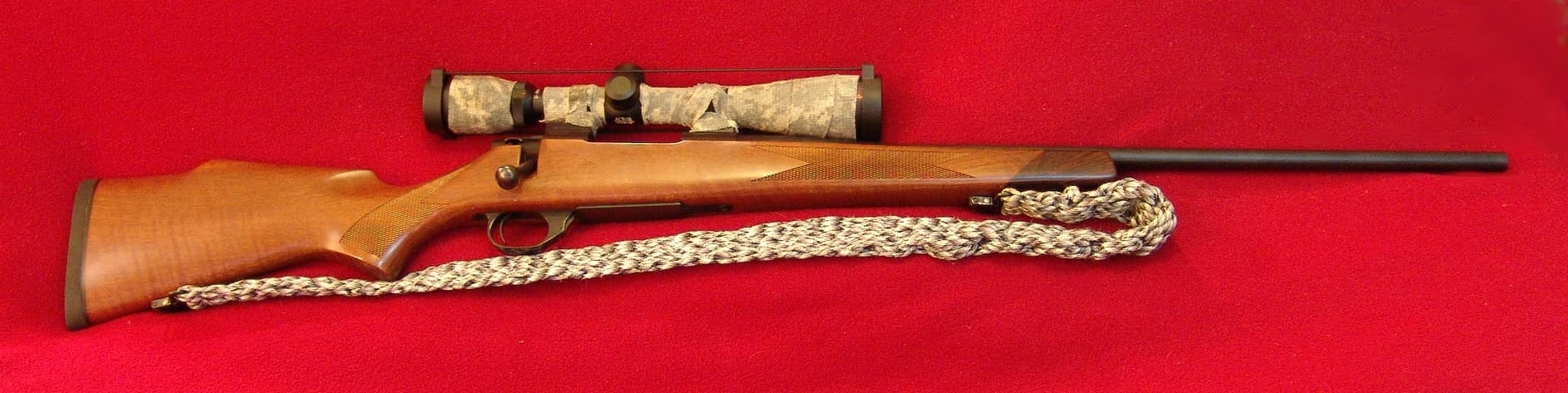
Introduced in 1958, the Weatherby Mark V was developed to handle Roy Weatherby’s high-velocity magnum cartridges. Its original action used nine locking lugs arranged in three equally spaced groups of three. This interrupted-thread arrangement permitted a 56-degree bolt rotation—substantially shorter than the 90-degree lift common to conventional two-lug actions.[1]
The Mark V’s design included a one-piece bolt with shallow locking lugs that did not project beyond the bolt body. This configuration eliminated conventional lug raceways and permitted comparatively thick receiver-ring walls. Weatherby subsequently revised the action to a 54-degree bolt lift, increasing clearance between the bolt handle and a mounted scope.[1][2]
Freebore and Weatherby Cartridges
Freebore—the rifling-free section of the barrel immediately ahead of the chamber—was integral to Weatherby’s approach to cartridge performance. In the .270 Weatherby Magnum, for example, the extended freebore allowed the bullet to travel farther before engaging the rifling. This increased the cartridge’s velocity potential while controlling pressure.[3]
Freebore cannot be considered separately from the cartridge and chamber for which it was designed. It forms part of a system that also includes case capacity, powder charge, bullet weight, chamber dimensions, and barrel length. Its presence does not make improvised or unpublished loads safe.
Nine-Lug and Six-Lug Actions
The nine-lug action is the original Mark V configuration and remains the design most closely associated with Weatherby’s larger magnum cartridges. Its three banks of three lugs provide the characteristic short bolt lift.[1]
Weatherby also developed a smaller six-lug action for less demanding chamberings. This bolt has three groups of two lugs. The six-lug version weighs less than the nine-lug action while retaining the Mark V’s short bolt rotation.[2]
Lug count is therefore a matter of action size and intended chambering, not a reliable measure of quality. Both configurations belong to the Mark V family, but they were designed for different cartridge and rifle requirements.
Manufacturing History
Initial Mark V production took place in South Gate, California, using components manufactured by Pacific Founders. Only a few thousand actions were assembled from California-made components before production shifted to J.P. Sauer & Sohn in West Germany. A German production line was established in 1959.[1]
Economic considerations prompted another manufacturing change around the beginning of the 1970s. Howa Machinery began producing Mark V actions in Japan in 1971 as Sauer production was phased out. Howa continued manufacturing the Mark V through the end of 1994.[1]
Production then returned to the United States. Mark Vs were manufactured in Maine and later in Minnesota before Weatherby moved production in-house to Paso Robles, California. Production there began in the fall of 2011.[4]
For collectors, these manufacturing periods create recognizable categories: early California, West German, Japanese, and later American production. A rifle’s markings can provide evidence of its manufacturing origin, but claims about originality, rarity, or value require examination of the complete firearm and any available provenance.
The Vanguard Is Not a Mark V
The Weatherby Vanguard is a separate rifle line. Its bolt employs two opposed locking lugs, an extractor, and a plunger-type ejector rather than the Mark V’s six- or nine-lug arrangement.[5]
Weatherby introduced the Vanguard as a lower-priced companion to the Mark V. Despite the common brand name, the two rifles use fundamentally different actions. A Vanguard should therefore not be described as a Mark V variant, and parts should not be assumed interchangeable between the two platforms.
A Design with a Distinct Identity
The Mark V’s identity rests on its short-lift, multi-lug action and its association with Weatherby’s high-velocity cartridges. The nine-lug original, the smaller six-lug derivative, and successive periods of American, German, Japanese, and renewed American production provide clear areas of study for collectors.
Freebore helps explain Weatherby cartridge performance. Lug count identifies the action configuration. Manufacturing origin provides historical context. Taken together, these features offer a sounder basis for evaluating a Mark V than reputation or sales language alone.
Frequently Asked Questions
When was the Weatherby Mark V introduced?
The Weatherby Mark V was introduced in 1958.
What is the difference between the six-lug and nine-lug Mark V actions?
The nine-lug action is the original configuration associated with larger magnum cartridges. The smaller six-lug action was developed for less demanding chamberings and lighter rifles.
What is freebore in a Weatherby rifle?
Freebore is the rifling-free section immediately ahead of the chamber. In Weatherby cartridges, it formed part of a coordinated design intended to increase velocity potential while controlling pressure.
Where has the Mark V been manufactured?
The Mark V has been produced in California, West Germany, Japan, Maine and Minnesota. Production returned to Weatherby’s California facility in 2011.
Is the Weatherby Vanguard a Mark V variant?
No. The Vanguard uses a separate two-lug action and is not a Mark V variant.
Sources
- American Rifleman, “Weatherby Mark V: History & Disassembly,” October 12, 2021.
- American Hunter, “Hardware: Weatherby New Mark V Rifle,” May 18, 2017.
- American Rifleman, “.270 Wby. Mag.: The Original Weatherby,” January 4, 2015.
- American Rifleman, “The Weatherby Mark V Comes Home,” May 10, 2012.
- American Rifleman, “Weatherby Vanguard Series 2 Synthetic Rifle,” December 19, 2012.
As a firearms enthusiast with a background in website design, SEO, and information technology, I bring a unique blend of technical expertise and passion for firearms to the articles I write. With experience in computer networking and online marketing, I focus on delivering insightful content that helps fellow enthusiasts and collectors navigate the world of firearms.
Comments
Be the first to leave a comment.
Be the first to read new editorial features, collector guides, and brand spotlights.