Key Takeaways
- The Modello 1891 infantry rifle has a long barrel, full-length furniture, an adjustable rear sight, and a six-round en bloc clip.
- An integral folding bayonet identifies the cavalry-carbine pattern, while the TS carbine uses a conventional bayonet fitting.
- Model 38-style rifles may be chambered in either 7.35 mm or 6.5 mm, so appearance alone cannot establish caliber.
The Carcano is a family of Italian bolt-action military rifles and carbines derived from the Modello 1891. The principal variants share a common action and six-round en bloc loading system, but differ in length, sights, bayonet fittings, and chambering.
The Modello 1891 Infantry Rifle
The Modello 1891 was developed at the Turin arms factory by a team led by Lieutenant Colonel Salvatore Carcano. Ferdinand Ritter von Mannlicher did not design the rifle, although its magazine incorporated a modified Mannlicher-type en bloc clip system.[1]
The standard infantry rifle was chambered for the 6.5×52 mm Carcano cartridge. It had a turn-bolt action with two opposed front locking lugs, a split receiver bridge, and a hook extractor. The rifle measured approximately 50.6 inches overall, had a 30.7-inch barrel, and weighed about 8 pounds, 10 ounces.[2]
Its adjustable rear sight was graduated from 600 to 2,000 meters. Folding the sight leaf forward exposed a fixed 300-meter battle sight.[2] The long barrel, full-length furniture, two barrel bands, and extended rear-sight assembly distinguish the infantry rifle from the shorter Carcano patterns.
The Modello 1891 used gain-twist rifling, meaning that the rifling turned progressively faster as it approached the muzzle. Royal Armouries records a progression from approximately one turn in 19.25 inches at the breech to one turn in 8.25 inches at the muzzle.[1]
Cavalry and Special-Troops Carbines
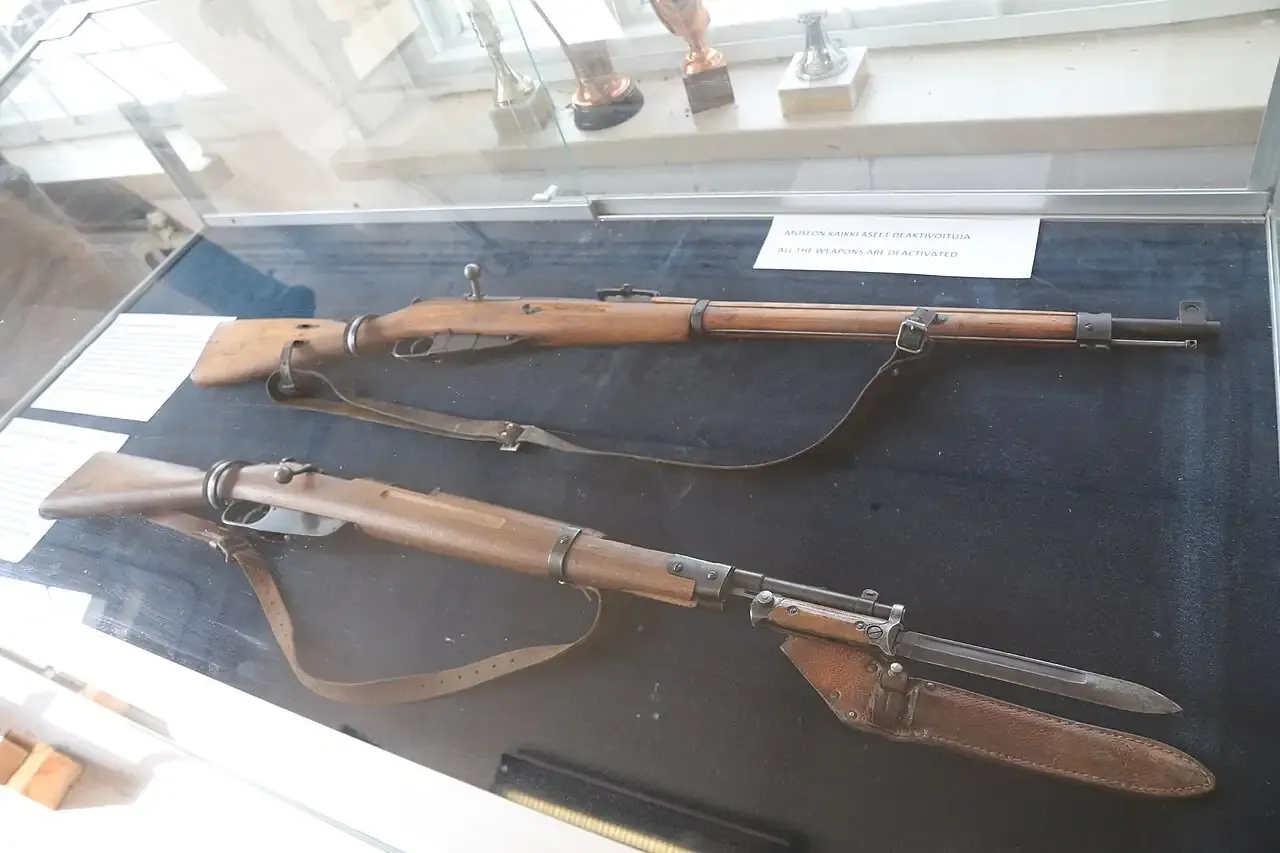
The Moschetto da Cavalleria Modello 1891 was the cavalry version. It had a 450 mm barrel and an integral folding bayonet, which remains its clearest identifying feature.[1]
The Moschetto per Truppe Speciali Modello 1891, commonly abbreviated TS, was issued to specialist personnel. It also had a shortened barrel but used a conventional bayonet mounting instead of the cavalry model’s folding bayonet.[1]
A compact Carcano with original folding-bayonet hardware therefore corresponds to the cavalry pattern. A shortened carbine with a conventional detachable-bayonet fitting may belong to the TS family, although its markings and complete configuration should be examined before a final designation is assigned.
The En Bloc Clip
The standard Carcano magazine holds six cartridges in an en bloc clip inserted through the open receiver. The clip has no designated top or bottom and can be inserted either way.[1][2]
After the final cartridge has been chambered, the empty clip falls through the opening beneath the magazine. It can also be released through the open receiver by operating the clip catch.[1] Because the clip positions the cartridges for feeding, it is an operating component of the magazine system.
Model 38 and Model 91/38 Rifles
The Model 38 introduced a 7.35 mm chambering shortly before the Second World War. Italy subsequently resumed production in the established 6.5 mm caliber, creating rifles known as the Model 91/38.[3]
This history makes external appearance an unreliable guide to chambering. A documented 1940 Terni Model 91/38 had the outward form associated with the 7.35 mm rifle but was chambered in 6.5 mm. Its caliber was confirmed by its markings, a cartridge-fit examination, and measurement of a cast made from the bore.[3]
The rifle was marked “CAL. 6.5,” “MADE ITALY,” “TERNI,” “1940,” and C2766. Information supplied by the Italian Armed Forces Intelligence Service identified “TERNI” with the Terni Army Plant, “1940” as the year of manufacture, and C2766 as the serial number.[3]
A short Carcano should therefore never be assigned a caliber from its stock, sights, or overall proportions alone. Chamber markings provide better evidence, and an unclear chambering requires physical examination.
The 6.5×52 mm Cartridge
Italy adopted the 6.5×52 mm cartridge as its military chambering in 1891. It was used in the bolt-action Model 91 rifle and employed a long, round-nose projectile in its original military form.[2][4]
Carcano barrel dimensions differ from those associated with conventional .264-inch 6.5 mm bullets. American Rifleman, citing the Hornady Handbook of Cartridge Reloading, gives a .257-inch bore diameter and .268-inch groove diameter for Carcano rifles. The same source reports that conventional .264-inch bullets generally do not produce satisfactory accuracy in these barrels.[4]
The 6.5 mm and 7.35 mm Carcano chamberings are distinct. Ammunition should not be selected solely because a rifle is described informally as a “Carcano” or because a cartridge carries a generic 6.5 mm designation.
Reading Carcano Markings
Identification should begin with the markings on the barrel and receiver. Record the model designation, caliber, arsenal or manufacturer, production year, serial number, and inspection symbols exactly as they appear.
“Terni” identifies a manufacturing and testing facility, not a model or caliber.[3] A Terni-marked firearm must still be identified through its chambering, date, physical configuration, and other markings.
External features can then be used to refine the identification:
- A long barrel, full-length furniture, and adjustable rear sight correspond to the Modello 1891 infantry pattern.[1][2]
- An integral folding bayonet identifies the cavalry-carbine configuration.[1]
- A shortened barrel with a conventional bayonet fitting is associated with the TS carbine.[1]
- A short rifle resembling the Model 38 may be chambered in either 7.35 mm or 6.5 mm.[3]
Serial numbers and stock markings should be documented separately. Matching visible numbers describe the firearm’s current numbered components, but do not alone prove that every part has remained together since manufacture.
Frequently Asked Questions
What is a Carcano rifle?
The Carcano is a family of Italian bolt-action military rifles and carbines derived from the Modello 1891.
How can I identify a Modello 1891 infantry rifle?
Look for a long barrel, full-length furniture, two barrel bands, and an adjustable rear sight.
How is the Carcano cavalry carbine identified?
The Moschetto da Cavalleria Modello 1891 has a shortened barrel and an integral folding bayonet.
How many cartridges does a Carcano clip hold?
The standard Carcano en bloc clip holds six cartridges and can be inserted with either end uppermost.
Can a Carcano’s caliber be determined from its appearance?
No. Model 38-style rifles were produced in both 7.35 mm and 6.5 mm, so the chambering must be established from markings or physical examination.
Sources
[1] Royal Armouries. “Arms of the First World War: Carcano Modello 1891 Rifle.” Royal Armouries, n.d.
[2] Morgan, Martin K.A. “Classic Guns: The 1891 Carcano.” Shooting Illustrated, October 9, 2018.
[3] President’s Commission on the Assassination of President Kennedy. “Appendix 10: Expert Testimony.” Report of the President’s Commission on the Assassination of President Kennedy, 1964, pp. 553–554.
[4] Carter, Aaron. “Quick Hits on 10 6.5 mm Cartridges.” American Rifleman, February 19, 2024.
As a firearms enthusiast with a background in website design, SEO, and information technology, I bring a unique blend of technical expertise and passion for firearms to the articles I write. With experience in computer networking and online marketing, I focus on delivering insightful content that helps fellow enthusiasts and collectors navigate the world of firearms.
Comments
Be the first to leave a comment.
Be the first to read new editorial features, collector guides, and brand spotlights.