Key Takeaways
- Identify an Arisaka by reading the model, arsenal, production series, and physical features together—no single marking tells the full story.
- An intact Imperial chrysanthemum may increase collector interest, but it does not prove battlefield capture without supporting documentation.
- Accessories, matching wear, original finish, and provenance affect collectibility, while any rifle intended for firing should first be examined by a qualified gunsmith.
Japanese Type 38 and Type 99 rifles are best evaluated as assemblies of markings, mechanical features, and documented history. No single characteristic, not an intact chrysanthemum, a missing dust cover, or a rough stock; can establish when a rifle was manufactured or how it reached the United States.
A sound examination begins by identifying the model, arsenal, production series, and configuration. Only then should condition, originality, and provenance enter the discussion.
Type 38 and Type 99: The Essential Distinction
The Type 38 was adopted in 1905, the thirty-eighth year of Emperor Meiji’s reign. The standard infantry rifle is chambered for the 6.5 mm Japanese cartridge and uses a five-round, fixed box magazine loaded from a stripper clip.[1]
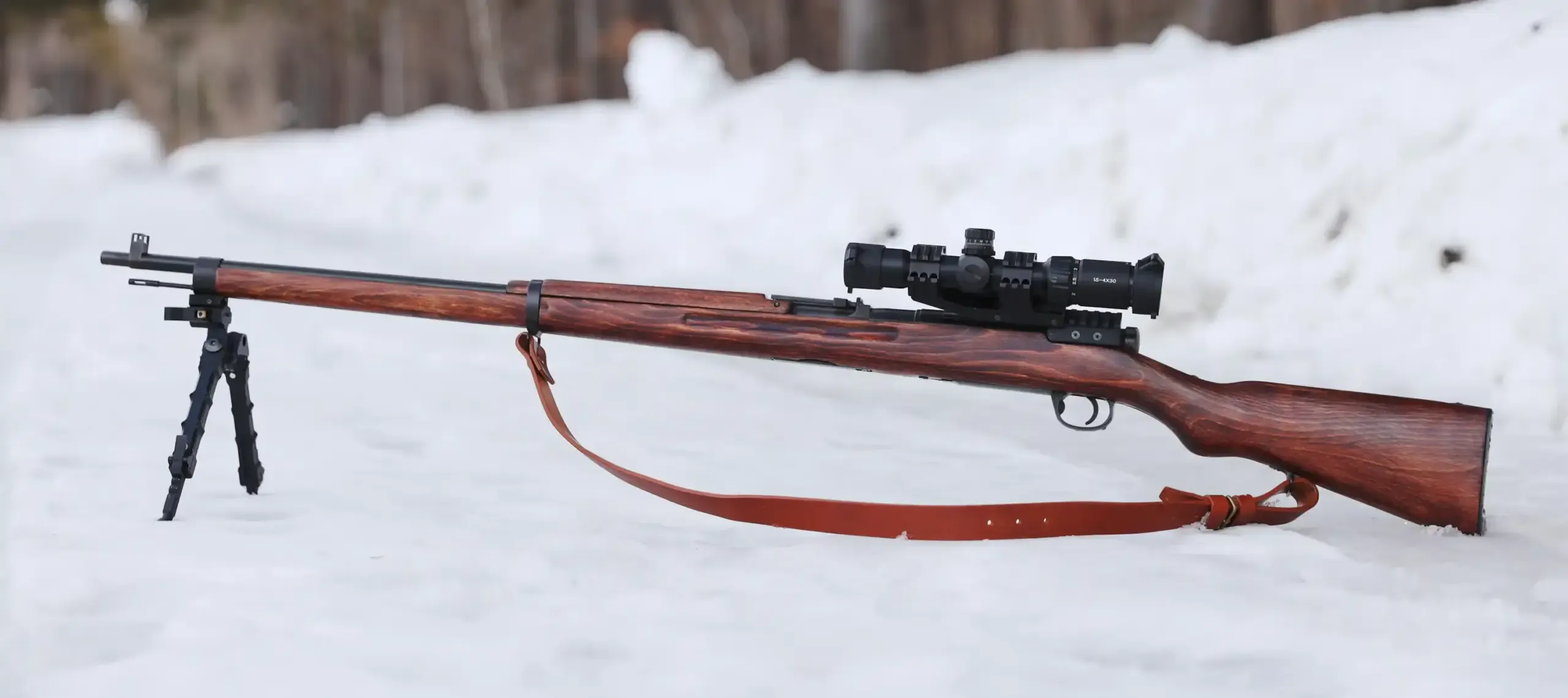
The Type 99 designation corresponds to Japanese calendar year 2599, or 1939. Developed as a 7.7 mm service rifle, it retained the basic Arisaka bolt-action system and five-round magazine while introducing a modified bolt, aperture sight, and, on many early examples, a chrome-plated bore, folding monopod, sliding dust cover, and folding lead-calculation arms on the rear sight.[2][3]
The common Type 99 short rifle measures approximately 44 to 45 inches overall. A limited-production long rifle, approximately 49½ inches long, preceded widespread short-rifle production. Published collector research places long-rifle production at approximately 38,000 examples, divided between Nagoya Army Arsenal and Toyo Kogyo.[4][5] Because production estimates are reconstructed from surviving rifles and specialist surveys, they should be treated as informed reference figures rather than complete factory totals.
Both models commonly have a two-piece buttstock. The joint near the butt is an intentional manufacturing feature, not automatically evidence of a repair.[4]
Read the Receiver as a Complete Record
On a Type 99, the top of the receiver normally carries the model designation and, when not removed or defaced, the Imperial chrysanthemum. The left side carries the serial number, production-series character, and manufacturer or arsenal mark.
Japanese military-rifle serial numbers were organized into production series rather than one uninterrupted national sequence. Consequently, a series number has meaning only when read with the arsenal mark and rifle configuration. A higher-numbered series from one manufacturer is not necessarily later than a lower-numbered series from another.[4]
Record the markings exactly as they appear before consulting a reference. Clear photographs of the receiver top, receiver side, bolt, safety, barrel bands, sights, stock cartouches, and any import markings are more useful than a seller’s verbal identification.
The most dependable published references for decoding these combinations are Fred L. Honeycutt Jr. and F. Patt Anthony’s Military Rifles of Japan and Don Voigt’s The Japanese Type 99 Arisaka Rifle. Series tables should still be applied cautiously: production transitions were not perfectly uniform, and rifles may have acquired replacement parts during service or afterward.[6][7]
What Early and Late Type 99 Features Actually Mean
Early Type 99 rifles may display several elaborate features:
- An adjustable rear aperture sight with folding lead-calculation arms
- A folding wire monopod
- A sliding sheet-steel dust cover
- A chrome-plated bore
- A machined and knurled safety knob
- A steel buttplate
- Relatively smooth machining and finish
The rear-sight arms were intended to provide approximate lead against low-flying aircraft. Their purpose is documented in the U.S. War Department’s 1944 handbook on Japanese forces.[3] Their presence does not demonstrate that a particular rifle was ever fired at an aircraft.
As the war continued, the Type 99 was progressively simplified. Features such as the dust cover, monopod, adjustable sight, cleaning rod, chrome-plated bore, and metal buttplate were reduced or eliminated in different production runs.[4][8] Late rifles may have fixed sights, wooden buttplates, less-finished stocks, simplified safeties, and conspicuous machining marks.
These changes were not introduced everywhere on the same date. “Early,” “transitional,” and “substitute-standard” are useful descriptive categories, but they are not substitutes for identifying the arsenal and series. A rifle combining early and late features may be a legitimate transition, an arsenal or field repair, or a postwar assembly.
The missing-dust-cover shortcut is especially unreliable. Many rifles manufactured for covers no longer retain them. Receiver grooves may show that a cover was once accommodated, but the grooves alone do not establish the rifle’s precise production date or prove that the missing cover was originally installed.
The Chrysanthemum: Important, but Not Provenance
The 16-petal chrysanthemum on the receiver indicated Imperial ownership. Surviving rifles may show an intact crest, a partially struck or over-stamped crest, or an area removed by grinding.[1]
Documentary research has established that Japanese authorities ordered the Imperial mark removed from arms leaving Imperial service, and that removal practices predated the 1945 surrender.[9] Large numbers of surrendered rifles were consequently defaced, but the appearance of the alteration varies.
An intact chrysanthemum can increase collector interest, but it does not prove that a rifle was taken from a battlefield. An intact crest may be consistent with capture before formal surrender, yet that conclusion requires independent evidence such as contemporaneous paperwork, correspondence, photographs, or a documented service history. Family recollection alone is useful context, not conclusive provenance.
Likewise, a ground crest should not automatically be described as evidence that an individual soldier personally defaced the rifle. The physical mark establishes that the crest was altered; it does not, by itself, identify who performed the work or precisely when.
Originality Requires More Than a Parts Checklist
Dust covers, monopods, cleaning rods, slings, and aircraft-lead sight components are frequently missing and can be replaced. Their mere presence does not establish factory originality.
Compare finish, wear, machining, and fit across the entire rifle. A nearly unworn accessory on a heavily worn rifle deserves scrutiny, although differing wear is not proof of substitution. Check screws and pins for recent disturbance, examine the stock around the barrel bands, and compare numbered components where the manufacturer and production period are known to have used assembly numbers.
Do not expect every part to carry the receiver’s serial number. Japanese component-numbering practices varied by arsenal and production period. A specialist reference is necessary before declaring a rifle “matching.”
Avoid restoration before the rifle has been documented. Sanding a stock, applying a modern finish, polishing metal, rebluing, or replacing parts can erase inspection marks and manufacturing evidence. Even honest restoration should be disclosed when a rifle is later sold.
Bore, Action, and Safety Examination
The presence of a bright bore is not proof of a chrome lining, and a dark bore is not necessarily unserviceable. Condition must be judged by inspecting the chamber, rifling, muzzle, crown, and evidence of corrosion or obstruction.
More importantly, a collectible rifle should not be fired merely because its bolt closes. Japanese training rifles and nonstandard arms can resemble service rifles, while some surviving Type 99 rifles were modified after the war. Ammunition and chambering must never be inferred from appearance alone.
Before firing, have a qualified gunsmith confirm:
- The rifle is a live-fire service arm rather than a trainer or substitute with unsuitable components
- The chambering and bore diameter
- Headspace
- Bolt and locking-lug condition
- Firing-pin protrusion and function
- Receiver, barrel, and stock integrity
- The absence of an obstruction or unsafe alteration
That examination is particularly important when the bolt or other major components may have been replaced.
Import Marks and Postwar History
Modern importer markings are separate from Japanese military markings. Federal regulations require licensed importers to apply identifying information that can include the importer’s name and location, caliber, model, manufacturer, and country of manufacture.[10] Depending on the regulations in effect and the firearm design, such information may appear on the barrel, receiver, or frame.
An import mark documents a postwar commercial-importation chapter. Its absence does not prove that a rifle was a wartime “bring-back,” because the applicable marking requirements and routes of entry have changed over time. A credible bring-back attribution requires supporting documentation.
A Disciplined Buying Sequence
When examining a Type 38 or Type 99, proceed in a fixed order:
- Confirm the model from the receiver inscription, caliber, dimensions, and configuration.
- Photograph and transcribe the series character, serial number, arsenal mark, and inspection marks.
- Compare the arsenal-and-series combination with a recognized reference.
- Check whether the sights, safety, buttplate, handguard, bands, and accessory provisions agree with that production range.
- Examine the chrysanthemum without assigning unsupported capture history.
- Look for mismatched wear, disturbed screws, replaced components, refinishing, and stock repairs.
- Record all importer or postwar markings.
- Preserve any associated documents, tags, photographs, or veteran correspondence.
- Obtain a professional mechanical inspection before firing.
The strongest collectible Arisaka is not necessarily the rifle with the most accessories or the most dramatic story. It is the example whose markings, configuration, condition, and documented history agree. Read the rifle first; evaluate the story afterward.
Frequently Asked Questions
What is the main difference between the Type 38 and Type 99 Arisaka?
The Type 38 was adopted in 1905 and normally uses the 6.5 mm Japanese cartridge. The Type 99 was adopted in 1939 and was designed for the 7.7 mm Japanese cartridge.
Does an intact chrysanthemum prove that an Arisaka was captured in battle?
No. An intact chrysanthemum may be consistent with a wartime capture, but only reliable supporting documentation can establish provenance.
Does a missing dust cover mean a Type 99 is a late-production rifle?
Not necessarily. Many earlier rifles lost their dust covers, so the receiver grooves, arsenal, series, and remaining features must be evaluated together.
How can collectors determine when a Type 99 was produced?
The production-series character, serial number, arsenal mark, and physical configuration should be compared with an established specialist reference. Serial numbers alone cannot provide a reliable national production sequence.
Is every surviving Arisaka safe to fire?
No. Training rifles, replaced bolts, postwar conversions, corrosion, and other alterations can create serious risks, so a qualified gunsmith should confirm the rifle’s chambering and mechanical condition before it is fired.
Sources
- Smithsonian National Museum of American History. “Japanese Arisaka Rifle with Bayonet.”
- Smithsonian National Museum of American History. “Japanese Type 99 Bolt Action Rifle.”
- U.S. War Department. “Handbook on Japanese Military Forces, TM-E 30-480.” October 1, 1944.
- Roth, Ryan. “The WWII Type 99 Japanese Rifle.” Military Trader, November 6, 2020.
- Australian War Memorial. “Arisaka Type 99 Rifle: Japanese Military Forces.”
- Honeycutt, Fred L., Jr., and F. Patt Anthony. Military Rifles of Japan. 5th ed. Julin Books.
- Voigt, Don. The Japanese Type 99 Arisaka Rifle. 1st ed., 2nd printing, 2010.
- National Firearms Museum. “Japanese Garand WWII Semi-Automatic Rifle.”
- Phillips, Patrick. “The Missing Mum Mystery: Solved.” Armax: The Journal of Contemporary Arms, vol. 9, no. 2.
- Bureau of Alcohol, Tobacco, Firearms and Explosives. “Properly Identify a Firearm for the Purpose of Tracing.” March 17, 2023.
As a firearms enthusiast with a background in website design, SEO, and information technology, I bring a unique blend of technical expertise and passion for firearms to the articles I write. With experience in computer networking and online marketing, I focus on delivering insightful content that helps fellow enthusiasts and collectors navigate the world of firearms.
Comments
Be the first to leave a comment.
Be the first to read new editorial features, collector guides, and brand spotlights.