Key Takeaways
- The M1922 series was developed for small-bore marksmanship training in civilian clubs, schools, colleges, and the armed services.
- The M1 introduced a revised bolt, flush-fitting magazine, and Lyman No. 48C receiver sight.
- The M2 evolved in several stages, so not every correct example has the same headspace components or markings.
The United States developed its military-style .22-caliber rifles to provide accurate, economical marksmanship training for civilian rifle clubs, schools, colleges, and members of the National Rifle Association. The rifles were subsequently adopted for small-bore instruction by the Army, Navy, Marine Corps, and Coast Guard.[1] The National Park Service describes the program as a joint effort by the Ordnance Department and the NRA to encourage training with the bolt-action service rifle.[2]
These rifles occupy an important place in American firearms history. They were not merely sporting rifles with military styling. Their configurations, sights, stocks, and operating characteristics were selected to support formal marksmanship training. The surviving rifles also require careful evaluation because many were updated during their service lives.
The Original M1922
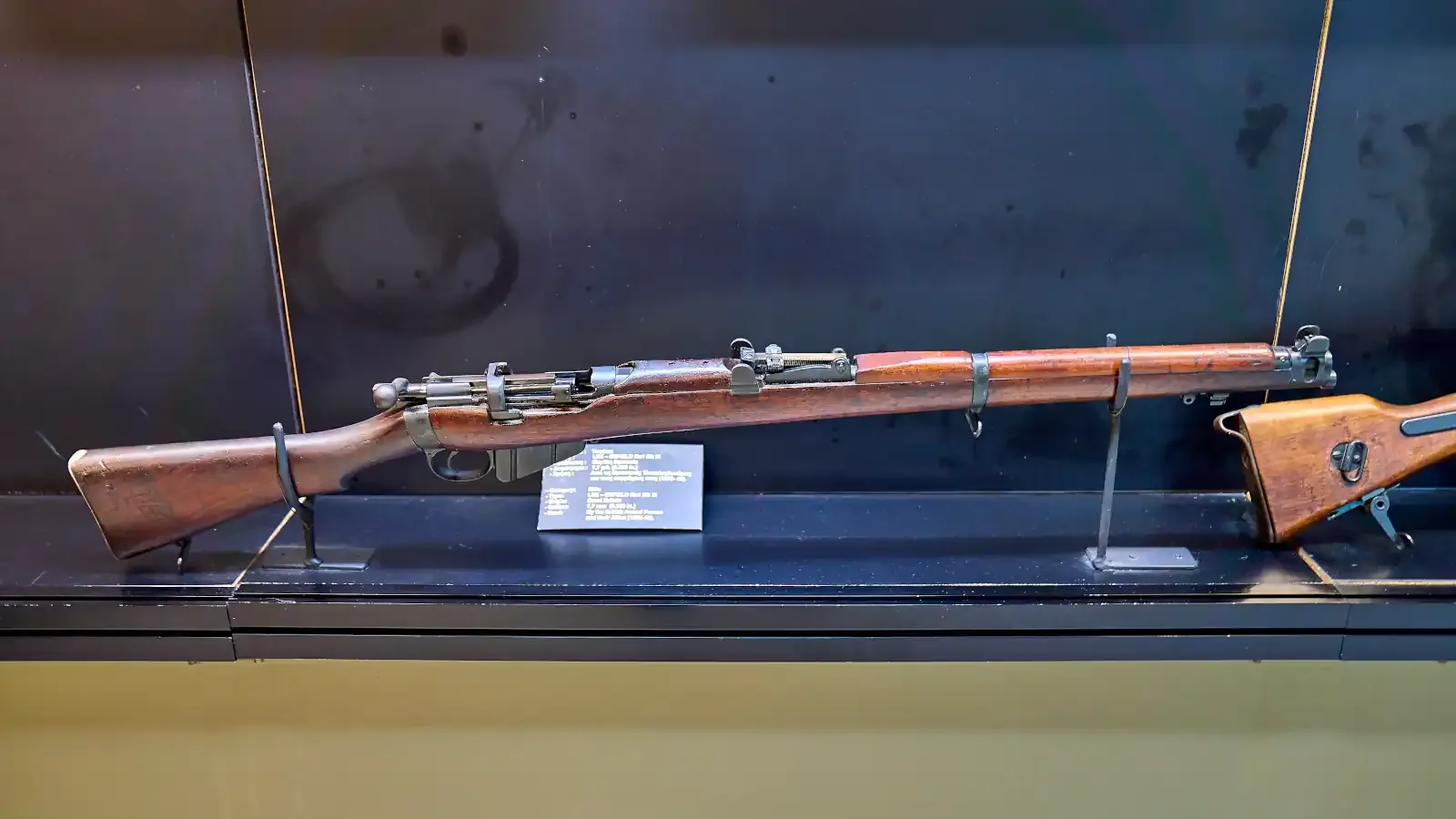
The first rifle in the series was officially designated the U.S. Rifle, Caliber .22, M1922. The original configuration used an M1922 bolt with a double-point striker and headed cocking piece, a five-round detachable magazine that projected below the floorplate, and a Lyman No. 48B receiver sight. Most were assembled with the NRA-type stock and a shotgun-style buttplate.[1]
A Springfield Armory Model 1922 preserved by the Smithsonian’s National Museum of American History is recorded as having been made in 1923 and transferred by the War Department’s Ordnance Department. The museum classifies it as a Springfield Armory-made, bolt-action .22 rimfire rifle.[3]
Original configuration is only part of the M1922 story. By 1944, the War Department reported that nearly all rifles still under military control had received later bolts and magazines, while their original No. 48B sights had generally been replaced with No. 48C sights. Consequently, a modified M1922 is not necessarily an incorrect rifle. It may instead reflect an authorized government conversion.[1]
For collectors, the important question is not simply whether parts match the rifle’s original pattern. It is whether the rifle represents a coherent original or officially converted configuration.
The M1922M1 and M1
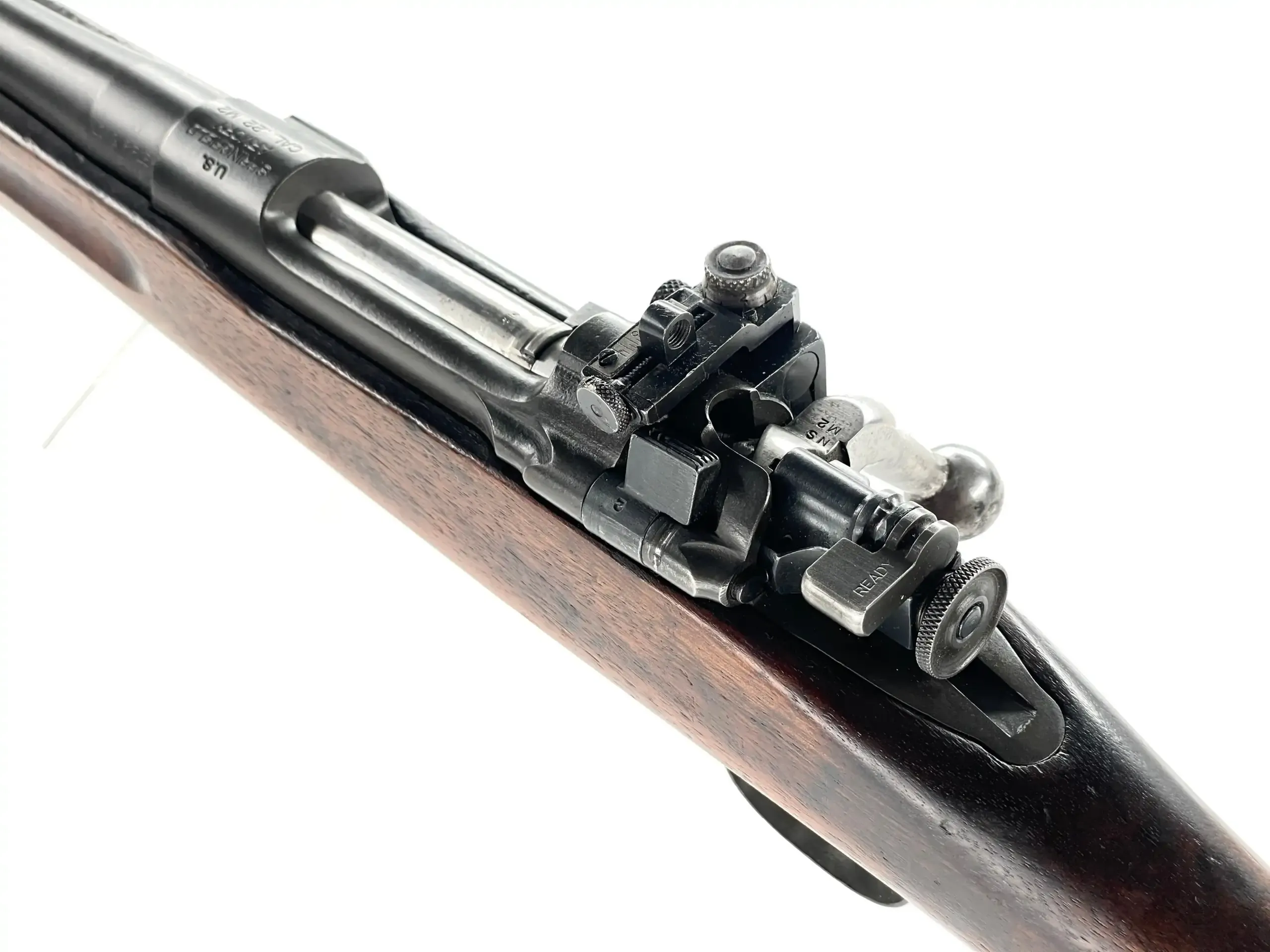
The first major revision was designated M1922M1 and later shortened to M1. It introduced the M1 firing mechanism, a redesigned magazine that sat flush with the floorplate, and the Lyman No. 48C receiver sight. The revised bolt permitted more precise headspace adjustment, while the No. 48C sight provided ten graduations per complete revolution of its windage and elevation screws, compared with five on the earlier No. 48B.[1]
The M1922M1 NRA version retained the earlier M1922 stock and buttplate. Its receiver markings were otherwise identical to those of the standard M1922M1. Stock configuration alone therefore does not establish whether a particular rifle was assembled for military use or for NRA distribution.[1]
Period documentation also warns against treating receiver nomenclature as a perfect guide to mechanical configuration. The War Department stated that M1922 rifles could receive later components and that rifles marked M1922M1 remained in circulation after the designation had changed to M1.[1] Correct identification requires examination of the bolt, magazine, sight, stock, markings, and any conversion suffixes as a complete system.
The M2 and Adjustable Headspace
The M2 represented the second major improvement of the M1922 design. Its development proceeded in stages. Approximately 3,800 rifles were initially assembled with the redesigned M2 bolt, firing mechanism, magazine, and stock. A subsequent bolt-handle revision incorporated an adjustable-headspace mechanism. The firing-pin fall was reduced, and the bolt head and magazine were altered to place the upper cartridge in line with the chamber and reduce feeding problems.[1]
The adjustable-headspace assembly itself changed over time. One version used an adjusting screw and set screw. A later pattern substituted a copper locking plug and sealed the components after adjustment. A still later version adopted an Allen-type adjusting screw and eliminated the sealing operation.[1] The common claim that every correct M2 must display one particular plug, seal, or inspection mark is therefore too broad.
M2 bolts and magazines could also be installed in earlier rifles. The prescribed conversion markings were an added “M2” on an M1922 receiver or an added second “I” on an M1 receiver. Converted M1922 rifles received an “A” after the serial number; converted M1 and M1922M1 rifles received a “B.”[1] These markings are central to evaluating a converted rifle, although they should still be considered alongside the installed components and evidence of later alteration.
Commercial Rifles in Government Service
The War Department’s 1944 technical manual covered three commercial target rifles alongside the Springfield series: the Remington Model 513T, Stevens Model 416-2, and Winchester Model 75. All five principal rifles addressed in the manual, the Springfield M1 and M2 and the three commercial models, were .22 Long Rifle, magazine-fed bolt actions with five-round magazines and rear sights adjustable for windage and elevation.[1]
The commercial rifles were not mechanically identical to the Springfields. The M1 and M2 used two-stage trigger pulls, bolt-mounted ejectors, and single extractors. The Remington, Stevens, and Winchester used single-stage triggers, fixed ejectors, and double extractors. Trigger-pull adjustment was provided on the Remington 513T and Winchester 75, but not on the Springfield rifles or Stevens 416-2.[1]
Government-documented sight equipment also differed:
- Springfield M1 and M2: Lyman No. 48C rear sight and blade front sight.
- Remington 513T: Redfield 75-RT rear sight and blade front sight.
- Stevens 416-2: Stevens rear sight with either a blade front or a hooded front, supplied with five inserts.
- Winchester 75: Lyman 57E rear sight and blade front sight.[1]
These specifications provide a defensible baseline, but they do not prove that every surviving rifle retains its issued equipment. Sights, magazines, slings, and other removable parts were readily replaced during decades of military, school, and club use.
Evaluating a Surviving Rifle
Inspection should begin with the rifle unloaded. The War Department’s own procedure called for visual and functional examination of the bolt, trigger, front and rear sights, barrel and receiver, stock, sling, and magazine. Dummy cartridges, not live ammunition, were specified for checking feeding and operation.[1]
On a Springfield, confirm the receiver designation, serial-number suffix, bolt pattern, magazine type, and Lyman sight model. An early-style projecting magazine or No. 48B sight may support an original M1922 configuration, while an “A” or “B” serial suffix may indicate an authorized M2 conversion. On an M2, the headspace components should be identified by their actual pattern rather than judged against a single assumed configuration.
The stock should be examined for cracks, repairs, sanding, damaged inletting, loose hardware, and poorly fitted replacement parts. The Army specifically directed inspectors to check stocks for cracks and mutilation, buttplates and swivels for looseness, and screws for damage or absence.[1] Collector inspection should add scrutiny for refinishing, recut markings, mismatched wear, and modern replacement components.
Rear sights deserve particular attention because the documented sight model helps define each rifle’s configuration. Check that the sight is complete, firmly mounted, and mechanically sound. Damaged screw slots or mismatched finishes may indicate later work, but neither alone establishes when or why a component was changed.
Shooting and Preservation
The 1944 manual authorized .22 Long Rifle ammunition and stated that high-velocity cartridges were neither issued nor recommended. It also cautioned against unnecessary dry-firing of the Springfield M1 because doing so could damage the firing pin. The manual expressly permitted dry-firing the other rifles it covered, although the condition and history of an individual collectible firearm should always govern present-day use.[1]
Any rifle with uncertain headspace, damaged locking components, a questionable firing pin, or evidence of unauthorized modification should be examined by a qualified gunsmith before firing. Mechanical safety and historical originality are separate questions; a rifle may be collectible yet unsafe, or mechanically sound but substantially altered.
The enduring appeal of these rifles lies in that combination of purpose and detail. The M1922, M1, and M2 document the Ordnance Department’s continuing refinement of a specialized small-bore training arm. The Remington 513T, Stevens 416-2, and Winchester 75 show how commercial target rifles supplemented the government designs. Together, they preserve a tangible record of organized American marksmanship training in the years before and during the Second World War.
Frequently Asked Questions
What was the Springfield M1922 designed for?
It was developed as an accurate .22-caliber rifle for marksmanship training and competition. Its intended users included civilian rifle clubs, schools, colleges, NRA members, and military services.
How does the M1 differ from the original M1922?
The M1 introduced an improved bolt and firing mechanism, a flush-fitting magazine, and a Lyman No. 48C receiver sight. It was originally designated the M1922M1.
What was the principal mechanical development of the M2?
Later M2 configurations incorporated an adjustable-headspace system. The bolt, firing mechanism, magazine, and feeding arrangement were also revised during the model’s development.
How can collectors identify an officially converted rifle?
Converted M1922 rifles received an “A” serial-number suffix, while converted M1 and M1922M1 rifles received a “B.” Collectors should confirm these markings against the installed bolt, magazine, sight, and other components.
Which commercial .22 rifles were covered by the 1944 War Department manual?
The manual covered the Remington Model 513T, Stevens Model 416-2, and Winchester Model 75. All were magazine-fed, bolt-action .22 Long Rifle target rifles.
Sources
- U.S. War Department. TM 9-280: Caliber .22 Rifles, All Types. Washington, D.C., 16 March 1944.
- Springfield Armory National Historic Site, National Park Service. “The National Matches.”
- National Museum of American History, Smithsonian Institution. “Springfield Armory Model 1922 Bolt Action .22 Caliber Rifle.” Collection record AF.35381.
As a firearms enthusiast with a background in website design, SEO, and information technology, I bring a unique blend of technical expertise and passion for firearms to the articles I write. With experience in computer networking and online marketing, I focus on delivering insightful content that helps fellow enthusiasts and collectors navigate the world of firearms.
Comments
Be the first to leave a comment.
Be the first to read new editorial features, collector guides, and brand spotlights.