Key Takeaways
- Parker produced side-by-side shotguns in grades ranging from restrained working guns to elaborately finished sporting arms.
- L.C. Smith became closely identified with sidelock construction, while the classic A.H. Fox employed a compact boxlock action.
- Ithaca began manufacturing double-barrel shotguns in 1883 before shifting its focus toward repeating designs such as the Model 37.
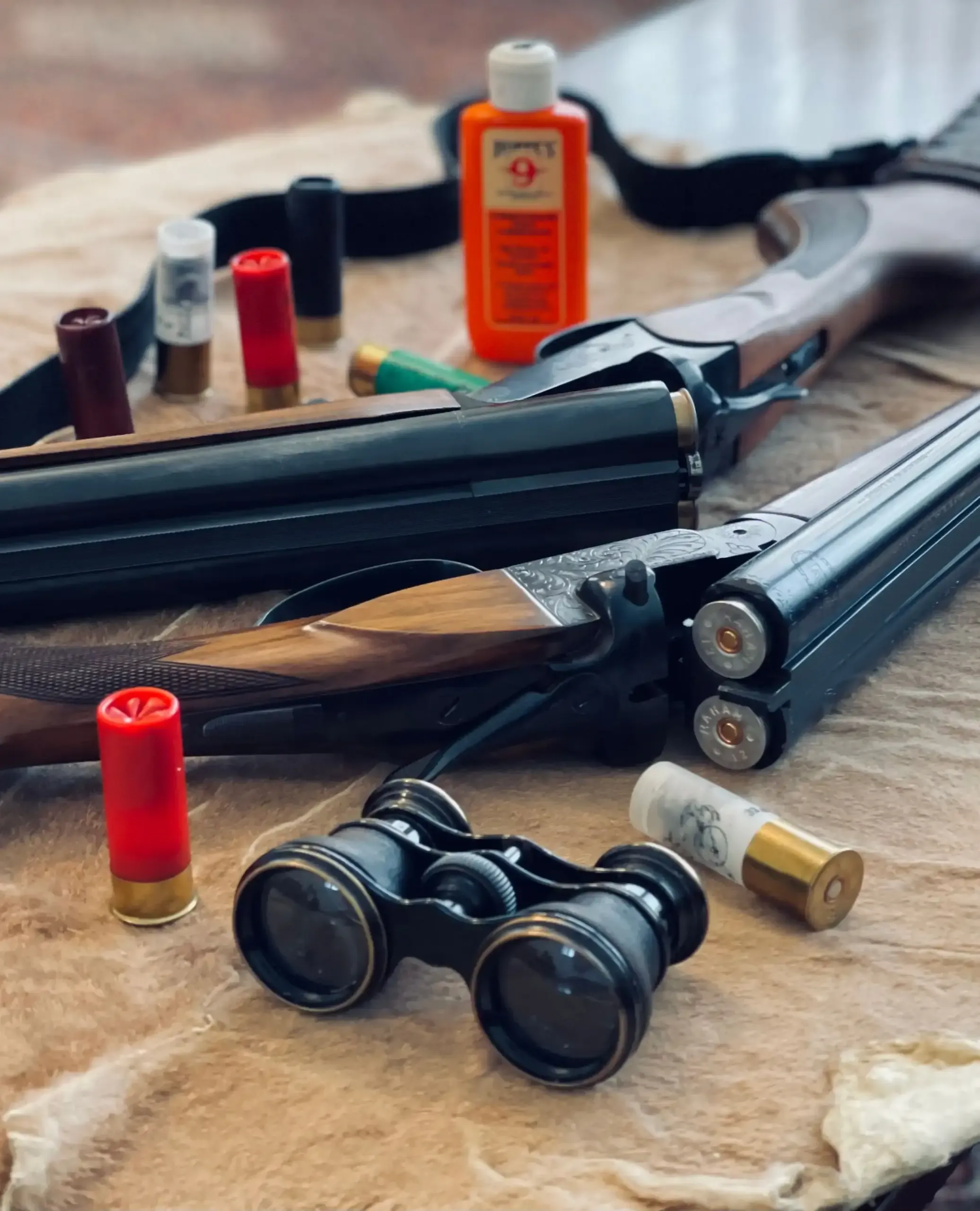
For much of the late nineteenth and early twentieth centuries, the side-by-side shotgun occupied a central place in American sporting life. It served hunters, competitive shooters, farmers, and professional guides. In its simplest form, it was a durable working gun. At the other end of the spectrum, it became a canvas for fine engraving, figured walnut, gold inlay, and made-to-order craftsmanship.
Among the numerous American manufacturers that entered the market, four names became especially important: Parker Brothers, L.C. Smith, A.H. Fox, and Ithaca. Their guns differed mechanically and stylistically, but together they represent the height of America’s traditional double-gun industry.
The American Double Takes Shape
The side-by-side’s defining arrangement is straightforward: two barrels mounted horizontally, each with its own chamber and firing mechanism. Early sporting doubles used external hammers. Later hammerless guns moved the hammers or tumblers inside the action, creating the cleaner profile now associated with the classic American double.
Two principal action arrangements emerged. In a sidelock, much of the firing mechanism is mounted on removable lock plates at the sides of the action. In a boxlock, the principal firing components are housed within the action body. Neither system is inherently plain or elaborate. American manufacturers produced both working-grade and highly decorated boxlocks, while the L.C. Smith became closely identified with the sidelock form.[1]
The period from approximately 1870 through World War I saw rapid development in breechloading shotguns. Self-contained ammunition replaced the earlier muzzleloading and percussion systems, while internal hammers, improved locking mechanisms, automatic ejectors, single triggers, and fluid-steel barrels appeared in increasingly refined forms.[2]
Parker Brothers
Parker’s firearms history grew from the industrial enterprises of Charles Parker in Meriden, Connecticut. Before entering the sporting-gun market, Parker’s associated companies manufactured tools, household hardware, machinery, military rifles, and repeating carbines. After the Civil War, Parker and his sons established Parker Brothers to manufacture side-by-side sporting shotguns.[3]
The earliest Parker doubles employed an under-lifter to open the action. Designer Charles A. King subsequently revised the system, introducing a top-opening mechanism and developing Parker’s first hammerless model. Further changes followed, including a simplified cocking system patented by James Hayes. Single triggers, ventilated ribs, and beavertail forends appeared during the 1920s.[3]
Parker offered a wide hierarchy of guns. Lower grades were relatively restrained, while upper grades received increasingly elaborate engraving, finer checkering, better-quality walnut, and additional decorative work. The underlying identity of the gun remained recognizably Parker even when the degree of ornamentation differed dramatically.
The GH was one of the company’s familiar hammerless grades. Surviving examples are commonly encountered with Damascus barrels and double triggers. The GHE designation identified a GH equipped with automatic ejectors.[4]
At the upper extreme stood guns such as the A-1 Special and the exceptionally rare Invincible. These were not separate mechanical inventions so much as highly finished expressions of the established Parker action. Their distinction lay in the quality of their materials, execution, engraving, and individual specification.[2]
Remington acquired Parker Brothers in 1934. Production continued in Meriden before moving to Remington’s plant in Ilion, New York. The Parker line ended in 1942, closing a production history of roughly three-quarters of a century.[3]
L.C. Smith
The shotgun bearing Lyman Cornelius Smith’s name developed from the work of W.H. Baker, an important figure in the early American double-gun industry. Baker’s initial design was a three-barrel gun combining two shotgun barrels with a rifle barrel. A conventional double-barrel shotgun followed, and the operation eventually became the L.C. Smith Gun Company.[1]
Smith’s direct involvement was relatively brief. In 1888 he sold the firearms business to John Hunter Sr., who established Hunter Arms Company. A new factory opened in Fulton, New York, in 1889. Under Hunter Arms, the L.C. Smith evolved into one of the best-known American sidelock shotguns.[1]
The sidelock construction visually and mechanically distinguished the L.C. Smith from the boxlock designs associated with Fox and many Ithaca guns. Its firing components were carried on lock plates fitted into the sides of the stock and action. The exposed plates also provided broad surfaces for engraving on the higher grades.
Hunter Arms offered the gun in progressively finer qualities. Early production included various Damascus-barrel grades, while fluid-steel barrels became increasingly prominent. Higher-priced guns received more elaborate engraving, finer walnut, and more detailed checkering, but the basic sidelock architecture continued throughout the range.[1]
The company also introduced several significant features. Automatic ejectors appeared during the 1890s. The Hunter One-Trigger was advertised in 1904, allowing both barrels to be fired through a single trigger. A selective version followed during the 1930s.[1]
In 1913, Hunter Arms replaced the earlier numbered and lettered grade designations with names including Field, Ideal, Trap, Specialty, Eagle, Crown, Monogram, Premier, and De Luxe. The Field Grade was the plainly finished working gun, while the upper grades carried progressively more complex engraving and higher-quality wood.[1]
Marlin acquired the assets of Hunter Arms in 1945 and reopened the operation as the L.C. Smith Gun Company. Production at Fulton ended in 1950. Marlin later produced a limited number of L.C. Smith shotguns in New Haven, Connecticut, between 1967 and 1971.[1]
A.H. Fox
Ansley Herman Fox was an inventor, competitive shooter, and firearms entrepreneur. His early ventures included the Fox Gun Company of Baltimore and the Philadelphia Gun Company. In 1906, he established the A.H. Fox Gun Company in Philadelphia and began producing the shotgun most closely associated with his name.[5]
Unlike the L.C. Smith, the classic Fox was a boxlock. Its internal hammers and sears were contained within the action rather than mounted on separate sidelock plates. The barrels were secured by a top-operated locking system incorporating a barrel extension and a horizontal rotary fastener.[5]
The Fox action was comparatively compact and mechanically direct. Early guns were offered in A, B, and C grades, with additional grades appearing in company literature. The primary differences between grades involved engraving, wood figure, checkering, and other finish details rather than a wholesale change in the basic action.[5]
Fox also produced the more affordable Sterlingworth. Although less ornamented than the graded guns, it retained the company’s characteristic boxlock action. At the opposite end of the range, high-grade Fox guns displayed extensive engraving, fine walnut, and special-order features.
The company developed specialized models for competitive shooting and waterfowling. Its single-barrel trap guns appeared in several grades beginning in 1919. These were produced in comparatively small numbers and represented a distinct branch of the Fox sporting line.[6]
Savage Arms acquired the A.H. Fox Gun Company in November 1929 and transferred production from Philadelphia to Utica, New York. Savage reorganized the grade structure and continued manufacturing the original-pattern Fox guns into the World War II period. Later Savage products bearing the Fox name were not always direct continuations of the original Philadelphia design.[5]
Ithaca
The Ithaca Gun Company was established in Ithaca, New York, in 1883 by William Henry Baker, Dwight McIntyre, and John Vanatta. Its original purpose was the manufacture of fine double-barrel shotguns. Baker left the business in 1887, after which McIntyre, Vanatta, and L.H. Smith—L.C. Smith’s brother—continued the company.[7]
Ithaca’s doubles changed substantially over time. Instead of relying on one action throughout its history, the company introduced successive designs as manufacturing methods and market expectations evolved. This distinguishes Ithaca from makers whose identity became more closely associated with a single action type.
The company’s early commitment to double guns preceded its better-known repeating shotguns by decades. By the late 1920s, however, Ithaca recognized the growing popularity of magazine-fed designs. That change in the market eventually produced the Model 37 pump shotgun, introduced in 1937.[7]
The Model 37 did not erase Ithaca’s double-gun heritage. Rather, it marked the company’s transition from the traditional break-action era to a market increasingly dominated by repeaters. Ithaca continued to be identified with both forms: the doubles that established the company and the bottom-ejecting pump that carried its name through the remainder of the twentieth century.
Four Different Interpretations of the Same Gun
The four manufacturers approached the American side-by-side from different directions.
Parker refined a distinctive action over a long production period and offered it in an unusually broad range of grades. L.C. Smith developed the American sidelock into a recognizable commercial line extending from field guns to highly decorated custom grades. Fox emphasized a compact boxlock action whose fundamental design remained consistent across plain and ornate models. Ithaca repeatedly revised its double-barreled designs before shifting its commercial focus toward repeating shotguns.
Their shared importance lies in more than decoration or present-day collectibility. These guns document a period when American manufacturers combined industrial production with substantial hand fitting and finishing. The same factory could produce a restrained field gun and an elaborately engraved sporting arm built on closely related mechanical foundations.
The classic American side-by-side was therefore never one gun or one grade. It was a complete category of sporting arm—adaptable in gauge, weight, stock dimensions, barrel material, choke, trigger arrangement, ejector system, and finish. Parker, L.C. Smith, Fox, and Ithaca gave that category four of its most enduring forms.
Frequently Asked Questions
What are the four historic American side-by-side makers discussed in the article?
The article examines Parker Brothers, L.C. Smith, A.H. Fox, and Ithaca. Each developed a distinct interpretation of the American double-barrel shotgun.
What distinguished the classic L.C. Smith shotgun?
The classic L.C. Smith used a sidelock action, with much of its firing mechanism mounted on lock plates at the sides of the gun. It was offered in grades ranging from the plain Field Grade to highly decorated models.
How did the A.H. Fox differ mechanically from the L.C. Smith?
The classic A.H. Fox was a boxlock with its firing components housed inside the action body. The L.C. Smith used sidelock construction.
When did Remington acquire Parker Brothers?
Remington acquired Parker Brothers in 1934. Parker production continued until 1942.
When did Ithaca begin making double-barrel shotguns?
The Ithaca Gun Company was established in Ithaca, New York, in 1883 to manufacture double-barrel shotguns. The company later became particularly well known for its Model 37 pump shotgun.
Sources
- Rick Hacker, “L.C. Smith Shotguns”, American Rifleman, September 17, 2015.
- NRA Publications, “Looking Back at Shotgun History”, American Rifleman, May 23, 2016.
- National Firearms Museum, “Parker Brothers (Meriden, Connecticut) DHE Side-by-Side Shotgun”.
- S.P. Fjestad, “Parker Brothers Model GH Shotgun”, American Rifleman, March 10, 2014.
- Dave Campbell, “A.H. Fox Shotguns: A Look Back”, American Rifleman, April 13, 2017.
- Michael McIntosh, “The A.H. Fox Single-Barrel Trap Gun: One of America’s Finest”, American Rifleman, May 29, 2021.
- Dave Campbell, “A Look Back at the Ithaca Model 37 Shotgun”, American Rifleman, August 25, 2016.
As a firearms enthusiast with a background in website design, SEO, and information technology, I bring a unique blend of technical expertise and passion for firearms to the articles I write. With experience in computer networking and online marketing, I focus on delivering insightful content that helps fellow enthusiasts and collectors navigate the world of firearms.
Comments
Be the first to leave a comment.
Be the first to read new editorial features, collector guides, and brand spotlights.