
I was once torn between two .303s on a show table that looked a generation apart. One had its identity up on the receiver ring, the other wore a squarer receiver with a small latch on the right wall. Same price, different stories. The stamps made the choice.
That is life with Lee-Enfields. If you know where the truth is stamped, how bolt heads and headspace were managed, what FTR really signals, and how to care for the finish and wood, you will spot value and avoid headaches.
Model basics: No.1 Mk III, No.4, No.5
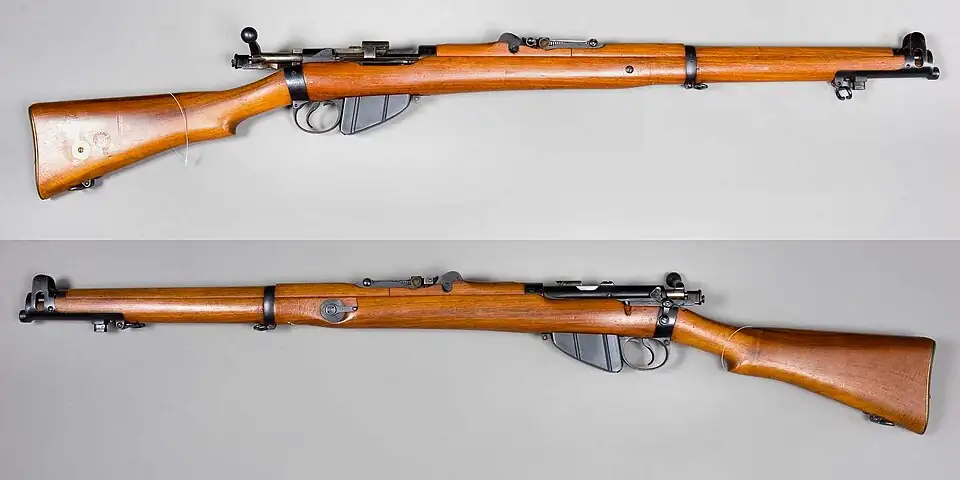
No.1 Mk III (SMLE) is the earlier pattern. Its serial number is on the rear of the bolt handle and on the receiver ring where the barrel screws in. Most No.1s were blued or browned, which age with a softer sheen.
No.4 rifles brought a bulkier, more squared receiver. Their serial is on the rear of the bolt handle and the left side of the receiver. Many No.4s were parkerized then painted, so they often show a durable, even gray finish.
No.5 carbines share No.4 mechanics and the same numbered bolt head system. They were commonly parkerized and, being compact and carried hard, deserve close inspection for wood and finish honesty.
Bolt removal tells: British vs North American No.4 and No.5
This is a quick origin check you can do without tools:
- British No.4 Mk.I, No.4 Mk.I/2, No.4 Mk.2 and the No.5 have a small bolt head retaining catch on the right side of the receiver. Push the bolt forward slightly, press and hold the catch, and slide the bolt out to the rear as the head rides over the catch.
- Canadian and American No.4 Mk.I and Mk.I/3 lack that catch. Instead, there is a notch in the bolt head guide rail to release the bolt.
That one feature is a reliable field tell for where the rifle was made.
Serial numbers and matching parts
Matching numbers are not collector superstition. The receiver and bolt body should match. On No.4 and No.5 rifles the serial is on the rear of the bolt handle and the left receiver wall. On No.1s, check the rear of the bolt handle and the receiver ring.
Mismatched bolts are common on No.4s and No.5s. Price accordingly and plan on a proper headspace check before shooting.
Bolt heads and headspace in the real world
No.4 and No.5 rifles use four nominal bolt head sizes, stamped 0, 1, 2, and 3. Higher numbers are longer and were used to take up headspace. In practice, wartime tolerances and armourer fitting mean lengths overlap. A 1 from one lot can measure longer than a 2 from another.
How to handle this at the counter:
- Confirm the fitted bolt head locks up smoothly without gritty drag.
- Note the bolt head number, but treat it as a clue, not a conclusion.
- Check that striker protrusion appears even and the cocking piece and safety operate positively.
- Before firing, have headspace checked with proper gauges.
The Lee-Enfield bolt is six parts working together: bolt body, bolt head, cocking piece, striker, striker retaining screw, and mainspring. If closing feels gravelly or the cocking piece sits out of place, pause and inspect before you proceed.
Maker marks that place a rifle fast
Factory styles help place a rifle without a spreadsheet. On many No.4s, the receiver line itself carries the maker. A forum member showed a Fazakerley marked “No.4 Mk.I ROF (F) 12/43” that says it all: model, Royal Ordnance Factory Fazakerley, and date.
Expect to see British production from Fazakerley, BSA, and Maltby, plus North American No.4s from Savage and Canada. Serial prefixes, letter codes near serials, and even fonts vary by plant and period. Comparing clear photos across many examples quickly trains your eye.
For photo references of stamps and finishes, browsing a broad set of Lee-Enfields helps:
Collector photo examples of No.4 Fazakerley and BSA with FTR stamps
Photo browsing for Lee-Enfield receiver and bolt markings
FTRs explained with real examples
FTR on the receiver flat marks a factory thorough repair program. It often appears with a factory identifier and year, and the work can change the model designation line.
- BSA No.4 Mk.I dated 1942, stamped “No.4 Mk.I/2 (F)FTR /52” with the original smaller “No.4 Mk.I” lined out. The Mk.I/2 indicates it was updated to the later standard during FTR.
- Fazakerley No.4 Mk.I dated 12/1943, later marked “No.4 Mk.I F(FTR)49” with the original factory line still visible on the far right of the receiver.
Read all lines on the receiver. FTR rifles often make outstanding shooters and may show a consistent mix of postwar parts.
Proofs and later import marks
It is common to find British commercial proofs like BNP. Rifles routed through Germany for sport use or sale carry German proof house stamps and retailer marks such as Frankonia. These marks document later legal steps and do not automatically reduce value. They should be clear and consistent with the rifle’s import path.
Finish, wood, and sensible maintenance
Many No.4s and No.5s were parkerized, often then painted after a phosphating process. Care is simple: wipe down with a very lightly oiled rag and touch up paint only where needed.
Earlier rifles were browned or blued. Treat both the same way: light oil wipe after handling. Small touch-ups with cold blue or plum brown can help worn edges, applied sparingly and per the directions.
Stocks respond to raw linseed oil when truly dry. Use a small amount worked in by hand, wipe off excess, and let it cure. Avoid harsh modern chemicals whose long-term effects on old steel and wood are unclear.
Use screwdrivers that fit the slots properly. Do not strip a rifle for the sake of it; repeated unnecessary disassembly wears threads and fitted surfaces. Some caretakers slightly slacken trigger guard screws for long storage, especially on earlier long fore-ends, to reduce wood stress. If you do, tag the rifle and retighten before firing.
Magazines: clean, lube, and leave them alone
Keep the magazine body clean and grit-free. Apply a light film of oil to the leaf spring. The undersides of the feed lips should be clean and dry. A very light smear on the platform edges helps it run.
There is no need to dismantle the magazine more than about twice a year unless it was used in the rain or picked up sand or grit.
Quick buying checklist
- Model and markings: On No.1s, read the receiver ring. On No.4 and No.5, read the left receiver wall and rear of the bolt handle. Note any FTR lines and dates.
- Origin tell: Right-side bolt catch equals British No.4 or No.5. Notch in the bolt guide rail equals Canadian or American No.4.
- Matching numbers: Receiver and bolt should match. If not, budget for headspace gauging and adjust price.
- Bolt head: Record the number, verify smooth lockup, and plan to gauge headspace before shooting.
- Proofs and imports: BNP and honest German proofs, including Frankonia, are normal and informative.
- Finish: Parkerized guns should show even, honest wear. Avoid buffed surfaces that wash out stampings.
- Wood: Check for cracks at the draws and reinforce, chipped handguards, and oil-soaked butts.
- Magazine: Clean interior, light oil on spring, lips true and dry. Avoid bent-lip fixes.
- Paperwork: Owning a service rifle responsibly includes a headspace check before live fire.
Why the Lee-Enfield still rewards collectors
The No.1 to No.4 and No.5 story is stamped right on the steel: where serials live, how the bolt comes out, what the finish looks like, and what FTR changed. Learn to read those signs and these rifles will tell you their journey. That is where the good buys hide, and how you keep them running for the next owner.