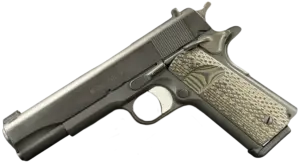

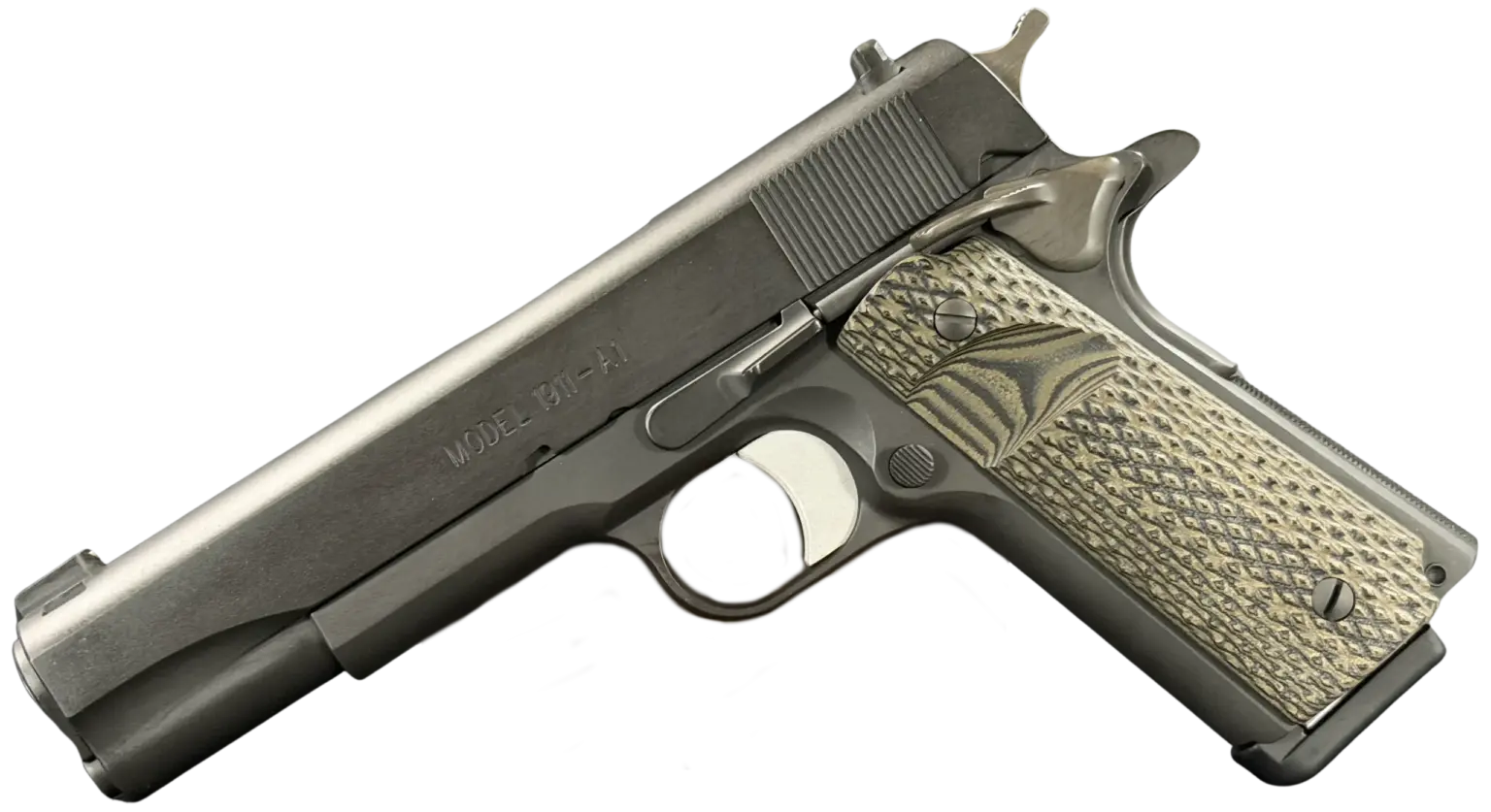
There it was at the corner of a crowded show table: bold S. MFG. CO. rollmark, crisp checkering, the whole Singer mystique staring back at me. The price tag matched the legend. But the frame told a different story. Wrong inspector initials. Wrong serial prefix. Great-looking Singer slide sitting on a frame that never left Elizabeth, New Jersey. If you spend any time around U.S. military 1911s and 1911A1s, you’ll find plenty of puzzles like that.
This guide is how I sort them. It’s the practical stuff you can use at a show table or in a dimly lit gun room: how to read frames and slides, how to spot the meaningful marks, what a rebuild really looks like, and what to inspect before you put money on the glass. We’ll stay brand-neutral, lean on what’s documented, and keep it friendly to new buyers without talking down to those who have a few pistols under their belt.
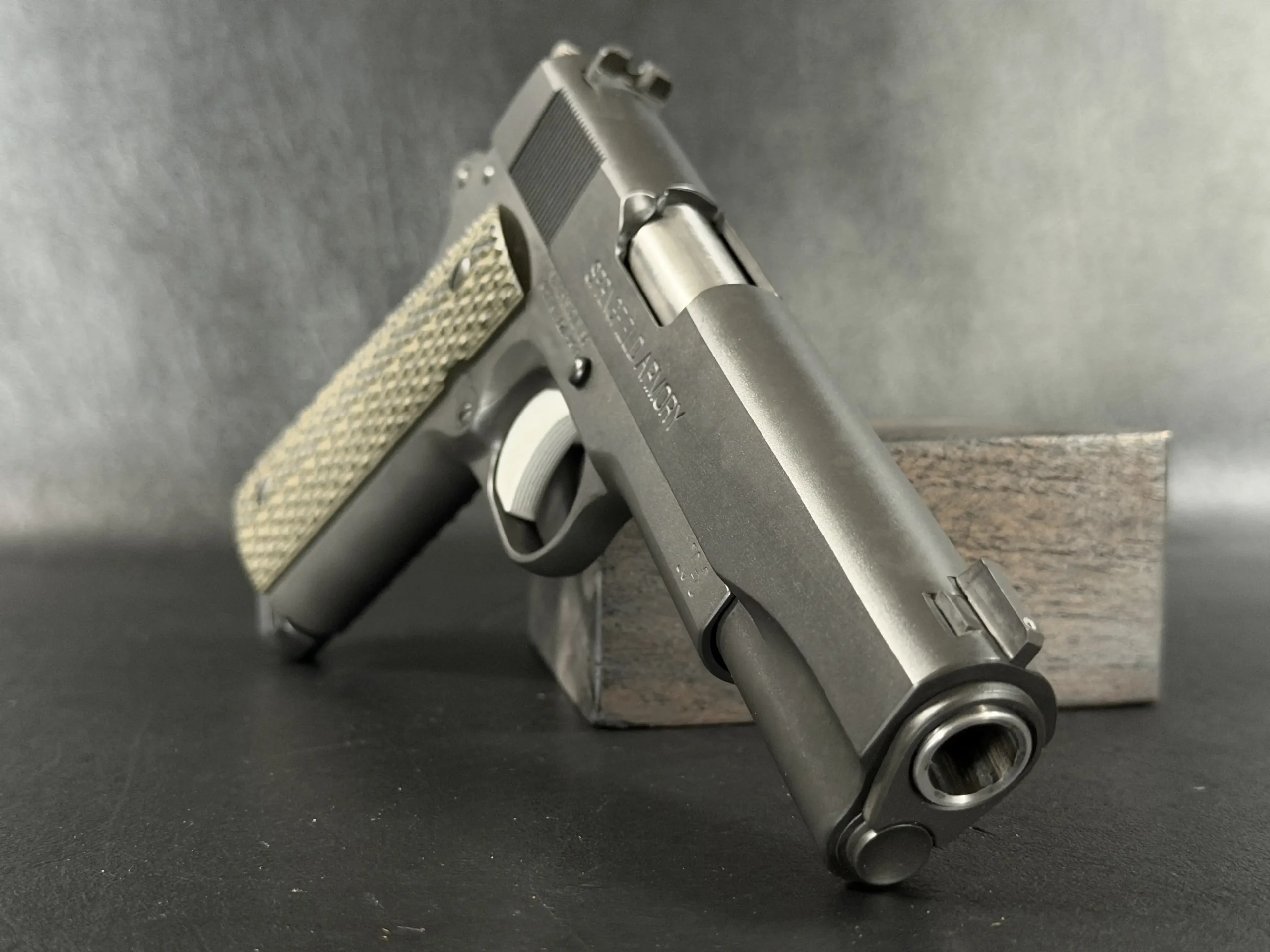
Before You Fall for a Slide: Why the Frame Tells the Tale
On U.S. military 1911s and 1911A1s, slides get switched constantly. That’s not recent mischief so much as a byproduct of how the pistols were built and maintained. The government required full parts interchangeability, and through decades of service those parts moved around. Slides are also the only place most WWII pistols carry the maker’s name, which makes them easy targets for later swaps.
The frame is your fixed point. It carries the serial number and the contract acceptance stamps, and it holds the most reliable clues to who made the pistol. As one respected identification guide notes, many parts were swapped during service life, but the frame can still reveal the original maker through its serial style and inspector markings, even when the slide is from someone else. Replacement slides are their own category, too. If you see a drawing number like 7790314 on the slide, that’s a later replacement style not original to WWII-issue pistols, and slides marked Drake were National Match replacements produced long after the fact. Both are good to know when you’re deciding what you’re looking at and what it’s worth to you as a collector or shooter. For a handy reference on these tells, the summary at Identifying your M-1911 is worth bookmarking.
Parts interchangeability also means you’ll meet honest pistols that are a blend of makers. That’s not a flaw by itself. The trick is knowing when the mix makes sense and when it doesn’t.
A quick frame-marking checklist for identifying your M1911/M1911A1 can save you time when the slide is telling a tall tale.
Quick Maker Clues on the Frame
You can learn a lot in sixty seconds with a flashlight and a loupe. Here are straightforward frame clues supported by long-running reference work:
- Colt: Look for the VP verified proof in a triangle at the left front of the trigger guard. Many WWII Colts also carry the inspector initials GHD on the left side of the frame. An M1911A1 legend without spaces between the characters is another Colt tell collectors note.
- Singer: Frames with an S prefix on the serial are associated with Singer. Due to rarity and widespread fakery, scrutinize every detail before forming an opinion.
- Remington-Rand: A serial line using NO instead of No is linked to many Remington-Rand frames. Treat it as a clue, not an absolute, and confirm with serial range and other marks.
- Union Switch & Signal: RCD inspector initials and the distinctive double spacing between M and 1911A1 are reported US&S identifiers. Cross-check with the 1943 serial window below.
- Ithaca: The FJA acceptance monogram is commonly seen on Ithaca frames during WWII. Because FJA appears on other contractors as well, lean on serial blocks and overall pattern, not the initials alone.
Remember, these are frame tells. Slides can and often do disagree. When the slide and frame don’t match, let the frame lead your evaluation.
The Big Five for Collectors: Colt, Remington-UMC, Ithaca, US&S, Singer
Plenty of names circle the 1911 story, from Springfields of WWI to the draft WWII contractors that never got into full production. But when buyers talk scarcity, markings, and what to inspect on a U.S.-issued sidearm, five makers get most of the airtime.
Colt
Colt is the thread that runs through the entire M1911 and M1911A1 story. From the earliest 1912 shipments through WWII, they produced pistols for the U.S. military and provided technical assistance to other makers. Colt frames show the triangle VP proof and carry period inspector initials. If you’re evaluating a WWII Colt, you’ll commonly see GHD on the frame, denoting inspection under Brigadier General Guy H. Drewry’s authority.
Beyond regular contracts, Colt and Springfield Armory participated in a pre-war purchase program where pistols sold to civilians were stamped N.R.A. on the right side of the frame beneath the serial number. Those were marked for the program and carried a $16 price tag at the time.
Remington-UMC
Remington-UMC was a WWI-only maker of the M1911, with approximately 20,000 pistols produced. They give collectors a compact, clearly defined slice of the Great War era. If you’re holding a 1911A1 frame with a Remington-UMC slide on it, you know the slide is a transplant, because UMC did not build the A1 variant. The National Firearms Museum highlights Remington-UMC among its WWI 1911s, underscoring how these pistols captured early service history.
NRA Museum: Remington-UMC M1911 profile
Ithaca
Ithaca came aboard during WWII. Their serial numbers were assigned in distinct, non-contiguous blocks spanning 1943 through 1945. This matters when you’re cross-checking a frame against a slide and inspector’s initials. If your Ithaca-marked slide is sitting on a frame that falls outside any of Ithaca’s accepted ranges for the war, it’s a mixed gun, which is normal, but you shouldn’t pay original-matched money for it.
Union Switch & Signal
US&S is a classic WWII limited-run maker. The company received a contract in 1942 for 200,000 Model 1911A1 pistols, later reduced to 55,000, with shipments wrapping up by November 1943. That reduction made US&S the second-smallest producer of the A1 during the war, behind only Singer. Frames often show RCD inspector initials, and serial ranges fall within a compact 1943 window, which makes cross-checking fairly direct.
NRA Museum: US&S M1911A1 overview
Singer
Then there is Singer. The firm delivered pistols by December 1941. A contract for an additional 15,000 was canceled as Singer shifted to higher-priority work, but the small initial production left a legacy. Due to their high quality and very limited numbers, Singer M1911A1s are highly prized by collectors today. The commonly cited Singer serial range appears as S800001 through S800500, and you’ll see this range echoed in long-running collector references. Because of rarity and value, these are among the most counterfeited 1911A1s. Approach any Singer-marked pistol with patience and check everything twice, starting with the frame’s serial prefix and inspector initials.
Service Life and Rebuilds: Why So Many Are Mixed
The M1911 and M1911A1 served longer than any other U.S. standard-issue sidearm. They were the standard sidearm until 1985, and none were produced after 1945. To keep them running, the military ran overhaul and rebuild programs before reissuing them to later generations. That’s why you see such a wide spread of mix-and-match slides, small parts, and even finish on the same pistol.
What does this mean for buyers? Two things. First, originality is relative on a U.S. service 1911. You should reward honest, correctly marked frames and period-correct slides, but be ready to see legitimate service replacements. Second, beware of parts combinations that could not have existed in service. A Singer slide on a WWI-era frame, or an M1911A1 frame wearing a Remington-UMC slide, tells you right away what is and is not original.
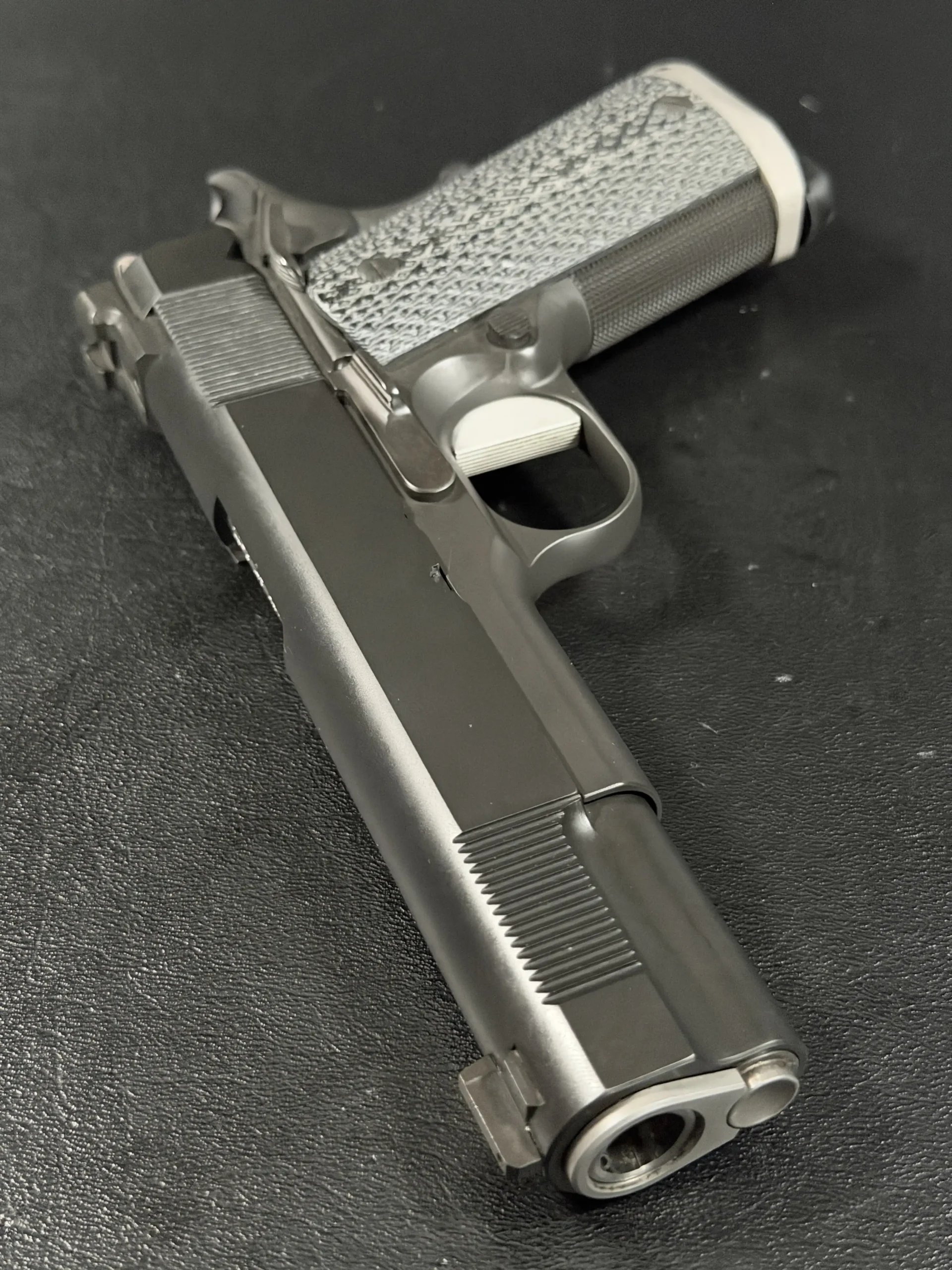
Arsenal Rebuild Stamps: AA, SA, RIA/EB, ANAD, OG, BA/60
Arsenal overhaul marks are a big part of the 1911 story. They usually appear on the frame, often near the trigger guard or dust cover area, and tell you the pistol went through a post-issue rebuild.
- AA: Augusta Arsenal. Common on postwar rebuilds. Signals an arsenal-refinished and inspected pistol.
- SA: Springfield Armory. Indicates an arsenal overhaul, not original production.
- RIA or RIA/EB: Rock Island Arsenal, sometimes with inspector initials. Confirms a rebuild event.
- ANAD: Anniston Army Depot. Typically a later rebuild code.
- OG: Ogden Arsenal. Another clear sign of refurbishment after initial service.
- BA/60 and similar: Benicia Arsenal with a year code. The two digits denote the year of rebuild.
Rebuild stamps do not make a pistol less authentic as a U.S. service arm. They do, however, move it out of the fully original category. Value should track accordingly, with honest arsenal-rebuilt mixmasters priced below crisp, as-issued examples.
Heat-Treat Eras in Brief: Practical Takeaways
Manufacturing practices evolved between early WWI production and later A1-era pistols. For show-table decisions, focus on the big picture:
- Condition over theory: Evaluate cracks, peening, and slide-to-frame fit. Later replacement slides on earlier frames often reflect routine upgrades.
- Period-appropriate mix: A late hardened A1 slide on a well-traveled frame can be a legitimate arsenal story. A commercial or National Match top end on a supposed wartime-original pistol is a different conversation.
If you need to go deeper on heat-treatment timelines for a specific serial range, pause and consult a dedicated reference rather than guessing under fluorescent lights.
Inspectors and Acceptance Marks You Should Know
The M1911 and M1911A1 wear a conversation on their metal. Some marks are small and faint, but they all mean something. Here are a few you’ll see often:
- Ordnance crossed cannons: Final acceptance marking, typically on the right side of the frame behind the grip. Often lightly applied.
- GHD: Initials of Brigadier General Guy H. Drewry, commonly seen on WWII-era frames. Left side above the magazine release is a frequent placement.
- P proof: You may see a P on the frame under the magazine release area on inspected examples. It denotes a proof, not a maker.
- VP in triangle: A Colt verified proof, usually on the left front of the trigger guard. A classic Colt frame tell.
- N.R.A. stamp: On early Colt and Springfield pistols sold through the pre-war program, the letters N.R.A. appear on the right side of the frame below the serial number.
Use initials as clues, not as sole proof. Always cross-check with serial ranges and the overall story of the pistol.
Counterfeit Flags: Quick Red-Team Notes
High-value guns draw creative sellers. Two fast cautions:
- Singer: The accepted serial range is S800001 to S800500, and authentic Singer slides carry the S. MFG. CO. ELIZABETH, N.J., U.S.A. style rollmark. A Singer-marked slide on a non S-prefix frame is a red flag. Verify the frame first.
- US&S: Watch for incorrect serials outside the tight 1943 window, mismatched inspector initials, or modern refinish that buries edges of the markings. Confirm the story with serial and marks together.
Field ID tips at m1911.org can help you pressure-test a claim in minutes.
Serial Blocks at a Glance
Serial ranges are your safety line, especially when the pistol in your hand has a slide and frame from different sources. Keep these quick checks in your pocket:
- Singer: S800001 to S800500 (1941). Rare and often counterfeited.
- Union Switch & Signal: About 1,041,405 to 1,096,404 (1943). Note the duplicate pocket 1,088,726 to 1,092,896 that was also used by Colt. Let inspector initials guide you in that overlap.
- Ithaca: Multiple non-contiguous WWII blocks. Examples include 914,000 to 916,404; 1,208,674 to 1,279,673; 1,441,431 to 1,471,430; 1,816,642 to 1,890,503; 2,075,104 to 2,134,403; 2,619,014 to 2,693,613.
- Remington-UMC: WWI-only production, approximately serial 1 through 21,676 in 1918 to 1919.
- Colt: Spans WWI through WWII. Because Colt is present across the entire era, confirm by serial window, inspector initials, and frame proofs rather than relying on a single tell.
It’s tempting to memorize blocks, but the better habit is to spot what cannot be right. Serial numbers get you to the right neighborhood quickly, and the inspector’s marks tell you which house you’re looking at.
Slides, Replacements, and National Match Parts
Slides lead charmed lives in the 1911 universe. They get swapped in service, swapped in postwar rebuilds, and later swapped by surplus dealers and owners. Some replacement slides are easy to spot:
- 7790314 drawing number: Replacement slides made long after WWII often carry a drawing number. They are perfectly good slides, just not original to a wartime build.
- Drake-marked: Drake produced National Match slides for the government. They are another indicator that the top half is a later addition.
Neither of these marks makes a pistol bad. They simply tell you that the slide is not a WWII contractor original and should be priced and represented accordingly.
Magazines and Grips: Originality vs Reality
Magazines and grips are the first things to wander. Wartime and postwar maintenance didn’t treat them as sacred artifacts, and many were swapped without ceremony. Government-contract magazines often bear small contractor marks, and late-service replacements are common. Plastic grips appear widely on WWII pistols and rebuilds, with many variations.
Reward a pistol for correct, period-appropriate accessories when they are there, but do not pay a premium based on those parts alone. They are the easiest to change and the hardest to authenticate beyond doubt. Focus your evaluation and your budget on the frame, slide, and the story those major components tell together.
A Simple Table-Top Inspection Routine
Here is a quick checklist I use when time is short and the lighting is bad. It keeps me honest and saves me from more than a few expensive impulses.
- Start with the frame: Note the serial number style and prefix, and the presence of a triangle VP, GHD, FJA, RCD, or other inspector initials consistent with the maker. If the serial falls in a duplicated or contested range, examine the inspector’s marks closely.
- Check the slide for replacements: Look for a 7790314 drawing number or a Drake mark. Either indicates a later slide and should temper originality claims.
- Cross-check maker and variant: A Remington-UMC slide on a 1911A1 frame cannot be original. A Singer slide without an S-prefix frame is a transplant.
- Find acceptance marks: The Ordnance crossed cannons on the right rear of the frame are often faint but meaningful. Look for a P proof in expected locations on inspected examples.
- Scan for rebuild hints: AA, SA, RIA, ANAD, OG, or BA/## on the frame point to arsenal work. Mixed finishes and later small parts are consistent with a rebuild story.
- Evaluate wear patterns: Honest carry and use tend to create even, believable wear. Fresh marks on a tired frame, or a new finish over faint acceptance stamps, call for extra scrutiny.
- Cycle and function check: Within safe handling, ensure the slide cycles smoothly, the safeties engage positively, and the trigger resets. Mechanical condition matters, even to display-focused buyers.
Buy the Gun, Not the Story
Collectors chase stories. The M1911 family has more of them than most, from WWI trenches to late Cold War armories. That’s the fun of it. But the best way to honor those stories is to make sure the metal in your hand supports them. Frames tell you who made the pistol. Slides tell you where the pistol has been. Inspectors’ initials and acceptance marks show how it entered service. Arsenal rebuild stamps and late magazines mark later chapters, not sins.
One last tip. When a seller’s tag leans on a claim, reach for a reference and a loupe instead of your wallet. Serial ranges are your first check. The frame’s marks confirm or contradict the claim. And when a pistol is rare, like a Singer, assume you need to verify twice. That extra five minutes is the difference between paying for a legend and owning a piece of it.
For a concise museum read on a limited-run WWII maker, the National Firearms Museum’s page on US&S is a solid short stop. If you want to zoom out to the Great War era and see early contractors in context, Rock Island Auction’s overview is a good primer. And for the field-identification shortcuts that save you at the table, the identification guide at m1911.org is one to keep on your phone.
Rock Island Auction: 1911s of the First World War
NRA Museum: Remington-UMC M1911 profile
NRA Museum: US&S M1911A1 overview
Identifying your M-1911 at m1911.org