
Remington Model 8 and 81: Browning’s Long Recoil Sporting Rifles
A practical, collector-minded look at Remington’s Model 8 and 81. Calibers, long recoil explained, police conversions, and what to check before you buy.

Call us any time at: (833) 486-6659

I remember the first time an old Browning Auto-5 ran beside me in a goose pit. The bird folded, the muzzle settled, and then there it was, that unmistakable two-step thump as the barrel and bolt finished their long dance. It sounded different from any pump or gas gun, mechanical but smooth, like the action itself took a breath before feeding the next shell. The shooter didn’t touch a thing. The gun simply did the work.
That rhythm belongs to John Moses Browning’s long-recoil design, and it did more than bring semi-automatic shotguns into the mainstream. It defined what an autoloader could be. If you own one, chase one, or are just trying to understand why people still talk about the Auto-5 more than a century after its birth, this story is worth knowing.
Long recoil is simple to explain and satisfying to watch. When you press the trigger on an Auto-5, the barrel and bolt recoil rearward together. Near the end of that stroke, the bolt is held to the rear while the barrel is driven forward by its return spring. As the barrel moves forward off the locked bolt, it extracts and ejects the fired shell. Once the barrel is home, the bolt is released to run forward, pick a fresh shell from the magazine, and chamber it.
That is the heart of it, and it underpins every licensed cousin. The Remington Model 11 and Savage 720 use the same sequence. One magazine full plus one in the chamber gave the Browning its name. Four in the tube and one up top, Auto-5.
If you are used to gas guns that vent propellant into a piston and push the bolt by borrowed pressure, long recoil feels like another species entirely. Nothing is tapped from the barrel, no ports to scrub. The gun moves, then settles, and in that motion, the next shot is made ready.
The Auto-5 began as a patent for a recoil-operated firearm filed on May 6, 1899. The idea was ambitious: a repeating shotgun that ran itself by using recoil alone. Browning carried it to meetings, pitched it, refined it, and, after hard negotiations, took the design to Fabrique Nationale in Belgium when other arrangements fell apart.
FN shipped the first Auto-5 to Browning in 1903. That date matters. Semi-auto shotguns existed as drawings and experiments, but this was the first one that worked so broadly and so well that it went into full production and stayed there for decades. Basic production at FN continued until 1978, with special runs after that, a remarkable span for a single shotgun design.
Long recoil did not live at FN alone. In the United States, Remington introduced the Remington Autoloading Shotgun in 1905. Six years later, they changed the name to Model 11. Over at Savage, a license was followed in 1930 for what became the Model 720, with additional variations like the 755 and 775 appearing later. Same operating system, different roll marks, and a shared lineage back to Browning’s workshop in Ogden. The story of one design across three shotguns shows how widely Browning’s idea traveled.
John Browning designed iconic rifles, pistols, and machine guns, and people argue endlessly about which one takes the crown. Browning himself considered the long-recoil shotgun that FN manufactured, the Auto-5, his best achievement. That is not just sentiment from a man who loved to hunt mountainsides above Ogden. It was a professional judgment from someone who knew how hard it is to create a machine that runs in mud, rain, and cold, yet makes every shot feel the same.
The Auto-5 had that quality. It was strong, reliable, and flexible enough to be produced in nearly a century in different grades and gauges. The design principles Browning pushed forward there show up broadly across semi-automatic firearms. Strip away today’s cosmetics and marketing, and you still find modern autoloaders solving the same problems he tackled at the turn of the 20th century, often with the same core ideas about harnessing recoil energy and managing timing.
Collectors like trail maps, and the Auto-5 gives you clear signposts over time. One of the easiest tracks to follow is the safety. There were four main iterations across the model’s long life.
From 1903 to 1909, the safety lived inside the trigger guard. From 1909 to 1951, it moved to a button in front of the guard. Starting in 1951, it became a crossbolt style behind the trigger, then in 1960, that crossbolt was updated with a flatter button that carried through 1999. If you are trying to date a gun or check that parts match the era, that little detail can tell you a lot.
As for variants, the Auto-5 family is rich. The 16 gauge became a fan favorite, especially in the lighter Sweet Sixteen configuration. Production later extended to Japan, and you will find examples like a Sweet Sixteen built by Miroku in 1988 that show how the design kept marching along in new factories while staying true to its roots.
Power options grew too. By the late 1950s, Browning offered a 12-gauge Magnum configuration chambered for 3-inch shells, bringing heavier loads into the platform while keeping the same core operating system.
Auto-5s have a way of announcing themselves. Pull the trigger, and you feel the cycle in two distinct beats. The barrel and bolt come rearward together, the gun shifts in your hands, then the barrel runs home, and the bolt follows with a solid closing stroke. People describe it as a shuck without the pump, a nod from the action that tells you the next shot is ready.
Fit matters. The humpback receiver gives a long, consistent sighting plane that many shooters track well. If the stock fits you, that sight picture and the cycle’s repeatable timing make an Auto-5 feel like an old friend.
Shopping for an Auto-5 is a pleasant kind of homework. The model’s long life means there are many honest field guns, a fair number of high-grade examples, and cousins wearing the Remington or Savage name. Here is how I approach a rack.
Factory originality matters most to collectors. To the buyer who plans to shoot a few rounds of trap or sneak through the timber for grouse, honest refinish work on a field gun can be your friend. It often buys you a solid shooter at a better price.
When people compare the Auto-5 to newer designs, they often ask a simple question. Does any of this old magic carry forward, or is it pure nostalgia? The answer is that the ideas behind the Auto-5 still matter, even if the parts and timing have changed.
Modern semi-autos split roughly into two families. Gas-operated guns borrow a bit of propellant from the barrel to push a piston that drives the bolt. Recoil-operated guns use the energy of recoil and the movement of parts under that recoil to cycle the action. Browning started this conversation at the turn of the last century with long recoil, and the company still builds on it today.
The current production Browning A5 is a different shotgun from the old Auto-5, but the principle at its heart is familiar. Browning’s Kinematic Drive is a short-recoil-operated system that harnesses recoil energy to generate the mechanical motion needed to run the action. The design is simple, runs clean because gases exit the barrel rather than into the action, and Browning backs it with a 100,000-round or five-year guarantee. They also point to broad load versatility, including reliable cycling with 1-ounce field loads in 3-inch chambers and 1 1/8-ounce in 3 1/2-inch guns, with no adjustments. If you want a modern expression of the same philosophy, it is right there with a very similar name. Browning explains that approach in their overview of the A5 Kinematic Drive.
How the A5 Kinematic Drive harnesses recoil energy is worth a look if you are weighing a classic Auto-5 against a brand new A5 for the blind or the clays course.
There is also a cultural throughline here. The original Auto-5 showed shooters that a self-loading shotgun could withstand harsh weather and mixed loads without constant tinkering. That expectation carried into the gas era and into today’s recoil guns. When we judge modern autoloaders, we still ask whether they run clean, tolerate cold and rain, and handle one-ounce field loads without drama. That bar was set early, and it stands.
One of the fun parts of chasing this lineage is how it spreads across brands and eras. Collectors and shooters often cross paths with Remington Model 11s and Savage 720s while hunting for an Auto-5. Each carries the same long recoil engine. If you want to understand how the design moved through American factories and wartime contracts, it is worth tracing those side branches. The story of one design across three shotguns shows how widely Browning’s idea traveled.
Even within Browning’s own catalog, you can see how the Auto-5 sat alongside other action types and how those families influenced one another. If you have ever wondered why many shooters still love a good pump, even with so many autoloaders to choose from, there is a companion conversation there. We explored some of that in our piece on why pump shotguns stayed relevant for so long, and it pairs nicely with a look at the Auto-5.
If you plan to shoot a classic Auto-5, the best advice is to treat it like what it is, a well-made machine from another time that still wants to work. Use quality ammunition in the load range the gun was built around. Keep the moving parts clean and lightly oiled. Pay attention to how it cycles by feel. These guns often telegraph what they need through that two-stage motion. When everything is right, the barrel moves, the bolt follows, and it all lands home with a confident close.
There is also the simple matter of joy. A lot of us grew up around Auto-5s that were tools first and heirlooms later. The guns that went to wheat fields for doves, to cattails for pheasants, to flooded timber for ducks, then back to the rack by the back door. Owning one links you to a practical tradition. You can shoot them gently or hard and still hand them down with honest stories at the end.
Buyers care about function and feel. Collectors care about lineage and condition. The Auto-5 has a way of satisfying both. It is the first successful semi-automatic shotgun, built around a long recoil core that still reads as clever when you put the parts in your hands. It pivoted through multiple factories and countries without losing its identity. It changed safeties, embraced new gauges, added magnum options, and kept showing up in duck blinds and on upland ridges.
If you want the history in your safe, an FN Auto-5 or a later Miroku built in Sweet Sixteen trim will always draw a smile. If you want the spirit with a warranty and modern materials, the current A5 carries the torch with a different take on the same core idea, recoil doing the work. Either way, the lesson is the same. The clever part was never just that a shotgun could load itself. It was that it could do it cleanly and reliably, with a feel that made shooters trust the next shot without thinking. That is the standard the Auto-5 set, and it is still the measure many of us use today.
Available
View Item
Available
View Item
Available
View Item
Available
View Item
Available
View Item
Available
View ItemA practical, collector-minded look at Remington’s Model 8 and 81. Calibers, long recoil explained, police conversions, and what to check before you buy.
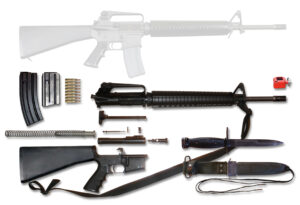
A collector’s look at Colt’s SP1 and early Sporters, from slickside uppers and pencil barrels to the rollmarks and small changes that hinted at the A2 era.

A practical, story-driven guide to reading JM vs REP barrel marks, understanding pre-safety 336s, Micro-Groove and Ballard-style rifling, and the smart checks to make before you buy.