
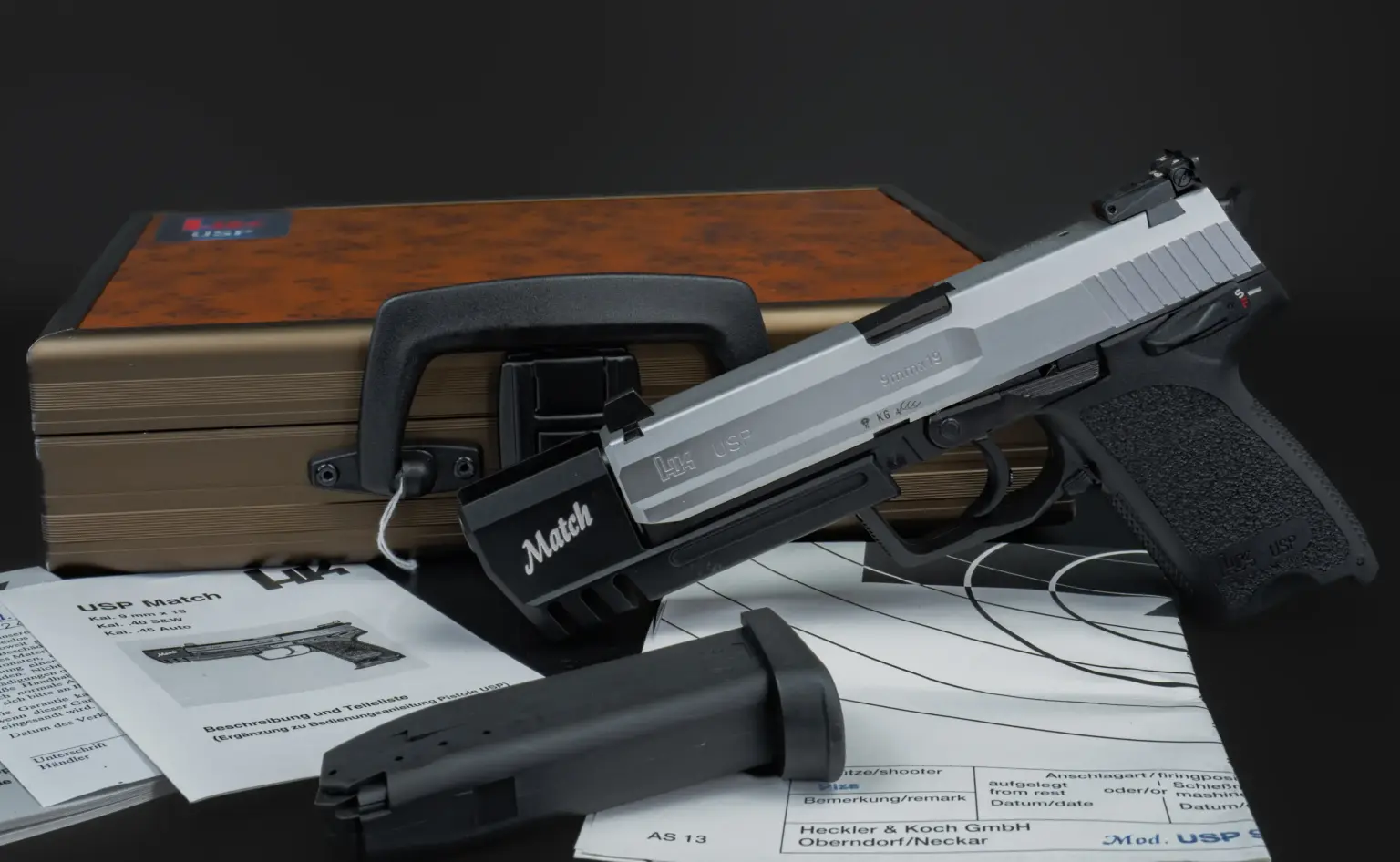
There are guns that shoot, and then there are guns that speak. The Heckler & Koch USP Match is firmly in the second category. It’s the kind of pistol that commands attention the moment you set it on a table, not because it’s flashy or over-engineered, but because it radiates a quiet, purposeful confidence. Like a seasoned surgeon’s hands, everything about it suggests it was built to do one thing extraordinarily well.
But how did we get here? What chain of decisions, engineering breakthroughs, and competitive pressures brought this pistol into existence? That story is more interesting than most people realize, and it stretches back further than the gun’s 1990s debut would suggest.
H&K Before the USP: A Company That Never Did Things the Easy Way
To understand the USP Match, you first need to understand Heckler & Koch. Founded in Oberndorf am Neckar, West Germany in 1949 by Edmund Heckler, Theodor Koch, and Alex Seidel, the company initially made machine tools. Firearms came later, almost by necessity. The devastated postwar German arms industry left a gap, and H&K filled it with characteristically German precision.
Their early work on the G3 rifle cemented their reputation: this was a company that didn’t cut corners. The roller-delayed blowback system powering the G3 was famously complex to manufacture but extraordinarily reliable in the field. That ethos, build it right even if it costs more, would define H&K for decades.
By the 1980s, H&K had serious pistol credibility with the P7 series. The P7M8, with its gas-delayed blowback and squeeze-cocker mechanism, was a masterpiece of unconventional thinking. Federal agents loved it. Collectors still do. But pistols were changing fast. The polymer revolution, sparked largely by Gaston Glock’s audacity in Austria, was rewriting what buyers expected from a service handgun. H&K watched closely, and then responded with something they’d been quietly developing for years.
The Original USP: Born for America, Built for the World
The Universal Self-loading Pistol launched in 1993, and the name itself was a statement of intent. “Universal.” Not narrowly optimized, not purpose-built for one narrow application, but designed from the start to be adaptable, modular, and broadly capable.
Here’s something worth understanding about the original USP’s origins: it was substantially developed with American law enforcement and military buyers in mind. This wasn’t a European pistol awkwardly retrofitted for the American market. H&K worked backward from what U.S. agencies said they needed. That meant a .40 S&W chambering as the primary variant (with 9mm and .45 ACP following), a double-action/single-action trigger with multiple control options, and a frame-mounted Picatinny-compatible rail years before that became standard.
The USP also incorporated H&K’s patented recoil reduction system, a modified Browning-style short-recoil mechanism with a mechanical buffer that genuinely flattened felt recoil. Experienced shooters who first picked up a USP in .40 S&W were often surprised by how manageable the cartridge felt. That buffer wasn’t marketing language. It worked.
So you had a polymer-framed, recoil-buffered, modular DA/SA pistol with serious engineering behind it. A strong platform. A very strong platform. But strong platforms invite refinement, and that’s where the Match enters the picture.
Competition Shooting and the Demand for Something More
If you’ve spent any time in IPSC or USPSA circles, you already know what happens when a pistol gains traction in competition: shooters immediately start asking for more. More trigger refinement, tighter tolerances, better sights, compensators, extended controls. They want the same gun, only sharper. This isn’t ingratitude. It’s the natural evolution of any tool when serious practitioners get their hands on it.
By the mid-1990s, the USP was finding favor in practical shooting competitions. Its accuracy was good, its reliability was exceptional, and the recoil system made fast follow-up shots achievable. Competitors were already having custom work done: lighter trigger springs, adjustable rear sights, extended magazine releases. The aftermarket was filling a gap that H&K had left open, at least temporarily.
H&K isn’t a company that ignores what competition shooters tell them. These aren’t casual users. They stress equipment mercilessly, they test modifications scientifically, and they have strong opinions based on thousands of rounds downrange. If the serious competitive community was asking for a match-grade USP, H&K had every reason to listen, and to do it properly.
Enter the USP Match: More Than Just a Factory Upgrade
The USP Match arrived in 1995, chambered initially in .40 S&W and 9x19mm, and the .45 ACP variant followed. At first glance, you might think it was simply a USP with a few factory modifications bolted on. That’s underselling it considerably.
The most visually obvious change was the barrel. The Match features an extended, match-grade barrel that protrudes beyond the slide. This isn’t just cosmetic. The longer barrel extracts every bit of velocity the cartridge has to offer, and more critically, it accepts H&K’s own compensator design. The comp attaches directly to the barrel’s muzzle threads, and its effect on muzzle rise is immediately noticeable. Shoot a standard USP back to back with a compensated Match variant, and the difference in muzzle flip is striking.
But the barrel extension and compensator were really just the starting point. H&K refined the trigger group substantially. The match trigger offers a cleaner break with reduced reset, which competition shooters value enormously. Reset distance is the distance the trigger must travel forward before it can fire again. A shorter reset means faster accurate shots. H&K tuned this carefully, maintaining reliability while improving the feel in ways that add up quickly over a stage.
The sights got serious attention, too. Where the standard USP shipped with fixed or drift-adjustable sights, the Match came standard with a fully adjustable target rear sight. You could dial in windage and elevation precisely, which matters when you’re shooting for score rather than just keeping rounds on a silhouette.
There’s also the matter of the slide. The USP Match slide features a distinctive vented, serrated design that reduces weight slightly at the top and looks, admittedly, quite purposeful. The additional serrations on the front of the slide make press-checks and manipulation easier with wet or gloved hands.
The .45 ACP Match: A Different Animal Entirely
When H&K developed the USP .45 platform, they used a physically larger frame than the 9mm and .40 variants. The USP Match in .45 ACP is, consequently, a substantial pistol, but substantial in the way that a full-sized competition gun should be. The added mass dampens felt recoil further, and the .45’s inherently subsonic velocities (in standard loads) mean the compensator becomes more about eliminating muzzle flip than managing gas pressure at the muzzle.
The .45 Match gained particular attention from IPSC shooters competing in Production-adjacent divisions and from those who simply preferred the wider, softer-pushing characteristics of the big bore cartridge. There’s a reason that certain competition shooters, once converted to a well-tuned .45, never go back.
What the .45 Match also offered was a gateway to IPSC Open division competitiveness with a factory pistol, rather than a heavily customized 1911 or CZ. Factory open-class guns were rarer in the 1990s than they are today, and the USP Match was genuinely ahead of its time in that respect.
The Expert and the Elite: The Family Grows
H&K didn’t stop with the Match. The competitive and tactical shooting community’s appetite for USP variants led to the USP Expert, which arrived a few years later and is perhaps even more relevant to serious competitors.
The Expert shares the extended barrel and adjustable sights of the Match but adds a few refinements: an improved trigger reset, an extended, ambidextrous control lever, and a front strap that’s more aggressively textured. The Expert also benefits from late-production refinements to the trigger group that H&K incorporated as they gathered more feedback from competition users.
Collectors sometimes debate which variant is superior, the Match or the Expert, and honestly the answer depends on intended use. For pure competition shooting with a compensator, the Match has the factory-threaded barrel and comp setup already sorted. For someone who wants match-grade performance without the compensator, or who plans to run the pistol suppressed, the Expert’s configuration often makes more sense.
There was also the USP Elite, which pushed the concept further still, with an elongated frame, extended barrel, and a hair trigger refined to near-perfection. The Elite is the rarefied end of the family: more specialized, more expensive, and rather beautiful in its single-mindedness. It’s the pistol H&K built for people who had already tried everything else.
Why Collectors Keep Coming Back
Here’s the thing about the USP Match that keeps it perpetually relevant in collector circles: it represents a genuinely distinct moment in pistol development. Not every gun does.
The mid-to-late 1990s were a fascinating time for semi-automatic pistols. The polymer revolution had already transformed service guns. Competition shooting was growing rapidly. Factory custom guns, pistols built to competition specifications directly from major manufacturers, were becoming a real market category for the first time. The USP Match sits at that intersection. It wasn’t a heavily customized aftermarket creation. It was H&K saying, formally and with their full engineering resources behind it, “here is what a competition pistol should be.”
That intentionality matters to collectors. When you hold a USP Match, you’re holding an artifact of a specific moment in firearms development, a moment when the lines between service pistols, competition guns, and tactical tools were being drawn and redrawn simultaneously. It’s a time capsule with adjustable sights.
The build quality reinforces this. H&K’s manufacturing standards during this period were genuinely exceptional. The German-made components, the tolerances on the barrel-to-slide fit, the texture of the polymer frame: these are things you notice when you handle a Match alongside contemporary competitors. Fit and finish were taken seriously in Oberndorf.
Numbers, Rarity, and Market Reality
The USP Match was never a high-volume seller in the way the standard USP was. This isn’t surprising. It’s a specialized firearm aimed at a specialized market, priced accordingly. Production numbers, particularly for the U.S. market, were always modest relative to the mainstream variants.
This relative scarcity has made clean, original-condition USP Match pistols increasingly interesting on the collector market. The .45 ACP Match in particular sees strong interest because the platform feels properly optimized for that caliber. Finding one with its original compensator, matching box, and documentation is the kind of find that generates genuine excitement at a gun show.
Secondary market pricing reflects this. A well-preserved USP Match in any caliber commands a premium over standard USP examples, and rightly so. The rarest configurations, the .45 in particular, with factory two-tone finishes or law enforcement provenance, attract the most serious buyer attention.
Interestingly, the USP Match also benefits from the H&K support ecosystem. Parts remain available. Magazines are still manufactured. The LEM (Law Enforcement Modification) trigger components are compatible with standard USP Match variants, which means those who want to tinker have options. For a pistol from the 1990s, that’s not guaranteed. The fact that it is means the USP Match remains a practical shooter’s collector piece, not just a safe queen.
The Match’s Legacy in H&K’s Catalog
Every manufacturer’s lineup tells a story about their engineering philosophy and their market relationships. The USP Match tells a specific story about H&K’s willingness to take competition shooters seriously, at a time when some manufacturers treated that market as an afterthought.
The Match influenced how H&K approached subsequent pistol development. The HK45, the P30L, the VP9 Match Optics Ready: you can draw a direct line from the engineering decisions and market feedback generated by the USP Match to these later products. The extended barrel concept, the adjustable sight standard, the attention to trigger reset: these themes recur throughout H&K’s modern lineup because the USP Match proved they mattered to buyers.
There’s also a broader cultural legacy. The USP series became deeply embedded in firearms popular culture through its appearance in countless action films and video games throughout the late 1990s and 2000s. The Match variant specifically, with its distinctive extended barrel and compensator, has an unmistakable visual profile that became something of a shorthand for “serious pistol” in visual media. Collectors who grew up with those cultural touchpoints often discover the actual gun and find it exceeds expectations. That’s a rare thing.
Shooting One Today: Does It Hold Up?
You know what the real test of a collector’s gun is? How it performs when you actually shoot it. Plenty of historically significant pistols are more interesting as objects than as shooting tools. The USP Match isn’t one of them.
Run a USP Match through a USPSA classifier today, and it will hold its own against much newer competition pistols. The trigger, particularly on well-maintained examples that have seen some rounds through them, smooths out to something genuinely pleasant. The adjustable sights make zeroing straightforward. The compensator works as advertised, keeping the muzzle flat enough that fast target transitions don’t require dramatic technique adjustments.
The ergonomics are decidedly 1990s in character, the palm swell, the trigger reach, the angle of the grip: these reflect design choices made before the current understanding of optimal grip geometry was fully established. Shooters with smaller hands sometimes find the reach to the trigger on the DA pull a stretch. That’s the honest reality. But serious competitors in the 1990s and early 2000s built championship results with this pistol, which tells you that ergonomic preference and shootability aren’t always the same thing.
A Few Things Worth Knowing Before You Buy
If you’re considering acquiring a USP Match, there are a few things that experienced collectors consistently mention. First, inspect the compensator carefully. The factory compensator is not easily replaceable if damaged or lost, and a Match without its comp is a less interesting piece both mechanically and historically. Original comps show wear from use, which is fine and expected, but check the muzzle threads on the barrel for damage.
Second, the original H&K-branded extended magazines for competition use are worth seeking out if the seller has them. These were purpose-made accessories that came with some competition packages, and they’re harder to find than standard-capacity magazines.
Third, verify the trigger group components are original and unmodified. Well-intentioned amateur trigger jobs on these pistols can affect reliability in ways that aren’t immediately obvious. If the pull feels unusually light or breaks inconsistently, have a qualified armorer check it before you put significant rounds through it.
Finally, documentation matters. Original cases, factory paperwork, and H&K test targets, which were sometimes included with match-grade pistols during this period, meaningfully affect both authenticity and resale value. Not every example will have complete provenance, and that’s fine. But when it’s there, it’s worth paying for.
The Lasting Impression
Step back from the technical details for a moment and think about what the USP Match actually represents. It’s a major European manufacturer, already respected for military and law enforcement products, choosing to invest serious engineering effort in a pistol designed specifically for sporting competition. That was, in the mid-1990s, not a given. It was a choice.
That choice says something about H&K’s confidence in their engineering team, their respect for the competitive shooting community, and their willingness to build a product that would be evaluated by some of the most critical and knowledgeable handgun users in the world. Competition shooters don’t forgive mediocrity. They find weaknesses, publicize them, and move on. H&K knew this. They built the Match anyway, and built it properly.
Decades later, the USP Match retains what it had when it left Oberndorf: a clarity of purpose that serious collectors recognize immediately. It’s not trying to be everything. It’s trying to be one thing, a competition-capable, precision-built pistol with real German engineering behind it, and it succeeds with an authority that time hasn’t diminished.
Some guns are legends because of their sales numbers. Some because of their historical significance in conflicts. The H&K USP Match is a legend because a small but serious community of shooters recognized, from the moment they first touched one, that it was built by people who genuinely understood what they were trying to accomplish. That understanding is the rarest manufacturing quality of all.