
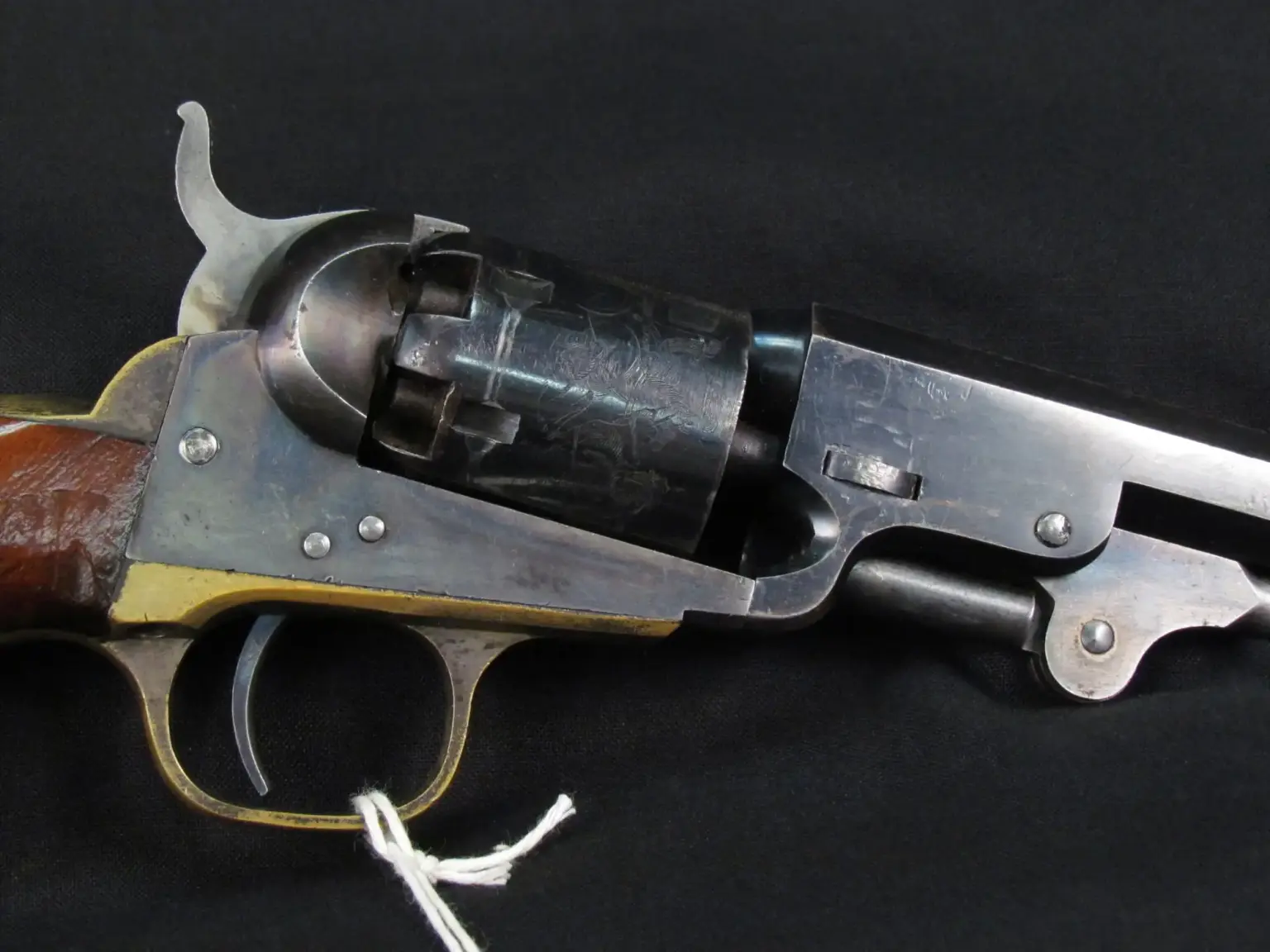
The first Colt 1860 Army that ever crossed my bench looked ordinary until it didn’t. The wedge scars, the way the loading lever seated, the wear on the cylinder scene all fit together like a story you could read. That is the appeal of percussion revolvers. When the features, numbers, and marks agree, you can buy with confidence. When they argue, you should slow down.
This guide focuses on the core of the American percussion era for collectors and buyers: Colt’s Model 1849 Pocket, the 1851 Navy, the 1860 Army, and Remington’s New Model Army. We will cover quick ID cues, where serials and inspection marks live, what common conversions look like, and a step by step inspection flow you can use at a show table.
How the Colt family relates
Colt’s percussion lineup evolved along one clear line. The .31 caliber Model 1849 Pocket set the pattern. That basic design was scaled up to create the .36 caliber 1851 Navy. Colt then enlarged the cylinder and relieved the frame to carry a .44, giving us the 1860 Army. With that success, Colt circled back with compact .36 caliber Pocket Police and Pocket Navy models that borrowed the Army’s look and mechanics. These relationships help you spot swapped parts and judge originality at a glance.
For a concise overview of how these models relate, see the Colt Pocket Percussion family notes on Wikipedia.
Colt Pocket Percussion Revolvers
Quick model ID by caliber and cues
Pair caliber with big visual tells. It is the fastest way to avoid mistakes on a crowded table.
- Colt 1849 Pocket: .31 caliber, octagonal barrel, traditional pivoting loading lever.
- Colt 1851 Navy: .36 caliber, essentially a larger 1849 with an octagonal barrel.
- Colt 1860 Army: .44 caliber, round barrel, creeping loading lever, enlarged cylinder on a rebated frame.
- Colt Pocket Police and Pocket Navy: .36 caliber compacts. The Pocket Police commonly shows a fluted 5-shot cylinder and Army-like lines with a stepped cylinder.
Visual mismatches are your early warnings. An “1860 Army” with an octagonal barrel or a Pocket Police wearing a fat, unfluted six-shot cylinder deserves extra questions.
Production context and London proofs
The 1849 Pocket dominated the civilian market, with production in the hundreds of thousands. Published figures for Colt’s pocket family note about 325,000 .31 Pocket Models, roughly 19,000 Pocket Navy, and about 20,000 Pocket Police examples.
London-market Colts matter because British proof marks and barrel addresses affect both authenticity checks and value. London-assembled or London-destined guns carry British proofs on the metal and the correct address. A Hartford-marked barrel paired with British proofs is a prompt to slow down and sort out what you are seeing.
Inspector and proof marks to recognize
Two categories of marks matter to collectors: U.S. military inspection marks and acceptance cartouches, and commercial proofing or market marks.
On Civil War issue 1860 Armies, expect small-letter sub-inspector initials on components and, on many examples, boxed script cartouches on the grips. Some early U.S. Army and U.S. Navy issued revolvers bear few or no inspection markings, so weigh features, condition, and context together rather than fixating on one stamp.
Ainsworth’s famed OWA cartouche is best known on early Single Action Army revolvers, but his remit also included percussion-era arms like Colt 1860 Armies and Remington New Model Armies. That is a reminder that small inspector letters on parts often follow a gun through repairs and even later conversions.
For a deeper look at U.S. inspection practices and how sub-inspector marks appear across components, Rock Island Auction’s piece on Colt inspection is helpful. Their feature on the 1860 Army also shows typical martial markings in context.
Inspecting the Colt Single Action Army Revolver
Colt 1860 Army
Conversions to know
By the early 1870s, Colt formalized the shift from percussion to metallic cartridges. Charles Richards secured a patent in 1871, followed by William Mason in 1872. Gunsmiths and the factory applied these systems to 1851 Navies and 1860 Armies, among others. Look for a conversion ring with a loading gate, an ejector assembly, and altered rear sighting. Many converted revolvers retain earlier sub-inspection letters on parts, which can help confirm a gun’s path from percussion to cartridge.
Rock Island’s coverage of the 1860 Army and U.S. inspection practices includes examples of factory Richards conversions built in 1871 and 1872.
Colt 1860 Army
Hands-on inspection checklist
Use a consistent flow. It keeps you from missing small tells that add up.
- Big picture first. Do the barrel profile, loading lever, cylinder type, and caliber match the model claimed.
- Serial logic. Read the main serial, then check other components that were typically numbered. Matching numbers across major parts are a comfort.
- Addresses and legends. Is the barrel address crisp and appropriate to the model and market. Beware heavy polish that thins lettering or fresh-looking stamps.
- Cylinder scene or flutes. On models with a roll scene, judge how it wears relative to the rest of the gun. On Pocket Police patterns, confirm the flutes and 5-shot layout.
- Finish honesty. Rounded edges, smeared case colors, and halos around stamps point to refinish. Screws tell tales through mangled slots or mismatched heat colors.
- Timing and carry. Cock slowly. The cylinder should rotate evenly and lock up positively. Sloppy carry or late lockup hurts collector value.
- Endshake and side play. Gently test fore and aft movement at full cock and check lateral play.
- Loading lever and arbor fit. The lever should seat naturally. The arbor should draw up correctly with a properly fitted wedge, not through force.
- Nipples and chambers. Check for peening, wrench damage, or corrosion that threatens function.
- Bore condition. A mirror bore in an otherwise gray revolver may signal a reline or replaced barrel.
- Grip fit and cartouches. Age-consistent wood-to-metal fit is good. Freshly proud edges or sharp new cartouches on a worn gun deserve scrutiny.
- Small marks. Note inspector initials and proof marks and make sure they live where they should and look their age.
Remington New Model Army notes
Remington’s New Model Army stands shoulder to shoulder with Colt’s big percussion guns in both service history and collector interest. It is a large-frame .44 with an 8 inch octagon barrel, produced roughly 1863 to 1875 in about 132,000 examples. Many were later factory-converted to metallic cartridges such as .46 rimfire and .44 Colt. Judge them with the same discipline you use on Colts: model-correct features first, then serial consistency on major parts, then small military or proof marks.
Remington Model 1858
Dating and serials without guesswork
Serial numbers are essential, but they rarely stand alone. Blend three things: a credible serial table or detailed auction listing to bracket production, model-correct features on the gun in hand, and any market indicators such as British proofs. When features, marks, and serials move together, your date estimate sharpens. When they do not, pause and recheck.
Avoiding refinish and parts-gun pitfalls
Refinishes are common. So are service-era parts swaps. Both can be honest, but both affect value. Keep a short list of warnings in mind.
- Color and texture. Original flats were crisp. Softened edges and pooling color suggest later work.
- Lettering and scenes. Thinned legends or halos around stamps point to sanding and buffing.
- Screws and pins. Chewed slots and mismatched tones betray heavy hands.
- Mismatched patina. Metal, wood, and screws that do not agree with each other call for a closer look.
- Too-fresh proofs or cartouches. Authentic marks sit down into the metal and age with it.
Provenance and paperwork
Good paper can change a gun’s place in a collection. Unit ID, named ownership, or period-correct documentation can elevate a common configuration. Vet the documents as carefully as the gun.
Care and handling
Treat old steel and old wood with respect.
- Handle with clean, dry hands and avoid unnecessary cocking or dry firing.
- Keep a light coat of oil on exterior metal and store in a dry space away from leather.
- Use correctly fitted tools if you must turn a screw or set a wedge. Stop if something feels wrong.
- When in doubt, let an experienced specialist evaluate a mechanical issue.
If you want more context on the 1860 Army’s wartime role and markings, Rock Island Auction’s feature is a solid reference, and their piece on inspection offers a useful primer on how U.S. sub-inspectors worked across models and eras.
Colt 1860 Army
Inspecting the Colt Single Action Army Revolver
Learn the language of these guns and they will reward you. The right Colt or Remington stops feeling like a gamble and starts feeling like a handshake across time.