The first time I racked an HK P7, I squeezed that front strap and felt the whole pistol wake up. The slide dropped without a slingshot, the trigger went crisp, and a few magazines later the frame was warmer than most pistols ever get. That contrast is why the P7 still pulls buyers and collectors decades on.
This guide explains what the squeeze-cocker actually does, how the gas system works, where the PSP differs from the P7M8 and P7M13, and what to inspect before you buy.
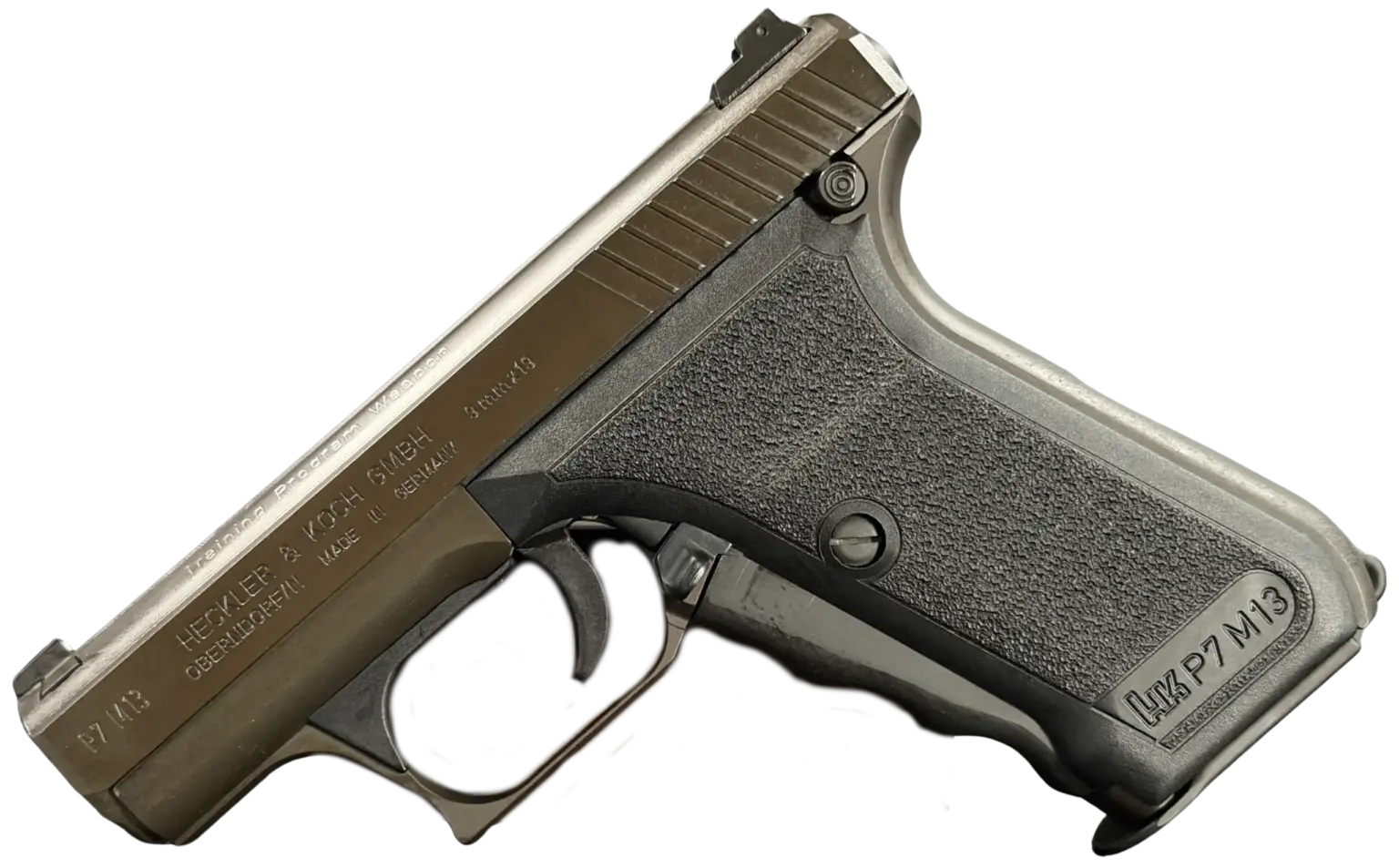
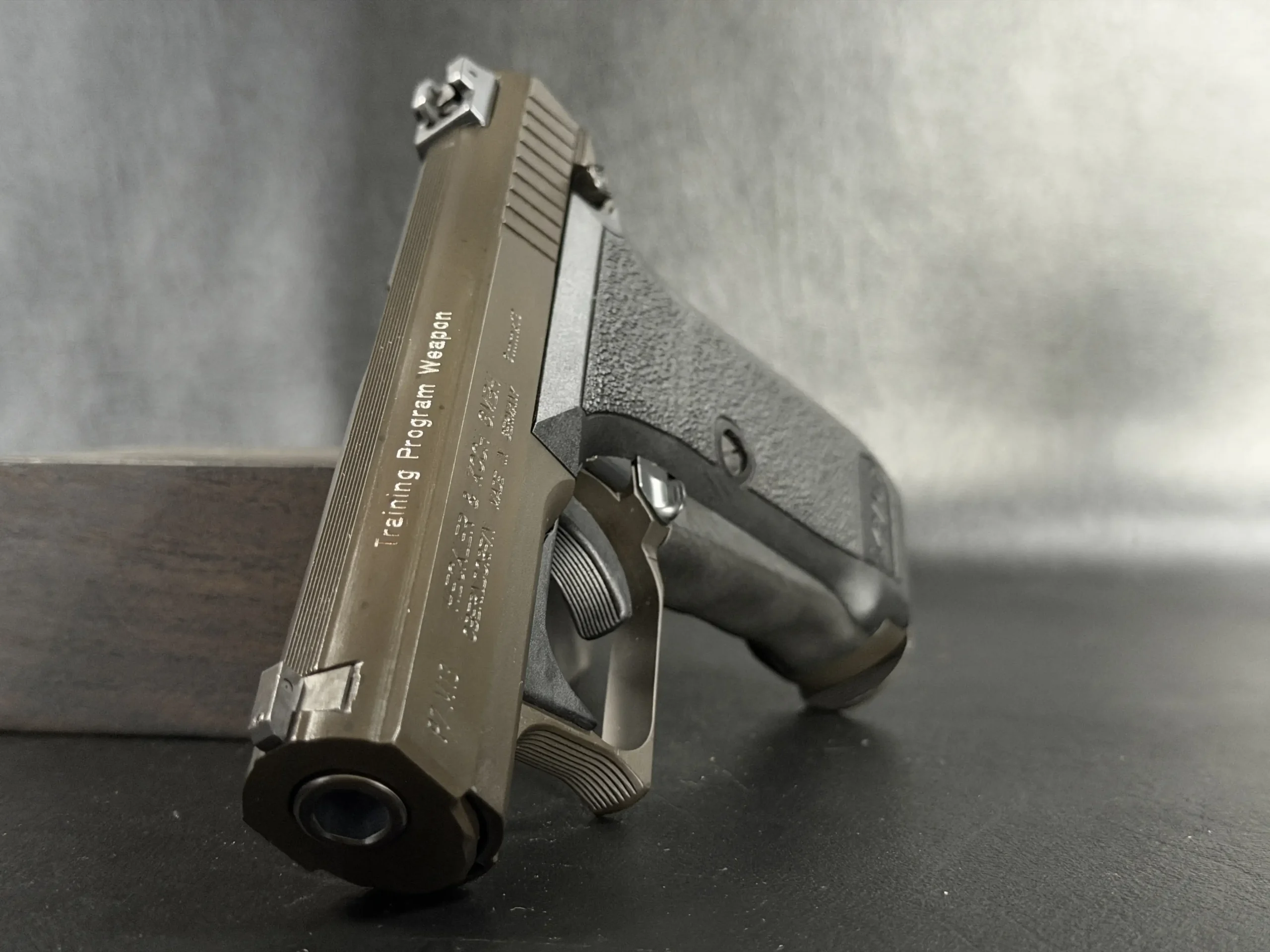
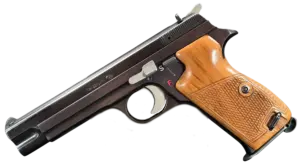
HK P7 M13 Training Weapon, shown in close-up detail, supports the article’s focus on Heckler & Koch P7 Series: Squeeze-Cocker, PSP vs. M8/M13, Gas Wear, and Collector Pointers.
Design snapshot
Designed in the mid 1970s by Helmut Weldle and produced from 1979 to 2008, the P7 is a compact 9 mm with three defining traits: a squeeze-cocking front strap, a fixed polygonal barrel, and a gas-delayed blowback system housed under the barrel. Field stripping is fast via a simple takedown control. That mix explains its reputation for accuracy, safe handling, and unusual smoothness in recoil.
How the squeeze-cocker works
The front strap is a cocking control, not a conventional safety. Squeeze it and the lever cocks the striker; relax your grip and it decocks. With the lever at rest, the trigger does nothing. The result is a true single action trigger paired with an always-decocked resting state unless you deliberately cock it again.
There is a brief learning curve. It takes notable effort to cock initially, then very little to keep it cocked. Reported figures are about 14 pounds to cock and roughly 2 pounds to maintain. The lever also acts like a slide release: with the slide locked back, insert a magazine and squeeze to send the slide home. It is efficient, though the lever makes a distinct click you will hear on a quiet range.
For a clear shooter’s-eye demo, the TFB review shows the control in motion and covers its safe behavior: The H&K P7 (And Why I Carry One).
Gas-delayed blowback explained
The P7 taps a small amount of gas through a port in the barrel into a cylinder under it. That gas drives a piston that momentarily resists the slide’s rearward travel until pressure drops after the bullet exits. Only then does the slide complete its stroke. This lets the gun run a fixed barrel without a tilting or rotating lockup, keeping sights steady and the bore line low.
Extraction gets help from a fluted chamber that bleeds a thin gas layer around the case, easing release under pressure. The P7’s fixed barrel also uses polygonal rifling; HK was early to bring that style to small-arms barrels. Put together, the pistol feels locked-in when you press the trigger.
PSP vs. P7M8 vs. P7M13
Controls and magazine release
– PSP: Heel magazine catch at the grip base. Deliberate and very hard to bump by accident, which some agencies preferred at the time.
– P7M8/P7M13: Ambidextrous thumb release. Faster and familiar to most modern shooters. These changes flowed from early trial feedback, including the XM9 and P80 era evaluations. A concise history of these updates is here: HK P7 Series and Its Variants.
Heat management
The gas cylinder sits near the trigger guard and gets hot during extended strings. The original PSP can become uncomfortable at the front of the frame after multiple magazines. The P7M8 and P7M13 add a plastic heat shield above the trigger guard that helps keep fingers cooler.
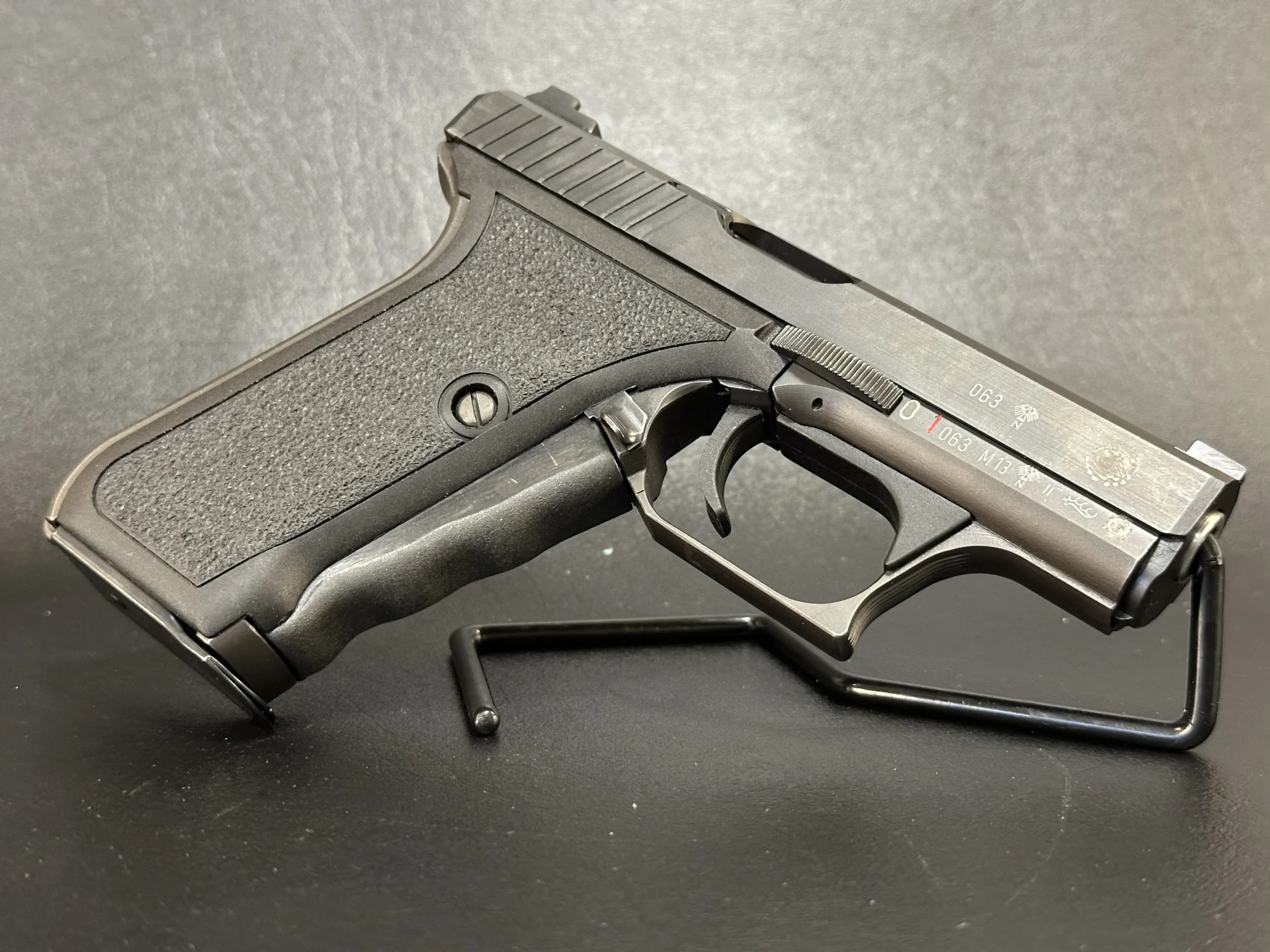
HK P7 M13 S Mexican Prototype, shown in close-up detail, supports the article’s focus on Heckler & Koch P7 Series: Squeeze-Cocker, PSP vs. M8/M13, Gas Wear, and Collector Pointers.
Capacity, grip, and weight
– PSP and P7M8: Single stack, 8-round magazines; slim grip. Typical unloaded weight around 28 ounces.
All three keep the fixed barrel, fluted chamber, squeeze-cocker, and gas delay, so shooting character stays consistent across variants.
Range behavior: accuracy, heat, reloads
The P7 is easy to shoot well. The trigger is short and crisp because the front strap does the cocking work. The fixed barrel and low bore center help the gun track straight. From a rest, good ammo prints tight groups; at carry distances, the gun feels point-and-click if you do your part.
Heat is real. The PSP warms up fastest. The M8 and M13 stay friendlier longer thanks to the heat shield, but extended rapid fire will still warm the frame nose. Pace your strings and it stays pleasant.
Reloads have a rhythm. PSP heel-release changes are secure but slower. On M8 and M13, mag swaps are modern and quick. With any variant, squeezing the cocking lever to drop the slide after a fresh mag becomes second nature.
Buyer checks: gas system and wear
The gas system is the heart of the P7 and where heat and fouling live. When inspecting a used example, field strip and check the following with a good light:
Gas cylinder and piston face: A thin carbon film is normal. Heavy crust, deep pitting, chipping, or obvious abuse is a red flag.
Gas port: Look through the cylinder at the small barrel port. It should be clean and evenly round.
Heat shield and frame nose: On M8/M13, confirm the shield is intact and not warped. On PSP, check the front of the frame for heat discoloration or softness.
Slide travel: With the gun empty, cock and decock a few times, then run the slide. It should move smoothly and return with authority.
Chamber flutes: Fine stripes in the chamber are by design. Do not confuse normal flute marks with damage.
Magazines: Original mags matter for value and function. Inspect feed lips and follower movement.
Field stripping is simple: press the takedown control, pull the slide back and off, and you are looking at the surfaces that need cleaning. Do not let the gas parts sit packed with carbon between trips; the design is robust but rewards normal care.
Collector notes
You do not need every production wrinkle to buy smart, but a few specifics help:
Design lineage: The P7’s gas-delay traces to earlier European concepts and was refined for service use. Later P7M8/P7M13 changes, particularly the thumb mag release and wider plastic trigger, were proven during trial programs. See the overview at Luxus Capital.
P7M13 pre-series: A documented pre-series of 59 pistols numbered 001M13 to 059M13 preceded mass production. These and very early production M13s are of special interest to variant collectors.
Outliers: The .40 S&W P7M10 is notably heavy at about 44 ounces. The P7K3 covered .22 LR, .32 ACP, and .380 ACP with a different blowback setup. Interesting, but the 9 mm PSP, M8, and M13 remain the main roads for most buyers.
Ownership: parts and maintenance
Magazines are the lifeblood; budget for spares. Springs are consumables, especially recoil springs. Cleaning is straightforward, but keep abrasives away from the gas port and cylinder walls. Solvent, time, and a soft touch are the right approach.
Bottom line
The P7 wins by being different in ways that matter. A cocking front strap that keeps the gun inert until you mean it. A fixed barrel and gas delay that make small guns shoot big. For buyers, the choice between PSP and M variants boils down to controls, heat management, and capacity. For collectors, condition, completeness, and known early runs carry the premium.
Handle each variant and shoot them if you can. Your hand will tell you what to buy.
As a firearms enthusiast with a background in website design, SEO, and information technology, I bring a unique blend of technical expertise and passion for firearms to the articles I write. With experience in computer networking and online marketing, I focus on delivering insightful content that helps fellow enthusiasts and collectors navigate the world of firearms.
A clear, collector-friendly tour of Accuracy International’s path from the cold-weather AW and magnum AWM to the modular AX and AT, with chassis lineage, contract context, and practical buying angles.
A collector-minded buyer’s guide to Ruger’s heavyweight double-actions: where the Redhawk ends and the Super Redhawk begins, what the Alaskan is for, chamberings you’ll actually see, and how to inspect a used one with confidence.
A buyer-focused guide to Benelli’s inertia-driven shotguns. How the system works, what changed across generations, what parts actually fit, and how to inspect one.