Cold hands. Heavy gloves. A wind that makes metal ache. Most rifles remind you of their limits in that weather. Accuracy International built its name by removing those excuses. That DNA runs from the original Arctic Warfare rifles to today’s modular AX and AT lines.
This piece walks the path from AW and AWM to AX and AT, explains the chassis philosophy that ties them together, notes the programs that pushed key changes, and closes with practical guidance for buyers and collectors.
Where it starts – reliability first
AI’s design attitude has always been blunt: the gun has to work, and it has to work well. Co-founder Dave Walls put that standard behind the L96, the rifle British infantry nicknamed the Green Meanie. Early lessons from international target shooting and Olympic circles were folded into a system meant to ride in a rucksack and still run when the weather stopped being polite.
The AW’s defining move – a spine, not a stock
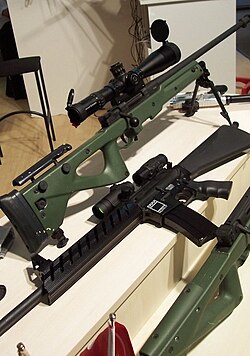
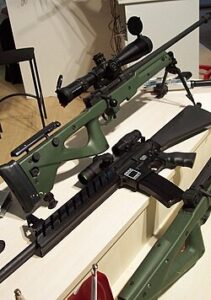
Introduced in the 1980s, the Arctic Warfare family moved away from a traditional one-piece stock and onto an aluminum chassis that runs the full length of the rifle. The receiver bolts directly into this backbone. Two polymer half thumb-hole panels clamp around it to create the familiar green, dark earth, or black “skins.”
Why it mattered: a rigid chassis keeps the action consistently supported, and the outer panels can be replaced without disturbing the barreled action. For field users it meant ruggedness and repeatable zero. For civilians it meant a rifle that came out of the case the way it went in.
Magnum turn – AWM and the rise of .338 Lapua
The AWM (Arctic Warfare Magnum) stretched the concept to magnum-length cartridges, most notably .338 Lapua Magnum. In casual use you may see AWSM used to denote those .338 builds. The formula stayed the same: cold-friendly controls and a robust bolt gun, now pushing serious distance without jumping to a heavy anti-materiel platform.
The AX leap – modular rails, folding stock, and PSR-era pressure
Unveiled in January 2010 at SHOT Show, the AX series was a major evolution based on AWM experience. It added modern mounting real estate for day and low-light optics, laser designators, and accessories without custom kits. The right-folding stock made the rifle more compact for transport and concealment, and a pistol grip modernized ergonomics for shooters crossing over from semi-autos.
The U.S. Special Operations Command Precision Sniper Rifle solicitation helped set the target: more range, caliber flexibility, and a chassis that played well with contemporary optics and accessories. The PSR contract ultimately went in 2013 to Remington Arms for the Modular Sniper Rifle, but the AX was already moving down the same practical path.
AXMC – stronger action and C.I.P.-length magazines
On 9 September 2012, AI announced that the .338 Lapua Magnum AWM would be phased out and replaced by the AXMC. The AXMC action is longer, wider, and significantly stronger to handle higher chamber pressures and temperatures than the AWM. The corresponding magazine architecture was enlarged to feed .338 Lapua Magnum at the C.I.P. maximum overall length of 93.50 mm. That detail matters to handloaders and anyone choosing longer factory loads.
AI describes the AXMC as a user-configurable, mission-adaptable long-range system that sits at the head of its lineup. For an overview of current U.S. offerings, see Accuracy International USA.
Where the AT fits
The AT sits alongside the AX line and carries forward the AI approach in a simpler package. Think of it as the same full-length chassis concept and bolt-in action, with fewer layers of multi-caliber complexity and accessory accommodations. For many civilian buyers, the AT delivers the AI feel and accuracy without going all-in on configurability.
AICS – the chassis that stepped beyond AI rifles
AI packaged the backbone itself as a product: the Accuracy International Chassis System (AICS). If you run an AI rifle, you are on an AICS by default, but AI expanded it to other actions.
- Introduced for Remington 700 receivers in 1999.
- U.S. distributors began selling AICS versions for Savage Model 10 precision rifles in late 2012.
- Variants include AICS 1.0 (fixed cheek piece), 1.5 (fully adjustable cheek piece), and 2.0 (folding stock that shortens the rifle about 210 mm when folded and adds roughly 0.2 kg).
The idea is consistent: lock the barreled action into a rigid core, then adjust what the shooter feels at the cheek and shoulder. That simplicity is why AICS footprints and magazine patterns remain reference points across the industry.
Contracts and competitions that nudged the designs
AI’s rifles evolved under real program pressure. The AX series followed years of AWM service and was, by AI’s account, partly driven by PSR requirements. The British Ministry of Defence also explored updating the L115A3 to an AX-style chassis to gain flexibility for optics and lasers, more compact folding, and pistol-grip ergonomics. Whether or not a specific contract landed, the civilian rifles benefited.
For a look inside the company’s perspective and origin story, see The Firearm Blog’s visit to Accuracy International.
The civilian line – what buyers actually see
In the U.S. market you will find AX and AT rifles, big-bore options like the AX50, the AXMC multi-caliber flagship, and chassis and magazines under the AICS banner. Recent catalogues also show AXSR models in the AX family. The magazine range spans 7.62 and .308 patterns, .338 Lapua CIP 5-rounders, and .50 BMG.
Two notes for buyers:
- Specifications can change. AI states that specs may be updated without notice.
- Export controls apply. AI’s products are subject to the United Kingdom’s export control regime. If you are purchasing across borders, expect licensing steps. See Accuracy International for policy details.
Buying choices – quick decision guide
AT or AX for a first AI
If you need multi-caliber capability and future-facing accessory mounting, start with AX. If you are set on a single cartridge and want the core AI experience with less complexity, the AT often makes more sense.
Coming from a traditional stock
Expect a different feel. The vertical pistol grip common on AX builds sets the hand directly behind the trigger, and adjustable cheek and length-of-pull make it easy to build a repeatable position around your optic height. If you want to keep your existing action, consider an AICS to bring AI ergonomics to a rifle you already trust.
Running long-range magnums
Focus on AX models configured for cartridges like .338 Lapua Magnum. The AXMC’s stronger action and C.I.P.-length magazines remove headaches for long loads and high-pressure work in varying temperatures.
Storage and transport
A right-folding AX chassis stows cleanly and stays clear of controls. If you move rifles in vehicles or tight spaces, this is a decisive feature.
Magazine compatibility
AI’s magazine ecosystem spans AW/AT patterns, AX/AICS patterns, .338 Lapua CIP, and .50 BMG. If you pair an AICS with a non-AI action, confirm the correct pattern before you buy.
Collector angles – variants and context
Collectors gravitate to the visible evolution. Early AW rifles show the original clamshell skins over an alloy spine. The AWM era marks the .338 Lapua chapter. First-wave AX rifles with modern accessory mounting and right-folding stocks bridge old and new in a way many appreciate.
AI notes that specifications can change and export controls have influenced runs. Match features to known eras and keep paperwork tight before making hard claims about provenance.
Closing thoughts
Draw a line from AW to AWM to AX and AT and the throughline is clear: a full-length chassis that keeps the action honest, controls that work in weather, and pragmatic updates driven by real users. Choose what fits your needs. AX if you want modern, rail-ready modularity. AT if you want the AI core without added complexity. Or bring some of it to a favorite action with an AICS. The standard that launched the brand still applies: the gun has to work, and it has to work well.