
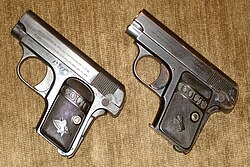
You can tell a lot about a pocket pistol the first time you slip it into a jacket. Some feel like compromises. The Colt Pocket Hammerless doesn’t. The slide sits low, the grip panels fill the hand better than they look, and there’s a quiet competence to the way the safety snicks on and off. Even a century on, the 1903/1908 Colt feels strangely current, the way good industrial design often does. It was made for real people carrying real guns in real clothes, and that shows.
The little Colt that still feels modern
Walk any decent show and you’ll spot them: the sleek, flat Colts with that horse on the grips and tiny, practical sights. They go by two names because Colt offered them in two chamberings. The 1903 Pocket Hammerless is the .32 version, and the 1908 Pocket Hammerless is the .380 version. Many of the parts, lines, and controls are shared, with subtle differences that matter to buyers and collectors. These pistols built a reputation as dependable, easy-carry sidearms for plainclothes work, business travelers, and anyone who needed a capable pistol that actually fit in a pocket or small holster.
Colt’s own literature for the model calls it an automatic pistol and makes the point clearly: it is a semiautomatic that fires a single shot with each press of the trigger. You won’t find any mechanical gimmickry here, just straightforward operation that rewards basic handling and a bit of care. Colt’s period instructions also emphasize correct operation and maintenance, and they remain useful reading today. If you’ve just acquired one, the original Colt manual for the Pocket Model in .32 and .380 is worth having on your screen while you handle the pistol for the first time.
Colt’s original Pocket Model .32/.380 Hammerless manual covers safety use and disassembly in the factory’s own words.
What “hammerless” really means
Despite the nickname, the pistol has a hammer. It’s just enclosed by the slide so it won’t snag on clothing. That shrouded profile is part of why these guns conceal and draw so cleanly. There’s also a grip safety at the rear of the frame, a control that demands a proper firing grip before the trigger can move. The frame-mounted safety on the left side of the pistol acts as the manual safety and, when engaged correctly, can also lock the slide. The combined effect is a simple set of user-facing controls that feel natural once you’ve handled the gun for a minute.
Ergonomically, there’s more going on than the photos suggest. The distance from the web of the hand to the bore axis is short, which makes these little Colts track flatter than many contemporaries. The grip angle points well for most folks. The trigger is a clean, straight-back pull rather than a hinged lever. Shooters notice the way the slide returns to battery with authority and how the recoil spring’s weight is balanced by the pistol’s all-steel mass. It’s a pocket pistol that acts like a grown-up on the range.
How it runs: controls, safeties, and handling
Think of the Pocket Hammerless controls as a small set of essentials that do exactly what they’re supposed to. The magazine catch is at the heel of the grip. The slide stop function is integrated with the safety lever, a period choice that keeps the profile smooth. The sights are small and kept low to avoid snagging, which was the priority for a pistol carried close to the body.
Colt’s factory manual stresses the basics: the pistol operates automatically through the cycling of the slide, but the trigger must be pressed for each shot. That sounds obvious, but it’s the company drawing a bright line between a compact serviceable pistol and anything that might be misused. Safety was part of the pitch. The cut of the grip safety, the feel of the manual lever, and the way the magazine seats home all reinforce that these guns were built for users who needed reliability in ordinary clothes, not a range bench laden with tools.
1903 vs 1908: .32 and .380 explained
Colt offered the same overall package in two calibers because buyers wanted a choice between softer recoil and a little more punch. The 1903 is chambered in .32 ACP. The 1908 is chambered in .380 ACP. Externally, they look like close cousins. In the hand, they feel nearly identical. Mechanically, Colt tuned each for its specific cartridge. That means magazines are caliber-specific and, as a rule, should not be mixed. A magazine that seems to fit from the outside can still cause malfunctions if its feed lips, internal geometry, or body length were made for the other cartridge. Keep the system matched and you’ll get the performance that made these pistols popular.
From a shooter’s perspective, the .32 version is usually the friendlier of the two. Many people find it easier to run well thanks to its softer recoil and a slightly different rhythm in the cycle. The .380 version adds some power, which some owners prefer. Both share the same core virtues: a genuinely compact footprint, steel construction, and a control set that rewards consistent handling.
Variants through the years: what changed and why it matters
Colt made running changes across the production life of these pistols. Some are small internal updates that only show up when you take the gun apart. Others are changes to markings, grips, or small parts that you can see at a glance. This is where collectors lean in, because certain features can help place a pistol in a broad early, middle, or later period of manufacture. Details in the rollmarks, the style of the rampant colt medallion, small changes to safeties, and the exact cut of the slide serrations can all be clues.
Buyers should approach these differences with a couple of simple goals. First, learn how the pistol you’re looking at is supposed to appear for its general period. Second, judge what’s in front of you rather than what you wish it were. It’s normal to see honest wear on a century-old pocket auto. What you want to avoid are mismatched parts that don’t belong together or refinishes that blur edges and wash out markings. Those are value and function issues.
If you plan to get deep into distinguishing sub-variants, study examples with factory letters and documentable histories. For most buyers, though, it’s enough to verify that the features on the pistol make sense together, that the controls are crisp, and that the slide and frame wear match. A tidy, mechanically sound example of either caliber will outshine an overly polished oddball with mixed parts.
Finishes and markings you will actually see
Commercial guns were commonly finished in blue, and surviving examples show the full spectrum from glossy, well-kept originals to holster-worn carry pieces with rounded edges. Over their long circulation, some pistols also received government markings and utilitarian finishes suited to service needs. If you encounter a pistol with agency or property markings, take extra time to evaluate the rest of the gun. The attraction is understandable, but the usual cautions apply: markings should be sharp, appropriate for the period, and consistent with the pistol’s other features.
Slide legends and grip medallions changed as the years rolled by. Spotting those changes is part of the fun. On a shooter-grade gun, legible rollmarks and intact grip panels are always a plus. On a collector-grade example, the sharpness of the lettering, the depth of the pony medallions, and the presence of correct period screws and pins all start to matter.
Magazines: the quiet make-or-break part
Colt’s Pocket Hammerless pistols are famously reliable when the magazines match the gun and are in good condition. They can also turn fussy if fed with the wrong magazines, tired springs, or feed lips that have been bent by well-meaning hands. Since the line includes both .32 and .380 versions, the first rule is simple: keep .32 magazines with .32 pistols and .380 magazines with .380 pistols. They are not interchangeable, even if they seem to clip in place.
What else matters with mags? Look for clean, uncracked bodies, straight feed lips, and followers that move freely. Springs should feel energetic, not gritty or tired. If you’re buying a pistol that comes with magazines, inspect them the same way you would inspect the gun. If you’re buying loose magazines, try to test them with your pistol. These aren’t complicated checks, but they save headaches. A Pocket Hammerless that stutters with a suspect magazine can run like a top with the right one.
Floorplate markings and witness holes can offer hints about era and origin. More important than decoding those on the spot is confirming that the magazine reliably locks in, strips rounds cleanly, and presents cartridges at the correct height. For a carry or range piece, function beats nostalgia every time. Keep the pretty magazine for photos and use the most dependable one on the range.
Range manners and ammo notes
These Colts were meant to be carried and shot, not babied into retirement, and many still run well with appropriate ammunition. Most owners favor standard-pressure loads that replicate the general power levels of the cartridges as originally offered. The sights are small but usable in good light. The grip safety rewards a solid, repeatable hold. You’ll feel the slide’s pace and the recoil spring’s weight in the hand, a reminder of how much these pistols accomplish without any excess bulk.
As with any older automatic pistol, your results will vary depending on the condition of springs, magazines, and the cleanliness of the gun. A basic cleaning and lubrication before a first range session often pays off. If something feels off, step back and sort the problem at the bench before you keep shooting. These are compact pistols that perform their best when kept in good mechanical trim.
Collector watch-points: a practical checklist
Shopping for a Pocket Hammerless is equal parts romance and routine. Let yourself enjoy the first part. For the second, a quick checklist helps.
- Confirm the caliber. It should be plainly marked on the slide. Make sure the magazines match that caliber.
- Work the controls. Grip safety should block the trigger when not depressed and allow a normal press when you have a proper hold. Manual safety should engage and disengage positively.
- Cycle the slide slowly. Feel for rough spots, dragging, or hesitation. The recoil spring should return the slide briskly to battery.
- Examine the ejection port and slide top for cracks or peening. Small pocket autos can suffer stress at the port if abused or if slides were battered with weak springs and hot loads.
- Look closely at the muzzle and leading slide edges. Overpolishing during a refinish can round off lines and erase sharpness in markings.
- Check the barrel’s crown and rifling. A clean, undamaged crown often tracks with good practical accuracy.
- Inspect grip panels for cracks at the screw holes and around the backstrap curve. Replacement grips are available, but original panels in good shape add appeal.
- Verify that the serial number on the frame is present and legible. Avoid any pistol with defaced markings.
- Test the magazines for lock-up and drop-free behavior. Don’t force stubborn mags; figure out what they’re hanging on.
- Ask for a simple function test if the seller allows it. Even two or three rounds can reveal a lot about magazine health and extraction.
If a pistol is represented as carrying government or agency markings, slow down and evaluate. The placement, font, and style should make sense for the period. Price should reflect condition and the presence of legitimate markings, not wishful thinking.
Care, takedown, and living with one
Colt’s period instructions are straightforward and remain the best map for learning your way around the pistol. The takedown sequence is different from later service pistols, but it isn’t difficult. It just asks you to pay attention at each step. The primary theme is controlled movement of the slide and careful alignment for disassembly and reassembly. Once you’ve done it a couple of times with the manual nearby, it becomes second nature. If you’re new to the design, keep that manual handy during the first session at your desk and go slow.
Routine care is exactly what you would expect. Keep it clean, lightly lubricated, and check springs for fatigue. If you plan to shoot yours regularly, consider refreshing the recoil and magazine springs with quality replacements appropriate for your caliber. Keep your original parts labeled and stored if they’re still serviceable but tired. Use ammunition of suitable pressure and format for the era and design. Period flat-nose or round-nose profiles often run more smoothly than exotic shapes in older feedway geometry.
Storage deserves a word. Older bluing can suffer in foam-lined cases that trap moisture. A clean, lightly oiled pistol stored in a breathable sleeve does better. If the pistol has family history or attractive finish, handle it with care at the bench and use a clean mat. These aren’t precious antiques that crumble at a touch, but they respond well to respectful handling.
Why people keep coming back to the Pocket Hammerless
The Colts have a way of getting under your skin. They do the small things right. The profile disappears under a suit coat. The controls land where your hand expects them. The trigger breaks with an honesty that encourages good shooting. Even the simple act of inserting a magazine and running the slide feels right in that unflashy way that speaks to thoughtful design. If you’re a buyer who wants a small steel automatic with real history that still makes sense on the range, the 1903 and 1908 sit near the top of a short list.
Collectors appreciate the quiet variations, the changes in markings, and the stories these pistols carry. Buyers care that parts, magazines, and good examples remain available if you look. Enthusiasts enjoy shooting them. That’s a rare set of boxes for any model to check, and it explains why these little Colts still show up in pockets, display cases, and range bags long after their debut. Start with a clean example in the caliber you prefer, match it to correct magazines, and let the pistol’s character do the rest.