
Every so often you pick up a rifle that tells you right away it was built during a shift in thinking. The Winchester Model 1895 is one of those. It is flat sided where its ancestors were rounded, it feeds from a box instead of a tube, and it was meant to sip the new smokeless powders at a time when big game hunters and armies were both reassessing what a rifle could be. John Browning designed it as his final lever-action for Winchester, and that alone hints at its significance. The rest you feel when you work the lever and watch the bolt travel through a long arc that would take this model much further than most levers ever went.
Why a Box Magazine on a Lever Gun, and Why Then
By the mid 1890s smokeless powder had changed the rules. Cartridges got faster and flatter, and pointed bullets took off because they held velocity better. That was a problem for tube magazines that stack rounds nose to primer. Browning sidestepped it with the 1895’s fixed box magazine hanging under the receiver. With cartridges now stacked one over the other, safe use of pointed bullets suddenly made sense on a lever action. As Rock Island Auction’s overview notes, the 1895 followed the smokeless-friendly Model 1894 but took the next logical step with a box rather than a tube, solving the pointed-bullet issue that European shooters were already keen on.
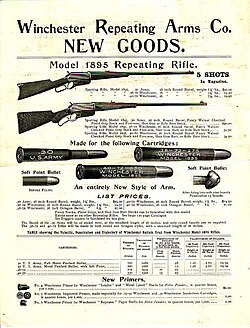
The box also let Winchester chamber the rifle for a new slate of military and sporting rounds that were longer and higher pressure than the classic pistol-length cartridges many earlier levers used. Wikipedia’s summary puts it plainly: the 1895 was designed for full-size military and hunting cartridges, and it was built to handle the higher pressures that came with smokeless powder. It was also Browning’s last lever-action for the company, and that adds a certain finality to its design choices.
If you want a single quote that cemented the rifle’s lore, you can thank Theodore Roosevelt. He famously called it a “medicine gun for lions,” and he was talking about the .405 Winchester version. Zane Grey admired it in print. Buffalo Bill Cody gave them as gifts. Those are big endorsements, but even without the celebrity glow, the 1895 is simply a smart answer to a technical problem that was reshaping rifles worldwide.
In the Hand: What the 1895 Is and How It Works
The Model 1895 has a few signatures you notice right away. The receiver is slab sided, and you can see the box magazine as a discrete unit below it. The bolt locks at the rear, just as in Browning’s earlier heavy-duty levers. That architecture kept the action strong for the day and let Winchester chamber it in modern cartridges. Standard finishes were blue, and factory barrel lengths varied by configuration and chambering, typically in the mid-20s inch range, with both rifle and carbine versions cataloged.
Cycle the lever and you feel a long, sure stroke. The cartridges rise from the box, feed straight into the chamber, and the spent case is ejected up and out. Capacity depends on the chambering, but plan on roughly four to six rounds, a detail that shows up consistently on period and auction literature. It is not a featherweight, and that is part of its charm. The 1895 aims like a Winchester lever should, but it sits in the shoulder with a more modern, centerfire-rifle confidence. It is the bridge between the 1870s and the bolt gun century that followed.
Chamberings: From .30 Army to .405 WCF and Beyond
Here is where the 1895 really surprises new collectors. It was fed a wide mix of cartridges across its production run, starting with rounds tied closely to the era’s military trends and moving into sporter territory as Winchester followed demand. Rock Island Auction’s capsule overview hits the highlights well:
- Early smokeless service and sporting rounds such as .30-40 Krag, often marked .30 Army.
- Two older black powder-era Winchester numbers, .38-72 WCF and .40-72 WCF, offered early on.
- .303 British as foreign interest grew, particularly outside the U.S.
- .35 WCF, a house sporting round.
- .405 Winchester, the Roosevelt favorite that gave the rifle some of its big-game reputation.
- .30-03 in step with U.S. ordnance, with the line later updated to .30-06 by 1908.
Each chambering changes the rifle’s personality. The .30-40 Krag and .303 British sit squarely in the “smokeless service rifle” slot and make the 1895 feel like a contemporary of bolt guns that soldiers were learning. The .405 Winchester is another animal entirely, delivering the straight-line thump Roosevelt leaned on. The old black powder pair, .38-72 and .40-72, tend to interest collectors who enjoy that twilight moment when the older propellant still had a voice. The .30-03 to .30-06 transition shows how the 1895 kept pace with American service ballistics.
Shooters today usually ask about two things with these chamberings. First, feeding with rimmed rounds. The 1895’s box magazine handles rimmed cartridges just fine. That is part of its design brief. Second, ammunition availability. For vintage chamberings, handloading tends to be the path, with careful attention to period-appropriate pressures. For .30-06 and .303, factory choices are far easier to find. As always, start with a knowledgeable gunsmith’s inspection before you light off a century-old rifle.
Military Contracts and Field Service
For a lever-action, the Model 1895 wore a surprising amount of military mud. Wikipedia’s service snapshot places the rifle in conflicts from the Spanish American War through the First World War and well into the 20th century’s border wars and civil conflicts. Chamberings tell part of that story. Rifles in .30-40 Krag line up neatly with U.S. service, and .303 British makes sense anywhere the British round was used. The big chapter, of course, is the 1895 in 7.62x54mmR, which points directly to Russian use.
Details of exact contract counts are beyond the scope of these notes, but the broad strokes are enough for buyers and collectors: the 1895 did real duty. Examples turn up with military features and markings that reflect their original service context. That history is part of why the total number built climbs so high. Wikipedia summarizes production across all types at about 425,000 units when you include the military rifles, with serials running into the 425,000 range before regular production ceased.
If your interests lean martial, keep an eye out for chambering marks and any original configuration clues. The box magazine allowed the rifle to live in the military world of pointed, full-power ammunition. That is the design legacy that sets the 1895 apart from its tube-fed Winchester brothers, and it is why the model appears in period photographs in places most lever guns did not go.
Sporting Variants and How They Were Configured
Winchester sold the Model 1895 as both rifles and carbines, and within those simple words lives a great deal of variety. Rifle-length barrels were common, with carbine-length versions for handier carry. Standard blue was the order of the day, with grades and special orders available in the era when you could still sit with a catalog and imagine your rifle before it was even machined. Collectors will find plain field guns, deluxe wood, and the occasional special engraved piece. Rock Island Auction regularly features fine engraved examples, including exhibition-grade rifles with carved stocks and gold inlay. Those are outliers from a production standpoint but a reminder that the 1895 served ranchers and safari camps as well as the gentlemen who could afford something more ornate.
Of the chamberings, the .405 WCF in a rifle configuration is the one most folks know thanks to Roosevelt. The balance of the other calibers tends to mirror broader demand trends of the early 1900s. If your interest is field use today, the reasonably available .30-06 chambering will feel familiar. If your interest is history and lore, the .405 is the heart pick. For buyers who want a carbine for the rack, shorter barrels exist, though many carbines saw hard life and honest wear, which you will see in the metal and wood.
Sights You’ll Actually See
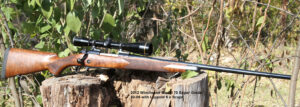
Open irons were the norm, and that is how most 1895s you handle will present. The typical picture is a front blade and a rear notch of the period. Because the model lived through an era of custom work and owner preferences, you will also encounter rifles wearing period tang or receiver apertures that were added by owners or ordered through the factory at the time. If you find one with a later scope attached, assume modifications and check for extra holes. Collectors tend to appreciate unaltered barrels and receivers, and any sight change that required drilling will matter to value.
As a practical matter, the 1895’s sights are entirely at home from 50 to 200 yards for hunting with suitable loads. That was the use case a century ago, and in the field it still is today.
Takedown Rifles: Packable and Clever
Winchester offered the Model 1895 in takedown form, a feature that shows up in period catalogs and in later reviews of surviving examples. The idea is simple: separate the barrel assembly from the receiver and buttstock for transport or storage, then return it to service without fuss. For traveling hunters in the age of trunks and steamers, that was a real convenience. You will find both rifle and carbine formats in takedown, though they are not as common as the standard solid-frame guns.
Collectors and buyers look closely at takedowns because fit matters. A good takedown locks up tight, with proper headspace and a clean return to zero for the sights. If you are considering one, check that the mechanism functions smoothly, that joint surfaces are clean, and that the action does not show odd play when assembled. As with any rifle over a century old, a competent smith can be the difference between a display piece and a confident shooter.
Accuracy, Recoil, and Field Manners
The 1895 is not a benchrest toy, and it was never intended to be. What it gives you is repeatable field accuracy with rugged mechanics. In the smokeless service chamberings, handle it like any fine iron-sighted rifle in the 2 to 3 MOA neighborhood with appropriate ammunition and a good day behind the trigger. In the .405 WCF, you get more shove. Hunters a hundred years ago chose it because it was decisive on big animals. It still is, if you load it appropriately and keep ranges sensible.
One handling trick that helps new shooters is to keep a firm, straight-line hold into the shoulder, especially with heavier loads. The stock shapes of the era differ from what many are used to on modern synthetic rifles, so be honest about your fit and how you shoulder it. Get the irons regulated for your chosen load, and the 1895 will pay you back with a very traditional kind of confidence.
Modern Reproductions and Limited Editions
Collectors often ask, can I buy a new one that looks and feels right without chasing an antique? The answer is yes, on limited terms. Wikipedia’s production summary notes a limited Browning-branded run in 1984 and later Winchester-branded limited editions beginning in the mid 1990s. Those later rifles deliver the 1895 experience with modern metallurgy and manufacturing. They are not made in the kind of continuous, year-to-year production you see on current hunting rifles, but if you want the pattern without antique age, they scratch the itch well.
Winchester’s own product page is the right place to check on current or recent catalog listings for the Model 1895 in modern trim. These newer rifles typically lean into classic chamberings and aesthetics, a nod to the original formula that made the 1895 special in the first place.
For a sense of the 1895’s era and Browning’s broader arc after he parted ways with Winchester around 1902, you might enjoy our look at Browning’s Remington Model 8 and 81. It shows where his thinking went as self-loading rifles took off, which makes the 1895 feel even more like a hinge between generations.
Buyer and Collector Tips: What To Inspect and How To Choose
Original 1895s span decades, multiple chamberings, and both military and sporting lives. That gives you choices, and it adds a few checkpoints worth your time. Here is a straightforward list I use when looking at one at a show or a friend’s rack.
- Chambering marks and barrel rollmarks. Confirm exactly what you have. The 1895 wore everything from .30-40 to .405 and .30-06, and misreads lead to wrong ammo.
- Bore and throat. These are turn-of-the-century smokeless rifles, but some early chamberings can show throat wear. A clean, sharp bore is a big plus.
- Feeding feel. Cycle snap caps or dummy rounds if allowed, and feel the lever stroke. It should be smooth, with clean pick up from the box and positive ejection.
- Stock integrity. Look for cracks, particularly in high-stress areas. Honest finish wear is fine. Structural issues are not.
- Sight originality. Many rifles wear open irons. If you see a later scope or non-period receiver sight, look for extra holes. Changes like that may affect collector interest.
- Takedown fit, if present. Assemble, lock, and check for play. A good takedown feels like a solid frame when it is together.
- Military features and markings. If a rifle presents as a service example, study its details. Martial marked rifles carry their own story. Originality matters.
- Headspace and safety. Before any live firing, have a qualified gunsmith check the rifle. That is a good practice with any antique or early smokeless firearm.
As for which chambering to choose, let your goal steer you. If you want to shoot it regularly with off-the-shelf ammunition, .30-06 and .303 British are friendly. If you want the Roosevelt aura, the .405 WCF is the clear pick. If you love the transitional nature of the 1890s, the early black powder chamberings bring that world right to hand. If you prefer a piece of military history you can take to the range on occasion, look for a service-marked rifle in a chambering with available brass and bullets for handloading.
Where the 1895 Sits on the Timeline
It is hard not to see the 1895 as the capstone of a way of thinking. Browning had given Winchester one landmark lever after another, from the 1886 that handled big dangerous game cartridges to the 1892 and 1894 that made repeaters part of everyday American life. The 1895 was the answer to the smokeless age and the pointed bullet. Then the world moved on to self-loaders and stronger, lighter bolt actions in mass service. Winchester’s own catalogs shifted that way, too.
And yet the 1895 stayed in the conversation. Sporting writers kept it there. Hunters in far away places who liked the feel of a lever but needed a serious cartridge kept it there. Later, collectors kept it there because the rifle really does feel like you are holding a design problem being solved in real time. Even museum placards note that the 1895 symbolizes the limits of the lever-action pattern being stretched by a designer who knew exactly what he was doing.
If You Want to Read and Window Shop
Two resources are worth a bookmark. First, Rock Island Auction’s overview offers a clean, readable history of the 1895’s role, chamberings, and cultural footprint, including the Roosevelt connection and the technical note on why the box magazine mattered for pointed bullets. Second, Winchester’s current Model 1895 page will tell you what the company is doing with limited editions today, and it is the authoritative place to check on features and trims in any recent cataloged runs.
For context on Browning’s Winchester years as a whole, the National Firearms Museum has a succinct summary of his work at the company and places the 1895 among the 1885, 1892, and 1894. It is a good reminder that the 1895 sits at the crest of a long wave.
Final Thoughts
Buyers often ask me, should I choose a Model 1895 over a more common 1894 or a bolt gun from the same era. My answer is that the 1895 is its own lane. If you are drawn to it, you are probably drawn to its story as much as anything. You can take an original to the range if it passes inspection and you assemble the right ammunition. You can hunt with a modern limited edition and smile at how little changed in the way it feels to run. Or you can put a .405 on the wall and know exactly why Roosevelt used the language he did. However you approach it, the 1895 rewards curiosity. It is an honest machine built at a hinge point in rifle history, and that is a joy to own in any form.
If your heart beats a little faster for box magazines on lever actions and late Victorian engineering, the 1895 will make sense the second you shoulder it. It did not replace the levers that came before, and it could not outrun the boltguns and autoloaders that followed. It was the bridge. A very handsome, very functional bridge that left tracks in both the hunting field and on military rosters. That is why it belongs in the conversation, and for many of us, on the rack.
Further reading and official resources:
- Rock Island Auction’s Winchester 1895 overview for history, chamberings, and period context.
- Winchester’s Model 1895 product page for current and recent limited edition information.