
At a small-town gun show years ago, a table held four nearly identical pistols with four very different stories. Same compact profile, same heel release, same wraparound grip held by a single screw. One had crisp black checkering. Another looked faintly reddish. A third wore blocky Cyrillic. The fourth showed a tiny circle with a 10 inside. I had wandered into the Makarov aisle of Cold War history, and I have been stopping at those tables ever since.
This guide is for collectors who want those stories straight. We will sort Soviet and Russian PMs from East German Pistole M, separate Bulgarian Circle 10 guns from Chinese Type 59s, and focus on the tells that matter: slide serrations, factory and import marks, magazines and grips, and how to inspect one in the wild. I will also point you to a couple of high-trust references that have saved me time and money.
First, what makes a PM a PM
The PM is a compact, blowback, single-stack service pistol chambered in 9x18mm Makarov. Designed by Nikolay Makarov, it was adopted as the standard Soviet sidearm in 1951. The 9×18 case body is nearly straight, which suits blowback operation and simple magazines. The PM layout is deliberately spare: a fixed barrel, slide-mounted safety that doubles as a decocker, and a heel magazine latch. See a quick overview at Wikipedia.
Collectors love the PM because it is consistent without being dull. The core design is brilliantly streamlined. As noted in modern scholarship on the PM, one long, cleverly shaped leaf spring and one wraparound grip with a single screw do jobs that take multiple parts in older designs. If you want a deeper read on part variations, serial styles, dating schemes under study, and accessories, Henry Brown and Cameron White’s book on the Soviet and East German PM is excellent, and the Forgotten Weapons review gives a clear overview.
Soviet and Russian PMs: military issue and the IJ70 clue
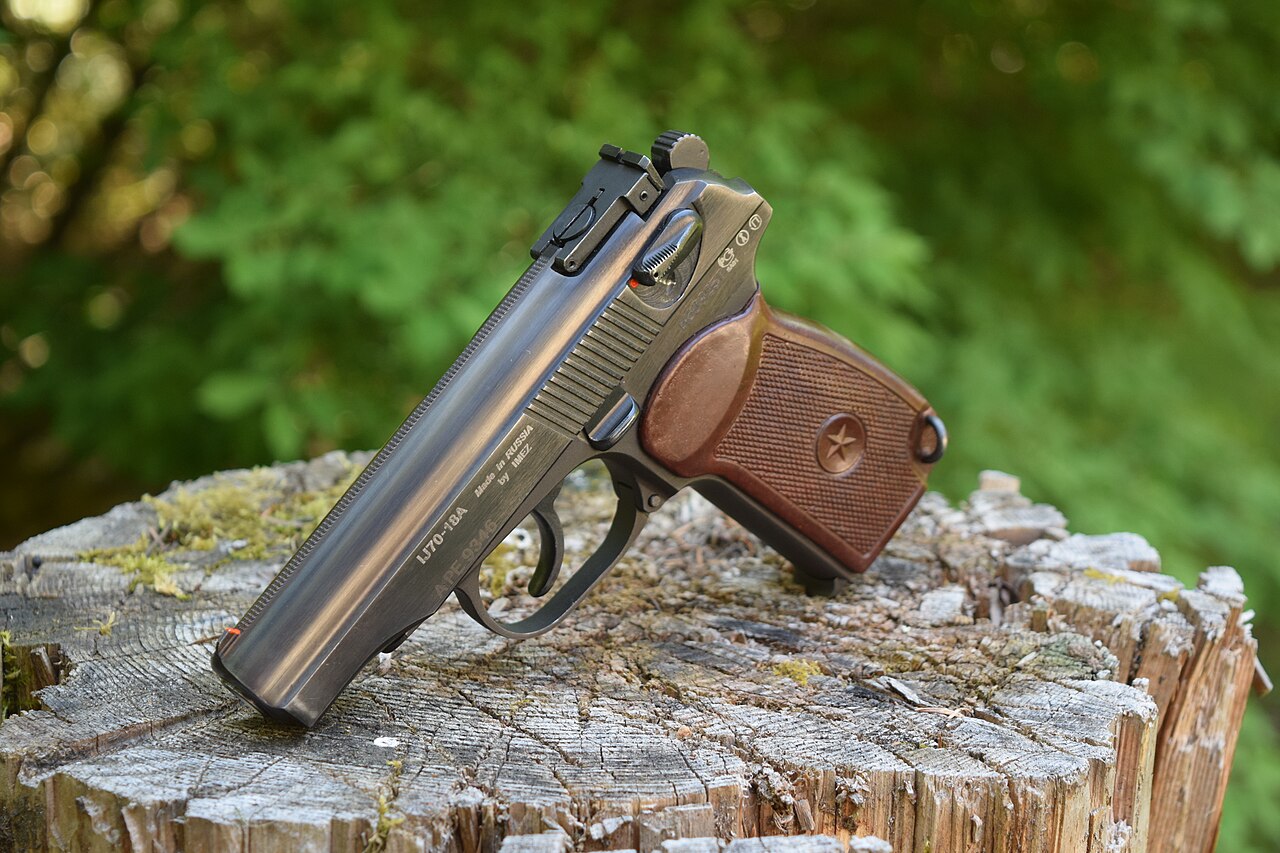
Original Soviet and later Russian military PMs are the baseline. Expect a service blue finish, fixed sights, and purposeful markings that often include Cyrillic. On the export side, Russia produced commercial PMs marked with model designations like IJ70 and English legends such as “Made in Russia by IMEZ.” Many of those have adjustable rear sights and appear in either 9×18 or .380 ACP. Some were branded for export as Baikal. If you see IJ70 on the slide and an adjustable rear sight, you are likely holding one of these commercial variants.
Quick handling clue: Russian military PMs typically show the same number of slide serrations on both sides. We will pin that down with exact counts in the serrations section.
East German Pistole M: clean lines and letter codes
If one PM variant gets called the connoisseur’s pick, it is the East German build. Fit and finish are typically excellent. Once rare in the West, many arrived here after 1990. These keep the PM’s fixed sights and clean mechanics, but their markings make life easier for collectors.
East German examples usually show a letter code and a four-digit serial on the left side of both slide and frame. Several internals on some pistols carry the last two digits of the serial electropenciled, such as the hammer. The pistols did not originally have markings to indicate model or country of origin. Grips are commonly jet-black plastic with fine checkering, though a reddish-brown flecked appearance appears on some. Lanyards are common, secured by an internal clip on some, or knotted through an extra hole in the back of the frame on others. For a focused overview, see American Rifleman’s East German Makarov piece.
Serration pattern is another tell. East German slides typically show an uneven count side to side. See exact counts below.
Bulgarian Circle 10: the clean do-it-all version
Bulgaria produced PMs at Factory 10, also known as Arsenal, from 1975 to 2007. The quick tell is a small digit 10 inside a circle stamped on the left side of the frame. Bulgarian PMs generally show straight hammer serrations, slim star-marked grip panels, and a frame lanyard ring. They stick to the original 9×18 chambering and fixed sights, which makes them a straightforward way to add a correct military-pattern PM to a collection.
Many Bulgarian imports arrived with thumbrest grips to meet import requirements. If you want the original look, swap in the slim star panels. Parts are common and the change is simple.
Chinese Type 59: faithful service with distinctive serrations
China adopted its local PM as the Type 59 in 1959. Most follow the military script with fixed sights and the original 9×18 chambering. China, like Russia, also exported PM-type pistols in .380 ACP under commercial labels, including Norinco.
As a handling clue, Chinese slides typically mirror the East German asymmetric serration pattern. Finish ranges from workmanlike to quite fine on some examples.
Slide serrations, factory marks, and import stamps
When you are at the counter with a clerk waiting, three fast checks help you separate PM variants and avoid confusing a non-PM in 9×18:
- Slide serrations. As a quick screen, Russian and Bulgarian PMs commonly have 13 serrations on each side of the slide. East German and Chinese Type 59 pistols often show 10 serrations on the left and 17 on the right. This is not the only clue, but it is fast. For a visual walk-through, see The Armory Life’s overview.
- Factory and acceptance marks. East German: letter code plus four-digit serial on slide and frame, with some internals electropenciled. Bulgarian: Circle 10 on the left frame, slim star grips, and a lanyard ring. Russian military: Cyrillic, fixed sights. Russian commercial: IJ70 and English export legends, often with adjustable sights. Chinese Type 59: straightforward military markings.
- Import stamps. U.S.-imported pistols carry an importer name and usually a location stamped on the gun. Common spots include the slide flats, frame above the trigger, or visible on the barrel through the ejection port. Small, tidy marks are generally preferred, but all import stamps document the pistol’s journey. The Brown and White book reviewed by Forgotten Weapons discusses import marks in detail, which is helpful for tracing East German examples in particular.
One more caution: do not assume every 9×18 pistol is a PM. Hungary’s PA-63, Poland’s P-64, and several Czech and Yugoslav designs share the caliber but not the pattern. Look for the PM’s wraparound one-screw grip, slide-mounted safety, fixed barrel with a simple takedown latch, and heel release.
Grips and lanyards: one screw, many clues
The single wraparound grip is a PM signature. Instead of two panels and multiple screws, you get one screw on the left side, and under it a long leaf spring that powers the magazine catch and other functions.
East German grips are normally deep jet black with fine checkering, with some showing a reddish-brown flecked tone. Lanyards vary from clipped-in cords under the grip to simple cords knotted through an extra hole in the rear of the frame. Those details can confirm an East German build when markings are obscured by refinish or import stamps.
Bulgarian guns commonly wear slim star-marked panels and a lanyard ring. Russian commercial exports may come with thumbrest or molded panels, especially on adjustable-sight IJ70 models that echo later styling while retaining the standard single-stack PM frame.
Magazines: what correct looks like and how to check them
Standard PM magazines are single-stack steel bodies holding eight rounds in 9×18 or .380 ACP. They lock via a cutout engaging the heel catch. A few checks for buyers:
- Fit and lock. Insert an empty magazine and tug. It should lock positively with minimal wobble. The heel latch should snap back under spring tension.
- Feed lips. Viewed from above, the lips should be even with crisp edges. Spread or pinched lips cause feeding issues.
- Base and spine. Inspect the baseplate for dings and the spine for ripples or cracks. A bent spine is difficult to save.
- Follower movement. Press the follower down with a tool. It should move smoothly and return briskly. Grit inside can mimic a bad spring; a careful cleaning often restores function.
Origin clues exist on magazines too, from welds to bluing, but function comes first. A reliable shooter mag is worth having even if the finish tone does not perfectly match your pistol.
PMM, Suhl builds, and commercial offshoots
The family tree has branches that matter to collectors. Russia’s PMM is a modernized variant with a double-stack frame and a fluted chamber for higher-pressure 9×18; parts do not interchange one for one with a classic PM. After reunification, some Makarov-pattern pistols were assembled and sold from Suhl as Simson-Suhl builds using available parts. They are a small but interesting niche. On the export side, Russian IJ70s appear in both 9×18 and .380 ACP with various finishes, including satin chrome. East Germany also tested a .380 ACP variant known as the Pistole Mk, with very few examples known.
How to inspect a PM at the counter
Most PMs were carried a lot and shot a little, but stories vary. Here is a practical routine before you say yes:
- Identity. Confirm it is a PM, not just a 9×18. Look for the one-screw wraparound grip, slide-mounted safety, fixed barrel, and heel release.
- Markings and matches. Note country tells: Circle 10, Cyrillic and IJ70, East German letter code plus four-digit serial. Check for matching frame and slide numbers. On some East German pistols, the last two digits are electropenciled on internals like the hammer.
- Import stamp. Find it. Size and placement affect appeal. A tidy frame mark is easier on the eyes than a billboard on the slide.
- Safety and decock. Unload, then cycle the action. On safe, the lever should block the trigger and rotate the firing pin transfer interface. With the hammer cocked, rolling the lever down should safely lower the hammer without firing.
- Trigger. Dry fire double and single action, with and without the magazine. You are checking for consistency and a clean reset.
- Barrel and crown. Light the fixed barrel. Rifling should be clear. The crown should be free of burrs and heavy dings.
- Slide and rails. Field strip and check for peening at the slide stop notch and rail edges. Minor peening is normal; heavy battering suggests hard service or weak springs.
- Recoil spring. It wraps the barrel. Avoid kinks or a dead feel. A fresh spring is cheap insurance.
- Extractor and ejector. Look for chips or deformation.
- Leaf spring. With the grip off, inspect the long leaf spring for cracks or odd bends. It is central to the PM’s function.
- Magazines. Test lockup, feed lips, and follower movement. If only one mag is included, plan for a spare.
For East German pistols specifically, examine the black plastic grips closely. Fine, even checkering is normal, and a faint brown flecking on some is not a flaw. Unusual lanyard routing through the back of the frame can be correct.
A simple type-sample path for new collectors
The PM is rich in variations. To build a tight, satisfying set without needing a second safe, try this:
- One Soviet or Russian military PM with fixed sights and Cyrillic markings.
- One East German Pistole M with the letter-code plus four-digit serial on slide and frame.
- One Bulgarian Circle 10 with slim star grip and lanyard ring.
- One Chinese Type 59 that shows the asymmetric serration pattern.
Expand with a Russian IJ70 commercial export, a Simson-Suhl post-reunification build, and a PMM to show how the pattern evolved.
Ammo, holsters, and the rest of the kit
Standardization is part of the PM’s charm. East German 9×18 ammunition was steel cased and packaged 16 rounds to a box. Holsters were simple, often full-flap duty rigs. Lanyards were issued for retention. When you build a display, matching accessories to the country and period of your pistol goes a long way.
Closing notes
The Makarov PM solves a service problem with parts that are easy to make, maintain, and carry. That simplicity left just enough room for factories and nations to leave their marks. Learn the serration counts and the country tells. Learn the Circle 10 and the East German code rhythm. Glance at an IJ70 and know why the sight looks taller. Then pick up the one that checks the boxes and feels right in the hand. That is a clean little slice of Cold War history.