The first time I saw a Ruger GP100 work at full tilt, it was on a gravel range with a shooter running hot .357 loads through a scuffed stainless gun. No drama. No timing hiccups. Just a steady rhythm and clean hits. After a few cylinders, he handed it to me with a grin. I cocked the hammer, pressed through a smooth break, and thought, ” This is why people still trust these.
How the GP100 earned its reputation
Ruger released the GP100 in the mid 1980s as the next step after the Security/Service/Speed Six family. The earlier Six-series guns were solid service revolvers. The GP100 arrived as the heavier duty evolution meant to handle .357 Magnum without flinching. Ruger brought lessons from its big-bore Redhawk into a medium frame, most notably a locking system that adds support where it counts and a beefier frame profile.
That combination gave the GP100 two things shooters notice right away. First, it feels like a solid block of steel that happens to be a revolver. Second, it shrugs off a steady diet of full-power ammo more comfortably than many peers. As one reviewer at American Rifleman put it, these are built with a tank-like toughness, and I think that captures the vibe perfectly.
Strength you can feel, and why it matters
The GP100 borrows the crane lock idea from the Redhawk, which secures the cylinder properly at multiple points. Ruger describes it as a triple-locking cylinder that is secured at the front, rear, and bottom. The yoke uses a spring-loaded lug for added support, and the result is a cylinder that stays put and keeps working shot after shot. It is a simple, confidence-inspiring system that owners point to when they talk about long-term durability.
Ruger also went with a solid, heavy frame and upgraded steel. According to published histories, the design was meant to handle an ongoing diet of full-power .357 Magnum. That is a design goal, not a free pass to ignore wear or maintenance, but it lines up with what many owners report: the GP100 is happiest when you feed it the real thing.
The family tree is bigger than you might think
When people hear GP100, they usually picture a six-shot .357, often with a 4-inch barrel. That classic spec still exists, but the GP100 line is wider than that stereotype.
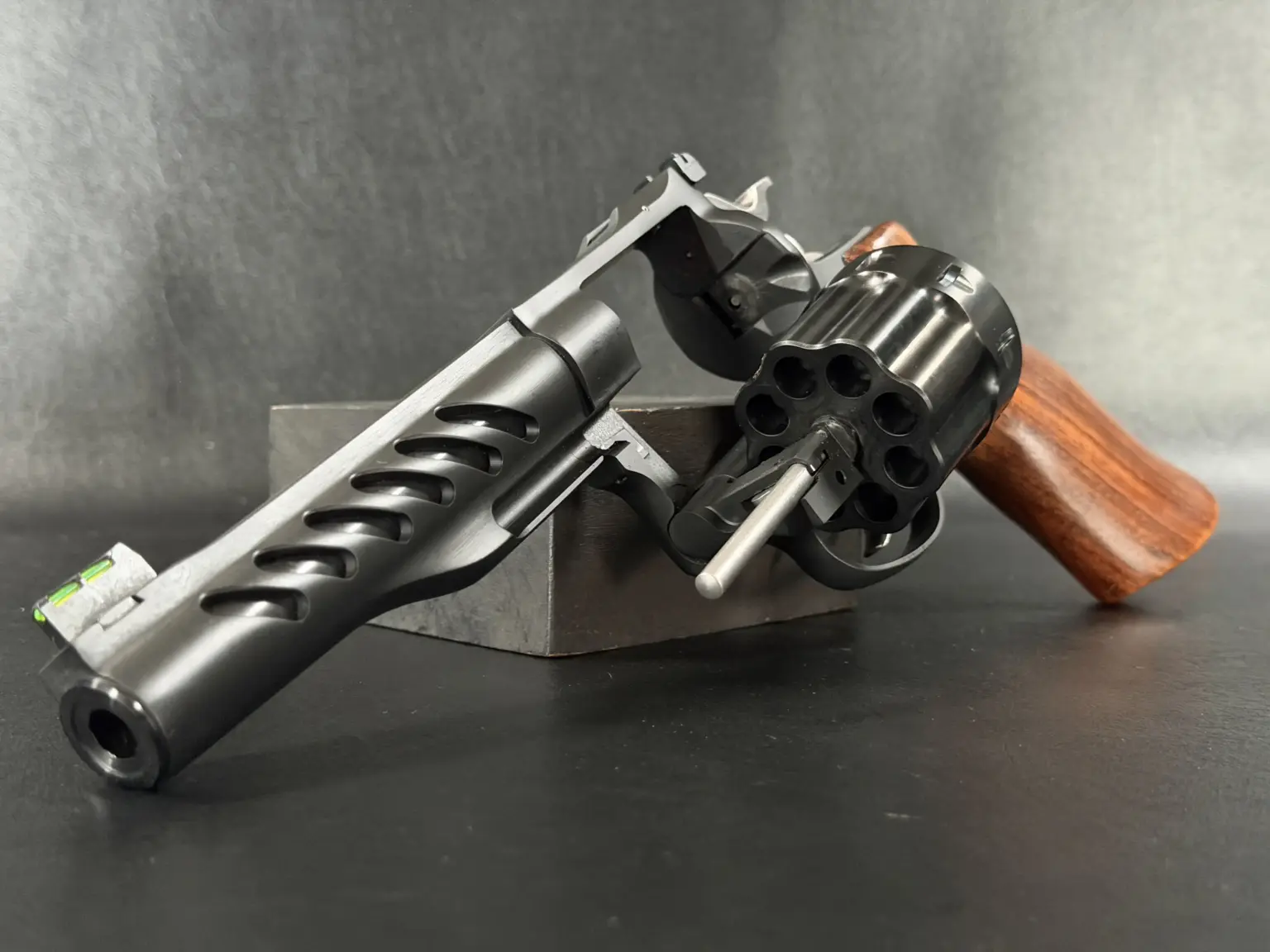
Across the family, you will find versions chambered in .327 Federal Magnum, .357 Magnum, .38 Special, .22 Long Rifle, .44 Special, and 10mm Auto. Capacity changes with caliber and specific model. There are five-shot .44 Specials, six-shot .357s, 10mm Autos, seven-shot .357s and .327s, and even ten-shot .22 LR models. Barrel lengths run from short and handy to long and sight-friendly, with 2.5, 3, 4, 4.2, 5, and 6-inch offerings depending on the exact variant.
That mix makes the GP100 a lot of things to a lot of people. It can be a trail gun, a sturdy home-defense piece, a plinker in .22 LR, a big-bore .44 Special with gentle manners, or a 10mm for folks who like moon clips and auto-pistol ammo in a revolver.
Sights and triggers: the parts you work with most
Ruger set the GP100 up with practical sights and a trigger system that suits both new shooters and old hands. Many models use a plain, black post-and-notch sight picture with an adjustable rear for zeroing. Some variants ship with a removable fiber optic front that is bright and easy to track, paired with an adjustable square-notch rear. Swapping front sights is straightforward on those versions, which is a nice touch.
As for the trigger, the GP100 is a traditional double-action with single-action capability. You can shoot it by pressing through a full double-action pull, or cock the hammer for a lighter single-action break. Reviewers often praise the smoothness of the double-action press, and I have to agree. It is not a featherweight pull, but the take-up is consistent and predictable, which is what matters for practical accuracy. One reviewer who tracked groups with a 2.5-inch seven-shot version saw average clusters around 1.8 to 2.5 inches at 15 yards. For a short-barreled wheelgun with defensive sights, that is honest performance.
If you want to tune feel even further, the GP100 has long enjoyed strong aftermarket support. Springs and small parts are available, and a good armorer can slick up the internals. Ruger’s own design helps here, too, which brings us to maintenance.
Maintenance without drama
Ruger built the GP100 around integrated subassemblies that come apart without special tools, so cleaning and reassembly are friendly for owners who like to keep their guns running without a trip to the smith every time. It is a design approach that fits the GP100’s personality. The gun begs to be shot, cleaned, and shot again.
There is also Ruger’s transfer bar system. The transfer bar is a safety part that sits between the hammer and firing pin. If the trigger is not held to the rear, the bar is not in position, which helps prevent the revolver from firing if it is dropped or the hammer is bumped. Ruger describes this as providing an unparalleled measure of security against accidental discharge. No mechanical system replaces safe handling, but it is a meaningful layer of protection that helped make many shooters trust Ruger wheelguns.
Grip frame and ergonomics: why it fits so many hands
The GP100 uses a grip frame that does not force one grip shape on the shooter. Instead, the frame accepts a wide range of aftermarket grips. Current-production guns commonly wear one-piece Hogue rubber grips from the factory, which many shooters find comfortable. If you prefer something smaller, larger, stickier, or more classic, there are choices. That flexibility is one reason a GP100 can be set up for medium hands, big mitts, or something in between without having to chase a specific frame version.
Seven shots in a medium frame
One of the modern twists that helped keep the GP100 current is the seven-shot cylinder variant. The late 1990s saw the idea of a seven-shot .357 become mainstream in medium frames, and Ruger has joined that party with GP100 models that pack one extra round without jumping up in overall size. The American Rifleman’s tester noted that there is just enough room for the seventh chamber and that it requires different speedloaders and strips than the classic six-shooters. That is a small price for many shooters who like the added capacity.
On the range, those seven-shot models behave like you would expect a solid GP100 to behave. With a 2.5-inch barrel, one test gun still produced tidy groups at 15 yards and offered controllable recoil. Longer barrels buy you more sight radius and a little more velocity, though the 2.5 and 3-inch models really stand out for trail-to-town carry where you want power in a compact package.
Barrel lengths and roles: picking what suits you
Here is a simple way to think about barrel length choices on a GP100, based on common user experience and published tests:
- 2.5 inch: Short and stout. Great for trail carry and concealed use with the right holster. Still shoots better than its size suggests.
- 3 inch: A sweet spot for many. Slightly more sight radius and velocity. Easier to find holsters than the 2.5 in many cases.
- 4 or 4.2 inch: The classic do-most-things barrel. Good balance, full ejector stroke, and a very practical all-around choice.
- 5 or 6 inch: The range and field versions. More weight out front and a longer sight radius. Friendly for hunting within .357’s lane or for target work.
One small note for the carry crowd: American Rifleman’s experience with a 2.5-inch model showed that 3-inch GP100 holsters will often cover the shorter barrel with a little extra leather at the bottom, which can actually be a plus. It is a handy workaround when exact-fit scabbards are hard to find.
How it shoots when you push it
There is a certain calm to a well-balanced .357 that weighs enough to help. The GP100’s mass and grip shape let you run full-power loads with less fuss. You still know you fired a magnum, but the front sight returns in a predictable way, and fast follow-ups do not feel frantic.
On paper, a short GP100 can still stack shots nicely at typical defensive distances. Handguns magazine documented 1.8 to 2.5 inch averages at 15 yards from a 2.5 inch seven-shot revolver. The double-action pull is on the longer side, as is common with many service-style wheelguns, but it is smooth. Single-action breaks are crisp and let you milk a little more precision from the bench or bags.
In stainless steel, the gun wears well in hard use. That is not a performance metric, but it explains why so many 1990s GP100s still look honest and presentable after years of firing schedules. Pew Pew Tactical takes calls the GP100 a tank and highlights how it remains a fantastic revolver that is fun and accurate, with a nod to its appeal for beginners, too. That matches the feedback I hear most often from new wheelgun shooters who borrow one for a first range trip.
Support gear and small decisions
The GP100’s size and weight make it a little easier to live with full-power ammo. That same bulk does ask more from carry gear. You will want a real belt and a holster with proper support. Medium-frame revolver gear is not as plentiful as it was a decade ago, but you can still find excellent holsters, pouches, and speedloaders from reputable makers. If you go with a seven-shot .357, make sure you grab the correct speedloaders and strip carriers. They are different than the standard six-shot patterns.
On sight, consider your use. For daylight-range work and general carry, a black post-front with an adjustable rear is familiar and quick. For low light or aging eyes, a fiber optic front can help. Some GP100s include a bright green factory-installed fiber-optic front sight that is easy to replace if you want to tune the height or color.
Why buyers still choose the GP100
In a market where polymer pistols rule the sales charts, the GP100 holds a loyal space for a few simple reasons:
- It is tough. The frame and locking system inspire confidence with real .357 loads.
- It is shootable. The weight, grip shape, and sight options make it approachable for new shooters and rewarding for experienced ones.
- It is straightforward to maintain. Subassemblies come apart without special tools, and parts support is good.
- It is flexible. Calibers, capacities, and barrel lengths cover a wide range of uses.
That is the short list. The longer answer involves feeling and trust. The GP100 is a revolver that just works. It encourages practice instead of punishing it, which is what any defensive or field gun should do.
Thinking like a collector
Collectors who like wheelguns usually keep a soft spot for the GP100 because it marks a clear step in Ruger’s double-action timeline. The Security Six family set the stage. The GP100 showed where Ruger wanted to go in terms of strength and user-friendly maintenance. Seven-shot versions add a modern chapter that sits beside similar moves from other makers. Stainless guns with honest holster wear, short-barrel variants that were made in smaller numbers than the 4-inch standards, and caliber outliers like 10mm or .327 Federal Magnum often catch a collector’s eye.
If you care about Bill Ruger’s design legacy beyond the GP100, you will find kindred themes in other company icons. We covered that spirit in our look at the single-action Ruger Blackhawk, and in the broader story of wheelguns, we explored what keeps the double-action format so enduring in our feature on why DA revolvers continue to matter.
Which GP100 fits your needs
Here are a few clean starting points that line up with how most people use these guns. There is no single right answer, just honest tradeoffs.
- Range and home defense: 4 or 4.2-inch .357 with adjustable sights. Balances well, easy to shoot, cleans up quickly. Six or seven shots both make sense.
- Trail carry and general-purpose: 3-inch .357. Handy, powerful, holster-friendly. The 2.5-inch is even shorter if concealment is the priority, though sight radius shrinks.
- Small game and rimfire training: 10-shot .22 LR. Same feel, lower cost per round, and a great way to build skill on a platform you might carry in a centerfire version.
- Mellow big bore: 5-shot .44 Special. Classic cartridge manners with the GP100’s heft and handling.
- Moon clip crowd: 6-shot 10mm Auto. A neat twist for those who like semi-auto power and easy extraction with clips.
Whichever route you choose, the core GP100 traits carry through. You get a stout frame, a cylinder that locks up with real authority, a serviceable trigger that can be improved, and a sighting system that is more capable than it looks at first glance.
A quick word on safety and expectations
The GP100’s design includes features meant to keep you safe, like the transfer bar system, and features meant to make the gun last, like the multi-point cylinder lock and heavy frame. Those are all positives. Still, heavy .357 loads will wear any revolver over time if you shoot enough of them. Pay attention to maintenance, use good ammo, and have a qualified armorer check the gun if you see changes in timing or feel. Ruger’s design makes care straightforward, and staying ahead of wear is part of long-term ownership with any mechanical tool.
Final thoughts from the bench
Every few years I run into someone who says they are just now getting around to revolvers and ask where to start. If their interest includes real .357 Magnum, the GP100 sits near the top of the list. That is not because it is flashy. It is because the things you can see in the design match what you experience when you shoot it. The cylinder locks and stays locked. The gun takes a beating and asks for another cylinder. The sight picture is honest. The trigger makes sense. And the grip can be changed until your hands are happy.
There are lighter choices, fancier choices, and rarer choices. But respect is earned. The GP100 has been earning it since 1985, one clean press at a time.
Sources used for features, specs, and testing impressions include Ruger’s GP100 product overview for mechanical details such as the triple-locking cylinder, grip frame design, subassembly disassembly, and transfer bar; the GP100 overview at Wikipedia for the model history, frame lineage, calibers, capacities, and barrel lengths; American Rifleman’s coverage of the seven-shot GP100 for practical notes on the cylinder, sights, holsters, and barrel roles; Handguns magazine’s review of the seven-shot GP100 for accuracy and trigger comments; Pew Pew Tactical and Gun University for user-level feedback on durability, sights, trigger feel, and use cases.