
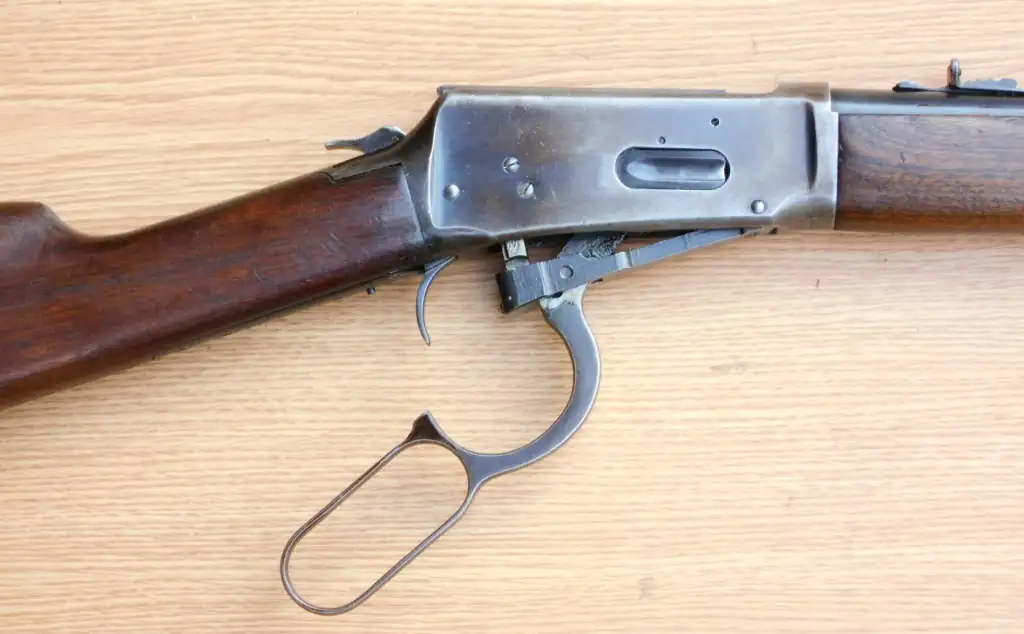
You can still spot a Model 94 from across the rack. Slim fore-end, carbine-band lines, and that lever that begs a hand. The real question is which era you are holding and whether its features match how you plan to use it. A little timeline knowledge makes the hunt easier and the decision clearer.
Why the Model 94 caught on
John M. Browning’s Model 1894 arrived with smokeless powder. Winchester bought the design and adapted it to the then-new .25-35 WCF and .30 WCF, the latter becoming the .30-30 Winchester. It kept the familiar side loading gate and tubular magazine, but with the strength to handle smokeless. More than 7.5 million rifles later, the appeal is obvious. As Guns & Ammo notes, the most popular configuration has long been the 20 inch carbine at about 6.5 pounds, short and handy for deer woods duty.
Pre-64: what it means to buyers
In 1964 Winchester changed manufacturing to reduce costs. That single date splits values and preferences. Pre-64 rifles tend to bring a premium and are prized for their fit and finish. Post-64 rifles vary across decades, with practical feature changes that some hunters prefer. If you are sorting one at the counter, judge the whole rifle: wood-to-metal fit, finish quality, and sight style usually tell you more than any one tiny detail. Pre-64 status matters most to collectors; later features often win for shooters.
Top-eject vs Angle Eject
Classic 94s eject straight up from the top. It is fast and traditional, but mounting a scope over the receiver is awkward. In the early 1980s Winchester introduced side or angled ejection so empties clear to the right, finally allowing an over-the-receiver scope mount. If you plan to run glass, that single change often decides the purchase. If irons are your thing, top-eject pre-64 and early post-64 carbines scratch that itch.
Receivers and how the 94 runs
The 94’s receiver houses a compact, sturdy mechanism. American Rifleman highlights its hinged floor plate that pivots down when the action opens, revealing a simple layout that has proven reliable. When clean and in spec, the lever throw feels short and smooth, and the bolt locks up with authority. Remember the tubular magazine stacks cartridges tip to primer. Use flatnose, hollow point, round nose flat point, or similar bullets designed for tubular magazines. Never use pointed bullets in a centerfire tubular magazine. Winchester’s Model 94 owner’s manual spells this out plainly.
Carbines vs rifles
The carbine most of us picture wears a 20 inch round barrel and carries light. Rifle versions stretch to 24 or 26 inches with round or octagon barrels. Add a full-length magazine and crescent buttplate and you get the classic long rifle look seen on many commemoratives. Guns & Ammo notes a 26 inch octagon rifle runs about 7.5 pounds, still very carryable.
Cartridges across the decades
The first Model 94s appeared in .32-40 and .38-55, then quickly added smokeless .25-35 WCF and .30 WCF, better known as the .30-30 Winchester. That pairing of a quick lever gun and a mild, effective .30-30 filled countless freezers. In the 1980s Winchester introduced the Model 94 Big Bore in .307 Win., .356 Win., .375 Win., and later .444 Marlin for more punch while keeping the familiar form factor.
Safety features by era
- 1894 to early 1990s: Safety block and a hammer half-cock notch were the norm.
- After 1992: A manual safety was added, initially a crossbolt (per Guns & Ammo).
- 2003 to present: Manual safety moved to the tang on current production rifles.
These cues help date a rifle at a glance and let you pick the control scheme you prefer.
Commemoratives worth knowing
Winchester’s long list of commemoratives starts with the 1964 Wyoming Diamond Jubilee and includes the 2016 Model 94 150th Year Commemorative. In 2019, two 125th Anniversary rifles appeared for one year: High Grade and Custom Grade. Both have 24 inch full octagon barrels, full magazines, crescent buttplates, and blued steel furniture. The High Grade stands out with a nickel-finished receiver and hand-chased engraving. For a closer look at these editions, see the Guns & Ammo overview: Winchester Model 94 125th Anniversary.
Used-buyer inspection checklist
- Bore and chamber: Inspect from the breech for sharp rifling and no obstructions. Light frost is common on old hunters; heavy pitting or a ringed bore is a red flag. The manual reminds you to ensure no patches or debris remain.
- Action feel: Cycle the lever slowly, then briskly. It should feed and eject cleanly if you can test with dummy rounds. Grit or a hitch often points to dried oil or wear.
- Ejection path: Top-eject flips up; Angle Eject clears right. If scoping, confirm Angle Eject and look for factory holes or an existing base pattern.
- Safety features: Identify half-cock only, crossbolt, or tang safety and verify positive function. The half-cock notch should hold securely.
- Stock head and tangs: Look closely for hairline cracks where the stock meets the tangs.
- Magazine tube and bands: Check for dents, wobble, and over-tightened or damaged screws. Dents can cause feeding issues.
- Sights: Note if they are era-correct or aftermarket. A rear sight drifted hard to one side may hint at alignment problems.
- Finish and markings: Honest carry wear is fine; look out for cold-blue touchups, pitting under the woodline, and sanded stocks. Crisp rollmarks help confirm originality.
- Trigger and function: Dry fire only if allowed. You want a consistent break. The hammer should not follow the bolt, and the lever safety should work predictably.
Care, ammo, and maintenance basics
Clean after each range or field day. Winchester advises removing powder fouling with solvent, scrubbing with a brass brush that is pushed completely through the bore before withdrawal, then dry patches. Wipe finger marks from exposed metal, clear any dried oil from the receiver, and give the wood a light oil or a furniture polish, not both. Use only modern factory ammunition in the exact caliber rollmarked on the barrel and suitable for tubular magazines. Examine every cartridge you load. The owner’s manual is the final word here.
Modern production and quality
Production ran in New Haven, Connecticut from 1894 until 2006 when U.S. Repeating Arms closed. It resumed in 2011. Current Model 94s are built by Miroku in Japan, imported by Browning, and marketed by Winchester Repeating Arms. Coverage in American Rifleman and Guns & Ammo notes these rifles are faithful and well finished. If you want new with classic manners, today’s runs are easy to recommend. You can browse current offerings at winchesterguns.com.
Closing thoughts
The Model 94 endures because it carries light, points fast, and comes in configurations for almost everyone. Pre-64 charm, Angle Eject practicality, half-cock hammers and tang safeties, plain carbines and octagon rifles, even Big Bore thumpers. Decide how you will use it, match the era and features, and then pick the one that shoulders naturally. Work the lever, check the bore, confirm the cartridge, and listen for that soft clack as it closes. The rest tends to sort itself out on the first walk into the woods.
Sources: American Rifleman histories of the Model 94, Guns & Ammo’s coverage of production and safety timelines, and Winchester’s official Model 94 owner’s manual for ammunition and maintenance guidance.