
Every company has a moment when a hard idea becomes real steel. For Weatherby, that moment was the Mark V. It wasn’t just a new rifle. It was Roy Weatherby saying out loud, and then proving, that speed needs a stronger engine. If you’ve ever closed a Mark V bolt and felt that short, slick rotation, you’ve handled a design built around velocity from the start. This is the story buyers and collectors keep circling back to, because it ties together Roy’s magnum cartridges, nine-lug and six-lug actions, three different countries of manufacture, and a rifle that still anchors Weatherby’s line today.
A fast start: Roy’s velocity obsession finds its action
Roy Weatherby’s name became synonymous with pushing bullets fast. Before the Mark V, he built his rifles on actions from others, including FN Mauser, Schultz & Larsen, and Mathieu. That worked for a while. But as his high-performance cartridges grew in reputation, so did the need for an action that didn’t just tolerate Weatherby pressure and case geometry, but embraced it.
In 1954, alongside chief engineer Fred Jennie, Roy began developing a new bolt action specifically around his magnums. By 1957, the rifle we know today as the Mark V was introduced. Prototypes had been tested and patents were in motion by 1958. The early work was hands-on and local. Components were first investment cast in San Francisco by Precision Founders and assembled at Weatherby’s South Gate, California headquarters. Only a few thousand actions came out of that setup before Roy shifted gears to large-scale, forged production overseas.
From South Gate benches to Sauer forges
In 1959, Weatherby opened a second line in Eckernförde, Germany, partnering with J.P. Sauer & Sohn. Sauer supplied forged action components and barrels. After those first few thousand California-assembled actions, Sauer became the sole source for Mark V actions for the next decade.
Those early German Mark Vs set the visual and mechanical template. They cemented the Mark V as Weatherby’s flagship and carried a wide spread of chamberings, from the brisk .257 and .270 Weatherby Magnums up through the 7 mm, .300, .375, .378, and the big .460 Weatherby Magnum, along with popular American and European rounds of the period. This was the Mark V’s coming of age: a high-strength, high-style action paired with cartridges that demanded both.
Why nine lugs mattered
Roy Weatherby had a checklist for this action. It needed a short bolt lift, a full-diameter bolt body, and the ability to cradle very large-diameter Weatherby cartridges like the .378 and .460. The result was a massive, cylindrical receiver with an integral recoil lug and a one-piece, full-diameter bolt. Up front sat nine compact locking lugs, arranged in three rows of three, ahead of a protruding bolt nose. The extractor was a spring-powered, pivoting design. Ejection came from a plunger.
The key experience for a shooter is that short bolt rotation. Depending on the source and variant, you’ll see it described in the mid-50s of degrees. The point is feel. The shallow cam path plus three banks of lugs give you quick bolt lift and less hand travel to re-cock and feed the next round. With heavy magnums and gloved hands, that matters.
The other big design promise was safety and strength. Weatherby promoted the Mark V as the world’s strongest bolt action, leaning on the design’s three rings of steel around the case head and the thickness of the receiver ring made possible by that full-diameter, shallow-lug bolt. Those are not just brochure lines. They are visible design choices that helped the Mark V handle the stoutest Weatherby cartridges of its era.
The six-lug Mark V Varmintmaster arrives
By the early 1960s, Roy had another itch. Speed wasn’t only for big game. In 1964 he introduced the Varmintmaster action, a six-lug, scaled-down Mark V for hot little cartridges like the .224 Weatherby Magnum. The idea was simple: keep the feel and safety profile of the Mark V, but trim the size and weight for a varmint rifle that shot flat and carried lightly.
The six-lug layout preserved the short bolt lift feel in a more compact bolt. It also showed Roy’s willingness to treat the Mark V as a pattern rather than a single size. To buyers today, this is why you will find both nine-lug and six-lug Mark Vs, the former tied to the big magnums and the latter associated with smaller, faster rounds and lighter rifles.
German, Japanese, and U.S. builds: what changed
Ask any Mark V collector and they will talk eras. That’s not just nostalgia. The rifle’s country of origin changed twice after the German years, and each shift came with its own small differences and plenty of opinions.
West Germany with J.P. Sauer & Sohn
From 1959 through the end of the 1960s, Sauer forged Mark V components and barrels in Eckernförde. These are the rifles many picture when they think of early Weatherby style. If you handle one, expect refined metalwork and classic lines. Initial chamberings during this period included the signature Weatherby magnums already mentioned, and you will encounter European and American standards from time to time as well.
Japan with Howa Machinery
In 1970, costs in Europe nudged Weatherby to move Mark V production to Howa in Japan. The key here is that the design stayed true to intent. The strength of the action didn’t take a step back. Some collectors even praise Howa’s fit and finish. You’ll often see a clean, consistent build quality on Howa-made Mark Vs, and plenty of those rifles still shoot tight groups today. Howa produced Mark Vs through to the mid-1990s.
Back to the United States
In 1994, Weatherby brought Mark V production home to the U.S. If you pick up a modern Mark V, you’re looking at a domestic build that still wears the same core engineering Roy and Jennie landed on in the 1950s, while embracing modern manufacturing and contemporary features.
As a buyer, you can usually tell origin by rollmarks on the receiver or barrel. West Germany, Japan, or USA markings are commonly encountered and add useful context when evaluating a rifle’s era and features.
Cartridges that defined the Mark V
Roy’s cartridges were the fuel for this engine. Many of them grew from the .300 Holland & Holland case, blown out and fire-formed to boost capacity and speed. The early Mark V chamber list speaks to that goal: .257, .270, 7 mm, .300, .375, .378, and .460 Weatherby Magnum headline the German period, and those chamberings continued to define the platform’s reputation.
On the small-bore side, the six-lug Varmintmaster showed how the platform could scale to rounds like the .224 Weatherby Magnum. It gave shooters that classic Weatherby flat-shooting profile in a lighter rifle that carried well and shot fast. If you’re looking at a six-lug Mark V, it is often these high-velocity small bores that make the package shine.
The thread that runs through every Mark V cartridge list is velocity. The action wasn’t designed first and then matched to cartridges later. It came out of a velocity-first mind, and the rifle shows it every time you feel that short bolt lift and see what those Weatherby cases can do.
Stocks, feel, and the Monte Carlo signature
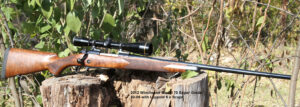
People sometimes talk about the Mark V as if it is just an action. The truth is that Weatherby has always wrapped that action in a distinct stock style. The raised Monte Carlo comb Weatherby favored is more than a look. It lifts the cheek into line with moderate to higher-mounted scopes, and it helps guide recoil straight back. Paired with the short bolt lift, it makes the Mark V feel quick through the shot and recovery.
Modern builds keep that vein alive. The current Mark V Accumark, for example, rides a hand-laid, raised Monte Carlo fiberglass stock. It pairs with a No. 3 contour barrel and modern surface treatments. You will see Graphite Black Cerakote on the receiver, bolt, bolt knob, and safety on current Accumarks, as well as a two-tone fluted barrel that keeps weight manageable while holding onto long-range accuracy goals.
Special editions underscore how Weatherby still treats the Mark V as a premium hunting rifle. The Live Wild edition, designed with hunter Remi Warren, layers in an adjustable TriggerTech trigger and a spiral-fluted barrel. The point is not that every Mark V looks the same. The point is that Weatherby keeps the action at the center and then builds legitimate field features around it for real hunts.
Proofs and strength claims
Weatherby put its reputation on the line by calling the Mark V the world’s strongest bolt action. The design choices that supported that claim are visible. A thick receiver ring wraps the chamber. The full-diameter bolt shrouds the case head with three concentric walls of steel. And the locking system spreads load across nine lugs on the magnum action, with generous barrel and receiver thickness around the chamber.
The company also publicized some extreme testing. Third-party descriptions have cited proof testing at very high pressures, with published figures as high as 200,000 CUP. Even if you never plan to flirt with the edges of performance, these are reminders of what Roy was chasing. He wanted margin, and he wanted it built into the rifle so that fast bullets didn’t have to mean thin safety buffers.
For collectors, strength claims become part of the rifle’s lore. For buyers, they translate into confidence that the action is built to live where Weatherby cartridges live. No matter the era, that’s worth understanding when you shoulder a Mark V.
How to shop Mark Vs by era and feature
Mark Vs make sense when you sort them by two simple axes: action type and country of manufacture. Do that and the rest of the details fall in line.
Action type
- Nine-lug magnum action. This is the classic big Mark V that handles the long Weatherby magnums. Expect the short bolt lift feel and the visual heft of a large-diameter bolt and thick receiver ring.
- Six-lug action, introduced with the Varmintmaster in 1964. Lighter, shorter, and built for smaller, very fast cartridges. You still feel the Mark V DNA when you run the bolt.
Country of manufacture
- Germany. J.P. Sauer & Sohn production began in 1959 after early California assembly and defined the first true production era. Many of the initial Weatherby Magnum chamberings appear here.
- Japan. Howa-built Mark Vs began in 1970 and continued through the early 1990s. Collectors often praise their consistent fit and finish, and the action’s strength remained a constant.
- United States. Production returned in 1994 and continues today with modern features layered onto the original core design.
When evaluating a rifle, look for origin markings on the receiver or barrel that indicate West Germany, Japan, or the USA. Chambering also gives clues. The largest Weatherby magnums strongly suggest a nine-lug action and, depending on furniture and finish, can signal the era.
If you are shopping used, condition and originality matter. Stocks and optics mounts are easily changed, so focus on action smoothness, bolt lug contact, the condition of the bore, and whether the finish on the receiver and bolt shows appropriate wear for its age. On German rifles, forged surfaces and early Weatherby styling often catch the eye. On Howa rifles, uniform machining and finishing are common strengths. On modern U.S. rifles, look for contemporary features like Cerakote, fluting, and factory triggers that point to current production.
Where the Mark V sits today
The Mark V remains Weatherby’s flagship bolt action. That’s not nostalgia. It is a practical nod to a design that still does what Roy asked of it. It contains serious pressure, runs with a short bolt lift, and wears stocks that help you shoot well with optics. Weatherby keeps breathing on it by adding features that reflect how people hunt right now, from carbon-friendly finishes to modern triggers and barrel profiles.
For someone buying their first Mark V, the current lineup is straightforward to understand. You pick the action size and cartridge that fits your hunts, then choose the stock and barrel profile that matches your terrain and range. The Accumark is a good example of that middle path. It blends carryable weight, a stiff No. 3 barrel, and that classic Monte Carlo fiberglass stock. Special editions like the Live Wild show how the platform can be configured for a wide menu of hunts without straying from its core action.
Collectors see the Mark V differently. German Sauer-made rifles appeal for their early place in the story and aesthetics. Howa rifles offer a sweet spot of quality and value in the used market, and some of them show excellent fit and finish. U.S.-made Mark Vs carry modern feature sets while keeping the original engineering at heart. There isn’t one right answer. There is a right answer for your taste and your hunts.
A few closing thoughts for buyers and collectors
The Mark V wasn’t built as a generic bolt gun. It was built as a Weatherby bolt gun, tailored to cartridges that chased speed. That is why its timeline is so clean. The action was conceived in the 1950s around Roy’s magnums. It matured with forged German parts. It expanded and steadied with Japanese manufacturing. It came back to the U.S. with modern builds. Along the way it spun off a six-lug counterpart for small, fast rounds, and it earned a reputation for strength that still shadows the name.
If you want a single reference piece on its origin and mechanics, the American Rifleman overview of the Mark V’s history and disassembly lays out the development, features, and the German shift in helpful detail. If you’re curious about how the current factory presents the platform, Weatherby’s own Mark V page shows how the action lives today in different models with modern features.
Stand behind one at the range or on a ridge and the throughline is easy to feel. The bolt lift is short. The recoil comes straight. The rifle wears the speed it was built around. That was Roy’s idea from the start, and it still shows every time you close the bolt.
Weatherby Mark V history and disassembly at American Rifleman