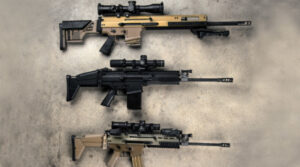

Put an SVD and a PSL on the same bench and the comparisons start fast. From ten feet they look related. From ten rounds they feel like they grew up in different families.
This guide gives collectors and shooters the specifics that matter: how they are built, what optics and rails they use, what to look for on import marks and magazines, and what the differences feel like on the firing line.
At a glance: real differences that matter
- SVD: purpose-built marksman and sniper rifle designed by Yevgeny Dragunov, part of a rifle-scope-cartridge system.
- PSL: Romanian designated marksman rifle based on the RPK, scaled for 7.62x54R.
- Gas: SVD short-stroke and adjustable; PSL long-stroke and nonadjustable.
- Receiver and rail: SVD milled with integrated side rail; PSL stamped RPK-type with a riveted-on side rail.
- Magazines: not interchangeable. PSL mags have X-stamped sides; Dragunov pattern mags use a different geometry and stamping.
- Muzzle devices: SVD elongated cage-type flash hider; PSL slotted brake-flash combo.
Gas systems and bolts
SVD: short-stroke piston with user-adjustable gas. The action uses a rotating, three-lug bolt and a carrier system distinct from the AK lineage. The idea is reliable cycling with a controlled impulse you can tune for conditions.
PSL: long-stroke, Kalashnikov-style system with a two-lug rotating bolt and no gas adjustment. It runs with the steady push-pull long-stroke feel, but you cannot fine-tune gas at the range.
On target, many shooters find the SVD settles a touch faster and is less sensitive to heat over a string. The PSL stays consistent in its own rhythm but carries more reciprocating mass. Owner discussions comparing Tigr and PSL often call out smoother triggers and cycling on the Dragunov side of the house, which matches the design differences.
Receivers, rails, and alignment checks
The easiest visual tell is the receiver and scope rail.
- SVD: milled receiver with an integrated left-side rail sized for PSO family optics.
- PSL: stamped and reinforced RPK-type receiver with a separate, riveted side rail.
It matters when you mount optics. An SVD’s integral rail is typically straight and rigid. A PSL’s riveted rail can be perfectly serviceable, but check for true alignment and tight rivets before you buy. A crooked rail makes zeroing harder than it needs to be.
Barrels and muzzle devices
Both rifles wear barrels appropriate to 7.62x54R service use. Up front, they are easy to spot:
- SVD: elongated, nonremovable cage-type flash hider.
- PSL: slotted unit that acts as a brake and flash hider.
Stocks share a laminated, skeletonized profile. The PSL has an integrated cheekpiece for optics. The SVD uses a removable cheekrest so you can drop back to irons. Pistol grips differ too, with the PSL’s typically wider in hand. Overall length is close, with the SVD usually slightly longer.
PSO-1 optics, rails, and practical zeroing
The SVD was issued with the PSO-1 4×24 on its left-side rail. The reticle combines a stadiametric rangefinder, BDC turret, and chevrons for extended holds. The SVD overview notes the elevation cam is set in defined increments to 1000 meters, with chevrons adding further hold points.
Important reality: that BDC is tuned at the factory for a specific rifle and cartridge at a defined air density. Change ammo and conditions and the knob numbers will rarely match perfectly. Confirm your dope.
PSL rifles commonly ship with a PO 4×24 or PSO-pattern optic that looks and runs much like the PSO-1. Guns & Ammo called out how familiar that optic makes the transition. The side rail on either rifle allows repeatable mounting if the rail is straight and the clamp is solid.
Zeroing tip for both: pick a load you can buy in quantity, set a careful base zero, then map your turret or chevrons to that load. The original SVD concept was a matched rifle-scope-cartridge complex. Rebuild that match for your ammo and local conditions.
Magazines and feeding
Both use 10-round detachable magazines that hook and rock into place. They are not cross-compatible.
- PSL: X-stamped magazine sides, PSL-specific geometry.
- Dragunov pattern: different stamping and geometry sometimes described as waffle. Russian and Chinese examples vary but remain in the Dragunov family.
They do not interchange without heavy modification. Do not force a mag or “fit” one with a file. Verify you are getting the correct magazines with any purchase.
Soviet, Chinese, and Tigr variants
The SVD story begins in the Soviet Union and continues in Russian service today. Production spans wood and later synthetic furniture, with multiple variants over time. China produced Dragunov-pattern rifles through Norinco. Civilian Tigr rifles are commercial Dragunov-pattern guns sharing the core mechanics and handling that make them frequent comparators to the PSL.
In owner reports and forum debates, Tigr and Chinese examples are often described as having smoother triggers and a more refined shooting feel than typical PSLs. That tracks with the purpose-built Dragunov design rather than a scaled AK base. For a sense of buyer perspectives, see the Tigr vs PSL discussion.
Romanian PSL differences and U.S. imports
The PSL is Romania’s designated marksman rifle in 7.62x54R, built on RPK architecture. Export and commercial versions appear under names like PSL-54C, Romak III, FPK, and SSG-97. Per the PSL overview, U.S. imports omit the original military receiver’s third trigger axis pin hole and typically lose bayonet lugs to meet import rules.
Century Arms has periodically brought in new-production PSL rifles built in Romania, paired with Russian PO 4×24 optics, refreshing supply after dry spells. Expect small differences across import waves such as furniture tone or accessory bundles.
Import marks and how to read them
Details on the metal tell you a lot, especially with PSLs:
- Look for model designations like PSL-54C, FPK, or Romak III on receiver or barrel.
- Importer name and location will be stamped somewhere visible. Format and size vary by era.
- Receiver pin holes on PSLs: U.S.-legal semi-auto receivers use two axis pins. Original military receivers have a third hole for a safety sear, which is not present on imports.
- Inspect the riveted side rail on PSLs for alignment and tightness.
- Confirm magazine type matches the platform before money changes hands.
If a configuration or mark seems off for the claimed variant, ask for documentation and a closer inspection.
How they actually shoot
Both rifles shine when used as intended: fieldable semi-automatic marksman rifles in a full-size cartridge. They are not benchrest queens, and that is fine.
Impulse: The SVD’s short-stroke cycle feels quick and controlled, especially when the gas is set correctly. Watching impacts through the scope is realistic with good technique. The PSL’s long-stroke cycle brings more carrier travel. It is not harsh, but the rhythm is different.
Heat: The SVD tends to keep its composure through a magazine. A hot PSL reminds you it is a large Kalashnikov. Manage pace and you will get what you came for.
Accuracy: With service-grade ammo and a good zero, both deliver practical marksman performance. The SVD historically paired with dedicated sniper ammunition and a matched BDC, which can make it feel easier to run to potential when you mirror that pairing. A well-sorted PSL with good 7.62x54R keeps up better than its looks-as-Dragunov criticism suggests.
Buyer inspection tips
- Rail alignment: sight along the receiver and confirm the side rail sits true. Test with a known-good mount if possible.
- Receiver integrity on PSLs: check rivet set and look for any bulging or warping at the trunnion.
- Barrel crown: small carbon is fine; edge dings are not.
- Stock fit: minor play can be fixed; big movement means time and cost.
- Mag fit: check lockup and release. Do not force mismatched magazines.
- Bore and chamber: clean and inspect, especially on older imports.
- Optics: verify PSO-pattern glass clarity, illumination if present, and that the clamp returns to zero with an on-off-on test.
Ergonomics and fit
Both use laminated, skeletonized stocks aimed at optic use. The PSL’s cheekpiece is fixed. The SVD’s removable cheekrest lets you drop to irons if you stow the scope. Grip width differs, with the PSL usually feeling fuller. Try both if you can; small ergonomic differences add up over a long day.
Who should buy what
If you want the Dragunov experience, the SVD family is its own thing: integrated rail, adjustable gas, three-lug lockup, PSO system, and often excellent triggers. For collectors, the Soviet, Russian, Chinese, and commercial Tigr landscape offers depth.
If your goal is a practical 7.62x54R marksman rifle with classic lines and a side-rail optic that behaves like a PSO, the PSL delivers. It is simpler, easier to service, and solves the same problem from RPK roots.
Final notes
Judge the rifle in front of you. On SVDs, confirm gas adjustment works and the rail is true. On PSLs, inspect the receiver, rivets, and rail, and verify correct magazines. Pick an ammo you can keep buying and build your own dope. The PSO system rewards time invested.
Either rifle will draw a crowd and, more importantly, will put hits where you ask from positions that flatter field rifles more than bench guns. That was the mission then, and it still shows on target today.