
Remington Model 8 and 81: Browning’s Long Recoil Sporting Rifles
A practical, collector-minded look at Remington’s Model 8 and 81. Calibers, long recoil explained, police conversions, and what to check before you buy.

Call us any time at: (833) 486-6659

I remember the first time I shouldered a well-cared-for M1A with a walnut stock that still had the tiny scallop cut at the right rear. It looked like a harmless notch, but it hinted at the rifle’s military parentage. On the GI gun that recess once made room for a selector assembly. On the civilian rifle, it was only a ghost, a reminder that what you were holding was born from a very particular American idea: one rifle to do almost everything.
If you have ever wondered how we got from the M14 of the barracks to the M1A on the range, why the selector disappeared, which parts still speak the same language, and how people wring accuracy out of the platform, this is the story in plain terms, with some practical notes for buyers and collectors.
By the mid-1950s, the Army wanted a successor to the M1 Garand that answered three long-running complaints. They wanted a detachable box magazine, a shorter cartridge that retained the .30-caliber punch without the long .30-06 case, and the option to fire in bursts, or at least very fast. In short, they wanted a true service rifle for the new era.
The result was the M14. It kept the Garand’s strong rotating-bolt and op-rod DNA, but added a 20-round detachable magazine and chambered the new 7.62 NATO. It was intended as a unifier. As Hi-Lux Optics points out, the M14 was meant to replace four guns at once: the M1 Garand, the M1 Carbine, the M3 submachine gun, and the BAR. It proved too powerful to be a subgun and too light to fill the BAR’s automatic rifle role, but it did cut logistical clutter and carried forward features troops already trusted.
The USGI story matters because it set the tone. According to American Rifleman, the M14 family came from military design culture: overbuilt for abuse, broken into subassemblies for easy service, and full of hard-won ergonomic touches. It carried provisions for a bayonet, a flash suppressor, and mounting points for optics and other gear. Those same design habits explain why so many of us still enjoy shooting and maintaining this pattern today.
Government contracts also meant spare parts. When production wound down, components and assemblies eventually trickled to the civilian market. That is one quiet advantage of a rifle with a GI pedigree: the parts stream lingers for decades, and the ecosystem never quite dries up.
On paper, the M14 was a selective-fire rifle. In reality, most soldiers treated it as a semi-automatic. The reason is simple physics. It is hard to keep a 7.62 NATO rifle that light and handy, truly controllable on bursts. As The Shooter’s Log at Cheaper Than Dirt notes, the M14 was practically uncontrollable in full-auto for most real-world use, and veterans reported they rarely saw it used that way in Vietnam. Forum discussions over the years have echoed the same theme, with many M14S receiving a selector lock that kept them running only in semi-auto in service.
That gap between capability and practice explains a lot about what the civilian version would become next. If the majority of M14S in the field were being run on semi-auto, then the commercial rifle could embrace that role cleanly without missing much of what made the gun valuable to shooters.
In the early 1970s, Springfield Armory brought out a civilian-legal M14-pattern rifle they branded the M1A. The year associated with that milestone varies depending on who you ask, but the pattern is clear. It was built for the civilian market and configured to be semi-automatic only. As Hi-Lux Optics puts it, the key difference from the USGI rifle is the absence of the selector switch and the related receiver machining that would support it.
The earliest M1As were extremely close to their GI parents. Athlon Outdoors notes that Springfield started by using surplus GI parts in its builds, then moved to making components itself over time. That changeover was not a step backward. In fact, with better machining practices and modern quality control, commercial makers were able to refine accuracy and reliability in some respects. There is a small tell on older commercial stocks. Many M1As, even into the late 1990s, wore wood stocks still cut at the right rear for the selector that would never be there. It was a visual hat tip to the origin story.
From across a gun shop counter, an M14 and an M1A look like twins. Up close, the differences come down to intent and the receiver geometry that expresses it.
The GI receiver includes machining and pockets for the selective-fire hardware. The civilian receiver is built without those features, so it runs only in semi-auto. That deletion defines the commercial rifle. From the shooter’s perspective at the range, the manual of arms stays familiar: same rotating-bolt feel, same reciprocating op-rod, same magazine pattern and paddle release concept, same sights in the same place. What changes is the absence of the selector and the reality that the gun is configured for one mode of fire from the ground up.
It is also worth noting that the commercial market has seen a mix of manufacturing approaches. As American Rifleman points out, today’s civilian M14-pattern receivers come from precision investment castings or forgings, and modern metallurgy, barrels, bolts, and gas system parts can be impressively consistent. Commercial rifles should not be dismissed as mere substitutes. In some respects, they are cleaner, tighter versions built by companies that learned from the GI blueprint and then updated the process.
On stocks, you will find two broad flavors: traditional wood and synthetics. Many older civilian rifles wear walnut that feels exactly like a GI stock should, even down to that selector cutout on some. Later commercial stocks are straightforwardly civilian with no such recess. Synthetic stocks, when used, typically remove historical flourishes and prioritize stability. They change nothing about the basic action, but they do influence how consistently that action sits in the stock, which matters for accuracy.
Ask three M14 collectors about parts compatibility, and you will get five answers. The safe, buyer-friendly way to think about it is this:
The M1A was designed on the M14 pattern and, for years, was literally built with many of the same GI parts. As commercial manufacturers began producing their own components, they remained within the pattern. That keeps the platform familiar and serviceable. It also means the market benefits from decades of surplus parts, as American Rifleman notes. That steady stream of bolts, barrels, stock furniture, gas system bits, and small hardware helps keep rifles running.
At the same time, there are places where it is smart to treat your rifle as its own system. Receivers are manufacturer-specific in their details and tolerances. The semi-auto receiver does not have the geometry to accept selective-fire parts. Commercial barrels, bolts, and other stress-bearing parts from reputable makers are built for their own receivers. If you are setting up a rifle for hard use or match work, it is wise to source parts that are known to play well together and, when in doubt, ask the manufacturer how they want the system configured.
That may sound conservative, but it reflects what the platform already taught us. The GI pattern encourages modular maintenance and keeps a large stock of spares in circulation. Modern commercial production adds tighter QC and materials. The smart buyer uses both facts to their advantage.
Now, to a question that always comes up over the counter: how accurate can these rifles be, and what work actually helps?
The short answer is that most well-built civilian M14-pattern rifles are dependable shooters with accuracy that suits their role. Athlon Outdoors points out that improved in-house manufacturing helped accuracy over time. That said, this is still a steel action living in a stock that can flex or swell, with a gas system that must cycle smoothly. Consistency is everything. Small improvements add up.
Here is how owners often approach it:
Set realistic expectations, and you will likely be pleased. This pattern produces satisfying groups for practical shooting and can be tuned to punch well above casual range work. Some agencies even adopted the semi-auto civilian rifles as overwatch tools, as Athlon Outdoors notes, thanks to the accuracy potential and the benefits of a .308-class cartridge when terrain or barriers complicate things. That is less about chasing a tiny number on paper and more about the rifle doing a steady job in the real world.
If you are shopping for a rifle on this pattern, you are navigating two forces: heritage and modern production. A few straightforward checkpoints can keep you grounded.
One more practical note for new owners: do not chase a select-fire fantasy with a civilian receiver. Civilian rifles are purpose-built semi-automatics lacking the geometry required for a selector. Beyond the mechanical mismatch, conversion of a semi-automatic firearm to automatic fire is heavily regulated and can be a serious crime. If you have questions on the topic, get qualified legal advice before you do anything.
Most people fall for this pattern because it runs with a kind of smooth certainty. The GI lineage gave it generous working margins and field-friendly disassembly. American Rifleman calls out those virtues and credits modern production with making some civilian examples even more refined and reliable in certain respects than the original GI rifles.
The gas system will accumulate fouling over time, and that is perfectly normal on a rifle of this type. Cheaper Than Dirt notes that the M14 system runs well in the long term but requires more frequent cleaning than the Garand. Keep it clean, keep it lubricated with common sense, and it will keep that loping, predictable rhythm it is known for.
As for ammunition, the cartridge story is part of the rifle’s appeal. The 7.62 NATO lineage traces to a shortened .30-caliber concept that aimed to give Garand-like performance in a more compact package. The result is a round with reach and authority, which helps explain why the M1A found a niche in roles where barrier performance and range matter, as Athlon Outdoors observed in the coverage of its use by law enforcement.
Part of the answer is simple: it feels right. The stock-to-shoulder geometry and the way the action cycles under your cheek give feedback that few modern rifles offer. But there is more to it than sentiment.
The M14 was designed to be a soldier’s constant, which means it was meant to be learned once and trusted for a long time. The M1A kept that personality while embracing the reality that semi-auto fire is how most of us actually shoot. The commercial market, for its part, gave the rifle clean manufacturing, better barrels and bolts in many cases, and a supply chain that rewards owners years after purchase. American Rifleman even argues that today’s civilian rifles can be more refined in some ways than the USGI originals.
For a buyer, that all adds up to a pattern that is unusually forgiving to live with and genuinely rewarding to understand. For a collector, the small tells are part of the fun. Stocks with that vestigial cut. Receivers and parts that carry a GI echo or a modern maker’s update. For the rest of us, the appeal is obvious the first time a string of rounds lands right where the front sight was living, and the op-rod returns home like it was meant to do nothing else.
If you want a primer on how stock fit and bedding influence any rifle’s accuracy, not just this one, take a look at our straightforward explainer on bedding and free-floating. And if you are curious about how the commercial and GI versions compare from 30,000 feet, the American Rifleman overview of M14 and M1A strengths gives a clean snapshot of why so many shooters still reach for them.
As for the classic question that started this whole conversation, what changed from M14 to M1A? Not the things that matter most to how the rifle shoots and feels. What changed was the role. The selector lever left the stock; the receiver lost the pockets that housed it; and the rifle fully embraced the way it was already being used. A lot of history in a very small notch of wood.

Available
View Item
Available
View Item
Available
View Item
Available
View Item
Available
View Item
Available
View ItemA practical, collector-minded look at Remington’s Model 8 and 81. Calibers, long recoil explained, police conversions, and what to check before you buy.
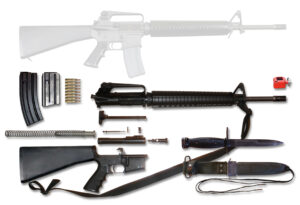
A collector’s look at Colt’s SP1 and early Sporters, from slickside uppers and pencil barrels to the rollmarks and small changes that hinted at the A2 era.

A practical, story-driven guide to reading JM vs REP barrel marks, understanding pre-safety 336s, Micro-Groove and Ballard-style rifling, and the smart checks to make before you buy.