
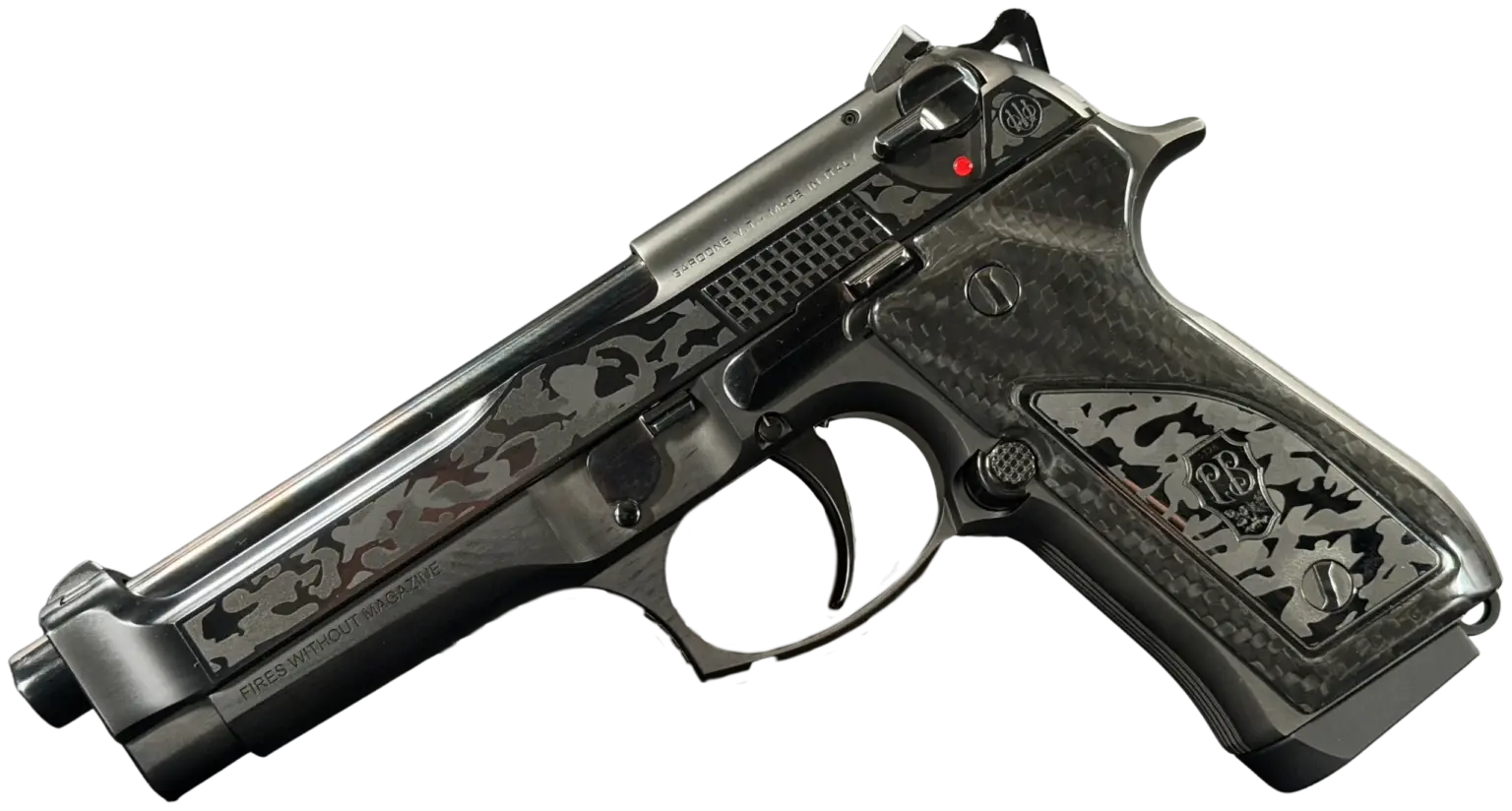
Pick up a Beretta 92 and the first thing you notice is daylight over the barrel. That open slide is more than a look. It is a through-line from the original 92 and 92FS to today’s M9A4, and it shapes how these pistols run, what parts interchange, and how the variants feel in the hand.
This guide focuses on the details buyers and collectors ask about most: open-slide lineage, locking block generations, Brigadier and Vertec differences, decocker-only vs safety slides, magazines, and practical parts compatibility.
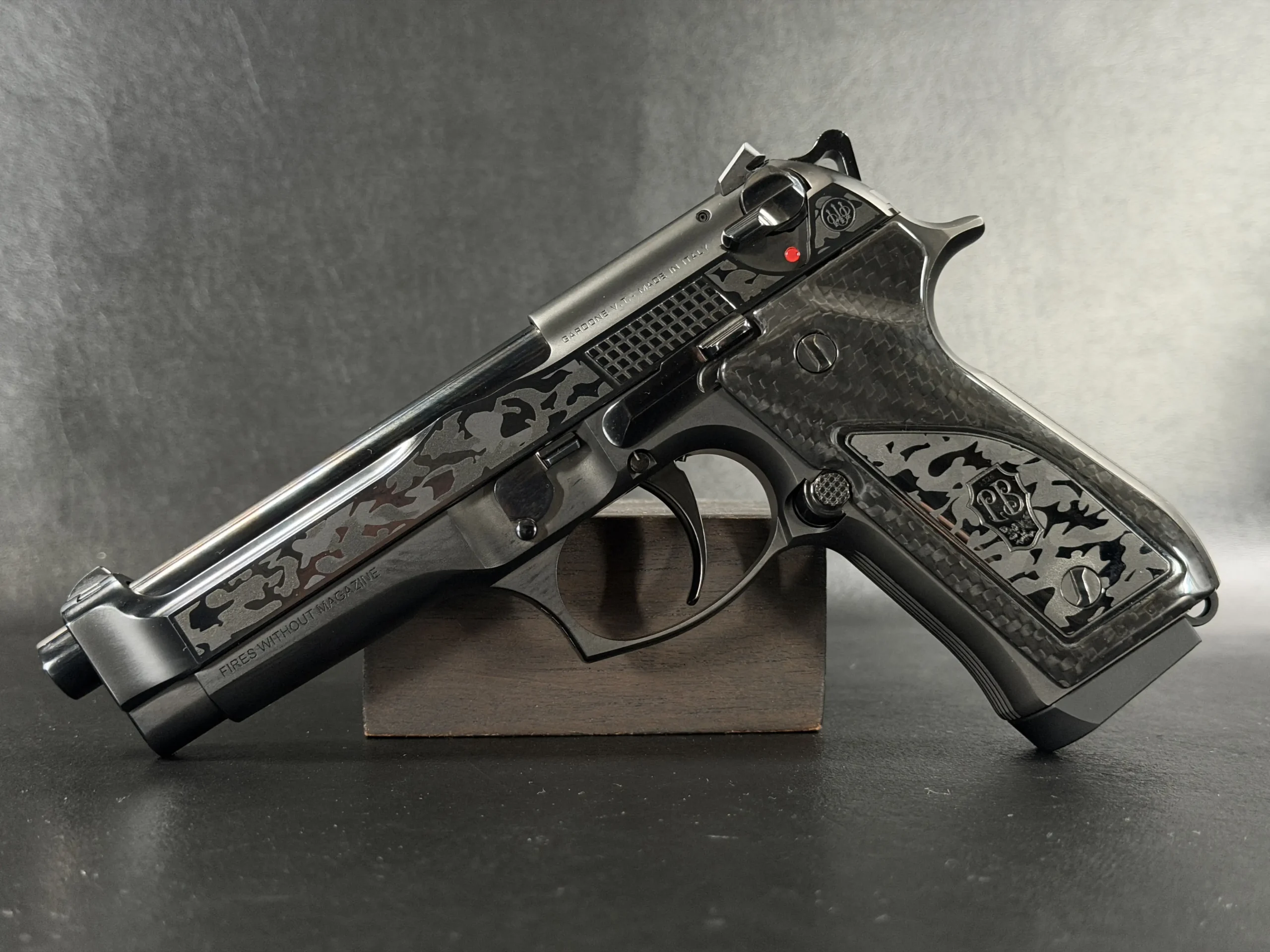
Open-slide DNA: roots and on-range benefits
The 92 design builds on earlier Berettas and a proven locking idea. The open slide traces to the M1923, while the alloy frame and hinged locking block came through the M1951, which itself used a Walther P38-style locking system. That history explains the 92’s smooth cycling and why the series still feels current decades on. The feed path is almost direct into the chamber, which aids reliable loading and extraction with factory-spec ammo across brands.
92, 92S, 92SB: control changes that set the pattern
The first 92 arrived in the mid-1970s with a frame-mounted safety and heel magazine catch. The 92S moved the safety to the slide, locking in the silhouette we all recognize. The 92SB then relocated the magazine release behind the trigger guard, added a firing pin block, ambidextrous safety levers, and 3-dot sights. Beretta also offered a compact around this era with 13-round magazines.
92F, 92FS, and M9: standardization and the service era
The major leap came when the 92F won US military trials in the 1980s. Updates included standardized parts, a squared trigger guard, refined grip contour, a chrome-lined bore, and the corrosion-resistant Bruniton finish in place of bluing. The military version was designated the M9, while the civilian 92FS followed with slight internal tweaks. Production across the series is estimated at about 3.5 million pistols, which helps today with parts, magazines, and support availability. For a concise historical overview, see Mag Life’s history of the Model 92.
Collector notes from this period: the 92FS Centurion combined the Compact’s shorter slide and barrel with a full-size frame, and Beretta also offered a limited 92FS .380 ACP caliber conversion kit for certain Latin American markets where 9×19 and .45 ACP were restricted.
Locking blocks: the hinged heart of the 92
Instead of a tilting barrel, the 92 uses a hinged locking block that drops to unlock. Beretta has revised this part’s geometry and materials over time to increase durability. On used guns, inspect the locking block lugs for peening or cracks. When replacing parts, favor current-production blocks and pair them with a fresh recoil spring. Match assemblies by model and generation, and verify part numbers with Beretta parts support before ordering.
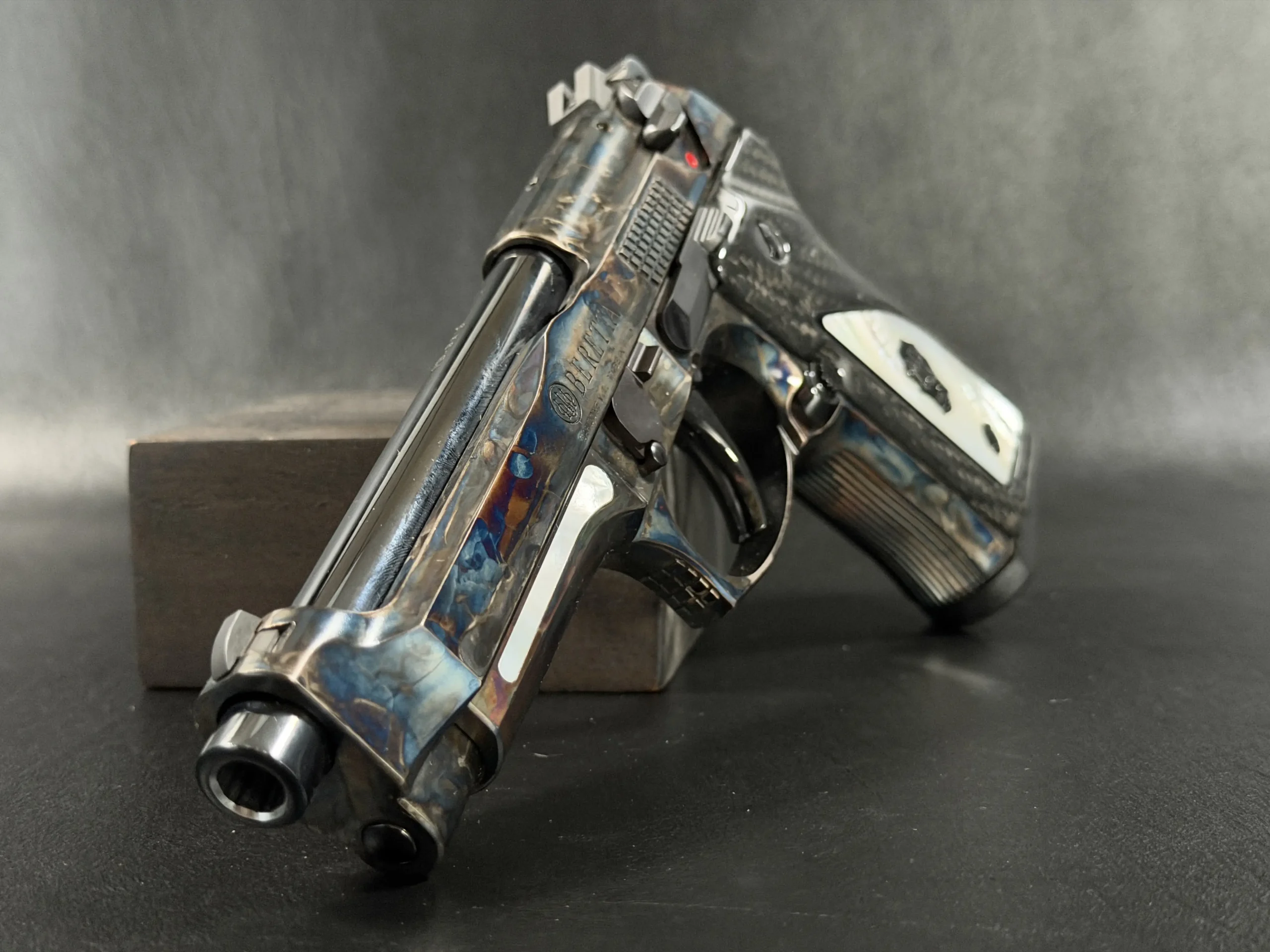
Brigadier slide vs Vertec frame: two distinct feel changes
Brigadier describes a heavier slide profile. The added mass softens perceived recoil and can steady the sights in rapid strings. Vertec refers to the frame profile introduced in the early 2000s: a flatter backstrap for a thinner, more vertical grip and shorter trigger reach, plus an accessory rail, beveled magazine well, and interchangeable front sight. Beretta retained overall slide length and shortened the barrel to about 4.7 inches so the gun still points like a classic 92.
Modern variants mix these traits. The 92FS Brigadier, 92X line, M9A3, and M9A4 blend Vertec-style ergonomics and, in some cases, added slide mass.
Controls: FS safety vs G decocker, and universal slides
FS-pattern slides combine a decocker with a manual safety. G-pattern slides are decock-only and return to fire after decocking. The decock-only concept, seen on the 92G for law enforcement, carries through to modern models and is part of the M9A4’s lineage. The M9A3 introduced a universal slide that can be configured either as decocker-safety or decock-only, which is useful for agencies and buyers who want flexibility.
Modern evolutions: 92A1, 92X, M9A3, then M9A4
- 92A1: A commercial package that brought M9A1-era improvements, with a rounded trigger guard reminiscent of early models.
- 92X: Launched in 2019 in compact, centurion, and full-size variants. Features the Xtreme-S trigger system with a shorter reset and adjustable pre-travel (in single-action-only models) and overtravel. Similar to the M9A3 in layout but with a non-threaded barrel and fully replaceable sights.
- M9A3: Adds a 3-slot Picatinny rail, Vertec-style thin grip with optional wraparound panels that mimic the older M9 swell, fully removable tritium night sights, a universal slide convertible between safety-decocker and decock-only, and a factory barrel pre-threaded for a suppressor. Ships with 17-round sand-resistant magazines shaped for easier reloads.
- M9A4 (2021): Direct upgrade to the A3, with a red-dot optic compatible slide and dovetailed tritium night sights, an enhanced short reset Xtreme trigger system, texturized thin Vertec-style grips, and 18-round sand-resistant magazines.
For model-by-model details, the Beretta 92 entry on Wikipedia is a solid, quick cross-check.
Magazines: 15, 17 sand-resistant, 18 flush, and what fits
The original full-size standard was 15 rounds. Beretta later introduced 17-round sand-resistant magazines with the same external dimensions, using updated springs and followers plus a raised track that helps shed grit. Those 17s backfit into older full-size 92s. The M9A3 ships with 17-round sand-resistant mags in a beveled shape for faster insertion. The M9A4 steps up to new 18-round sand-resistant magazines. Compact 92 variants use shorter 13-round mags.
In general, full-size 15, 17, and 18-round magazines interchange across full-size 92s. Compact frames need compact-length magazines, though full-size mags will seat and protrude.
Parts compatibility: common swaps and smart checkpoints
- Slides and levers: FS slides use a safety-decocker. G slides are decock-only. The M9A3 “universal” slide can be configured either way. The M9A4 follows the decock-only lineage while adding an optics-ready slide.
- Frames and grips: Traditional 92FS frames wear thicker, arched grips. Vertec frames are thinner and more vertical. The M9A3’s wraparound panels let a Vertec backbone mimic the older M9 swell. Match grip panels to your frame style.
- Sights and optics: Early slides with an integral front sight limit options. Vertec, 92X, M9A3, and M9A4 slides use dovetailed, replaceable sights. The M9A4 slide is cut for red-dot optics. Swap like for like within the same pattern for the least friction.
- Magazines: Full-size mags generally cross-fit between 92, 92FS, 92X, M9A1/A3/A4. Compact models need compact mags.
- Small parts: Locking blocks, plungers, and springs evolved over time. Verify part numbers by model and generation with Beretta before you buy.
If you want a very specific combination, it is often easiest to buy a factory variant built that way. With decades of production, the configuration you want likely exists.
Buyer’s short checklist
- Controls: Decide on safety-decocker (FS) vs decock-only (G). If undecided, the M9A3’s universal slide offers flexibility.
- Grip feel: Choose the classic 92 arch or the thinner, more vertical Vertec profile. The M9A3’s wraparound panel can split the difference.
- Sights and optics: If you want a red dot, the M9A4’s optic-ready slide is the straightforward pick. For easy iron sight changes, look to 92X, M9A3, and M9A4.
- Magazines: For full-size guns, 17-round sand-resistant mags are a proven baseline; add 18-rounders for the M9A4 or 92X RDO.
- Locking block: On used pistols, inspect the block and confirm which generation it is. A fresh recoil spring is cheap insurance.
Final thoughts and where to verify
The 92 series ties a 1920s open-slide idea to modern features without losing its identity. The 92FS cemented the look, the M9A3 modernized the platform, and the M9A4 added optics and capacity while keeping the manual of arms familiar. For current specs and side-by-side comparisons, check Beretta’s 92-series listings: beretta.com/search?q=92-series.