A bolt, a stock, and the moment you know
The first time I grinned at a gun show over a Springfield, it wasn’t a cartouche or a rare serial block. It was a bolt handle. One rifle wore the early straight style that drops almost straight down; the other had that later, slightly swept-back look. Then I noticed one stock lacked grasping grooves and another had an upper handguard ring inlet that didn’t match the receiver’s era. That was when I stopped shopping these rifles by name and started reading them like puzzles.
If you’re eyeing a U.S. M1903 or M1903A3, you already know the appeal. They’re honest rifles with a century of service. But details matter. Heat-treat eras carry real safety implications. Stocks shift by model and maker. Bolts tell time if you know what you’re looking at. Here’s what’s safe, what’s correct, and what to check before you open your wallet.
Model overview: M1903 to M1903A3
The M1903 Springfield was the standard U.S. service rifle through the First World War and into the 1930s. It’s a five-round, .30-06, bolt-action rifle with Mauser roots and a reputation for accuracy. Wartime production pressures in the next conflict drove the update to the M1903A3, the same core rifle with cost-and-speed changes that warranted a new model name.
Remington is central in this handoff. Remington produced M1903 rifles between late 1941 and early 1943, starting close to the prewar standard and then adopting wartime expedients: stamped parts replaced some milled components, and the classic finger-groove stocks gave way to simpler straight stocks without grooves. By early 1943 Remington had fully transitioned to the “U.S. Rifle, Cal. .30, Model of 1903A3” and also produced the “U.S. Rifle, Caliber .30, M1903A4, (Sniper’s).”
On the A3, the philosophy is obvious. Stock furniture went to stamped metal, and a redesigned stamped follower alleviated the old fourth-round jam complaint. Most milled parts made by Remington are marked with a small “R,” a useful detail when you’re sorting rifles that went through rebuilds.
Good primers on features and pitfalls: American Rifleman’s collector overview and the M1903 Springfield page on Wikipedia.
Heat-treat eras and safety cutoffs
Receiver failures early in service led the Ordnance Department to change heat treatment. The switch to double heat treatment is the dividing line collectors and shooters still use.
The Civilian Marksmanship Program summarizes the cutovers this way:
- Springfield Armory changed to double heat treatment at approximately serial 800,000.
- Rock Island Arsenal changed at serial 285,507.
Rifles below those thresholds are commonly called low-number. Those at or above are high-number. The Army withdrew low-numbers from active service once the risk was understood, though WWII rebuilds later mixed parts widely.
Today’s takeaway is simple. The CMP does not recommend firing any Springfield rifle with a low-number receiver, and it does not recommend firing any Springfield rifle, regardless of serial, with a single heat-treated bolt. Bolts were generally not serialized by the Army, so a stray number on a bolt is no guide. Visual ID helps, and that’s next.
Bookmark for context and safety language: CMP M1903/M1903A3 information.
Bolts: straight vs swept
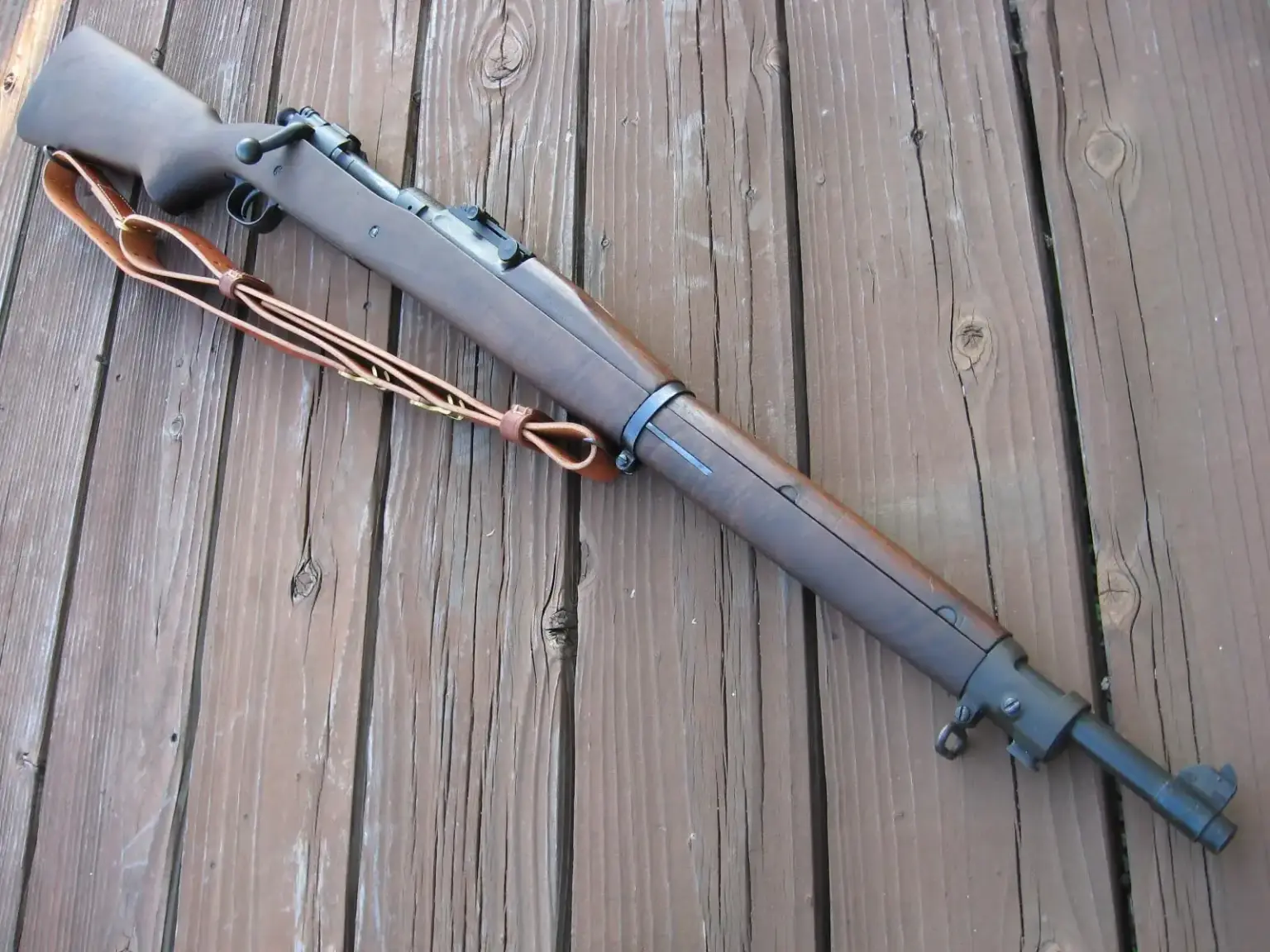
There’s a quick visual that places a bolt in the right era. Early single heat-treated bolts are often called straight when viewed from the side; the handle drops almost straight down. Later double heat-treated bolts are slightly swept back. Once you’ve handled both, the difference is obvious.
As a rule of thumb for age-correctness, a straight bolt is appropriate for World War I and earlier M1903s. Swept-back bolts show up on late-1918 and later production. That timing closely follows the receiver heat-treat change. WWII rebuilds mixed bolts across rifles and makers, so treat bolt style as a clue, not a verdict. From a safety angle, the CMP’s caution about single heat-treated bolts still stands.
Stocks that tell stories: grooves, inlets, A1 and scant
Stocks reveal a lot quickly.
- Grasping grooves: Early M1903s used high-grade walnut with finger grooves. Remington eliminated the grooves on its M1903 production and kept straight stocks through the A3 era.
- Who used straight stocks: Straight stocks without grooves were used primarily on Remington M1903 rifles and on M1903A3s from both manufacturers. Most retained transverse stock bolts. A brief wartime trial substituted simple pins on some A3s, but pins proved unsatisfactory under hard use.
- A3 inlet tell: Stocks intended for the M1903A3 have an inlet for the upper handguard ring. That cut is absent on M1903-only stocks. An M1903 barreled action will drop into an A3 stock, but an A3’s barreled action will not fit an unmodified M1903 stock. Most collectors avoid modifying an M1903 stock, especially since A3 stocks are not scarce.
- A1 and scant: M1903A1 is a formal variant you’ll see in ordnance manuals. “Scant” is a collector term for a wrist profile that sits between straight and full pistol grip. Because rebuilds swapped stocks freely, confirm inletting and hardware against period references rather than judging by feel alone.
Maker-correct patterns you can trust
After a century of service and rebuilds, perfectly untouched rifles are the exception. Still, these patterns hold up:
- Springfield Armory and Rock Island Arsenal M1903s: Expect milled small parts and many early rifles with finger-groove stocks. These are the rifles most affected by the low/high-number heat-treat split, so sort the receiver’s era and confirm a bolt style that makes sense.
- Remington M1903, late 1941 to early 1943: Began to spec, then quickly adopted wartime expedients. Look for elimination of grasping grooves, use of stamped parts to replace some milled components, and milled parts often marked with an “R.”
- M1903A3, wartime production: Stamped stock furniture, a stamped follower that addressed the fourth-round jam, and straight stocks without grooves. Stocks include the A3 handguard ring inlet. Most used transverse bolts; a short run used pins that didn’t last.
Three buying notes:
- Remington “R” marks on milled parts are a helpful cross-check, not proof of factory-original condition.
- Stamped followers on later rifles are correct and can improve feeding.
- On stocks, prioritize inletting and hardware over cartouches. Cuts and bolts versus pins are harder to fake and easier to judge.
Drawings and manuals that settle arguments
When parts don’t agree, reach for primary references. The U.S. War Department’s ordnance maintenance manual covers the M1903, M1903A1, M1903A3, and M1903A4 with component descriptions and illustrations that help identify, fit, and inspect parts correctly.
Keep this on the bench: TM 9-1270: U.S. Rifles, Cal. .30, M1903, M1903A1, M1903A3 and M1903A4 (Ordnance Maintenance).
Quick reference checks at the table
- Receiver serial vs heat-treat cutoffs: Springfield about 800,000; Rock Island 285,507. Below those, treat as low-number receivers.
- Bolt shape: Straight suggests early single-heat-treat; swept-back suggests later double-heat-treat. Treat as a clue because of rebuild mixing.
- Stock grooves: Finger grooves say early M1903 style. No grooves align with Remington’s M1903 changes and A3 production.
- A3 stock inlet: Look for the upper handguard ring cut. An M1903 action fits an A3 stock; the reverse requires modification and is a negative for most collectors.
- Stock hardware: Transverse bolts are standard. Pins on some A3s were a short-lived wartime shortcut.
- Small-part stamps: An “R” on milled parts points to Remington manufacture and can support a period-correct story.
- Follower type: Stamped followers on later builds are correct and address feeding complaints.
Buying smart: wear, rebuilds, and red flags
You’ll see more honest service mixes than pristine time capsules. Judge a rifle the way an armorer would have: part by part, for fit, function, and plausibility.
- Start with safety. Check serials against heat-treat thresholds and identify the bolt style. Low-number receivers or single-heat-treat bolts are for display unless you change components and headspace professionally.
- Check the stock as a system. Does the inletting suit the action? Does the hardware match the model and era? Evidence of wood removal to make an A3 action fit a straight M1903 stock is a walk-away for many.
- Read the small parts. On a Remington, the presence of “R”-marked milled pieces where expected helps the story hang together. On an A3, stamped furniture and a stamped follower are pluses, not minuses.
- Accept period rebuilds. The Army mixed parts when necessity called. Consistent, era-correct mixing often beats a too-perfect rifle curated yesterday.
- Be wary of big claims. “All original” and “as issued” should be demonstrated, not declared.
Red flags that make me slow down:
- Mismatch between model and stock inlet. An A3 action crammed into an M1903 stock is a no for most collectors.
- Fresh tool marks or newly cut wood around bands or handguard ring areas.
- Over-sanding that softens edges around bolt cuts, band springs, or sling swivel inlets.
- A low-number receiver with a straight bolt pitched as safe “because it’s been fine.” Trust known guidance instead.
Living with one: document the rifle’s story
Part of the fun is that you never stop learning. Keep notes with the rifle. Print the serial thresholds and jot what you confirmed and why. If you swap a bolt for safety, label and store the original for display. For evenings of productive rabbit holes, the ordnance manual above, the CMP page, and American Rifleman’s overview are steady touchstones. With time, the details jump out across a table: a swept-back bolt at ten feet, an A3 inlet at a glance. That’s when collecting these Springfields shifts from guessing to a satisfying conversation with history.