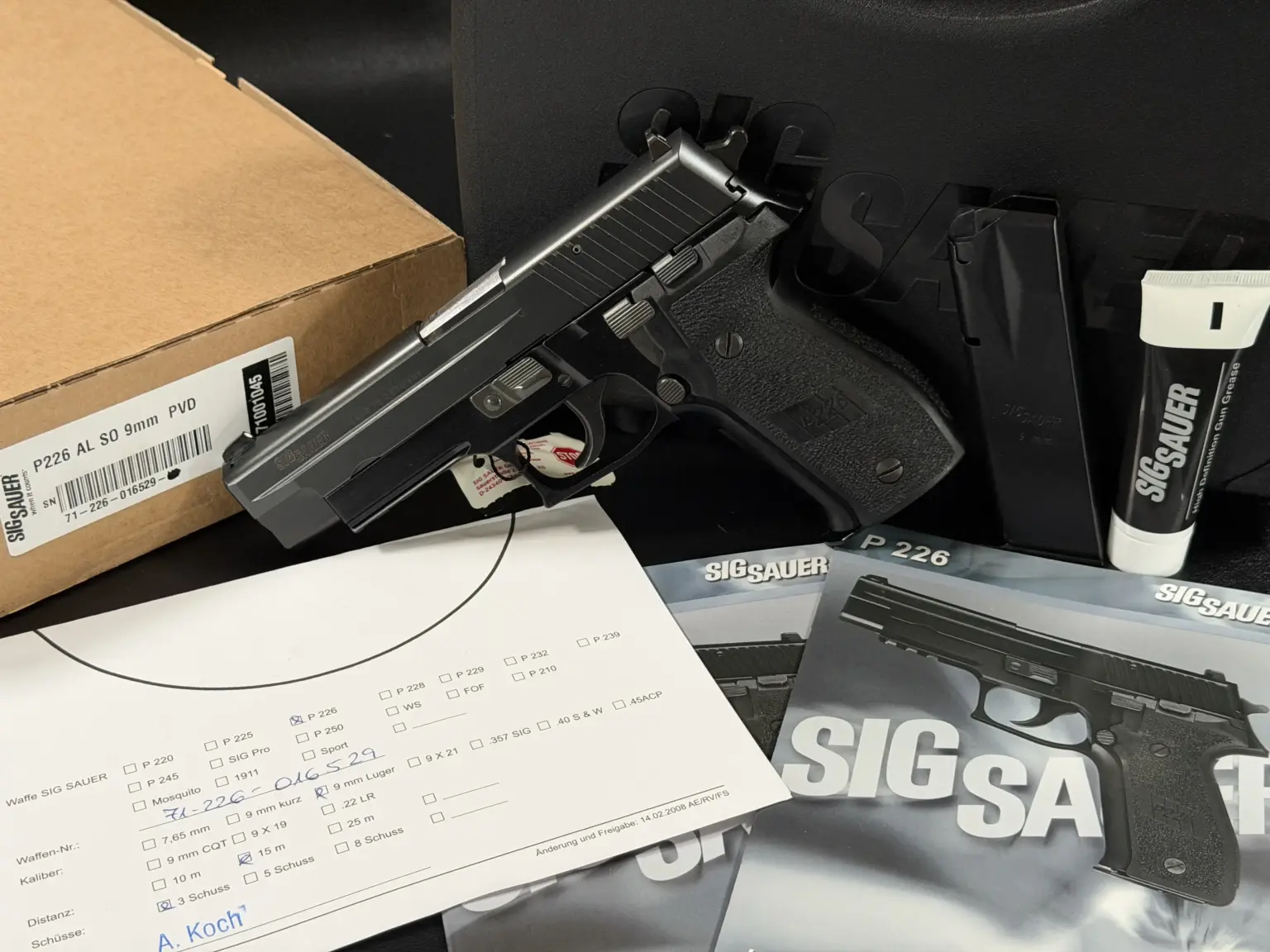
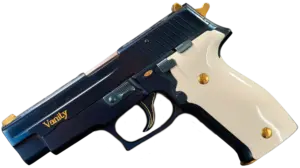
There is a certain kind of range day where the SIG P226 shows up with honest holster wear and smoothened checkering. The owner may carry something lighter now, but when it is time to shoot clean, the 226 often comes out. That is loyalty earned at the firing line.
How did SIG build that following around a full-size, metal-framed, double-action pistol from the 1980s? The short answer is simple: it worked across years, climates, and trends. The longer answer is the story below.
Where the P226 Actually Came From
The P226 did not appear out of thin air. It grew out of the P220 line, a Swiss and German collaboration that put SIG and J.P. Sauer & Sohn on the same team. SIG’s modern pistol arc runs from postwar Swiss service handguns through the P220 and compact P230. By the early 1980s, SIG reworked the single-stack P220 into a double-stack service pistol to meet U.S. XM9 trial requirements. That became the P226.
Production started in 1984, and by 1985 the pistol was on the market as SIGARMS took root in the U.S. The fundamentals stayed familiar: a locked-breech, hammer-fired design with refined controls and a reputation for clean cycling.
Winning Hearts by Losing a Contract
The XM9 trials ended with the Beretta 92F winning the U.S. military contract and becoming the M9. The P226 performed competitively but did not get selected. Many histories point to total package cost and logistics factors weighing heavily in the final decision. Either way, missing the big award did not slow the pistol down.
Without a sweeping contract, the P226 found users one agency and one unit at a time. Word spread that it was accurate, rugged, and simple to keep running. The sidearm that did not win the headline contest built its own record the slower way.
The DA/SA Rhythm, and Why It Stuck
Ask ten P226 devotees why they stay loyal and the trigger comes up fast. The classic format is DA/SA. The first shot runs through a longer, heavier double-action pull that cocks and releases the hammer. After the slide cycles, you get a shorter, lighter single-action pull.
A proper decocking lever is part of the appeal. After a string in single-action, drop the hammer safely and return to that deliberate first pull. There is no manual safety to remember. Internally, a firing pin block and other safeties keep the mechanics honest. The concept is not unique to SIG, but the P226’s execution became a reference point for service pistols.
Reputation Travels: The SEALs and the Salt Spray
The P226 earned a reputation for doing the same job day after day in rough places. Industry histories note U.S. Navy SEAL adoption around 1989 and a long service run under designations that include MK25, with a phased transition to more compact pistols such as the Glock 19 in roughly 2015 to 2016. The specifics varied by unit and timeline, but the arc is clear: the 226 served for decades in demanding roles.
That kind of service record matters even to people who will never see salt spray. A pistol trusted in places where failure is not tolerated carries weight on duty ranges and public lines alike.
Ergonomics That Aged Well
The original 226 grip was large but well shaped. Over time, SIG trimmed and refined. A notable update was the E2 grip system, which reduced circumference and reshaped the panels to improve reach and feel. SIG’s own support notes explain that E2-labeled models were a limited run at first, and feedback was strong enough that the ergonomic panels became a standard addition in the lineup.
Specs That Still Make Sense
For most people, the P226’s core package still makes sense: a full-size sight radius, real slide and frame mass, and predictable cycling.
Key numbers remain consistent across classic variants: a 4.4-inch barrel, overall length near 7.7 inches, and about 34 ounces unloaded. Common chamberings include 9mm, .40 S&W, and .357 SIG. In 9mm, standard magazines are typically 15 rounds, with higher-capacity options available. .40 S&W and .357 SIG versions generally hold fewer rounds. Most models pair an aluminum alloy frame with a steel slide.
From Duty Sidearm to Range Mainstay
Many pistols serve well in uniform and then fade. The P226 crossed over. Timing helped. SIGARMS set up U.S. operations in 1985, moved to a larger Virginia space in 1987, and shifted to Exeter, New Hampshire, in 1990 to expand and begin manufacturing. The company grew its workforce, invested in equipment and engineering, and kept parts and updates flowing. Owners could maintain their guns and find variants that fit new roles without leaving the platform.
It also helps that the 226 is a straightforward teacher. Controls are intuitive, fieldstripping is simple, and the DA/SA cycle rewards good trigger work. New shooters can learn on a deliberate first pull and then ride the lighter single-action. Experienced shooters use it for quals, matches, or long range sessions without getting beat up by recoil.
Modern Takes: Legion, SAO, and Optics Cuts
SIG has not let the P226 sit still. Legion models sharpened the platform with features that matter on the clock: Short Reset Trigger parts, aggressive front strap treatment, front cocking serrations, X-RAY3 day-night sights, and textured G10 panels with an extended beavertail. The SAO variant adds a flat-faced trigger and a manual thumb safety for those who want a consistent light pull with 1911-like control.
Optics changed the pistol landscape, and some P226 variants address that with factory slides machined for mini-reflex sights. SIG literature notes slides and kits specifically cut for the ROMEO1 on certain 9mm models, and that ROMEO1 mounting solutions exist for SIG dovetails including the P226. Cuts and footprints vary by model, and not every Legion or RX configuration supports cross-caliber exchange kits, so matching the slide cut to a chosen optic is important.
Choosing a P226: Buyer Notes That Matter
DA/SA or SAO: The classic DA/SA gives a deliberate first pull with a decocker and no manual safety. The SAO runs a consistent light pull with a frame-mounted safety. Pick the manual of arms you will practice.
Grip size and texture: If reach is a concern, look for E2-style panels. For more traction, Legion checkering and G10 panels deliver a grippier interface.
Use case: As a duty or home-defense pistol, the full-size 226 is right at home. For concealed carry, size and weight demand a good belt and holster, but the payoff is flatter shooting and smoother tracking.
Caliber and capacity: 9mm offers the broadest support and most shooter-friendly economics, with standard 15-round magazines and higher-capacity options available. .40 S&W and .357 SIG variants generally trade capacity for larger calibers.
Optics and sights: If you want a red dot, look for factory-cut slides or RX packages matched to the optic footprint you plan to run. If irons are your preference, X-RAY3 day-night sights show up on many modern models.
Trigger parts and compatibility: Company guidance is clear that flat triggers are designed for SAO models and curved triggers for DA/SA. Stick to parts intended for your specific trigger system.
What Collectors Actually Care About
The P226 offers several honest chapters to collect. Early 1980s production shows how the pattern began. Duty-linked models tied to agencies and units have their own pull. MK25-era pistols carry the maritime lineage. Legion releases map how SIG refined the platform for enthusiasts who want extra features from the factory.
The healthier approach is to buy examples with documentation you trust rather than chase rumors. If you value ergonomics first, an E2-era gun may fit better. If you want the tune modern parts bring, a Legion variant often includes what you would add anyway.
Why Loyalty Stuck: The Boring Things That Matter
Loyalty is usually built on small truths. The P226 breaks down easily and goes back together without drama. The magazines are reliable. The trigger smooths with use. The decocker is where your thumb wants it. Predictability builds trust.
The company behind the pistol matters too. SIG set up SIGARMS in the U.S. in 1985, expanded in 1987, and moved to New Hampshire in 1990 to grow manufacturing and engineering. The brand later consolidated in Newington, NH, in 2014 and expanded into suppressors, optics, ammo, and airguns by 2015. That footprint keeps parts, service, and new models flowing, which helps an older platform stay relevant.
Where the P226 Sits Now
More than forty years in, the P226 is not a museum piece. SIG continues to release updated models, and Legion variants keep the performance side fresh with refined triggers and sighting options. The core recipe remains the same. It is a full-size, metal-framed, hammer-fired pistol with a control layout most shooters understand in a single session.
Plenty of owners carry smaller pistols day to day, but the 226 still anchors duty belts, nightstands, and range bags. Loyalty builds when a product keeps doing the job it was built for, long after trends say it should have retired.