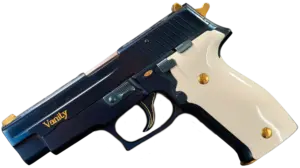
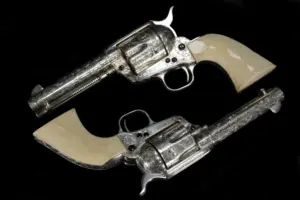
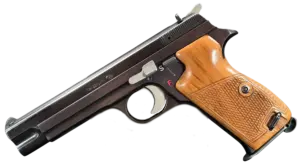
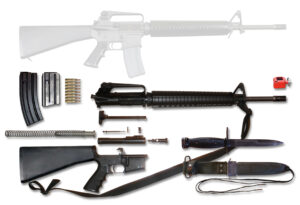
Pick up a well-worn 1911, then pick up a modern M17. Same basic mission, wildly different answers. You can feel a century of hard lessons between their grips. That is the story of service pistols. They changed when ammunition changed, when armies learned hard truths, and when officers and recruits needed sidearms that were safer, faster, and easier to keep running in the grit of real life.
Why did pistols have to wait for the cartridge?
Early handheld guns were experiments bolted to the stock and barrel. Matchlocks, wheellocks, flintlocks, and percussion systems all carried the same burden: you were managing fire, powder, and projectiles as separate items. It worked, but it was slow and demanding. Multi-shot handguns existed as early as the mid-1500s in those ignition styles, but they were exotic pieces and not the kind of sidearm a large army could truly bank on for speed and safety. The Library of Congress frame for military sidearms lays out that chain clearly: matchlock to wheellock to flintlock to percussion, and eventually to metallic cartridges.
That last step is the key. Self-contained ammunition in the late 1850s bundled case, primer, powder, and projectile into a single, tidy cartridge. Pull the trigger, a pin strikes the primer, and the whole system does its job. Loading got faster. Handling got safer. And once cartridges showed up, the door opened to repeaters, semi-automatics, and even machine guns. As Rock Island Auction’s overview puts it, that one invention changed the way people used guns. Everything that follows in the service pistol world sits on top of that little brass cylinder.
From single shots to the revolving idea
When cartridges became reliable, revolvers became truly practical for armies. The basic concept was older than metallic ammo, but the cartridge is what made the revolver both serviceable and scalable. Revolving cylinders, uniform cartridges, and rugged lockwork gave soldiers and officers dependable firepower in a compact package.
Through the late 1800s, you see it across uniforms worldwide. France carried Chamelot-Delvigne revolvers and later the Model 1892 in 8 mm. Russia and Belgium relied on the unusual but durable 7.62x38mmR Nagant M1895. Italy issued the 10.35 mm Model 1874 and, later, the Bodeo Model 1889 well into the mid-20th century. Japan adopted foreign revolvers at first, then produced the 9 mm Type 26. These weren’t curiosities. They were the working pistols of their day, and they set expectations for ruggedness that would follow the handgun into the 20th century.
The leap to the self-loader
The semi-automatic pistol was the next big step. The concept sounds simple now: use the energy of a fired cartridge to load the next one. But it took reliable cartridges and clever engineering to make it truly soldier-proof. Designs proliferated in the early 1900s. Some aimed at power, some at capacity, and many at both.
Japan’s early semi-autos, for example, collected ideas from all over. The First Model 8 mm Nambu, followed by the Second Model and the Baby Nambu, drew on the Mauser C96 and the Italian Glisenti while also showcasing local thinking. It is a reminder that semi-automatic handguns were not just an American or German story. Everyone was trying to find the right balance of size, power, and controllability.
The American inflection point: Colt’s 1911
In the United States, the defining moment arrived with John Browning’s work. The Army examined what kind of ammunition the next pistol should use around 1904, looking hard at power after experiences with earlier, smaller-caliber pistols. Browning’s ideas matured into the Colt Model 1900 in .38 ACP, which saw service in the Philippines, and then into the .45 ACP Colt Model 1911. The Library of Congress notes that the M1911 was the first universally adopted semi-automatic service pistol for the United States military. It stayed in that role for more than 70 years, through four major wars, with military production alone totaling around three million pistols. Millions more reached the civilian market.
Even after formal replacement, the 1911 kept turning up with American forces. It remained in the hands of some special operations units for a very long time. The last of those units reportedly retired it in 2023, which says something about the design’s staying power. For buyers and collectors, that longevity translates to deep parts support, layered history, and a platform that still makes sense at the range. If you want a refresher on why heavy full-size steel pistols still feel right in the hand, we covered that separately in our look at steel duty guns.
Why Full-Size Steel Pistols Still Have a Place
Wartime shortcuts and the revolver’s second act
Big wars expose supply gaps. When the United States entered World War I, there were not enough M1911 pistols to go around. The stopgap was clever. The Colt Model 1917 revolver used half-moon clips to hold .45 ACP cartridges in a revolver cylinder bored for the rimless round. That made issuing ammunition much simpler. The New Service revolver family saw service again in World War II with tankers and artillerymen, and its simple reliability was noted later by tunnel rats in Vietnam. The lesson shows up repeatedly across service pistol history: when there is a supply crunch, simple, robust answers step in and keep working.
If you’re a collector, these wartime variants and stopgaps are a field of their own. Their stories are often written on their metal in unit marks, re-arsenal stamps, and the kind of honest wear you only get from issue guns. If you are looking at a 1917-pattern revolver today, you will likely be working with clips, and you will want to budget for them, along with springs and, if you intend to shoot, a careful inspection by a qualified gunsmith who knows these lockworks.
NATO 9 mm and the long Beretta M9 chapter
Fast forward to the 1980s and the Joint Service Small Arms Program. After trials against updated designs from Smith & Wesson, SIG, Walther, Steyr, FN, and others, the Beretta 92-based pistol won and became the M9. It was officially adopted in 1985 and formally replaced the M1911A1 the following year. The M9 brought many modern features to military holsters. It used a 15-round staggered magazine, a reversible magazine release to accommodate different hands, and the short-recoil system that had come to define most modern service autos.
Switching to the 9 mm NATO standardization simplified logistics and gave troops more rounds on board, which training cultures could put to good use. Plenty of troops had strong feelings about the safety lever and its placement, and the gun was big for some hands, but there is no question that it marked a new era. The M9 soldiered on for about three decades, during which time accessory rails, night sights, and modular grip designs became part of the service pistol conversation.
Polymer frames and modular guts: the M17 era
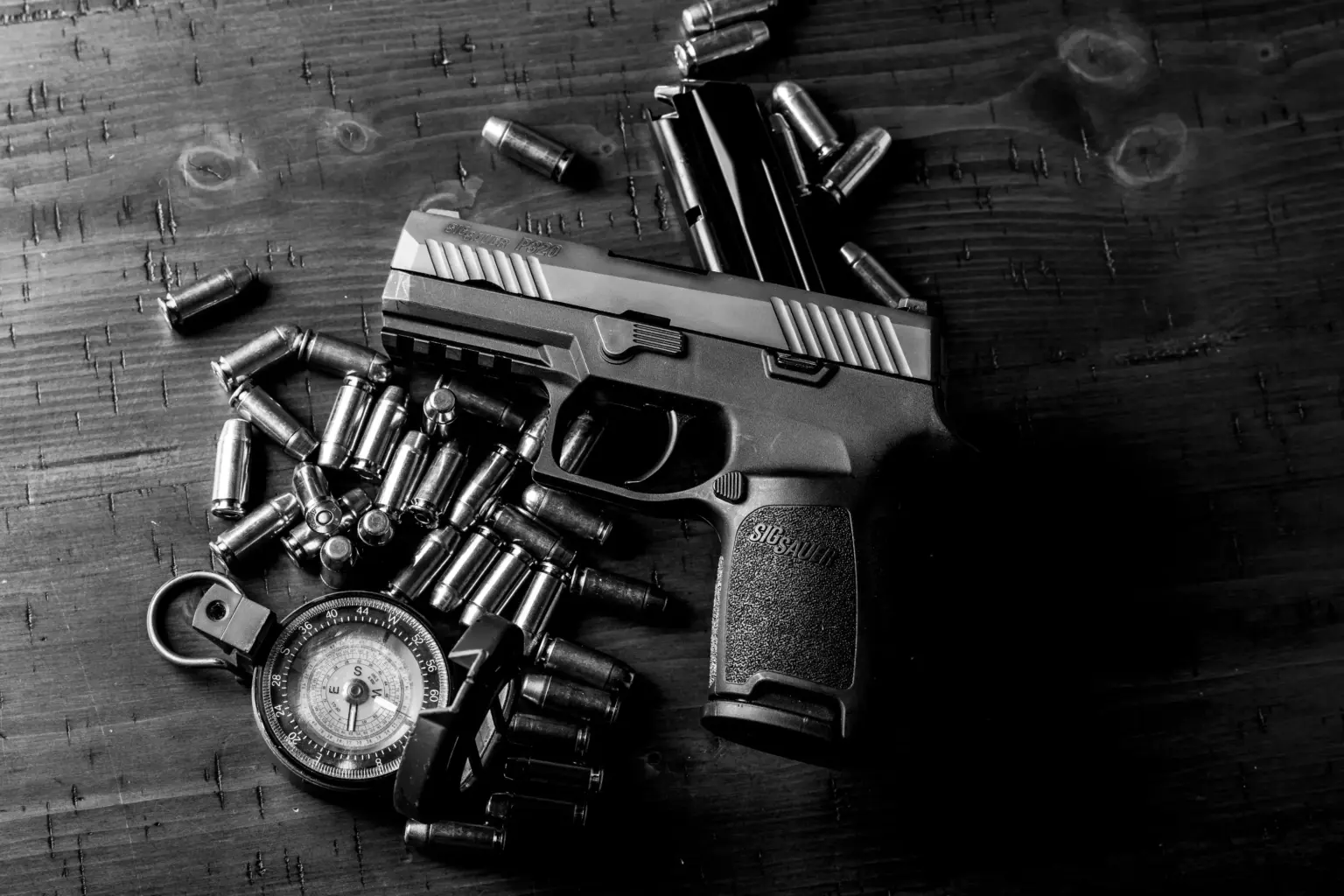
By the 2010s, the military looked again at pistols. The result in 2017 was a new selection: a polymer-framed, modular 9 mm, designated the M17. Based on SIG Sauer’s P320 architecture, it arrived with fully ambidextrous controls, a standard 17-round magazine capacity, and the ability to use extended 21-round magazines. The frame included an integrated accessory rail for lights or aiming devices, and the heart of the gun was a removable fire control unit that could be dropped into different frames to configure size and role. That modularity is the headline of the M17 story and reflects how modern forces expect pistols to adapt to different missions and body types.
The other side of the coin is practical. Guns are machines. They wear out with use and cleaning, and they get updated as new ideas prove themselves. One of the big new ideas of recent years is the small red dot sight on a duty pistol. The concept meshes well with modular slides and frames, and it is increasingly common in service pistol trials and police agency adoptions. The M17 sits at the crossroads of those changes. It is lighter than the M9, easier to tailor, and built with the expectation that lights and, potentially, miniaturized sights will ride the gun regularly.
Not just an American story: Nagants, Nambus, and Hi-Powers
Service pistols reflect national tastes and supply realities. Russia’s 7.62x38mmR Nagant M1895 remained a staple well into the 20th century because it was reliable, common, and already in the system. The Soviet Union later leaned heavily on the TT-30 Tokarev in 7.62 mm before and during World War II. Japan’s early semi-autos show how designers drew on European inspiration while solving local problems. And in the West, the Browning Hi-Power changed the capacity discussion entirely with a 13-round magazine that gave users more ammunition on tap without ballooning the gun’s size.
The Hi-Power found a home on multiple continents, including long service with Canada. Even if different militaries update on different schedules, the threat is the same. As training moved toward higher round counts and as logistics pushed toward standardization, pistols trended toward higher capacity, better sights, and easier manual-of-arms.
What police guns tell us: the NYPD as a living timeline
Militaries write one chapter. Police agencies write another. The New York City Police Department’s history mirrors many broader trends. For decades, the NYPD carried double-action revolvers with stout 12-pound triggers. When the automatic wave arrived in the 1980s, the department began testing and then adopting semi-automatics. By 1994, the Glock 19, SIG P226, and Smith & Wesson 5906 were on the approved list, with the SIG and S&W issued as double-action-only and the Glock saddled with an equally heavy 12-pound trigger module to keep the feel familiar.
In time, the NYPD standardized on the Glock platform. Today, the gun issue is the Glock 17 Gen 4 with 15-round magazines. As of 2021, the department shifted to a standard 5-pound trigger, a major change from a century of extra-heavy pulls that corresponded with higher academy scores. The department also modernized holsters, moving to a Safariland 6360 retention holster to improve safety and weapon security. The whole arc illustrates a constant balancing act: safety, shootability, and logistics. For buyers who train on NYPD trade-ins or who pick up police-surplus holsters, those details explain why some older Glocks feel very different on the trigger and why certain holster bodies dominate the resale market.
What this evolution means for buyers and collectors
Collectors and practical buyers both benefit from understanding why service pistols changed with the times. Each move left fingerprints on the guns we see on the market.
Here are a few takeaways that help when you are browsing the case or the auction catalog:
- Cartridge history is destiny. Self-contained metallic cartridges made revolvers reliable and made semi-autos possible. If you collect 19th-century handguns, this is the dividing line that explains many design choices and prices. Rock Island Auction’s broad overview drives home how that one invention unlocked the rest.
- War creates interesting variants. The M1917 revolvers that fired .45 ACP on clips, or re-arsenaled 1911s and M9S with unit marks, tell stories that peacetime guns do not. When considering a piece like this, ask for detailed photos of markings and any documented provenance, then have a quality gunsmith check the timing and springs before regular use.
- Capacity and controls evolved together. The jump to 15- and 17-round service pistols in the late 20th century brought ambidextrous controls, reversible mag releases, and new safety strategies. If you prefer simple manual-of-arms with a consistent trigger, the M17-era guns will likely feel natural. If you admire a long double-action first shot, earlier DA/SA designs remain satisfying.
- Police standards shape the surplus market. Heavy triggers on older agency Glocks and DAO conversions on hammer guns are there for policy reasons, not because anything is wrong with them. As the NYPD example shows, policies change. That creates interesting transition guns and parts that can be configured back to a more modern feel by professionals, where policy and local law allow.
- Modularity is here to stay. The M17’s removable fire control unit and drop-in frame options reflect a broad trend. If you like to tune the grip size, add lights, or mount a red dot sight, a modern, modular pistol may suit you better than a classic one. If you love steel and walnut, there has never been a bad time to own a 1911. If you love simplicity, there is a reason revolvers still have a loyal following.
On that last note, if you find yourself drawn to the older way of doing things, there is nothing wrong with choosing a classic wheelgun for enjoyment or collection. We wrote about that culture and why it keeps going strong.
Why Revolvers Still Appeal to So Many Shooters
Where service pistols seem headed
The funny thing about the service pistol is how small its role is on paper and how big its lessons are in practice. It is a backup for most soldiers, a routine companion for most officers, and a training platform that needs to be as safe and intuitive as a seat belt. That is why the trend line points toward pistols that are:
- Easy to shoot well under stress. Clear sights, good triggers, and consistent controls help recruits succeed. The NYPD’s shift to lighter triggers after years of heavy pulls speaks to this.
- Adaptable without a trip to an armorer. Replaceable backstraps, modular frames, and removable fire control units, as seen on the M17, make it easier to fit guns to different hands and roles.
- Ready for lights and compact red dot sights. Rails are now expected. Slide cuts and mounting footprints are becoming common because they allow better target focus and faster hits for many users.
- Supported by secure holsters. Duty holsters like the Safariland 6360 show how retention and ergonomics keep evolving right alongside the pistol.
The big picture is simple. Technology and training improved, so the pistols had to keep up. From the first reliable cartridges to the first high-capacity magazines, from the 1911 to the M9 to the modular M17, each era solved the same problem in fresh ways. If you are buying, look for the features that match how you actually shoot. If you are collecting, follow the stories that make you smile when you open the safe. Service pistols have changed a lot, but they remain what they have always been: compact lessons in the priorities of their time.
Sources and further reading used for this overview include the Library of Congress guide to military sidearms, Rock Island Auction’s history of pistols, The Mag Life’s look at U.S. issue sidearms, Popular Mechanics on the Army’s sidearm evolution, the Safariland profile of NYPD issue pistols and holsters, Firearms News on the modern military pistol, and a comparative look at U.S. service pistols on Combat Operators.