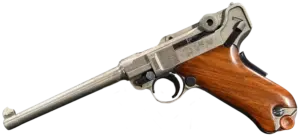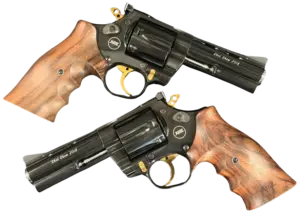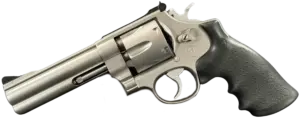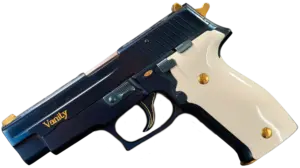

I bought my first milsurp Mauser on a Saturday morning with coffee in one hand and a head full of optimism. The seller called it a “solid shooter,” and it was. But what lingered with me was the finish. Between the thin blue clinging to the receiver ring and the gray-brown freckles riding the barrel, I could read its past at a glance. Every dark patch and rubbed corner told a story of field carry, rain, and old oil.
If you care how a gun looks after a decade of honest use, or you’re trying to bring a classic back to the life it once had, the finish is not just color. It’s chemistry, thickness, surface texture, and how it wears. Pick the right approach and your pistol or rifle shrugs off weather and hard use. Pick the wrong one and you’ll polish through edges, fuzz rollmarks, or worse, turn a soldered double into a box of parts.
What a gun finish actually is
Most of the dark finishes we see on steel fall into two big families:
- Conversion coatings that react with the steel surface itself. That’s bluing and Parkerizing. They’re thin and change the topmost layer of iron rather than laying a film on top.
- Deposited or thermochemical treatments that build or diffuse something onto or into the surface. Think nitriding and modern sprayed or plated coatings. These can be thicker and can change fit if you’re not planning for them.
Here’s why that split matters. Conversion coatings tend to be very thin with negligible dimensional change. Deposited coatings and some diffusion treatments can add measurable thickness, which is great for toughness and corrosion but needs thought if you’re fitting tight slides, bolts, or trigger housings. A useful high-level comparison of blackening vs bluing notes hot bluing films around roughly 0.5–2 microns, phosphate coatings under about 25 microns, nitriding in the moderate 5–50 micron range, and some PVD or electroplated films from about 5 up past 100 microns depending on the process.
Now let’s look at the finishes you’ll actually run into, how they’re done, how they wear, and what that means when you buy, use, or restore a firearm.
Hot salt bluing: the fast workhorse
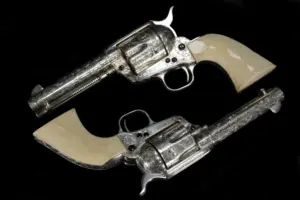
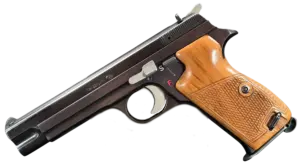
Hot salt bluing is what most people mean when they say a modern gun is “blued.” It’s an industrial process that uses molten caustic salts to create a controlled layer of black iron oxide. In plain terms, bluing is rust on your side. Think of it as oxidation that’s been stopped at a sweet spot to slow deeper rust from taking hold as long as it’s maintained.
Shops usually run bluing as a sequence of tanks. The common routine includes a hot degreasing tank to chase away every bit of oil, a hot rinse, a wipe or scrub with degreased materials, sometimes a repeat degrease and rinse, then into the hot bluing salts for the conversion to happen. Parts are typically suspended in the tanks on wire or jigs so every surface sees the solution evenly. If you want to read that flow in more detail, TFB’s Armorer’s Bench walked through practical hot salt bluing steps.
Why it’s everywhere: it’s relatively quick and consistent at scale. It also takes polish beautifully. The same hot salt process can look slate gray on a bead-blasted bolt handle and inky black on a 600-grit slide. Underneath the shine, though, hot bluing is thin and offers limited corrosion protection by itself. Keep it oiled and it behaves. Forget the oil and wet weather will remind you who’s boss.
Buyer notes and restoration cautions:
- Dimensional change is negligible. That’s good news for fitted parts.
- It’s not ideal for all guns. Caustic bluing salts can attack soft solder. If you’re dealing with older doubles, combination guns, or anything with soldered ribs and lugs, hot bluing can be a mistake. This is where rust bluing shines.
- Touch-ups with cold blue are cosmetic at best. If a modern factory blue shows holster wear, expect to either live with patina, re-blue, or move to a different finish category.
Rust bluing: slow, traditional, and still one of the best
Rust bluing is the classic method older factories used before fast commercial hot bluing took over. It’s slower, more hands-on, and especially well suited to valuable or delicate guns that can’t swim in caustic salts.
The process is simple to explain and satisfying to do. A rusting solution is applied to squeaky-clean steel. The steel is allowed to form a fine coat of red-brown iron oxide. You then boil the part in water, which converts that oxide to black magnetite, and card it with very fine steel wool or a soft wire wheel to burnish the new layer. Then you repeat the cycle until the color and coverage are right. In chemistry terms, you’re turning Fe2O3 into Fe3O4 by boiling and burnishing between coats.
There are different speeds to get there. Express solutions force the rust layer to appear quickly. Slow rust formulas take hours between coats and can build tremendous depth of color with patience. Surface prep, as always, sets the tone. Blast it and you’ll see a soft gray-black. Finish it to a high polish and you’ll get that deep blue-black you see on old English guns.
Why a lot of restorers still swear by it: rust bluing is friendly to soldered assemblies and can be repaired in place if the finish gets dinged. It’s a conversion finish so dimensional change isn’t a worry. It looks right on period guns and takes oil well. Like any blued surface, it still wants a light coat of oil to slow new rust. The chemicals and fumes are nothing to play with, so ventilation and protective gear matter.
Buyer notes and restoration cautions:
- Choose rust blue when a gun has soft-soldered parts or when you want traditional appearance with durability.
- It’s still thin, so edges stay sharp and rollmarks stay crisp if prep is careful.
- Minor damage can often be spot-repaired by an experienced hand, which is a big plus on heirlooms.
A quick word on cold blue touch-ups
Cold bluing has its place, but that place is small. It’s meant for touching up worn corners or very light scratches, not for finishing a whole firearm. It lays down a thin film and can mask rub spots beautifully, but it’s not as protective against rust or abrasion as real hot or rust bluing. If you don’t follow directions closely, cold blue can even trap moisture and let corrosion creep under the film. Use it for what it is, then oil.
Parkerizing: the service rifle work coat
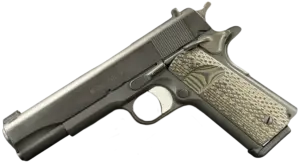
Parkerizing, or phosphating, trades gloss for grit on purpose. Chemically, it’s a phosphate conversion coating on steel. Practically, it’s the matte, slightly chalky gray to black finish you associate with mid-century service pistols and rifles.
Why people still choose it: Parkerizing absorbs oil well and offers more corrosion resistance than a bare blued surface. It tends to resist small dings and scratches better than a thin blue, and it keeps glare down. It’s not maintenance-free. It still likes frequent, light oiling, but it’s a durable working finish with a track record.
Thickness and wear sit in a friendly middle ground for a conversion finish. Industry overviews put phosphate layers under about 25 microns. That’s still thin in the grand scheme, yet it gives you a toothy surface that holds oil well. Color and texture depend on the prep and the exact phosphate bath. A bead-blasted part takes on a uniform, low-luster look that hides prior pitting better than a polished blue ever will.
Buyer notes and restoration cautions:
- Correct for many martial arms after the early 20th century, so it’s a strong choice for historically minded restorations.
- Because it’s matte, Parkerizing can help visually even out honest pitting on a rescue project, but it won’t erase pits. Surface prep still rules.
- Oil is still part of the system. The micro-porous surface holds it. Keep it fed and it lasts.
Nitriding and QPQ: heat-treat skin, not paint
Move from conversions into thermochemical territory and you find nitriding. In simple terms, nitriding diffuses elements into steel at controlled temperatures to harden the surface and boost wear and corrosion resistance. The black version many shooters see on slides, barrels, and bolts today is sometimes called black nitriding or ferritic nitrocarburizing. You’ll also hear QPQ, which refers to a quench, polish, quench sequence that influences appearance and performance.
From a buyer’s angle, this is where toughness climbs. Nitriding is not a paint or a film in the same way as a spray-on coating. It changes the top layer of the steel itself. Industry comparisons group nitriding in a moderate thickness band around roughly 5–50 microns, with high wear resistance and strong corrosion performance. It is not dimensionless like hot bluing, but it’s still far thinner than a heavy deposit coating.
Buyer notes and restoration cautions:
- Excellent for high-use slides, bolts, and barrels where you want hardness and low maintenance.
- Not something you touch up casually. It’s a process, not a dab-on coating. Plan at the build stage rather than as an afterthought.
- Because it’s a diffusion treatment, reworking the surface after the fact may require abrasive removal and a fresh run of the process to match.
Modern deposited coatings: color, corrosion, and caveats
Beyond the classics live sprayed ceramics, electroplating, and vapor-deposited films. This is a big universe that ranges from simple rattle-can stand-ins all the way to controlled physical vapor deposition on precision parts. The common thread is that the coating is added to the surface rather than created from the steel itself.
Why people go this route: color choice, strong corrosion resistance, and the ability to coat non-ferrous parts make these finishes appealing. Nickel-boron, for example, shows up on fire control groups for lubricity and corrosion resistance. Ceramics and PVD finishes bring many color and sheen options.
Industry comparisons place some of these in the 5 to 100-plus micron range depending on the recipe. That is a big swing and a reminder to think about fit. A few ten-thousandths on a slide rail is not much on paper, but it can change how a gun feels. Deposited coatings also rely heavily on surface prep. Most want a sandblast or similar tooth, which can visibly soften sharp edges or polish lines if the operator is careless. Once applied, many of these finishes are tough, but if you scratch through to bare steel you’ve made a tiny door for rust.
Buyer notes and restoration cautions:
- Expect measurable thickness. Communicate with the finisher about your tolerances.
- Surface blasting sets the look. Decide up front if you want crisp machining marks to remain visible.
- Great for mixed-material builds since you can coat aluminum and steel to match. Just remember that not all processes suit all substrates.
Thickness, wear, and corrosion at a glance
If you remember one snapshot, make it this simple ladder, adapted from common industry comparisons:
- Hot salt bluing: very thin, roughly 0.5–2 microns. Low corrosion on its own, minimal wear resistance. Lives on oil and maintenance.
- Rust bluing: similarly thin conversion layer. Protection improves with regular oiling. Loved for appearance and suitability on delicate assemblies.
- Parkerizing: still thin, under about 25 microns. Better at shrugging off light nicks and it drinks oil for corrosion control.
- Nitriding and QPQ: moderate 5–50 microns. High wear resistance and strong corrosion performance. Minimal upkeep.
- Deposited coatings like PVD or electroplate: roughly 5–100-plus microns depending on type. Wear and corrosion performance vary by formula. Plan fit accordingly.
Also worth noting: conversion finishes are usually specific to ferrous alloys. Deposited films can be tailored to a wider range of materials, and some blackening approaches exist for stainless, but the core idea holds that substrate matters.
Picking a finish by use-case
There’s no single right answer. There’s a right answer for you, your gun, and your climate.
For a classic bolt gun that will see range days and deer season:
- Rust bluing if you want traditional looks with real-world durability and you’re willing to keep it oiled.
- Hot salt bluing if you prefer a fast, factory-style route and the gun has no soldered assemblies.
For a carry pistol or a pistol that gets carried a lot in sweaty weather:
- Nitriding or QPQ on the slide and barrel gives you a hard skin and decent corrosion resistance with low maintenance.
- A modern deposited coating can add color and corrosion performance, but discuss thickness on rails and locking shoulders with your finisher.
For a GI-pattern rifle or a beater truck gun you want to run and not fuss over:
- Parkerizing is still an honest, proven choice. Keep it lightly oiled and it holds up to real use while looking the part.
For an heirloom side-by-side or a vintage rimfire with soldered bits:
- Rust bluing is the safe lane. Hot bluing salts can attack soft solder, which risks the joints that hold the gun together.
Restoration choices that respect the gun
When you’re restoring or refinishing, chemistry is only half the story. The other half is restraint. A few guiding thoughts from the bench:
- Match the method to the period. A 1930s sporter or an English gun wants rust blue. A World War II service rifle is at home in phosphate. A late-model factory bolt gun probably wore hot salts from new.
- Let the surface talk. Heavy blasting wipes away sharp edges and sands history right off a receiver. If rollmarks matter to you, prep around them rather than through them.
- Think about thickness before you coat. Conversions like rust blue and Parkerizing will not close up slide-to-frame fit. Nitriding adds a little, and sprayed or plated films add more. If your gun was fit tight, plan around that.
- Cold blue is a bandage, not a transplant. Use it to quiet a bright scratch, then oil.
- Respect the hazards. Bluing and rusting solutions are caustic or toxic if handled carelessly. Good ventilation and careful degreasing are part of the work.
Maintenance that matches the finish
Finishes are systems. They work best when you support them the way they’re built to work.
- Blued guns like oil. Wipe them with a rag dampened with a good gun oil after handling, and stash a silicone cloth in the safe for quick touch-ups.
- Parkerized guns also like oil, and the finish holds it. A light, frequent coat wins over heavy slathering.
- Nitrided parts need less babying, but sweat, salt, and time still win if you ignore them. Clean like normal and avoid harsh abrasives that could dull the surface.
- Modern coatings resist chemicals well, but not every solvent is friendly. Test on a hidden spot before you hose down an entire slide with an aggressive cleaner.
If the alphabet soup of finishes still makes your head tilt, that’s normal. Even folks who live with this stuff keep a cheat sheet nearby. The good news is the choices have never been better, and the older methods still have a place. Bluing is still bluing, Parkerizing still soldiers on, nitriding does what it says on the tin, and modern coatings bring color and convenience without changing the soul of a good rifle or pistol. If you match the method to the metal, the job, and the era, your finish will age as gracefully as the rest of the gun.
If you want a quick refresher while shopping or planning a refinish, The Armory Life’s overview of common coatings and finishes for modern guns offers a broad look at how these choices behave on real firearms.