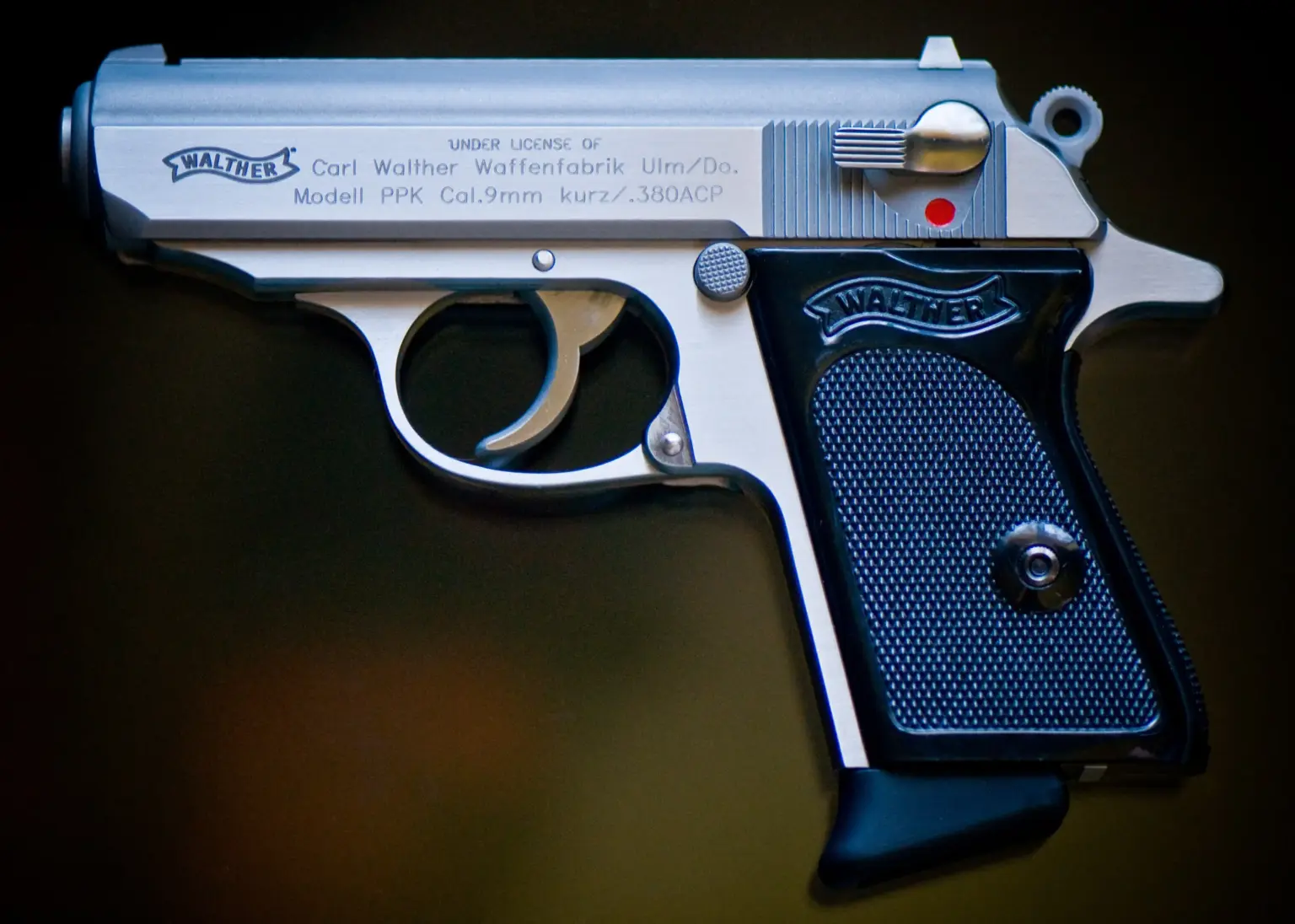
On a Walther PP-family pistol, the city line on the slide does a lot of heavy lifting. Zella-Mehlis or Ulm usually puts you in the right decade, then proofs and importer lines fill in the rest. Get those three to agree and you are most of the way to a confident ID.
Why this moment matters
Walther has paused legacy PP, PPK, and PPK/S production for a multi-year modernization program, and says remaining inventory has already been sold into the market. That shifts attention to what is already in circulation. As Walther’s VP Sales Tyler Weigel notes, this is the beginning of a new chapter, not the end of the story.
All three trace back to the same core: a fixed-barrel blowback pistol with double-action first shot and a slide-mounted safety that decocks. That lockwork made the PP line the first commercially successful DA/SA auto, and it remains a big part of the appeal.
PP vs PPK vs PPK/S
PP – Service-size Police Pistol with longer slide and grip.
PPK – Shorter slide and grip, the compact profile most people picture.
PPK/S – PPK top end on a PP-length grip frame for extra capacity and, in the U.S., import eligibility after 1968.
Timeline: Zella-Mehlis to Ulm to the U.S.
1929–1930s – PP debuts, followed by the smaller PPK. Zella-Mehlis slide addresses, commercial Crown N then Eagle N proofs, and, on government pistols, acceptance eagles are typical.
Postwar – Walther’s Zella-Mehlis plant falls into the Soviet zone; machinery is removed. Fritz Walther reestablishes in Ulm, West Germany.
1950s–early 1960s – Production with Manurhin in Mulhouse, France. Many parts are made in France, with final proofing and rollmarks in France or at Walther Ulm.
U.S. imports and manufacture – Interarms imports West German and French-made pistols. The first U.S.-made PPK appears in 1978 via Ranger Mfg. in Alabama, distributed by Interarms. In 1998, U.S. production shifts to a Smith & Wesson facility in Houlton, Maine. In 2012, Walther Arms takes over U.S. operations in Fort Smith, Arkansas, with assembly of PPK and PPK/S in .380 ACP as the standard chambering.
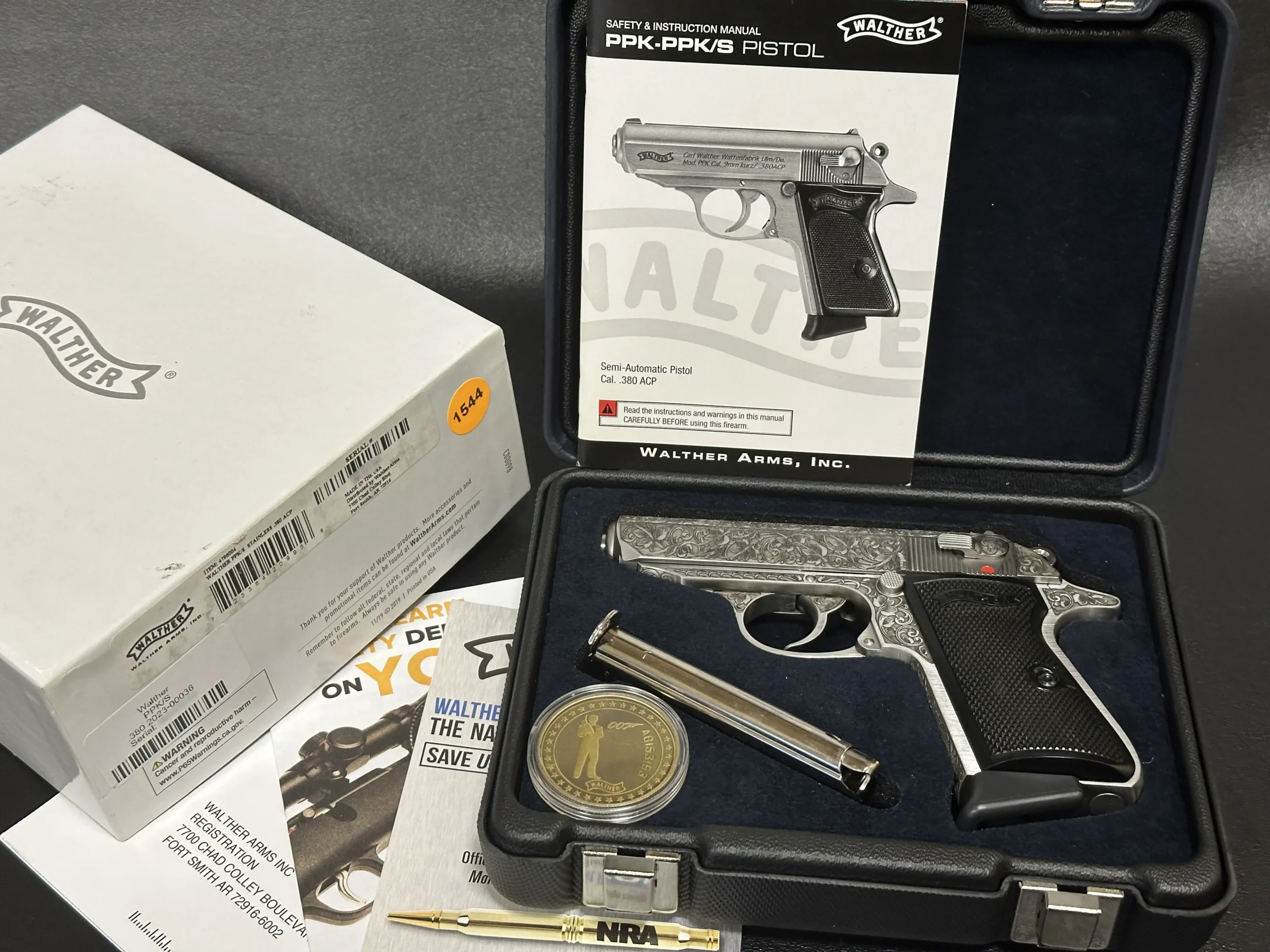
Walther Ppk S James Bond Commemorative 380 Acp Full View 2, shown in detail view, supports the article’s focus on Walther’s Police Pistols: PP, PPK, and PPK/S – Zella-Mehlis to Ulm, Interarms Imports, Markings, and What Matters to Collectors.
Markings by era: quick cues
Zella-Mehlis, pre-1945 – Slide legend with Walther banner and Zella-Mehlis address. Commercial proofs transition from Crown N to Eagle N by the late 1930s. Waffenamt eagles appear on government-accepted pistols. Expect high-polish prewar finish, trending more utilitarian late-war.
Manurhin collaboration, 1950s–early 1960s – French-manufactured components are common. You will see French slide legends and proofs on Manurhin-finished guns, or Ulm proofing and German legends on examples completed at Walther.
Ulm, West Germany, mid-1960s onward – Slide legends typically read Carl Walther Waffenfabrik Ulm/Do. with Ulm antler and postwar nitro proofs. Many export pistols add Made in W. Germany.
Small details matter. Prewar PP and PPK pistols often have externally numbered slides, and magazines can be serialized on the spine or baseplate depending on the variation. Documented collector research also notes special-contract markings and narrow serial ranges, for example RZM-marked PPKs clustered in the 838769–841397 range. Treat such features as an invitation to slow down and compare trusted examples.
Interarms and U.S. maker lines
Importer marks – Many U.S. examples show Interarms, Alexandria, VA on the right side of the slide or frame. Depth and placement vary by batch.
Made in USA – U.S.-made pistols will add a maker line, such as Ranger Mfg. (Alabama), Smith & Wesson (Houlton, Maine), or Walther Arms (Fort Smith, Arkansas), along with Made in USA.
Collector note – Light, well-aligned import stamps tend to be preferred. Read the importer or maker line alongside the city address and proofs to place the gun correctly.
GCA ’68 and the PPK/S
The 1968 Gun Control Act created a points system for imported pistols. The PPK came up short, so Walther combined the PPK slide with the longer PP grip frame to add points. That hybrid is the PPK/S most American buyers know.
Calibers and typical capacities
.380 ACP – Very common in U.S.-market PPK and PPK/S, and the standard chambering for recent U.S. production. Typical capacities: PPK 6+1, PPK/S 7+1.
.32 ACP – Common in European-market PP and PPK. Typical capacities: PP 8+1, PPK 7+1, PPK/S 8+1.
Confirm the caliber rollmark, then check that the magazine type and baseplate style match the era you expect.
Boxes, papers, and accessories
Pre-1945 – Two-piece cardboard boxes with period labels are typical. Surviving labels and penciled or inked serials help.
Postwar – West German pistols often shipped with contemporary manuals, and many include a test target stamped with proof information and date.
U.S. import and U.S.-made – Expect importer or maker-branded manuals and warranty inserts appropriate to the period.
Packaging that does not line up with the pistol’s features is not automatically a deal breaker, but it should prompt more questions or adjust price expectations.
Quick checks for authenticity
Address, proofs, finish – These three should tell the same story. If one is out of tune, pause and compare more examples.
Rollmark quality – Fonts and depth should be consistent. Sharp addresses with mushy model text are a clue.
Proof coherence – Prewar Crown N or Eagle N do not belong on postwar Ulm-addressed slides, and vice versa.
Importer vs origin – An Interarms line is normal on European-made guns. U.S.-made pistols should add a clear maker line and Made in USA.
Small parts harmony – Safety levers, sights, grips, and magazines should look era-correct. Overpolished edges and washed-out lettering often signal a refinish.
Where Walther says the line goes next
Walther describes a multi-year reengineering program for PP, PPK, and PPK/S that preserves the look and feel while modernizing how they are built and how they run. With legacy inventory already in the channel, now is a good time to get fluent in city lines, proofs, importer stamps, and the paper that comes with the gun.
As a firearms enthusiast with a background in website design, SEO, and information technology, I bring a unique blend of technical expertise and passion for firearms to the articles I write. With experience in computer networking and online marketing, I focus on delivering insightful content that helps fellow enthusiasts and collectors navigate the world of firearms.
Two FALs can look identical until a magazine will not lock. This field guide cuts the confusion around metric vs inch patterns, receiver cuts, para parts, surplus kits, and what matters to collectors.
A practical, collector-minded look at Remington’s Model 8 and 81. Calibers, long recoil explained, police conversions, and what to check before you buy.
A collector’s look at Colt’s SP1 and early Sporters, from slickside uppers and pencil barrels to the rollmarks and small changes that hinted at the A2 era.