
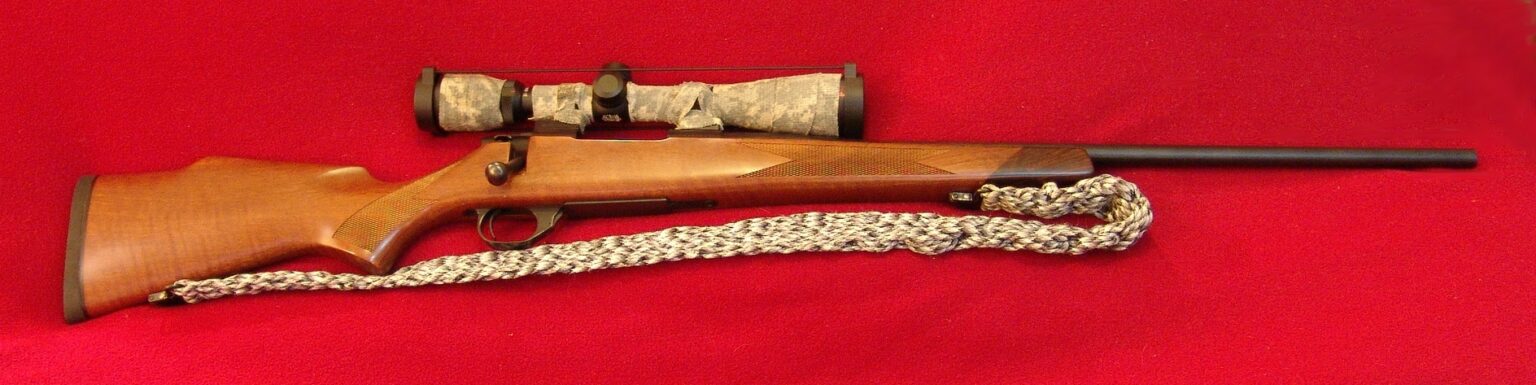
You can spot a Weatherby from across a gun show aisle. Sleek lines, sporty intent, and a bolt that feels fast even at rest. Behind that look is a very specific story about Roy Weatherby’s magnums, the Mark V action that tamed them, and a production trail that runs through California, West Germany, Japan, and back to the United States.
Roy’s Magnums: The Idea That Shaped the Rifles
Roy Weatherby bet his young company on high velocity and flat trajectories. By 1945 his .300 Weatherby Magnum was pushing bullets roughly 300 fps faster than the .300 H&H it sprang from, and soon it was joined by staples like the .257, .270, 7 mm, .340, and the big .460 Weatherby Magnum. Early rifles were built on strong commercial actions such as FN Mausers and Schultz & Larsen, but Roy wanted a purpose-built action for his cartridges.
Mark V: Development and What Makes It Different
In 1954 Roy and chief engineer Fred Jennie set out to create an in-house action for Weatherby pressures and field use. The Mark V debuted in 1958 after extensive testing and patents. First actions were investment-cast in San Francisco by Precision Founders, Inc., and assembled at South Gate, California, before Weatherby moved to forged production with J. P. Sauer & Sohn in West Germany.
Mechanically, the Mark V is defined by its multi-lug bolt and short bolt lift. Large Mark Vs use a nine-lug bolt for Weatherby magnums. Smaller Mark Vs use a six-lug version for the .240 Weatherby and many standard cartridges. Weatherby cites a 54-degree bolt throw, which helps the action run quickly and clear optics. For a deep dive on the design and teardown, see American Rifleman’s Mark V history.
Production Eras and How to Identify Them
- 1958–1959: Early California assembly — Sand-cast receivers by Precision Founders, Inc.; assembled at South Gate. Limited volume. Reported serials for these cast actions fall in the 15,000–16,000 range. You may see older sources call the foundry Pacific Foundry; Precision Founders is the firm named in authoritative accounts.
- 1959–early 1970s: West Germany, J. P. Sauer — Forged actions and barrels by Sauer in West Germany. These “German Mark Vs” typically show country-of-origin on the barrel or receiver. Sauer-built actions are reported to begin around serial 20,000.
- Early 1970s–1994: Japan, Howa — Long, consistent run by Howa in Japan. Look for Japan rollmarks on the receiver wall or barrel shank.
- 1994–2000: USA, Saco Defense — Production moved to Saco Defense in Maine toward the end of 1994. Expect U.S. manufacture noted in rollmarks.
- 2003–present: USA, specialty shops and ATEK — After Saco’s parent exited commercial work in 2000, Weatherby used specialty shops beginning in 2003. Current Mark V barreled actions are made by ATEK in Brainerd, Minnesota, with final assembly at Sheridan, Wyoming.
Tip: Always examine both sides of the receiver and the barrel shank in good light. Country-of-origin and model markings can move around by era.
Vanguard: The Accessible Workhorse
The Vanguard gives hunters a proven two-lug action under the Weatherby name. Howa manufactures the barreled action in Japan; Weatherby completes final assembly in Wyoming. Chamberings and configurations are broad, and select models have carried accuracy guarantees. In practical terms, the Vanguard is the one many hunters buy, carry, and use hard.
Stocks and Styling, Then and Now
Weatherby leaned into a distinctive look early and kept evolving. The catalog now spans conservative hunting stocks, synthetics, and modern carbon builds. On the ultralight end, current Mark V Backcountry Capra models start around 4.0 lb and are offered in multiple cartridges. You can browse current Mark V variants at Weatherby’s Mark V lineup and the broader catalog at weatherby.com.
Proofs, Serials, and Verification Tips
- Serial signposts — Early California cast actions are reported in the 15,000–16,000 range; Sauer-built actions begin around 20,000. Treat these as guides, not absolutes.
- Country-of-origin — West German, Japan, or U.S. markings usually appear on the barrel shank or receiver. Small proof and inspection marks on German rifles tend to cluster near the chamber area.
- Parts swaps — Stocks and triggers change over time. Weight these clues lightly if originality matters.
- Rebarrels — Barrel markings may no longer match the original chambering. For older magnums, confirm chamber and headspace with a competent gunsmith.
- No universal date code chart — Weatherby does not publish a simple date-code lookup for all eras. Clear photos of all markings plus a note to Weatherby support can help confirm production period.
Where Weatherby Is Today
Weatherby’s headquarters is in Sheridan, Wyoming. The company builds three centerfire families: the flagship Mark V, the Vanguard, and the newer Model 307 branch. Mark V barreled actions are currently produced by ATEK in Brainerd, Minnesota, with final assembly in Sheridan. Vanguard actions and barrels are made by Howa in Japan, with Weatherby handling final assembly in Wyoming.
Buyer Tips for Shooters and Collectors
- Pick your use, then cartridge — For reach and authority, the .257, .270, .300, and .340 Weatherby Magnums are proven. For 300 yards and in, a standard chambering in a Vanguard often frees budget for glass.
- Handle both actions — The Mark V’s nine- or six-lug, 54-degree throw feels different than the Vanguard’s two-lug rhythm. Buy the one you cycle smoothly.
- Mind the scale — Ultralights shine on the mountain but can be brisk at the bench. Pads and loads can tailor feel.
- Verify era claims — Photograph all rollmarks and proofs. Cross-check country-of-origin and serial signposts. Document unusual features before paying a premium.
From bench-built magnums to today’s ultralights, Weatherby’s throughline is velocity and field performance. If you want the flagship experience, the Mark V still delivers the multi-lug confidence Roy launched in 1958. If you want a reliable two-lug hunting rifle that tends to shoot without drama, the Vanguard fills that role well.