
Lay three Glocks on a bench and you will get five opinions. Someone will point at the finger grooves, someone else will talk about the slide finish, and before long the conversation drifts into magazines, recoil springs, and a mysterious half-moon cut that pinches fingertips. If you are trying to pick a Glock 17 or 19 and want the straight story on what actually changed from Gen1 to Gen5, this is the map I wish I had years ago.
How to read Glock “generations” without getting lost
Glock does not treat generations like brand-new models. Think of each as an iterative step. Frames change a little, slides change a little, springs and small parts shuffle, and every so often there is a bigger mechanical refresh. The 9mm Glock 17 and Glock 19 carry those changes most clearly, which is why they are the right place to learn the language.
If you need official specs for current production guns, go straight to the factory pages for the Glock 17 and Glock 19, or use the site’s search to compare variants before you shop used.
Looking for a broader brand overview or shopping checklist? Our Glock hub and Glock buyer tips keep the homework simple.
Quick reference: hallmark changes by generation
- Gen1: Smooth grip, no finger grooves. Early G17 focus with rare outliers.
- Gen2: Front/backstrap checkering, front magwell cut, captive recoil spring assembly, G19 becomes a standard model.
- Gen3: Adds finger grooves and accessory rail on many models. The aftermarket baseline.
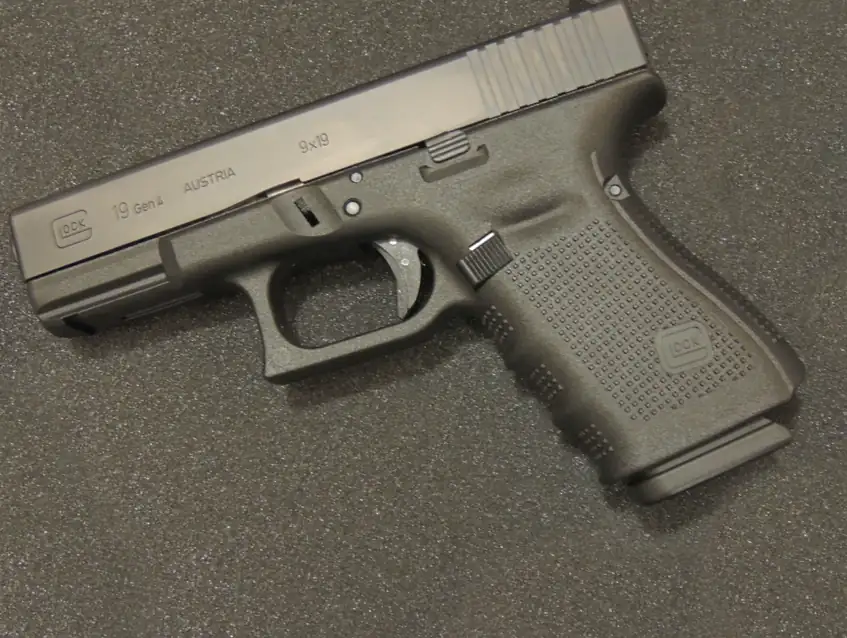
- Gen4: Removable backstraps, revised matte-ish slide finish on most, dual nested recoil spring assembly on 9mm G17/G19, reversible magazine catch. Mixed parts compatibility with Gen3.
- Gen5: No finger grooves, slightly flared magwell, undercut trigger guard, ambidextrous slide stop, Glock Marksman Barrel, wider frame with revised internals and finish. Early Gen5 frames had a half-moon cut; later FS variants added front serrations and dropped the cut.
Gen1: smooth frames and the original 9mm service pistol
The story starts simple. The vast majority of first-generation pistols were standard Glock 17s. A longslide 17L existed, and Glock also built Gen1 Glock 18 machine pistols. Tucked off to the side are a few ultra-rare compact Glock 19s from that earliest period, but the Gen1 world is, for most of us, really the full-size G17 in its original trim.
In the hand, Gen1 is the smooth-frame era. You do not see later checkering or finger grooves. The silhouette is clean and a little austere. If you are holding a shooter rather than a safe queen, what matters is how that straight, early grip feels in your hand. Some love it. Others want more traction.
Gen2: checkering, captive spring, and the G19 joins the party
By 1988, Glock introduced its second-generation handguns, and the practical changes begin to arrive. The front and back straps pick up more aggressive checkering, which immediately helps the gun anchor under recoil. Down at the magwell, a small front cutout appears to help strip a stuck mag. You will also see a metal serial number plate at the bottom of the dust cover become standard, a quick Gen2 tell.
Inside the slide, Gen2 brings a one-piece captive recoil spring assembly in the 9mm line. It simplifies takedown and keeps the spring from launching across the bench. On the model lineup side, this is where the compact Glock 19 becomes a standard, widely available option rather than a rarity.
Gen3: the baseline many still picture
Gen3 sits in the background of almost every Glock conversation because so much of the aftermarket and so many long-tenured range rentals trace back to it. It is the era many shooters picture when they say Glock without qualifiers. For our purposes, treat Gen3 as a control group. Later debates about texture, triggers, finishes, and small-part compatibility tend to use Gen3 as the yardstick.
Gen4: backstraps, dual RSA, new finish, mixed feelings
When the fourth generation lands, you can feel Glock listening to hands of all sizes. Gen4 frames brought removable backstraps so you could tailor the reach to the trigger. Many Gen4 slides wore a newer, more matte finish compared to the earlier generation’s glossy coating that enthusiasts nicknamed the frying pan finish. You will still find some early Gen4 pistols with the older sheen, but most lean matte. The last of the Gen4s were discontinued in late 2025.
The key mechanical note for the 9mm G17/G19 is the dual nested recoil spring assembly. It aimed to tame recoil impulse and extend service life compared to earlier single-spring setups. Gen4 also introduced a reversible magazine catch so right- or left-side setup is possible, though the slide stop remained single-sided.
Between the finger grooves, a trigger many describe as slightly worse than Gen3, and the parts shuffle versus the big Gen3 ecosystem, Gen4 is remembered as the most polarizing of the modern steps. It still shoots well and fits more hands thanks to the backstraps.
Gen5: big refresh, no grooves, ambi controls
In 2017, Glock rolled out Gen5, and a lot of shooters consider it the biggest single step forward since the beginning. The finger grooves are gone. The frame gets a subtle flare at the magwell and a small relief cut under the trigger guard for a higher grip. Controls improve with ambidextrous slide stop levers and the continued reversible magazine catch introduced in Gen4. Internals were reworked enough that the frame is slightly wider and the cross pin above the trigger guard disappears. Finish moves to a tough carbon-based coating, and the barrel changes to the Glock Marksman profile with an updated crown.
There is also a split within Gen5. The original run had no front slide serrations and included a half-moon cut at the front of the grip. Later FS-marked Gen5 pistols added front slide serrations and dropped the half-moon cut.
Slides and finishes: what changed to the eye and in the holster
From the outside, the slide is where a lot of the generation talk lives because you can see and feel it in a second. Three details do the heavy lifting.
- Finish: Many Gen4 pistols wear a matte slide finish. Earlier guns often carry a glossier coating that many owners believe wears more slowly. If you value a slide that looks new longer under a duty holster, that older sheen is prized. If you like a utility, low-glare surface, the later matte look does that job.
- Front serrations: Early Gen5 pistols did not include them. Later FS-marked Gen5 slides do, which helps if you press-check off the front or want extra traction.
- Barrel and crown: Gen5’s Glock Marksman Barrel is a mechanical change you will see when you break the gun down. Shooters chasing a little more practical accuracy often care about that detail.
RSA and trigger notes by generation
Recoil spring assemblies and triggers sit under the hood, but they change how a Glock runs and feels more than you might expect.
- Gen2: One-piece captive RSA becomes standard on 9mm models.
- Gen4: For the 9mm G17/G19, Glock moves to a dual nested RSA, intended to smooth recoil and extend service life.
- Gen5: Spring rates and internals are revised again to match the wider frame and new barrel/slide profile.
Triggers are where opinions start. The broad pattern you will hear goes like this: Gen3 sets a baseline many are used to. Gen4’s trigger is often described as slightly worse or differently sprung. Gen5’s internal revisions are widely associated with a smoother, more consistent feel. Whatever the label, test the specific gun in your hand. For any dry fire or takedown, first lock the slide open and visually and physically verify the pistol is unloaded before pressing the trigger.
Parts and magazine compatibility that actually matters
You can lose an afternoon arguing about parts compatibility. Here is the short version that matters when you are standing at a counter or searching for spares.
- Gen3 to Gen4 is not a clean swap. Gen4 changed enough that you cannot assume cross-compatibility with Gen3 small parts.
- Gen5 internals were substantially revised. The frame is slightly wider, the cross pin above the trigger guard is gone, and the slide stop is ambidextrous. Treat Gen5 as its own parts ecosystem.
- Magazines mostly play nice across G17/G19 generations, but pay attention to notches: early Gen3 mags with a single left-side notch will not lock if you reverse the mag catch to the right side on Gen4/Gen5. Later dual-notch mags work either way. Always confirm that a mag locks and drops free in your exact setup.
- Slides and barrels track with their frames. The Gen5 slide, RSA, and Glock Marksman Barrel are designed as a set. Do not plan on shuffling Gen5 slide assemblies onto earlier frames.
If you need to verify a current feature set on new guns, compare the Glock 17 and Glock 19 listings at the source.
Real-world wear points when buying used
Glocks are famously durable, but any pistol that has lived a real life will show you where it has been. When I am checking a used G17 or G19, this is how I read the clues without overthinking it.
- Slide finish vs holster wear: That older glossy finish many associate with Gen3 tends to hide miles better than the matte Gen4 look. Do not confuse a rubbed corner with hard use.
- Barrel hood and locking surfaces: Field strip and look for even, polished contact on the hood and lugs. Bright metal is normal. Deep gouging or chipping deserves a question.
- Rails and frame: Run a fingertip down the slide rails and the matching frame surfaces. Smooth, even tracks are normal. Sharp burrs or odd peening are not.
- RSA condition: Glance at the recoil spring assembly for obvious kinks or corrosion. It is a wear item; budget for a fresh spring on hard-used trade-ins.
- Trigger feel and reset: Dry fire for a consistent break and positive reset. Grit can be dirt or parts wear. Either way, price it in.
- Magazines: Inspect feed lips, and make sure mags insert, lock, and drop free smartly. Early Gen5 half-moon cuts can show cosmetic marks from hard reloads; note it but do not overvalue it.
Which generation fits you
If you want a shooter that checks the most boxes with the least fuss, Gen5 is the easy recommendation: no finger grooves, ambi slide stop, flared magwell, tough finish, and the Glock Marksman Barrel.
If you like finger grooves or want removable backstraps without ambi slide controls, a clean Gen4 can make sense. Know its finish often shows wear sooner and not every Gen3 small part will swap. The reversible mag catch is a plus if you shoot lefty.
If your taste runs traditional, Gen3 is a steady go-to. A well-kept Gen3 G17 or G19 feels like home to many shooters and remains the aftermarket’s comfort zone.
If you are collecting, Gen1 and early Gen2s tell the origin story. The earliest G17s and the checkered-front Gen2 period have a quiet charm. The ultra-rare Gen1 G19s sit in their own orbit.
Still torn? Handle a no-groove Gen5 and a grooved-frame example from the previous era. Ride your support hand high under the trigger guard, work the controls, and dry fire both after verifying clear. Your hands will pick the serial number faster than any spec sheet ever could.