

I first understood Benelli standing at a counter with an old SL80. The owner eased the stock against his hip, rode the charging handle forward, and that small rotating bolt head clicked into lock. One little twist, and the whole line made sense.
Origins: Civolani’s 1967 Inertia System
Benelli’s modern identity starts in 1967, when Bruno Civolani designed a semiauto that times its own cycle with a spring and inertia rather than bleeding gas from the barrel. The recipe is still the point: a rotating bolt head with steel locking lugs, a floating bolt body, and a spring that compresses under recoil, then drives extraction, ejection, and feeding. Fewer parts take heat and fouling, so the guns stay light and run clean.
For the factory’s overview of how the idea evolved, see Benelli’s history and the company’s writeup on the inertial system.
The history of the Benelli Inertial System | Benelli history
Early Semiautos: 121, SL80, and the 20 Gauge
Benelli Armi S.p.A. was founded in 1967, built its Urbino plant in 1968, and launched the 121 that same year. Company records call the 121 the progenitor for later semiautos. The line broadened fast: a 20 gauge arrived in 1973, followed by the SL80 family in 1974 with hunting, clay, and slug versions. The theme was consistent across gauges and trims: one operating heart, many roles.
Super 90, Montefeltro, and Where M1/M2 Fit
By 1983 the inertial system anchored the Montefeltro series, and the Super 90 platform took shape. In 1987 the elegant Raffaello line appeared, alongside a true left-handed semiauto. Most buyers know this era through the M1 and later M2, which carried inertia reliability into field, sport, and practical circles. The draw is simple and durable engineering: a compact rotating head with steel lugs, a clean-running bolt, and easy maintenance.
On used M1 or M2 guns, hand cycle the action. The bolt head should rotate crisply in and out of lock and return with authority. Like any semiauto, fresh recoil and return springs restore rhythm in high-mileage examples.
Super Black Eagle: First 3.5 Inch Semiauto in the U.S. (1991)
In 1991 Benelli launched the Super Black Eagle, the first 3.5 inch 12 gauge semiauto on the U.S. market. Waterfowlers could run heavy steel without giving up semiauto speed, and Benelli did it while staying with inertia.
SBE 3: Updates You Can Feel
Benelli folded decades of refinements into the Super Black Eagle 3. Factory materials highlight practical gains: the SBE 3 cycles everything from light target shells to 3.5 inch magnums, and a spring-activated ball detent helps keep the bolt locked and guides it back into position after hand cycling. Recoil and handling get attention too, with ComforTech 3 buttstocks, CombTech cheek pads, and fit adjustments for length, drop, and cast. The point is control and consistency in real use.
Super Black Eagle 3 Series | Inertia Driven System
Tactical Branch: M3 Dual Mode and M4 ARGO
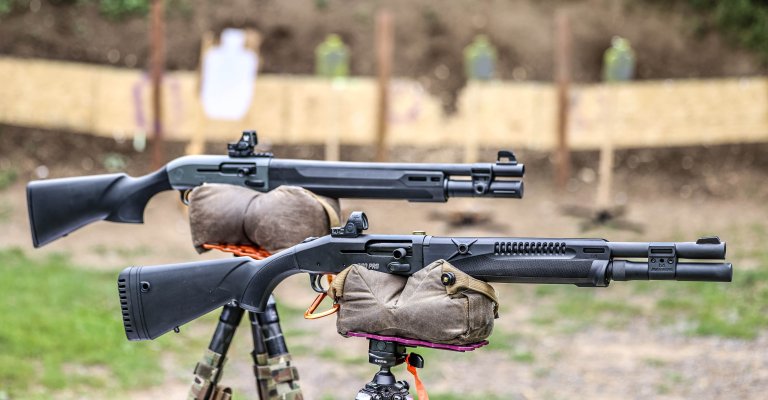
Benelli’s tactical branch splits in two. The M3 keeps inertia but adds a manual pump mode, so users can switch between semiauto and pump for specialty or low-recoil loads. It is a flexible bridge between duty and competition.
The M4 takes a different path with Benelli’s Auto Regulating Gas Operated system, widely known as ARGO. In 1998 the M4 was selected by the United States Marines. Short barrels, rugged furniture, and a self-regulating gas setup define the family.
Bolt Heads and Rotating Lugs
Benelli keeps pointing at the rotating bolt head because it is the compact, high-strength lockup that lets the rest of the gun stay simple. Pop the bolt out of an inertia model and you will see why the timing is fast and positive without a lot of extra mass.
Recoil Feel: Inertia vs ARGO
- Inertia: A firm shove with a quick pulse as the action unlocks and runs. Cleanliness and balance stand out because no barrel gas is vented into the receiver.
- ARGO: Gas operation spreads the impulse differently, which many shooters find steady in short tactical guns with accessories. Plan on routine gas-system cleaning.
Stocks, Fit, and Finishes
Across the line you will see three themes:
- Recoil management: ComforTech 3 stocks and CombTech cheek pads to soften hit and cheek bite.
- Fit: shim kits for length of pull, drop, and cast so the gun mounts naturally.
- Protection: many trims add corrosion-resistant surface treatments. Benelli’s BE.S.T. finish appears on select models in the premium lines.
Proofs and Date Codes
Italian shotguns wear their proof. Practical tips:
- Where to look: barrel flats and the barrel exterior near the chamber, then the receiver. Use bright light and magnification.
- What you will see: Italian proof marks applied in Italy plus a small boxed two-letter date code that ties to the year of proof.
- Urbino note: in 1997 Benelli obtained a license to host the National Proof House in Urbino, so later guns may reflect Urbino proofing.
- How to verify: photograph the marks and consult Italian proof-date resources or contact Benelli USA with the code.
Import Marks and Benelli USA
Benelli set up Benelli USA in Accokeek in 1997. Most modern imports will show Benelli USA markings. Earlier U.S.-bound guns can carry different importer rollmarks, typically on the receiver or barrel. Pair those marks with the boxed two-letter Italian date code to place a gun in time with confidence.
Today’s Lineup at a Glance
Hunting and sport are anchored by the Super Black Eagle 3, with Montefeltro and Ethos models building around the same inertia core. The catalog also leans into small gauges where it fits the role. On the tactical side, the M4 Tactical and M1014 carry ARGO, while Nova and SuperNova pump guns remain options for simple duty or field work.
Buyer Checks: Quick Field Notes
- Use case first: Waterfowl and upland point to inertia guns like SBE, Montefeltro, and Ethos. Duty, training, or hard-use setups point to M3 or M4.
- Gauge and chamber: SBE 3 spans light target loads up to 3.5 inch shells in 12 gauge. For lighter carry and report, consider 20 and 28 gauge offerings in the line.
- Fit over specs: use the shim kit to dial drop, cast, and length. A clean mount beats paper numbers.
- Inertia health check: hand cycle the bolt and watch for crisp rotation and a snappy return. Plan on new springs in well-used guns.
- M3 specific: verify smooth switching between semiauto and pump, then run the forend to feel for consistent travel and lockup.
- M4 upkeep: field strip, inspect the ARGO gas parts, and keep carbon under control per the manual.
- Marks that matter: document proof and date codes along with importer marks for resale value and provenance.
One Philosophy, Two Paths
Line up a 121, an M1 or M2, an SBE 3, and then an M3 or M4. The parts rhyme across decades because the big ideas stayed tight. Benelli introduced inertia in 1967 and kept refining it, while building a parallel gas-driven duty branch that proved itself in 1998. Different mechanisms, same goal: simple, durable shotguns that work when it counts.
Benelli company timeline