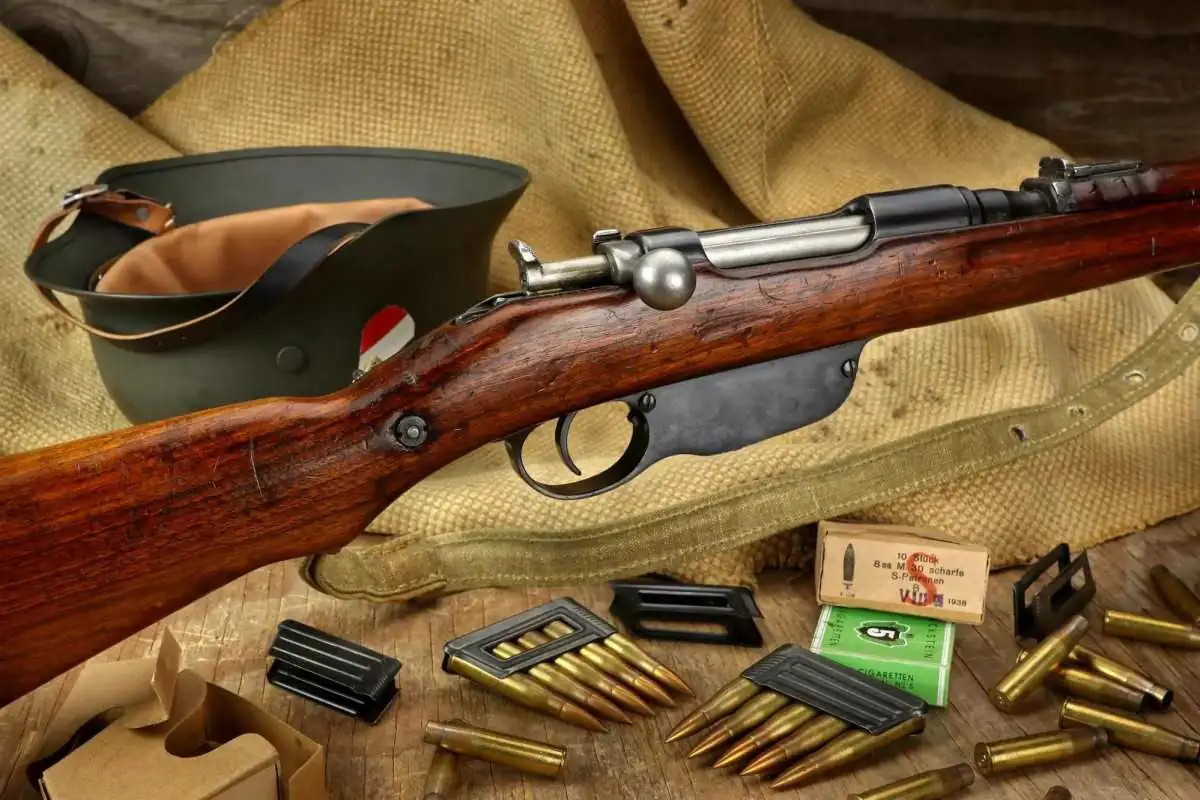
I once set an early M95 carbine and a factory AUG across the same bench and just stared for a minute. One was all steel and wood with a bolt you could work without lifting. The other packed a full-length barrel into a compact bullpup shell. You would not mistake one for the other, yet both solved the same problem the way Steyr has done for more than a century and a half: by engineering toward the simplest possible answer that still runs in the real world.
That is the thread running through Steyr-Mannlicher history. From Ferdinand Mannlicher’s straight-pull ideas to a polymer-stocked sniper rifle, then a space-age service rifle that actually makes daily sense, there is a consistency here that buyers and collectors can feel. Let’s walk it in order, with an eye for what still matters when you are choosing one for your safe.
Where it starts: Werndl and a city wired for progress
Steyr’s story opens in 1864, when Josef Werndl founded the works that would become a fixture of Austrian industry. The city of Steyr had iron in its bones long before that, but Werndl gave the place a gear train and a payroll. He built rifles for a living, yet he also chased new technology wherever he saw it coming. In 1884, the city hosted an industrial exhibition that lit its streets with electric light. That was not common. It signaled a culture that did not mind being an early adopter.
That openness created a landing strip for the next act.
Mannlicher arrives and changes the rules
Ferdinand Mannlicher joined the scene in the 1880s. He was trained as an engineer, not a gunmaker, which helped him question things others accepted. He played with clip systems that sped up loading, designed repeating rifles when many were still thinking in singles, and pushed on actions that could run faster with fewer wasted motions.
His early work used a packet-style clip system and a locking method that evolved quickly. Within a few years, he was refining straight-pull ideas using a pair of frontal rotary lugs to lock the bolt. That detail, small on paper, gave shooters a firm lockup without the usual handle lift. The thinking was practical: get the shot off, cycle without breaking your cheek weld too much, get back on target. It felt different in the hands, and it mattered.
The M95 straight-pull becomes a workhorse
By the mid 1890s, Mannlicher’s concepts landed in the Model 1895, the straight-pull rifle most associated with his name. It took the lessons of the late 1880s and fixed them in a form that was easier to build and easier to run. The American Society of Arms Collectors has noted how the two-lug, front-locking layout gave the design a more positive lock than earlier attempts, and production stretched into the late 1930s.
What made the M95 stick is not mysterious. The action cycles with a straight pull and push rather than a lift, pull, push, and drop. Less movement can mean less disruption to your position. In practice, that makes a short carbine or full-length rifle feel quicker without any trick beyond the shooter’s rhythm. Steyr turned that into a production success through the 1890s and into the war years.
For collectors and shooters today, a few practical notes:
- Cycle the bolt a few times before you buy. You are looking for smooth, even resistance and full lockup without hitching.
- Check the bore carefully. Age and storage conditions show up fast in older small-bore barrels.
- Look closely at wood-to-metal fit. Cracks around the action or tang can warn you about hidden stress.
The appeal of the M95 is not speed alone. It is the feeling that a clever idea was made simple enough to live a hard life and keep working.
A pistol that hinted at the future: the Steyr-Hahn
Steyr was not just a rifle house. In 1912 it put a semi-automatic pistol into service that reflected the same appetite for clean, dependable function. The Steyr-Hahn, often referred to by its M1912 designation, fed from a fixed magazine loaded by stripper clips. That is unusual by modern standards, yet the whole point was to keep the pistol fast and solid at a time when many still preferred revolvers.
If you have handled one, you know how much old-world machining ends up in your hand. A good overview of its character and influence can be found in a plain-language history of the model that explains why users trusted it and how it nudged expectations for service pistols forward. See the piece on the Steyr-Hahn’s evolution for a readable tour of that story.
An industry folded into war, then forced quiet
The 1930s brought the kind of change no company asks for. In 1938, after the annexation of Austria by Nazi Germany, the holding that contained Steyr’s arms business was broken up and drawn into Reichswerke Hermann Göring. Production served the occupier’s needs with firearms and other war goods. By 1945, weapons manufacturing stopped.
There is no way to write that chapter without a hard pause. The factories survived, but the company had to rebuild its purpose afterward under the eye of Allied authorities.
Reconstruction and the Mannlicher-Schönauer revival
By 1950, with permission granted to resume limited work, the company restarted production where it had deep roots: sporting rifles. The Mannlicher-Schönauer came back to the line. It echoed what the company did best before the war, and it reached the kind of users who expected graceful lines and careful fitting. That return brought skills back into circulation and set the table for a different kind of precision to follow.
1969 puts a stake in precision: SSG 69
Precision for both hunters and military users was the company’s headline by the late 1960s. In 1969, a bolt-action sniper system entered service that read as thoroughly modern. The SSG 69 combined cold hammer-forged barrels with synthetic components that most competitors were still hesitant to trust. The stock, trigger guard, and magazines were not wood and steel. They were engineered materials chosen for stability and durability. The rifle was light for its role, yet it held accuracy that stood out for its era.
It became the Austrian Army’s standard sniper rifle, and production continued for decades. A compact summary of the model’s history and features, including its long run from 1969 to 2015, is available here: Steyr SSG 69 overview.
For buyers considering an SSG 69 today:
- Inspect the barrel crown and throat as carefully as the exterior. Round counts vary widely, and precision fades first where you cannot see at a glance.
- Confirm that the bolt lifts and closes with the same pressure across several cycles. Consistency tells you more than a single easy close.
- Expect a different feel from a rifle designed around stability in varied conditions. That is part of its charm and purpose.
SSG 69s are not museum pieces by default. Many still shoot to a standard that rewards good glass and careful ammunition choice.
A bullpup with a passport: AUG and the StG 77
Steyr’s late twentieth century contribution to service rifles is easy to spot from across a room. The AUG took a bullpup layout, where the magazine and action sit behind the trigger, and made it reliable enough for a national adoption. In 1977 the Austrian Federal Army chose what it called the StG 77 as its standard rifle, and the silhouette became familiar well beyond Austria. Law enforcement agencies and military units around the world picked it up, and it earned plenty of screen time in films.
The other part of the AUG story is less flashy. It is light for what it does, handles neatly in tight quarters, and keeps full-length barrel performance in a compact package. Those are practical advantages if you need one rifle to do city work one day and open fields the next. Steyr had already been producing the StG 58 for Austria since 1958, so the AUG did not arrive out of nowhere. It arrived as a polished answer to a long-running question.
Buyer notes for AUG fans:
- Understand the bullpup tradeoffs. The compact overall length is a real benefit. Trigger feel is different from conventional rifles and worth a hands-on test.
- Pay attention to barrel configuration and sighting systems. The line has seen several options over time, and matching your intended use to a specific setup saves you tinkering later.
If you grew up seeing the AUG in movies, it is easy to treat it as a prop. Spend an afternoon on a range, and the design reads as very functional rather than merely futuristic.
New era, new name, new pistols
Corporate structures shifted in the late 1980s. In 1989 the broader industrial conglomerate that once housed the arms division was dismantled, and the weapons arm became independent again as Steyr Mannlicher. That label stayed in use until 2019, when the company was renamed Steyr Arms. In April 2024, Steyr Arms was acquired by RSBC Holding.
On the product side, the company greeted the year 2000 with a fresh pistol line. The M1 series arrived with a look and feel that marked it as contemporary. The goal was simple: a modern service pistol built with a design language that matched the new millennium. It was a nod to the past only in the sense that it chased practical reliability over flash.
Back to the valley and a focus on refinement
In 2004, headquarters moved to the Raming Valley. The shift was not just a change of address. In that period, the company pushed out sporting rifles that showed a kind of quiet confidence. Models like the Mannlicher Classic, the updated Luxus, and the SM12 were praised for finish and precision on the one hand and for lines that would not age out on the other. That balance is hard to strike. Plenty of rifles look the part until you work the bolt and find a rattle where there should be a glide. These did not earn that criticism.
By 2014, the firm was celebrating 150 years. That is a long stretch for any company, much less one that bridged the black powder era, two world wars, and a polymer revolution. It did not happen by chasing novelty for its own sake. The pattern you see instead is a willingness to use new materials and layouts when they make the shooting experience better or the rifle more dependable.
Why this lineage matters to buyers and collectors
Steyr’s history is not just a curiosity for people who like old catalogs. It shapes what you can expect from the product lines that matter to shooters today. Three ideas run through the story that translate neatly to the bench and the range.
1. Mechanisms made simple last longer in the field
The straight-pull M95 takes a complex concept and turns it into two motions that can be done under stress. The AUG packs a rifle into a shorter overall footprint by moving the action without making disassembly a nightmare. The SSG 69 uses smarter materials to reduce swelling, shifting, and weather-related drift. If you are deciding between two rifles with similar ballistics, the one that runs cleaner often wins a decade down the road.
2. Materials matter when they are chosen for a reason
Steyr leaned on synthetics in the SSG 69 before it was fashionable, pairing those choices with cold hammer-forged barrels for durability. That pairing was ahead of its time. Even if you prefer walnut and deep bluing, the lesson is about purpose. Pick materials that serve what you do, not what pleases the camera. The result is a rifle that behaves the same in heat, cold, and hard use.
3. Balance the story with the shooter’s job
Collectors will find joy in early features, matching numbers, and original accessories. Shooters may care more about barrel life and ergonomics. Steyr’s lineup offers both kinds of satisfaction because the designs have a through line: practical function. When you are weighing a purchase, ask which version of the story matters more to you right now. There is no wrong answer, only a clearer one.
Quick pointers for the short list
- M95 straight-pull: Great character piece that still works as a shooter if inspected carefully. The action feels unique and rewards good technique.
- SSG 69: A classic precision rifle with modern bones. Look for honest wear and focus on barrel condition over cosmetics.
- AUG: Brings true utility in a compact form. Handle one before you commit, since bullpup ergonomics are personal.
- M series pistols: Designed for contemporary carry and service roles. If you like a consistent trigger and modern lines, they are worth a close look.
Across those choices, the brand’s personality shows through. It is not loud. It is not nostalgic for its own sake. It tends to take the shortest path that still does the work, and it has been doing that since Werndl wired a city to prove a point about the future.
Milestones at a glance
Here are a few signposts that help orient the conversation when you are talking Steyr-Mannlicher with other enthusiasts:
- 1864: Josef Werndl establishes the company in Steyr.
- 1884: The city of Steyr showcases electric street lighting during an industrial exhibition.
- Late 1880s: Ferdinand Mannlicher refines repeating rifle concepts and straight-pull locking with frontal rotary lugs.
- 1895: The straight-pull M95 becomes a mainline success and remains in production for decades.
- 1912: The Steyr-Hahn semi-auto pistol arrives with a distinctive loading method and dependable service life.
- 1938: The firm is drawn into Reichswerke Hermann Göring after the annexation of Austria.
- 1950: Postwar reconstruction begins with Mannlicher-Schönauer sporting rifle production under Allied permission.
- 1958: Steyr begins producing the StG 58 for Austria.
- 1969: The SSG 69 enters service with advanced materials and cold hammer-forged barrels.
- 1977: The AUG is adopted by the Austrian Army as the StG 77 and gains international traction.
- 1989: The arms division becomes independent again as Steyr Mannlicher.
- 2000: A new pistol line launches with the M1 series.
- 2004: Headquarters relocates to the Raming Valley, accompanied by new sporting rifle introductions.
- 2014: The company marks 150 years of continuous history.
- 2019: Steyr Mannlicher is renamed Steyr Arms.
- 2024: Steyr Arms is acquired by RSBC Holding.
That line traces a company that keeps touching the same theme: use fresh ideas when they make real shooting better, and then keep making those ideas simpler and stronger.
Final thoughts from the bench
When you pick up a Steyr rifle from any decade, you can usually feel where it sits in the timeline. An M95 speaks with a crisp mechanical voice that says speed without fuss. An SSG 69 feels like a quiet professional with a modern core. An AUG hums along like it was designed to be racked in and out of vehicles all day without complaint. None of that is accident. It is what happens when a factory keeps solving the same kind of problem for 160 years and keeps records on what worked.
If your collection leans toward historical pieces with a functional edge, the M95 and the Steyr-Hahn are rewarding handles on the company’s early thinking. If you want a precision rifle that brought the future into the 1970s and then refused to age, the SSG 69 is still a fine way to spend focused time behind glass. And if a general purpose rifle must be compact without giving up reach, the AUG’s layout earns its reputation by putting performance where it can be used.
For company milestones, timeline highlights, and model context, the official history offers a compact overview of key dates and product turns. For details specific to the SSG 69’s long service run, materials, and configurations, the SSG 69 page is a handy companion when you are comparing notes or shopping for one.
Notes on sources: Dates and milestones align with Steyr’s published history and general summaries. Naming and corporate updates reflect the Steyr Arms overview. Model characteristics and service timelines use commonly cited references, including the SSG 69 summary and a plain-language history of the Steyr-Hahn.