
Remington Model 8 and 81: Browning’s Long Recoil Sporting Rifles
A practical, collector-minded look at Remington’s Model 8 and 81. Calibers, long recoil explained, police conversions, and what to check before you buy.

Call us any time at: (833) 486-6659
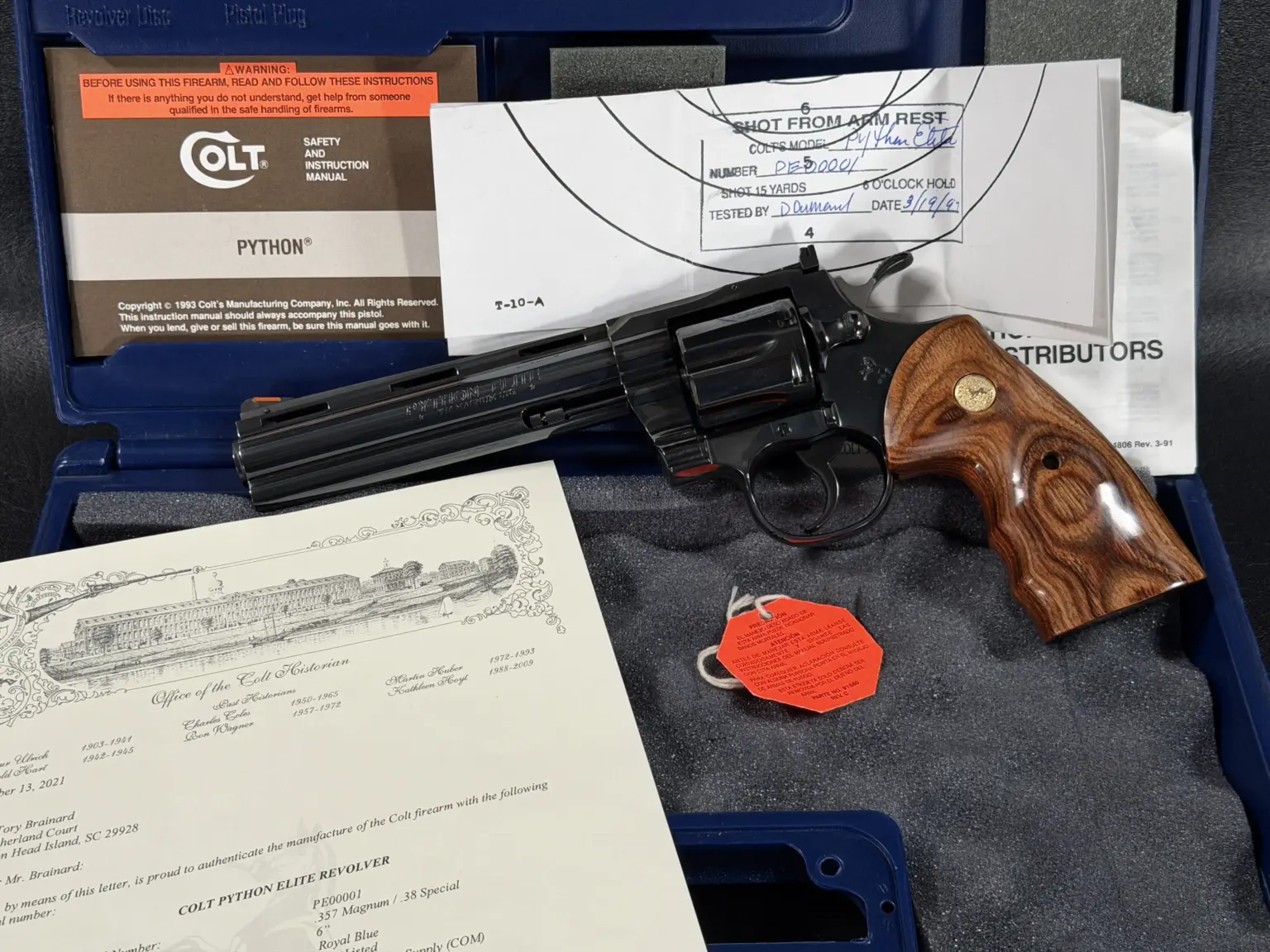
There is a specific click that hooks people on the Colt Python. Close the cylinder, ease the trigger back, and feel that cylinder come into bank-vault lockup. If you were introduced to revolvers on rougher fare, the Python can feel like cheating. The sight picture settles. The double action is smooth in a way that encourages you to keep the sights aligned and just roll through. And if the gun glows a deep midnight blue under good light, you understand why some folks talk about them in hushed tones.
That reaction is not nostalgia alone. The Python launched in 1955 as Colt’s premium .357 Magnum target and field revolver, and it announced its intentions with details that still read like a wish list today: a true target-grade action built on the company’s I-frame with the old-style V-leaf mainspring, a ventilated rib, a full underlug for balance, an adjustable rear sight, and an accuracy reputation that earned real-world loyalty. It was priced and positioned at the top, and Colt built it that way.
Midcentury Colt was no stranger to fine revolvers, but the Python was a statement piece. The .357 Magnum had proven itself as a powerful service and sporting cartridge, and shooters were pushing for a revolver precise enough for serious target work yet strong enough for the field. The Python is delivered with forged steel, hand-fitted lockwork, and careful attention to barrel and cylinder fit. Out of the gate, it was marketed as a top-tier gun for people who wanted the best accuracy and finish Colt could muster.
That positioning was not just catalog puffery. Early Pythons wore the kind of polish that set a benchmark for blued steel. Colt’s Royal Blue finish on the carbon-steel guns became a calling card. The surface looks deep, almost wet, and it rewards careful handling. Bright nickel was also offered for buyers who wanted the glare and corrosion resistance of a plated finish while keeping the Python’s lines intact.
Python’s distinctive profile is more than a silhouette on a poster. Several design choices became part of its identity and performance:
Put that package together, and you get a revolver that feels locked to the target. The underlug-tuned balance and carefully fitted action made the Python a serious platform for accuracy in capable hands. That is why old bullseye shooters still smile when the name comes up.
The Python’s sight story is straightforward but useful for dating and collector verification. In early production, you will most often see the Accro adjustable rear, a robust unit with protective ears. As the years passed, Colt migrated to the Elliason rear sight, a sleeker target sight with a narrower notch that many shooters prefer for precision work. Matching the sight to the gun’s era is one of several small checks collectors make when assessing originality.
Factory grips also changed with the times. Walnut target stocks with Colt medallions became a common sight on mid and later guns. Earlier pieces may turn up with slimmer stocks or different checkering patterns. Because grips get swapped in normal use, they are not proof of anything on their own, but era-appropriate stocks with correct medallions and hardware support an originality story, especially when the box and papers are present.
Trigger feel is why the Python remained in range long after its price pushed it off many duty belts. The classic V-leaf mainspring and hand-fitted parts produce a double-action pull that, when right, feels like a smooth roll with a predictable rise in weight at the end. Some call that flavor stacking. Others simply note that it makes precise DA work easier because you can ride the last bit of the pull without the sights wandering. The single-action break on a dialed-in Python is crisp and short.
Colt offered a useful spread of lengths, and each one changed the gun’s role and personality:
There were also special configurations that turned heads. The Python Target was chambered only in .38 Special, reflecting a pure target focus where a flush-seated wadcutter and mild recoil ruled the day. The Python Hunter bundled an 8-inch Python with a scoped package, aiming squarely at handgun hunters who wanted magnum authority and a sighting system worthy of it.
By the early 198s, stainless steel had become more than a fad. Shooters loved its corrosion resistance and low-maintenance appeal, and revolver makers responded. A factory stainless Python variant entered the lineup around 1983, instantly changing the gun’s vibe. The polish of Royal Blue is romance; the look of stainless Python is confidence. It wears hard use without crying for constant oil and cloth. Underneath, it was still very much a Python, with the same rib, underlug, and action profile that made the model famous.
The Target and Hunter packages marked Colt’s willingness to specialize. The .38 Special-only Python Target courted bullseye shooters who didn’t need magnum power. The Python Hunter, meanwhile, made the long-barreled magnum a serious field tool by pairing it with factory optics and accessories. These variants are a reminder that while Python anchored itself in refinement, Colt was not afraid to aim it at focused tasks.
Nothing stays simple forever, especially hand-fitted revolvers in an era shifting to service pistols and cost-controlled manufacturing. Through the 1990s, broad Python production slowed. Labor-intensive lockwork and finishing made it tough to maintain healthy margins as the market’s center of gravity shifted toward high-capacity autos. Rather than walk away cold, Colt moved the model through the Custom Shop, where smaller runs could get the attention they deserved. The Python Elite of the late 1990s into the early 2000s represented that phase. By the mid-2000s, Python had left the catalog, ending a remarkable original run that spanned decades and styles.
Then Colt surprised everyone. In 2020, the Python returned, built entirely in stainless steel and initially offered with 4.25-inch and 6-inch barrels. A 3-inch option arrived later. The look was instantly familiar: vent rib, full underlug, adjustable rear sight, checkered walnut stocks with medallions. But beneath the lines, Colt reworked the action and the frame. The top strap and rear sight area were strengthened. The internal mechanism was redesigned with fewer individual parts while retaining a leaf mainspring, preserving that Colt flavor while improving durability and serviceability. Modern steels and CNC machining brought consistency that is hard to achieve with entirely hand-fitted systems.
Colt also addressed user needs with a front sight that can be swapped by the owner. That single change lives rent-free in the minds of shooters who experiment with fiber optics or different blade heights. The rear sight remains adjustable, honoring the model’s target DNA. Fit and finish are modern stainless, with polished flats and matte contrasts that nod to the past without copying it outright.
On the range, the new stainless Pythons behave very much like their ancestors where it counts. The heavy underlug tempers magnum snap, and the rib keeps the sight picture clean. The redesigned action, while not a part-for-part copy of the old V-spring internals, still uses a leaf mainspring and is tuned for a smooth double-action roll and a crisp single action. Many shooters describe the new pull as consistent and friendly to speed work with magnums or .38 Special. In other words, it feels like a Python without requiring that a single craftsman spend hours with stones and gauges on each one.
The stronger top strap and revised sight area speak to lessons learned from decades of magnum use. A stiffer frame does not hurt accuracy, and added meat around the sight cut is welcome in a gun expected to see thousands of rounds. The user-swappable front sight is a small upgrade that pays daily dividends when tuning a hold for a given load. All of it lands in a package that keeps the essence: a premium .357 with a distinctive profile and a reputation for accuracy.
Python’s long life and strong prices mean details matter. If you are hunting for a classic example, slow down and confirm what the gun is telling you. A few practical checks help separate original configuration pieces from later alterations.
Two resources reduce guesswork. First, serial number tables maintained by independent references can often place a Python in a production or shipping year range. Collectors often consult the Proofhouse tables for this purpose. Second, Colt Archive Services can issue a factory letter showing shipping date, destination, and the configuration the gun left with. A letter is not a magic shield, but it is the best official documentation you can have for verifying originality. If a seller’s claims rely on exact barrel length, finish, or a special package, the letter is worth the wait.
Be cautious about assumptions. Plenty of Pythons have lived honest, modified lives. A reblued shooter with a perfect bore can be an excellent range companion at the right price. A pristine, documented example with box and papers belongs in a different conversation. Know which kind you are buying before you shake hands.
The classic V-spring action is both a gift and a responsibility. It rewards careful use and suffers under abuse. Here are practical habits for keeping a Python happy:
The 2020 Python was designed with durability and serviceability in mind. Fewer internal parts and modern steels reduce the need for constant tinkering. That does not mean you can abuse it, but it does mean you are less likely to require a specialist for routine service. Follow the manual, keep it clean, and let the gun do its thing.
One last practical note: laws on handgun purchase, barrel length, rosters and approved lists, and specific features vary widely by state and locality. Before you buy, sell, or transfer a Python, confirm that your planned configuration complies with your local rules. When in doubt, ask a knowledgeable dealer or your jurisdiction’s authorities.
The Python earned its place by being a shooter’s revolver with a showpiece finish. The hand-fitted V-spring action and that deep Royal Blue made the classic guns irresistible. The rib and underlug were not just style calls; they built a sight picture and balance that helped shooters print good scores and make clean hits in the field.
The 2020 stainless Python did not try to re-create every internal quirk of the old lockwork. Instead, Colt kept the leaf mainspring heritage, strengthened the frame around the sight area, and trimmed the parts count to deliver a smoother path to the same result. It still balances like a Python. It still shoots like one. And for people who prefer stainless and user-friendly sights, it may be the most practical Python yet.
For buyers and collectors, the choice is not either-or. The old guns reward careful selection, documentation, and mindful stewardship. The new ones reward on-target rounds and easy living. Both carry the same name for a reason. When that cylinder locks up and the sights settle, the lineage is obvious.
If your first brush with a Python is at a gun shop counter, ask for permission to handle it, then run the action slowly and watch the cylinder come home. That click you feel is 1955 whispering to 2020. It is also your cue to learn the differences, respect the details, and enjoy what remains one of the most recognizable and genuinely capable .357 Magnum revolvers ever built.

Available
View Item
Available
View Item
Available
View Item
Available
View Item
Available
View Item
Available
View ItemA practical, collector-minded look at Remington’s Model 8 and 81. Calibers, long recoil explained, police conversions, and what to check before you buy.
A collector’s look at Colt’s SP1 and early Sporters, from slickside uppers and pencil barrels to the rollmarks and small changes that hinted at the A2 era.

A practical, story-driven guide to reading JM vs REP barrel marks, understanding pre-safety 336s, Micro-Groove and Ballard-style rifling, and the smart checks to make before you buy.