
I was halfway down a crowded aisle when I saw them: three SIGs in a neat row, each tagged with confident handwriting. “German P226,” one said. The second: “P229, Exeter-made.” The third: “P220, West German.” The prices matched the signs. The details did not.
If you’ve ever felt that twinge of doubt at a gun show table, this piece is for you. The classic SIG Sauer line can look uniform from a few feet away, but there’s a lot going on under the hood. German vs. U.S. production. Folded vs. milled slides. Rails and frame markings that can change how the gun balances and how it’s perceived. And then there are the proof marks and date codes, which are where the truth quietly lives.
Let’s walk through what matters, what to check, and how to buy with confidence without getting lost in lore.
What “German” really means with classic SIGs
“German SIG” is a phrase that gets tossed around loosely. The reality is a little more nuanced, and it shows up in the markings.
From the early import years through the 2000s, frames, slides, and barrels were made in Germany at various points, but they were not always assembled there. As the U.S. operation in New Hampshire ramped up, more guns were built or fully assembled stateside. By 1992, the first fully American-made classic-line SIG, the P229 in 40 S&W, was being produced in Exeter. Later, some pistols would mix a German-made frame with American-made top-end parts, then be assembled in New Hampshire.
This leads to the common hybrid you’ll see in the case: a frame that says “FRAME MADE IN GERMANY” matched to a slide and barrel without German proof marks. That gun was assembled in the U.S. and should not be represented as a fully German-made pistol. On the other hand, when all three major components wear German proofs, you’re looking at a pistol that was made and assembled in Germany.
If this is your first time sorting SIGs by origin, a solid primer is to understand where the marks belong and what they mean. We’ll break that out next.
Proof marks and date codes: where truth lives
Germany participates in CIP, a standards body that requires firearms to be proof tested and marked before sale in CIP countries. The U.S. does not. That difference matters when you’re trying to pin down where a SIG was actually proofed and assembled.
- Look for German proof marks on the slide, barrel, and frame. When all three parts wear the marks and matching serials, you have what collectors often call a triple proofed gun, assembled in Germany.
- If the frame alone mentions Germany, but the other parts lack German proofs, the gun was assembled stateside with a German-sourced frame. That’s still a fine pistol, just not the same thing as a fully German build.
- Date codes tell you the year of proofing. They aren’t the serial number. You can’t decode a SIG serial to find the year, but a proper date code will give you the year the gun was proofed.
Proof marks evolved in appearance over the years, which is why you’ll sometimes hear folks reference different looks to the peening or the specific style of stamp. The important part for buyers is simply this: proof marks live on the metal, not on the box, and a date code is the most straightforward way to confirm when a SIG was proofed. If you want a deeper refresher on the symbols and what to expect, I recommend reading a clear walkthrough on how SIG proof marks and date codes work.
Folded vs. milled slides: what changes and how to spot them
Ask a table of SIG fans to talk slides and you’ll get stories about balance and recoil impulse. For buyers, the two categories to know are the older stamped carbon steel slides and the later milled stainless slides.
Both types exist across the classic series, sometimes even within the same model generation. A great real-world example is the German-marked P226R that slipped into the U.S. market in two flavors: one with the classic stamped carbon steel slide and another with a milled stainless slide. Both varieties carry triple proof markings, signifying German assembly.
How do they differ in hand? The stainless slide adds some weight up top and wears modern finishes like Nitron. Some shooters describe a slightly different feel on the rack and a change in how the gun tracks in recoil. The stamped carbon steel slide keeps the classic profile and look that many associate with earlier SIGs. Neither is “better” across the board. What matters is what you prefer when you handle them side by side and which configuration fits your use case and holsters.
If you encounter a seller using slide type to justify a large premium, ask them to slow down and show you the actual component markings and condition. The slide style is part of the story, not the whole story.
Rails and frames: the small details that matter
Classic SIGs started as slick-sided pistols before the accessory rail era. As lights became standard in duty holsters, factory railed variants of the full-size and compact models appeared. You’ll see examples marked as P226R and P229R. The rail affects holster choice and changes the frame profile at the dust cover. It also influences the market price, with some buyers preferring the older, clean lines and others insisting on a rail for light compatibility.
Frame markings can also hint at the gun’s path into the U.S. market. Be mindful of frames marked “FRAME MADE IN GERMANY” paired with non-proofed top ends. That mix is common and honest, but it isn’t the same thing as a fully German-made SIG, which will show proofing and serialization where it should be.
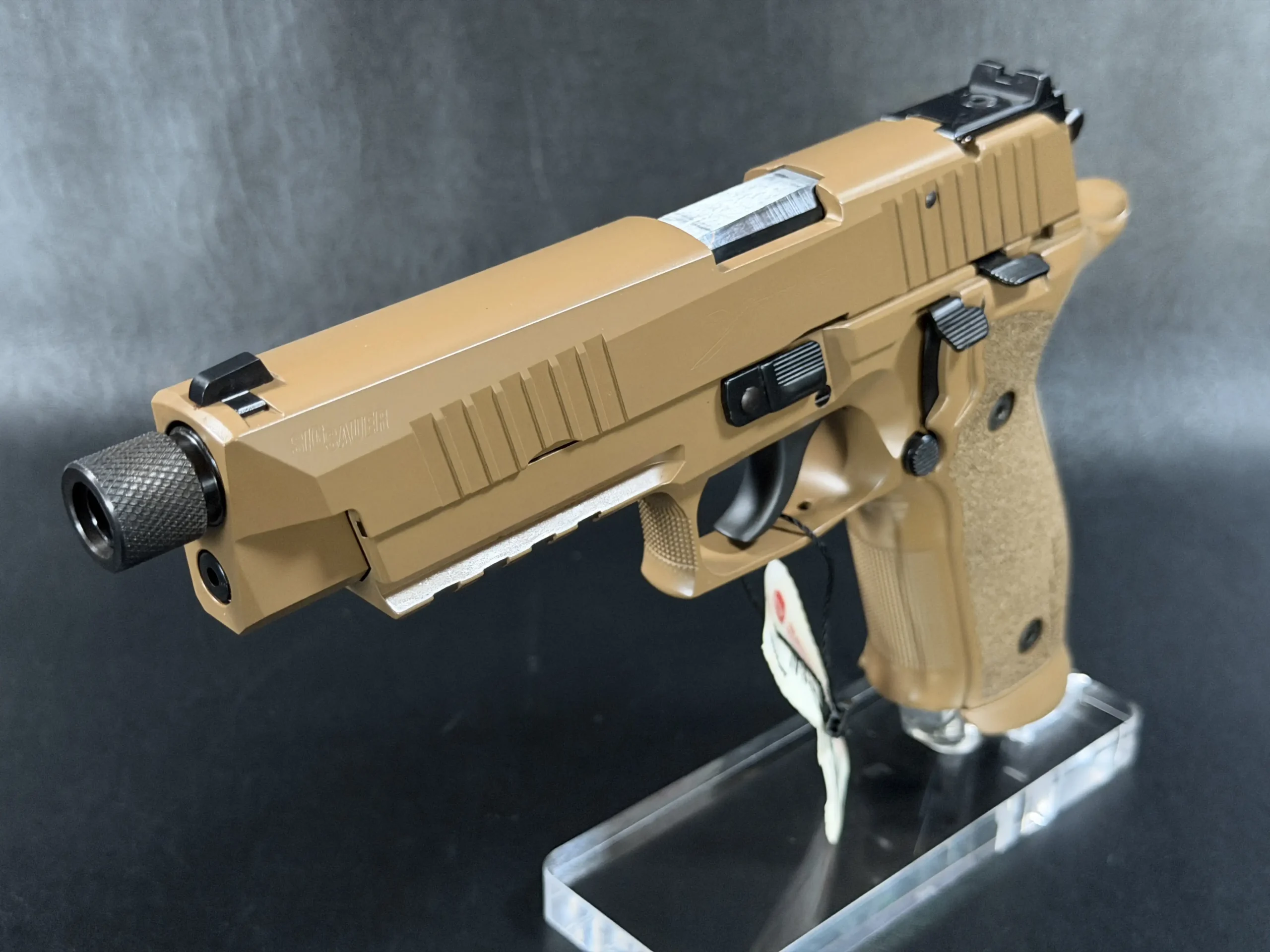
Grip styles changed over time as well. Some later German P226R examples shipped with the slimmer E2 grip format, while earlier guns wore the classic two-panel grips. If you have a strong preference, note that some grip styles are directly linked to the frame and mainspring setup, so casual swapping may not always be plug-and-play without the right parts.
Triggers and lockwork: what to expect and how to check it
The classic SIG family is known for its traditional double action and a decocking lever. That layout gives you a longer, heavier first pull followed by lighter single-action pulls, with a safe decock to return the hammer to rest when you’re done firing. Some models were also built in double-action-only configurations. When you’re buying, focus on verifying what’s in front of you rather than what the listing says.
Practical checks at the counter:
- With the gun confirmed clear, test the double action. You want a smooth pull with no gritty stalls.
- Hold the trigger to the rear as you rack the slide, then slowly release until you feel the reset. It should be distinct and repeatable.
- Run the decocking lever smartly. The hammer should drop under control and the trigger should return to the double-action position. If there’s hesitation, binding, or an inconsistent hammer drop, pause the purchase.
- Cycle the slide several times and listen. A consistent, clean run without scraping or galling noises is encouraging.
These are simple, tool-free checks that help you flag obvious issues with the lockwork. If a seller objects to such basic function checks, consider that your warning sign. If you need an official baseline for inspection and function testing language, the factory SIG Classic Line manual section on inspection and function checks is a handy reference.
Magazines: what to look for before cash changes hands
Magazines are the quiet heroes or the silent culprits. A SIG that runs on one mag and chokes on another usually points to the mag. Fortunately, it’s easy to screen them at the counter.
- Tube condition: Look for dents, cracks, or crushed spots that can slow the follower.
- Floorplate: It should be secure and free of gaps.
- Follower movement: Press down and make sure it moves freely and returns under spring pressure.
- Insertion and release: Insert the empty mag and feel for a positive lock. Hit the catch and confirm smooth release.
- Correct model and caliber: Mixing models or calibers can create hard-to-diagnose stoppages. Verify markings match the pistol.
These steps mirror the factory guidance and take less than a minute. A questionable mag is a bargaining point and, if necessary, a quick replacement item you can budget for.
Model-by-model quick notes: P220, P226, P229
Every family has its personalities. Here’s how I think about these three when I’m sorting a case or paging through listings.
P220
The elder statesman of the bunch carries the classic SIG look and feel. You’ll encounter a spread of markings across decades, from earlier West German proofs to later mixed-origin builds. When someone advertises a P220 as “German,” do the same check you’d do on any other: proof marks on barrel, slide, and frame, plus a proper date code. If they aren’t there, you’re looking at either a U.S.-assembled gun with some German parts or a later U.S.-made example. That is not a knock against it. It’s just the truth of what you’re holding.
P226
Full size, service pedigree, and a platform that bridged the transition from stamped slides to milled stainless. As mentioned earlier, there were fully German-assembled P226R runs with both slide types and triple proofs. Finish and grip configuration can vary. Later finishes like Nitron are common on stainless-slide examples. If a seller is leaning hard on the “German-made” angle, watch for the right marks and walk away from any story that doesn’t match the metal.
P229
The compact sibling that found its legs in the American market. By 1992, the P229 in 40 S&W was being produced in Exeter, and you’ll see that origin reflected in many examples. You’ll also see some hybrids with German-marked frames and U.S.-made slides and barrels. Again, there’s nothing wrong with that. The question is whether the description and the price respect the gun’s actual build history.
A buyer’s inspection routine you can use today
Here’s a simple sequence I run through on any classic SIG at a shop counter or a show table. It’s quick, polite, and keeps you from missing something obvious.
- Confirm clear: Remove the magazine, lock the slide open, and both look and feel the chamber and breech face to verify the gun is unloaded.
- Exterior sweep: Check the slide flats, top, and serrations for damage or unusual wear. Note finish condition on high spots. Confirm front and rear sights are tight and straight.
- Markings: Scan the left and right sides for import marks, proof marks, and a date code. Check the barrel hood and the right side of the slide for German proofs if the gun is billed as German-assembled.
- Function check: Run the trigger through double and single action, verify reset, and test the decocking lever. Rack the slide several times to feel consistency.
- Magazine check: Inspect the tube, base, follower movement, and insertion and release as described earlier.
- Field-strip if allowed: A quick look at the breech face, extractor, chamber, and the general cleanliness of the frame window tells you a lot about care. Reassemble and verify the slide closes fully and locks as it should.
If anything feels off or you suspect a bore obstruction from prior squibs or storage debris, stop. Do not force parts or attempt to “shoot it out” later. The factory guidance is clear: if you suspect a bullet in the bore, field strip and inspect, and return the pistol to SIG Sauer for evaluation rather than risking pressure damage.
Avoiding common auction pitfalls
I’ve seen a dozen auctions that all make the same mistakes. A few quick reminders can save you time and money.
- “Frame made in Germany” is not the same as a fully German-made gun. If the slide and barrel lack proofs, it was assembled in the U.S.
- “Made in Germany” on a part does not require German proofing if the gun was assembled for sale in the U.S. The U.S. is not a CIP country.
- Serial numbers won’t decode a year. A proper date code will give you the year of proofing.
- Photos should show the right side of the slide and barrel hood where proofs live. If the seller can’t provide them, press pause.
- Slide type can affect balance and feel, but it should be priced as part of the whole, not used as a magic word.
Is German better than U.S.? A balanced take
This debate gets emotional fast. Some shooters who own both describe a subtle, precise feel in certain German-assembled examples. Others point to the robust stainless-slide builds from New Hampshire and the decades of hard use those guns have absorbed. A noteworthy footnote is that fully German-made SIGs stopped appearing in the U.S. by 2016, closing a chapter that many of us grew up admiring.
Here’s my advice as a buyer and as a guy who spends too much time peering at proof marks under a lamp: ignore the hype and read the metal. If a German-assembled, triple-proof P226R with the features you like crosses your path, that’s a special find. If a clean, U.S.-made P229 fits your hand and your holsters and runs like a sewing machine, that’s a great pistol. Let markings inform you. Let condition and function guide you. Pay for the gun that makes sense in your world, measured against how you’ll actually use it.
And if you end up back at a gun show table, staring at a row of familiar slides and frames, remember the simple checks. Proofs and a date code for the story. A clean function check for peace of mind. A careful look at the magazines and sights. The rest is just handwriting on a tag.