
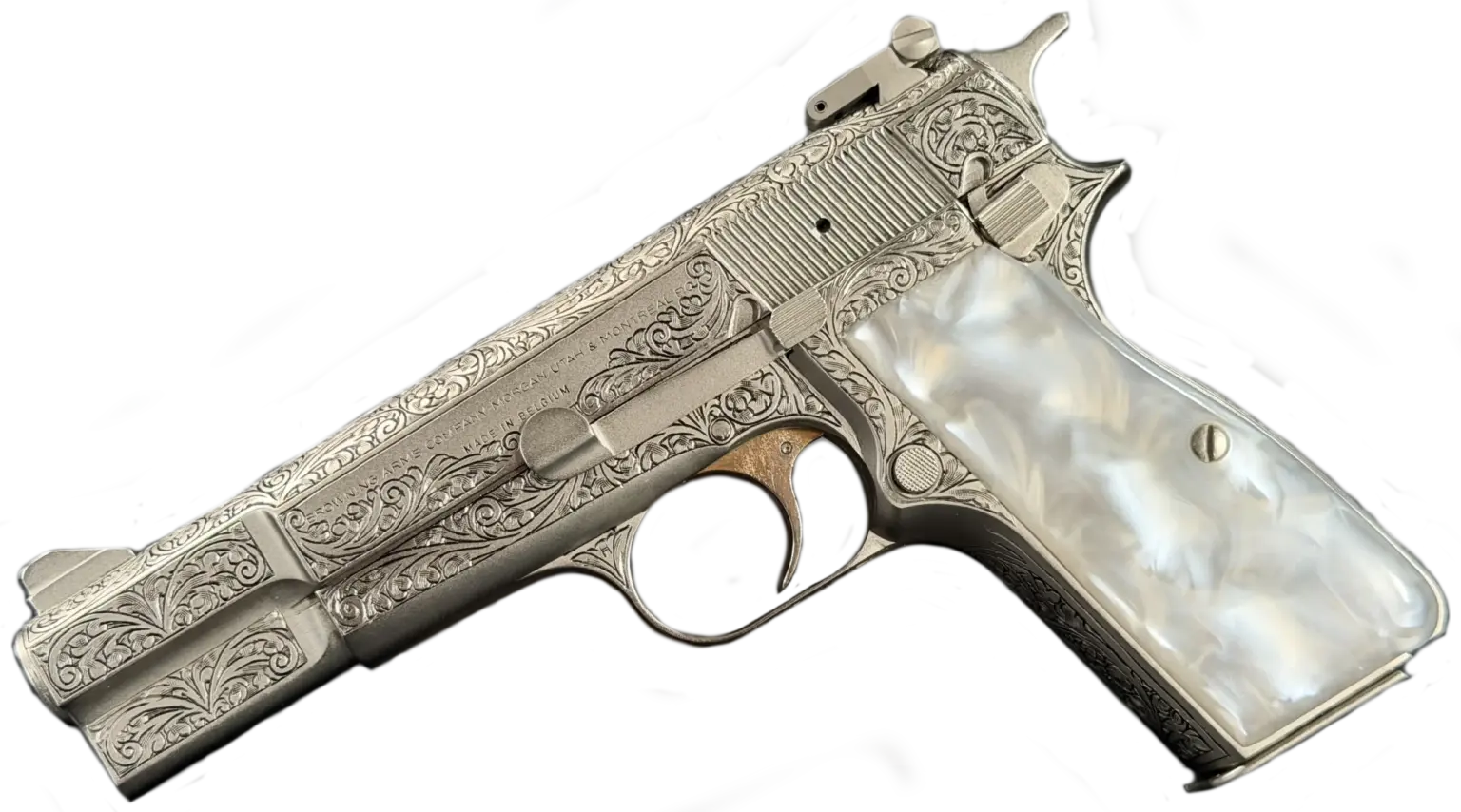
I still remember the first time a tangent-sight Hi-Power landed on the table in front of me. The ladder rose out of the slide like a little footbridge to 500 meters, the ring hammer peeking out from under checkered wood. The seller said five words that always make me slow down: it has a story. With the Hi-Power, that’s almost always true, and the story is written in sights and hammers, stock slots and proofs, and sometimes in a faint import stamp you only notice in the parking lot light.
If you’re buying your first Hi-Power or trying to sort an Inglis from an FN at a glance, this guide will get you speaking the language. We’ll walk the pre-war to post-war arc, pause in Canada with Inglis, translate tangent versus fixed sights, ring versus spur hammers, and make sense of Mk I through Mk III. We’ll also talk about proofs, date codes, import marks, and a practical inspection routine you can use at the counter.
Why collectors split the Hi-Power by era
The Hi-Power’s life is easier to understand in three slices.
Pre-war FN guns carry the original features that made the pistol famous: ladder rear sights on many, stock slots cut into the frame, and the slender ring hammer that looks like it belongs on a pre-war sporter. Wartime production breaks into two threads: FN guns made under German occupation and Canadians from the John Inglis Company. Post-war and later commercial FN bring steadier production, gradual part changes like extractor and hammer styles, and eventually the Mk II and Mk III refreshes that many modern shooters prefer.
Each slice uses different parts and markings. That’s where collecting gets interesting.
Pre-war FN: ladders, slots, and early exports
The first production Hi-Powers hit in the mid 1930s. They were single-action 9 mm pistols with a 13-round magazine, which was a big deal at the time. Early features set the template many of us picture when we say pre-war Hi-Power:
- Adjustable tangent rear sight, initially marked out to 1,000 meters on very early examples, with production quickly moving to a 500-meter ladder
- Stock slot cut into the rear of the frame to accept a detachable wooden shoulder stock
- Lightweight ring hammer and a small left-side thumb safety
- Checkered wood grips
- Magazine disconnect safety that blocks the trigger when the magazine is removed
Orders came in from several countries before the storm clouds closed over Belgium. According to an overview of the period, FN shipped on the order of tens of thousands pre-occupation, with buyers including Lithuania, Finland, Estonia, Sweden, Peru, and even France. One source notes that about 70,000 FN Hi-Powers were manufactured and shipped before May 1940. The Germans took Belgium in 18 days and seized the FN Herstal plant, which brings us to the wartime chapter. For a readable narrative of this period, see The Classics: The Browning Hi-Power in WWII.
Occupied production: Pistole 640(b) and wartime proofs
Under German control, FN kept making the pistol for the Wehrmacht. The designation you’ll see in books is Pistole 640(b). Early occupation guns often kept the tangent rear sight. Very early examples can be found with the frame slot for a shoulder stock, though the slot was phased out because the Germans were not issuing stocks with these pistols.
Collector talk about occupation Hi-Powers quickly turns to acceptance stamps. If you hear someone mention 613 and 103, they’re talking about the German Waffenamt inspector codes that show up on slides, frames, and even sometimes on the spine of the magazine. A useful rule of thumb from collectors who study these variations: early 1941 occupation pistols show the 613 acceptance, with 103 turning up later that year as inspectors changed. Legacy Collectibles has a handy walk-through of an early slotted, tangent pistol that carries both Belgian and German markings, and a later example with 103 proofs and no slot.
What matters as a buyer is consistency. If the sights, slot, finish, and proofs do not tell the same story, slow down and ask questions.
Inglis of Canada: Chinese contract, fixed-sight hump backs
While Herstal worked under occupation, FN’s exiled leadership looked for a way to keep the pistol alive for Allied use. Plans were brought to the UK, and eventually the John Inglis Company in Toronto took on production. There were legal and tooling hurdles, but by spring 1944 Inglis had guns coming off the line.
Inglis built two main flavors:
- An adjustable-sight, stock-slot model primarily for a Chinese Nationalist contract. This one looks classic with its ladder and slot.
- A fixed-sight model without the stock slot, intended for Commonwealth use. This is the one with the distinctive hump-backed slide profile unique to Inglis fixed-sight pistols.
On the left side of Inglis slides you’ll find model designations like Browning FN HP No1 Mk1 on the ladder-and-slot version and No2 Mk1 on the fixed-sight version. An asterisk marks minor modifications that did not change the mark number. The Chinese contract portion was cut short around the 50,000 mark, after which production focused on the fixed-sight, no-slot type for Allied service. By the end of the war, more than 150,000 Inglis Hi-Powers had been made.
In short, if you see a hump-backed fixed-sight slide, think Inglis. If you see a tangent with a stock slot and Canadian markings, you may be looking at a Chinese-contract pattern that grabs attention on any table.
Post-war and commercial eras: extractor, hammer, Mk I to Mk III
After the war, FN resumed peacetime production. The stock slot disappeared as a standard feature, though tangent-sight guns remained available long after the war for buyers who wanted them. The Hi-Power changed slowly but meaningfully in the decades that followed, and those changes help date a gun at a glance:
- Extractor: FN moved from the original internal extractor to a more robust external extractor starting around 1962. If you spot an external extractor on the right front of the slide, you’re looking at a later gun.
- Hammer: the ring hammer was gradually replaced by a heavier, more conventional spur hammer around 1965.
- Mk II: in the early 1980s FN rolled out what most people shorthand as the Mk II. Look for polymer grips, a larger ambidextrous safety, and easier to read three-dot sights.
- Mk III: released in 1988, the Mk III added a distinct glossy black epoxy finish that stands out from earlier bluing or parkerizing.
Collectors debate the sweet spot. Some chase mint Mk IIIs to shoot and keep, others live for pre-war features and patina. The good news is the Hi-Power stayed true to itself through these transitions, which helps parts and magazines cross over and keeps them viable on the range.
Tangent vs. fixed sights: what they tell you and how to check them
The Hi-Power’s tangent sight is a personality trait. You can recognize it across a room. Pre-war FN guns and the wartime occupation pistols often wear the tangent, and so do Inglis No1 Mk1 guns. The ladder is typically graduated to 500 meters on production examples, though very early pre-war ladders reached to 1,000 before FN sensibly dialed that back.
Fixed sights show up on post-war commercial guns, Inglis No2 Mk1 pistols, and many later military contracts. Fixed sights generally make a Hi-Power easier to shoot well on a casual range day, and they sidestep the wobble and drift that can appear on a loose or poorly fit ladder assembly.
As a buyer, inspect the rear sight closely. On tangent guns:
- Check that the base is tight in the slide and that elevation steps are not peened flat.
- Verify the leaf and slider move and lock without excessive slop.
- Look for grinder or file marks around the base that might suggest a swapped or refit ladder.
On fixed-sight slides, check for clean staking or dovetail fit and signs of drift from heavy handed adjustments. Mismatched finish around the rear sight, especially on wartime pistols, can be a clue that parts were changed later.
Ring vs. spur hammers: era-correct parts and shooter comfort
The ring hammer belongs to early Hi-Powers in most minds. It is graceful and, on some hands, nips. Hammer bite from the ring style is not rare. FN moved to a spur hammer in the mid 1960s, and that change lines up with a broader shift to other user-driven improvements in the 1980s.
Collectors look for era-correct hammers. A pre-war or early post-war FN with a spur hammer raises the question of a parts swap, unless other late features match. Conversely, an otherwise late gun wearing a ring hammer might be a shooter’s personal swap. It is not a deal breaker if you plan to shoot the pistol, but for a collection example it is worth confirming the hammer style matches the production period and configuration.
Mk I, Mk II, Mk III: quick tells at the table
Hi-Power markings can be all over the map depending on market and importer, but you can usually spot the major versions without pulling out a loupe.
- Mk I and earlier commercial: classic look, smallish left-side safety, blued or parkerized finishes, wood grips on earlier guns, ring or spur hammer depending on era. Extractor can be internal on older guns or external after 1962.
- Mk II: early 1980s update. Think polymer grips, a larger ambidextrous safety that is much easier to use, and three-dot sights.
- Mk III: 1988 update. Shiny black epoxy finish, usually paired with modern sights and the larger safety. The overall look is more contemporary compared to earlier blued pistols.
If you like shooting your collectibles, the Mk II and Mk III are very friendly at the range. If your heart is with the early style, pre-war and immediate post-war pistols carry the lines and details that made the Hi-Power famous.
Magazine disconnects: function, feel, and caution
The Hi-Power uses a magazine disconnect safety. If the magazine is out, the pistol will not fire. That feature lived with the model across eras, and you will feel its effect in the trigger. Many Hi-Powers have a heavier, slightly gritty break until the parts wear together.
Some owners remove the disconnect to improve the trigger. That can change how the gun behaves and may have implications for safety, warranty, or how the pistol is treated by local rules. If you are buying one to shoot and are tempted to modify the trigger system, it is worth talking to a competent gunsmith and understanding the tradeoffs before you make changes.
Proofs, markings, and date codes: what you can reliably read
Markings are where a Hi-Power tells you who it worked for and when. Here are the ones you can count on without guesswork:
- German occupation FN pistols wear eagle over inspector numbers that collectors shorthand as 613 and 103. Early occupation guns with tangent sights and slotted frames often show 613. Later 1941 examples very commonly show 103. These stamps appear on slide and frame, and sometimes on magazine spines.
- Inglis pistols carry clear model text on the slide such as Browning FN HP No1 Mk1 for the tangent-and-slot type and No2 Mk1 for fixed-sight guns. An asterisk indicates minor modifications.
- Commercial FN pistols can be dated by serial number style and markings. Browning maintains a helpful page for serial formats and date ranges under its support section. If you are trying to pin down a year, start with the official Browning Hi Power date your firearm page.
FN’s heritage out of Herstal spans more than a century and touches a lot of sporting and service icons. If you enjoy the company’s broader story, it pairs well with another Belgian classic in our look at the Browning Auto-5 for Collectors.
Import marks: where they show up and what they mean to buyers
Many Hi-Powers on the U.S. market were brought in by commercial importers. That usually means a small import stamp added to the frame or slide. You will see them in different places depending on the importer, often low on the frame or along the dust cover or slide flat. They are not always obvious at first glance.
Collectors sometimes prefer examples without import marks, while shooters care more about mechanical condition. An import stamp is not a flaw. It is simply part of a gun’s journey back to the commercial market. When in doubt, factor it into your price expectations and be honest about how much it matters to you.
What to inspect: a collector’s checklist you can carry
Here is a quick checklist I use when I am looking at a Hi-Power in person. It helps separate a honest service pistol from a parts salad or a gun that needs immediate work.
- Serials and markings: Do the markings and features match the story. For example, an Inglis with a hump-backed slide should be fixed sight without a stock slot. A German occupation pistol with 103 or 613 stamps should have features that fit that time range.
- Sights: On tangent guns, verify the ladder is intact and tight. On fixed-sight slides, check staking or dovetail fit and that the sight is not visibly canted.
- Hammer and extractor: Do the hammer style and extractor type match the era. A pre-1962 gun normally shows an internal extractor. External extractors belong to later guns.
- Finish and refinish clues: Look for rounded edges, blurred rollmarks, filled-in proof stamps, or a different sheen between frame and slide. Those can indicate a refinish. Wartime parkerized surfaces and later black epoxy on Mk IIIs have very different looks.
- Slide and frame integrity: With the slide off, inspect rails and the area around the slide stop hole for peening or cracks. Check the ejection port area and the front of the slide for stress signs.
- Barrel lugs and hood: Look for crisp lug engagement surfaces and even wear. Excessive peening can suggest hard use or poor timing. Fit the barrel and feel for lock-up play.
- Safety and disconnect: Verify the thumb safety clicks on and off positively and blocks the sear. Test the magazine disconnect to confirm it functions as built.
- Trigger feel: Expect a heavier trigger, especially on guns with the disconnect in place. Consistent take-up and a clean break are good signs.
- Magazines: Original magazines vary across eras. Make sure the mag locks in smartly and drops free. A weak spring or bent feed lips can cause headaches and are easy to replace.
- Grips and small parts: Check for cracked wood on pre-war and early post-war guns. On later pistols, ensure polymer panels are not warped and that escutcheons and screws are correct for the period.
- Bore and crown: A bright bore with sharp rifling and a clean crown is worth paying for, especially if you plan to shoot the pistol.
Take your time. A Hi-Power does not hide its condition if you handle it carefully and look for the tells above.
Shooting and living with a Hi-Power: practical notes for buyers
Part of the Hi-Power’s charm is that it is still entirely practical at the range. A few notes that help match expectations to eras:
- Pre-war and wartime sights are small. The front blade is fine, and tangent notches can be shallow. They shoot better than you think, but your eyes will work harder than on a Mk II or Mk III.
- Triggers vary. Some guns smooth out with use, others never quite lose the square feel of the disconnect. If you plan to leave the disconnect in place, a careful polish job by a pro can pay dividends without changing original parts.
- Springs matter. A fresh recoil spring and magazine springs go a long way on service-worn guns. Keep a spare extractor spring on hand for heavy use pistols.
- Magazines are the easiest upgrade. Modern mags often feed more reliably than tired originals and protect your originals from range abuse.
Many Hi-Powers were chambered in 9 mm across all eras, and later commercial runs also appeared in other calibers. If you want a shooter that feels classic but runs like a modern pistol, a clean Mk II or Mk III often hits the sweet spot.
Closing thoughts
The Browning Hi-Power has a way of pulling you into its timeline. A pre-war ladder and slot gun lives in a different headspace than a hump-back Inglis or a glossy black Mk III, but they all trace back to the same elegant idea. As a buyer, decide which story you want your pistol to tell. Then use the tools above to make sure the sights, hammers, markings, and condition all speak the same language.
For a deeper World War II snapshot, the wartime arc is well told in the Shooting Illustrated history of the Hi-Power in WWII. And if you need to anchor a commercial gun to a year, Browning’s own date your firearm page is a smart first stop.