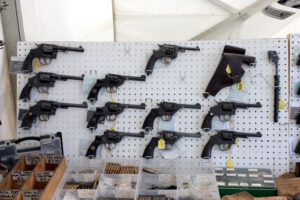


I bought a puzzling 12 gauge side-by-side at a county show years ago. The seller didn’t know much beyond “continental, shoots great.” The wood had stories, but the barrels had the truth. Under the flats, with a flashlight and a bit of patience, those tiny stamps began to speak: an oval ELG with a star, a little tower, a sneaky PV with a lion, and a stout 12 in a diamond. That was the moment I stopped guessing and started listening to what proof houses had already said.
What these little stamps really are
They’re proof marks, the official footprints left by a national proof house after a firearm or barrel survives a pressure test. Europe takes this seriously. The tradition of compulsory proofing goes back a long way, with England formalizing it in the 19th century and Germany following near the century’s turn. Once a gun passes, it carries that news on its metal for the rest of its life. If you can read those stamps, you can usually learn where it was tested, how it was tested, and often when.
For buyers, that means you can verify a lot without a manual. For collectors, it’s the fast way to confirm origin and narrow dates. For everyone, it’s a safety sanity check that costs nothing but a good look.
If you want a compact visual reference to keep handy, the NRA Museum’s proof marks chart is a useful overview of country marks and timeframes. I’ve kept a screenshot on my phone for years. See the NRA’s downloadable overview under Proof Marks for the major houses and symbols.
NRA Museum proof marks overview
CIP, in plain words
Across much of Europe today, proof houses work to a shared framework that standardizes how guns are tested and how results are recorded. You’ll see that shared language in the way many modern barrels record pressure in bar, and in recurring nitro proof symbols across borders. You don’t need to memorize the regulations to benefit from them. All you need is a sense for what the common marks mean and what era they point to.
Country hallmarks you’ll see again and again
There are dozens of marks, but you don’t have to learn them all at once. Start with the big ones that show up the most on the market.
Germany: the Ulm antler and the Eagle over N
Modern German arms are wonderfully consistent about telling you where they were proved. The Ulm proof house uses a small antler, and it appears with other marks depending on the test. Postwar German nitro proof is typically shown as an eagle over the letter N. You’ll often see these on the barrel, slide, or frame of pistols from Walther, H&K, and SIG Sauer, and on sporting arms out of Ulm.
Historically, German marks changed across eras and regions. East German Suhl proofing used its own symbols during the postwar years, and prewar commercial marks often included a crown over a letter such as U for a definitive proof. The NRA chart notes Ulm activity after the early 1950s and documents Suhl’s postwar smokeless powder proofs. If you’re holding a 1960s or 70s West German arm, expect an Ulm antler plus the eagle over N, often with a separate date code nearby.
For a breezy walkthrough focused on modern German marks and why they matter to buyers, the International Sportsman guide lays out the basic families of symbols you’ll see on H&K, Walther, and SIG pistols and long guns.
German proof marks explained with examples
Italy: PSF, stars, and a cheery FINITO
Italian barrels out of Gardone and Brescia leave you good breadcrumbs. Look for letters with a star above them, often alongside PSF. That PSF tells you it passed smokeless powder proof. Many Italian barrels also carry FINITO to indicate a final proof passed. You’ll see these on Beretta over-unders, Perazzi target guns, and plenty of working doubles and semi-autos from the valley.
Italy also likes to stamp a compact date code in a little box. The format varies by period, but boxed letter or letter-number combinations are common. Collectors trade rosetta stones for these, and they’re worth a bookmark if you’re narrowing a purchase by year.
Belgium: the Perron, ELG, and PV with lion
Belgium’s Liège proof house has left a very clear trail for well over a century. Three stamps matter most to buyers and collectors:
- ELG in an oval, often with a star. This is a definitive proof mark. If I see it neat and deep under a set of shotgun flats, I know the barrels saw the official bench in Liège.
- The Perron, a small tower-like symbol. Think of it as a provisional or view mark. On older arms it often shows alongside the other Liège symbols you’d expect.
- PV with a lion above or nearby. This is used with nitro proof for smokeless powder.
Belgium exported guns by the boatload, from simple guild doubles to high-grade sidelocks and the classics out of FN. If your barrel says Made in Belgium and wears an ELG oval, you’re in the right neighborhood. The NRA and Belgian proof resources show that ELG and the Perron have long runs, so you’ll want the date clues discussed below to tighten the window.
Britain: crown over NP, BNP, and the metric shift
British barrels tend to be tidy, but there are two broad eras you’ll run into the most on the market.
- Crown over NP shows up widely from 1925 onward and signals nitro proof. You’ll see this on many interwar and immediate postwar sporting guns.
- BNP, or Birmingham Nitro Proof, comes in after the 1950s and becomes the everyday modern stamp for Birmingham-proved barrels. London has its own parallel marks.
On later barrels you’ll often see pressure expressed in bar rather than old British tons figures. A common sight is 850 BAR on a 12 gauge chamber marking. That metric notation takes off late in the 20th century and is a quick way to know you’re looking at a modern reproof or a late production gun.
Suhl and the East German lane
Suhl was a gunmaking town long before the border cut it off from Ulm. Postwar East German Suhl barrels carry their own smokeless and nitro symbols, and many will include a tidy month-year style date code. More on that coding in a moment. If your drilling or 16 gauge side-by-side has that Suhl flavor and plain smokeless proofs, you may well be looking at a midcentury East German piece.
Date codes that move the needle
Many European proof houses stamp a compact code that puts you within a year or two without touching serial numbers. These are worth learning.
- Liège, Belgium: A single letter used as a date code appears on many barrels. It can be Roman or Greek, upper or lower case, and sometimes underlined. Collectors cross reference it with the controller’s mark to nail the exact year run. If you spot a lone letter near the ELG, it is probably your date clue.
- Birmingham, England: The famous crossed swords include a little letter as a date code, but you have to know where to look because the position of that letter changes by era. From 1921 to 1941 it sits at the top of the intersection, from 1950 to 1974 it moves to the left of center with a B to the right, and from the mid 1970s a different circular layout takes over with the letter inside the upper left of a circle. Learn the layout for the period you’re shopping and you can read these at a glance.
- Suhl, Germany: Early 20th century Suhl barrels often use a month-year straight on the metal, written 5/24 for May 1924. Later, especially into the 1960s, it compresses into four digits like 1163 for November 1963.
- Italy: You’ll usually find a boxed letter or letter-number combination as a compact date code. Some examples include forms like XX7 seen on 1970s barrels. The exact map varies by decade, but the presence of that small boxed code is your signal that the answer is right there if you have a table to consult.
- Germany, modern commercial: Alongside the eagle over N and the Ulm antler you’ll often find a two-digit year code like 72 for 1972 on many postwar arms.
Nitro symbols and what they do not say
A nitro proof mark tells you that the barrel survived a controlled overpressure shot of smokeless powder at a recognized house on a specific day. It does not tell you it is safe with any load you can find in a shop. It also does not convert a black powder proof into a nitro proof. What it does give you is the comfort that at that proof, with that configuration, the barrel met the standard. If you are looking at a British or Belgian gun that carries only black powder proofs, be cautious with modern smokeless shells. If you see a modern nitro mark with a recent date, you have better footing. When in doubt, have a competent double gun smith measure the bores, check wall thickness, and confirm chamber length.
How to read a barrel, step by step
Roll the gun gently, get some light, and take notes. Most of the good stuff hides under the barrel flats on break actions, or on the barrel hood and frame flats for pistols. Here is the routine I use at a show table.
- Find the country or proof house first. Look for the obvious house hallmark. Ulm’s antler. Liège’s Perron or ELG. London or Birmingham crowns and crossed swords. Gardone’s PSF and star letters.
- Confirm the type of proof. Is there a nitro mark? In Germany that’s the eagle over N. In Britain it is crown over NP in earlier decades and BNP in the modern Birmingham era. In Belgium PV with a lion pairs with smokeless proof. In Italy, PSF with the star letters signals smokeless.
- Look for a final or definitive mark. Belgium’s ELG oval is the classic. In Italy, FINITO is a friendly way of saying final proof passed. British barrels often carry a definitive nitro proof after provisional marks.
- Note chamber and bore data. British barrels write gauge and chamber length, often as 12 in a diamond and length in inches or mm depending on era. French and other continental barrels often write actual bore dimensions in millimeters. If a 65 mm chamber is marked, that hints at 2.5 inch shells unless later reproofed.
- Check pressure and service. On late British barrels look for bar figures, often 850 BAR on 12 bore. On older British arms you might see tons per square inch. Continental barrels sometimes record proof pressure in bar or kilograms per square centimeter.
- Hunt the date code. In Belgium look for that stray letter. In Birmingham find the letter on the crossed swords and note where it sits. In Suhl, look for a month and year number run. In Italy, search for the boxed code.
- Inspector or controller marks. Tiny letters or numbers near the main stamp often tie to a particular inspector. They are supporting details but help confirm the date code tables you use.
- Don’t forget reproofs. A second set of proofs, often from a different house or a later era, might sit beside the first. That can change what loads are appropriate. British reproofs, for example, commonly add metric pressure figures on older guns reworked in the late 20th century.
Worked examples you can apply at the counter
Let’s walk through a few patterns you’re likely to see. No serial numbers, no fantasies. Just the stamps and what they say.
A Gardone over-under that says PSF and FINITO
You open the barrels and on the flats you see a compact PSF under a small star over letters, plus a neat FINITO. That stack of marks tells you it was proved at an Italian house for smokeless and passed the final. Nearby there’s a small boxed date code. That little box is your year. If it follows the letter-number pattern used in the 1970s, you can place it quickly with a reference. Good news if you are picking between two similar guns and prefer a certain production era.
An Ulm-stamped German pistol slide
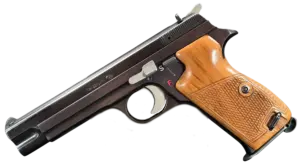
On the right side of a commercial P-series slide you see a tiny antler mark. Right next to it there is an eagle over N. A few millimeters away, a plain two-digit 73. The antler points to Ulm’s house, the eagle over N says nitro proof, and the 73 is the year. That trio is all you need for origin and time window. If you later see the same model with a different year code, you can start tracking running changes by year, which is useful when certain generations have parts or finish differences.
A Liège-marked side-by-side with ELG and the Perron
Under the flats of a 12 gauge barrel set you find the Perron, the oval ELG with a star, and a PV with a lion. That is the Liège trifecta. You have provisional/viewed, definitive, and nitro. If there is also a single letter off to one side, jot it down. That is the date code. Check the bore size and chamber figures as well; on older Belgian guns you may find shorter chambers, and many were later lengthened and reproofed. If you see a second set of stamps from a later date, that likely happened during a rework.
A Birmingham-marked game gun, midcentury
On the flats you see crossed swords. There is a letter at the left of the intersection, a B at the right, and an inspector’s number under. Across the metal you also see BNP. You are looking at a Birmingham nitro proof from the postwar period when the letter sat at the left of the swords. If you carry a small chart of those letter-year matches, you can usually land the year within a moment. On some later barrels you’ll see 850 BAR, which is the straightforward modern pressure notation.
A Suhl 16 bore with tidy numbers
Flip the barrel set and find a small 5/58 or a condensed 1163. Suhl loved that month-year stamp. That little touch is a gift to collectors of German sporting guns, especially the many 16 bores and drillings that crossed the Atlantic. Combine the date with a smokeless proof mark and you’ve got a reliable picture of when and how it was tested.
A few marks worth memorizing
If you stick these in your head, most of the rest will organize themselves around them.
- Ulm antler: the West German house that shows up on a huge number of postwar arms.
- Eagle over N: Germany’s modern nitro proof symbol.
- ELG in an oval with star: Liège’s definitive proof on Belgian arms.
- Perron: the little tower symbol that flags a Liège provisional or view mark.
- PV with lion: Belgian nitro pairing found with smokeless proofs.
- PSF with star letters: Italian smokeless powder proof out of Gardone and Brescia.
- FINITO: Italian final proof passed.
- Crown over NP: British nitro proof used widely from the mid 1920s era.
- BNP: Birmingham Nitro Proof, the modern workhorse stamp.
Practical buying notes from the bench
Proof marks are there to help you, but they are pieces in a bigger picture. A few practical habits make them even more useful.
- Photograph first, decode later. Take clear, square photos of all flats and breech faces. You will always see something in the photo you missed at the table.
- Translate the chamber marking honestly. A 65 mm chamber is not a 70 mm chamber. Plenty of older European doubles were built short. They can be lengthened and reproofed, but you want to see the later proof if they were.
- Pair marks with measurements. Even a perfect nitro stamp does not measure wall thickness. If the gun matters to you, especially a thin-walled game gun, have it checked.
- Expect mixed families on imports. It is common to see an Italian barrel later carrying a British reproof or a Belgian barrel restamped after modification. Follow the most recent definitive proof mark for load guidance.
Why this decoding actually helps
When you can read proof marks, you stop guessing about features that matter. You quickly confirm whether a barrel left the factory as a smokeless-tested 70 mm 12 gauge or an earlier 65 mm game gun. You see when that nice German target pistol was actually made and whether its marks line up with the generation you prefer. You spot a reproof that explains why a late figure in bar sits next to a much older British crown. Those are real buying clues, not trivia.
If you keep just three references in your kit, make them a general chart of country marks, a simple Birmingham date code layout by era, and a reminder that Liège likes single-letter dates and Suhl likes month-year numerals. With that, and a flashlight, you will be surprised how many barrels start telling you the truth before you ever look at a serial number.
And next time a seller shrugs and says, “It’s European,” smile, turn the barrels to the light, and let the proof house do the talking.