

The first time I stood over a gun show table with six M1 Carbines laid out nose to tail, the lesson was not in the rollmarks. It was in the features. A slim early band here, a late bayonet band there, a flip sight next to an adjustable. That one-minute scan told a story of wartime rush and postwar rework. If you are hunting a carbine or trying to make sense of the one you have, start with the big tells. Then let the rest of the details fall into place.
How production unfolded and who made what
The U.S. asked for a light rifle, got the M1 Carbine, and then asked for a mountain of them. The first large contracts went to Inland Manufacturing and Winchester in late 1941. Inland came online in late spring 1942, Winchester followed in late summer, and it became obvious almost immediately that those two alone could not meet demand. Production was, in the words of a modern restoration overview, fast, furious, and chaotic, which is what you get when you field a new rifle at wartime scale. Additional contractors joined, bringing the wartime maker count to ten (Guns & Ammo: Restoring an M1 Carbine, Part 2).
Wartime makers at a glance
There were ten main U.S. wartime manufacturers of the GI M1 Carbine. Most production ran 1942 to 1945, with early, mid, and late patterns overlapping across lines. Use the patterns below to frame expectations, not to declare absolutes.
| Maker | Early as-built (typical) | Mid-period (typical) | Late as-built/service (typical) |
|---|---|---|---|
| Inland | High-wood stock, flat bolt, flip rear sight, push-button safety, narrow band | Low-wood shows up; flat bolt common; some adjustable sights appear; Type 2 band starts late | Low-wood or pot-belly; mix of flat/round bolts; adjustable sight; lever safety; Type 2, with Type 3 common postwar |
| Winchester | High-wood, flat bolt, flip sight, push-button safety, narrow band | Low-wood transition; flat bolt common; adjustable sight appears late | Low-wood or pot-belly; mixed bolt types; adjustable sight; lever safety; later bands as above |
| Underwood | High-wood, flat bolt, flip sight, push-button safety | Low-wood more common; flat bolt; some adjustable sights toward end | Late features often present via service upgrades |
| IBM | High-wood, flat bolt, flip sight | Low-wood becomes typical; flat bolt; adjustable sight appears late | Adjustable sight and later bands common on service returns |
| Quality H.M.C. | High-wood, flat bolt, flip sight | Low-wood transition; flat bolt | Late features via rebuilds are common |
| National Postal Meter | High-wood, flat bolt, flip sight | Low-wood transition; flat bolt | Adjustable sight and later bands often added postwar |
| Standard Products | High-wood, flat bolt, flip sight | Low-wood transition | Adjustable sight and later bands via service upgrades |
| Rock-Ola | High-wood, flat bolt, flip sight | Low-wood transition | Late hardware commonly added in service |
| Saginaw SG | High-wood, flat bolt, flip sight | Low-wood transition | Late features via upgrades |
| Saginaw S’G’ | High-wood, flat bolt, flip sight | Low-wood transition | Late features via upgrades |
As production accelerated and postwar rebuilds began, mixing of parts became the rule. Frame questions with patterns, not absolutes.
Rear sights and safeties
- Rear sights: Early carbines typically wear the simple two-position flip sight. An adjustable rear sight appears later and is very common on rifles that went through postwar maintenance. Either can be appropriate depending on build date and service history.
- Safeties: Early carbines use a push-button safety. A rotating lever safety shows up later and becomes widespread after the war, especially on arsenal-upgraded rifles.
Both changes rolled in as improvements and then spread unevenly across makers.
Type changes collectors track: stocks and bolts
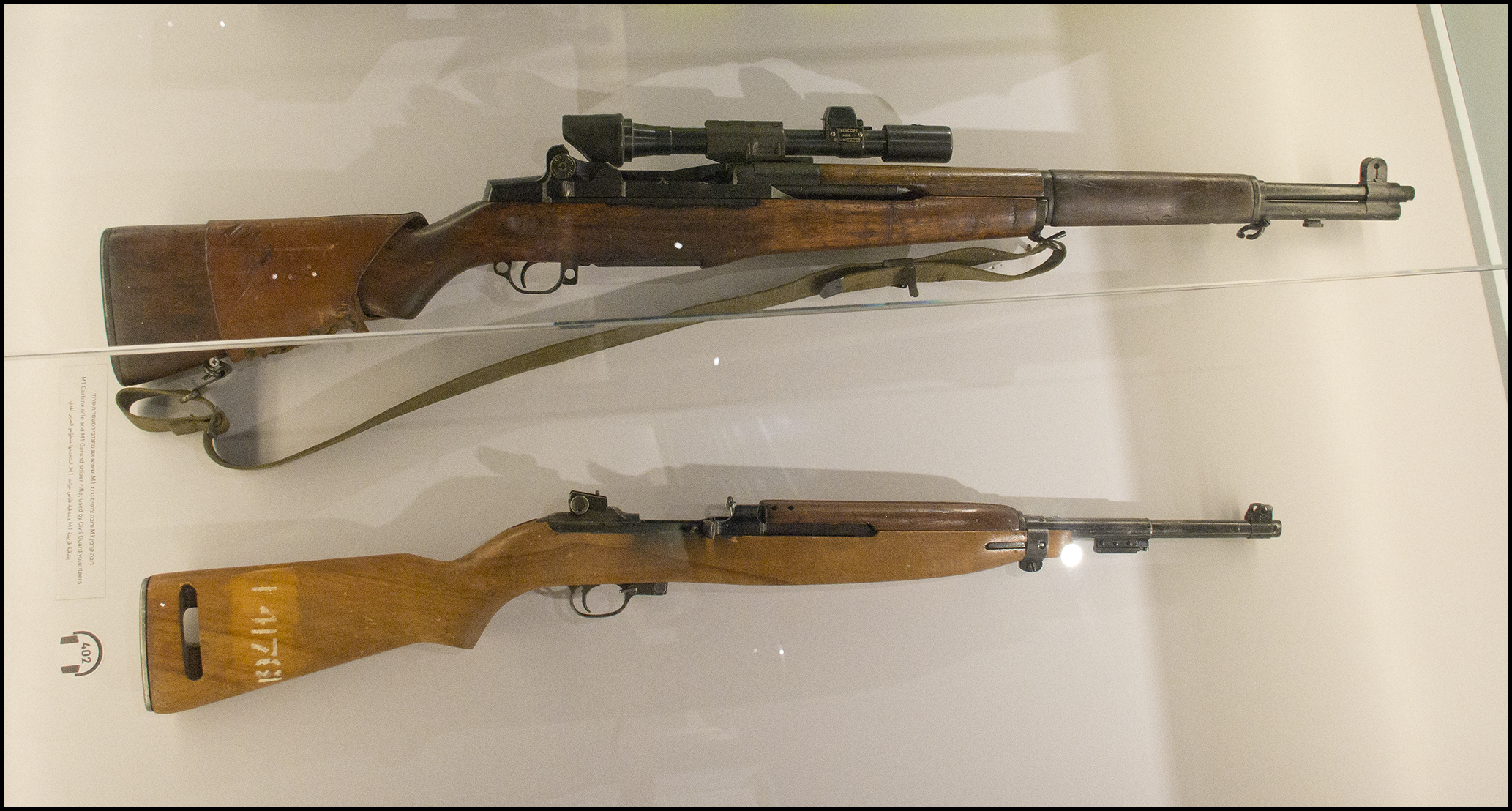
- Stocks: Early high-wood stocks protect the op-rod channel but are fragile there. Low-wood stocks follow as a durability fix. Late production often shows a fuller pot-belly profile in the forend (RJ Militaria summarizes the evolution).
- Bolts: Early to mid-war carbines commonly have flat-top bolts. Later production and service upgrades introduce other bolt profiles, so a mix is normal in the field.
Barrel bands and the late bayonet band
The band around the barrel and forend is one of the most visible clues on a carbine. Collectors talk about three main types. The Type 2 was fitted to some late-war carbines around mid 1944. The Type 3 was introduced in 1945 toward the very end of the war, and the vast majority of carbines were upgraded to Type 3 after 1945. That late pattern is often called the bayonet band because of its lug. You will see it on a high percentage of service carbines that passed through postwar maintenance (RJ Militaria).
When someone says a carbine is a World War II configuration, the band becomes a focal point. A very late 1945 rifle can plausibly wear the late band as built. Many earlier rifles wear it due to postwar upgrades. That reflects service life rather than a frozen moment in 1943.
Parts interchange and postwar rebuilds
The last wartime carbines left production in August 1945. After that, Springfield Armory assumed control of the .30 Carbine program, manufactured replacement parts, and arranged for others as needed. Springfield-marked pieces often carry an SA mark. Postwar, Rock Island Arsenal produced sears, recoil plates, front sights, and other small parts, often marked RIA. Mixing of original and replacement parts is the norm on rifles that stayed in service through the 1950s and beyond (USCarbineCal30: Post WWII).
With that backdrop, a Winchester receiver with an SA-marked part is not odd. A stock from another maker is not a red flag by itself. Interchangeability kept rifles shooting and keeps parts available today. The trick is learning which combinations make sense for a given period, and which were almost certainly swapped later.
Stocks, cartouches, and inletting marks
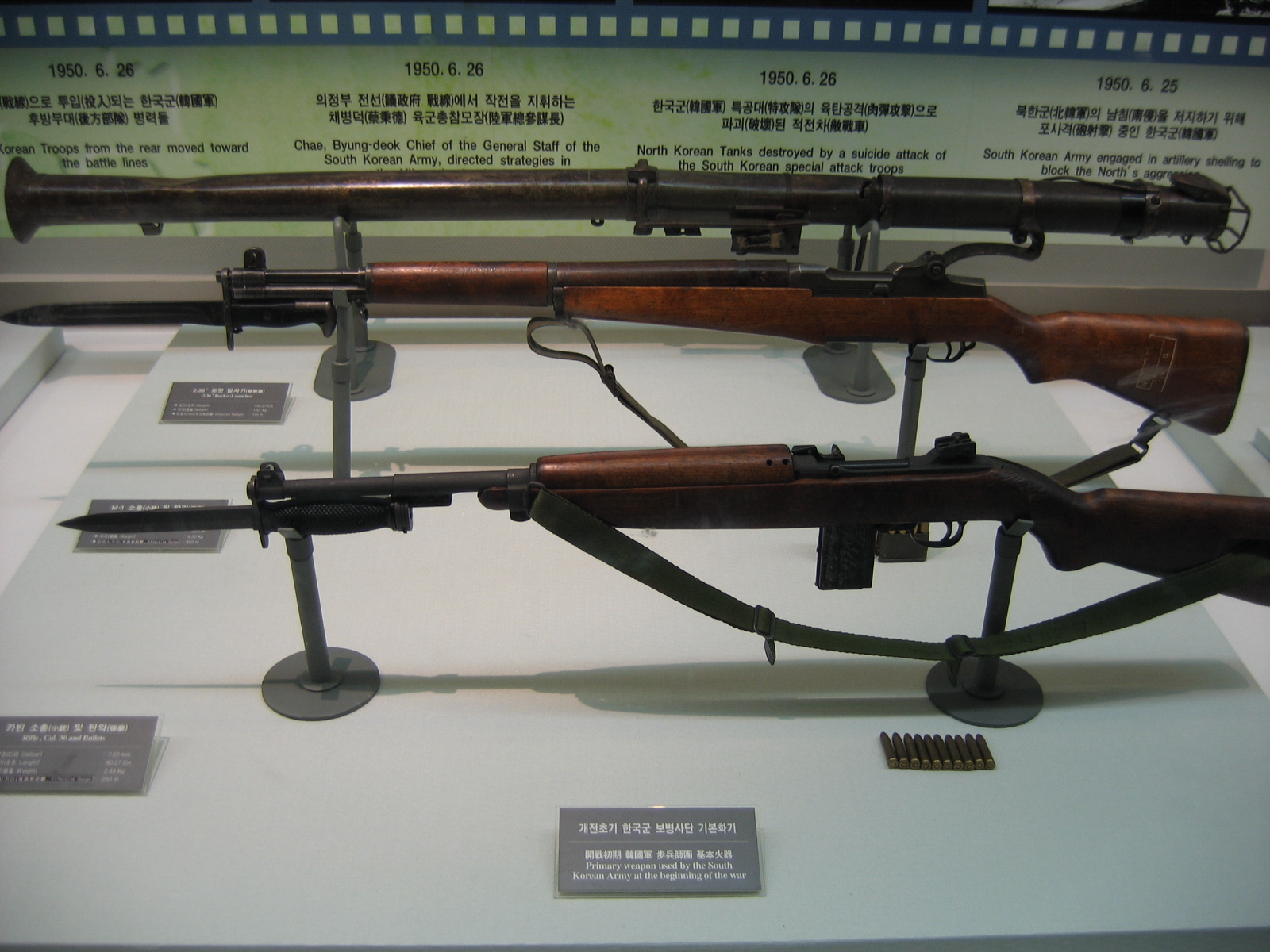
Stocks carry a lot of the story. High-wood to low-wood to pot-belly tracks the push for durability and speed. None of that guarantees when the stock met the receiver. During and after the war, armorers grabbed what worked.
- Arsenal and replacement marks: SA on replacement parts ties to Springfield Armory’s postwar role; RIA appears on some small parts from Rock Island Arsenal (postwar reference).
- Inspection cartouches: Expect ordnance inspection marks on the right butt in various forms, and a proof mark at the grip base on many rifles. Rebuild stamps from armories may appear on the left butt or near the sling well.
- Inletting marks: The sling well and handguard underside often hide maker or subcontractor codes. Read them as clues, then weigh them against the rifle’s overall story.
Practical note: honest finish wear at the sling cut, softened edges, and dings that match the rifle’s metal finish suggest a stock that has been there awhile. A freshly refinished stock on weathered metal can be valid as a replacement, but price it accordingly.
Magazines: 15s, 30s, and function checks
A feature that set the carbine up for success was its detachable box magazine. Standard issue was a 15-round double-stack magazine. GI 15s are usually marked with maker codes on the spine or floorplate. Thirty-round magazines also exist and became common later; for most collecting and range use the 15 is still the baseline.
Function first: check feed lips for symmetry, a free follower, healthy spring tension, and positive lockup with the mag catch. A straight GI 15 with a fresh spring is hard to beat for reliability.
Spotting commercial carbines fast
Commercial carbines look the part but are their own category. Universal and Iver Johnson are postwar commercial models, not USGI. Universals often wear a ventilated handguard and have a modified bolt, and many of their internal parts do not interchange with USGI. If someone is pitching a “GI Universal,” they are mixing terms. Decide if you want a GI-pattern carbine or a commercial variant, then shop accordingly (RJ Militaria).
What to inspect on every M1 Carbine
Most carbines on the market have seen several lifetimes of attention. A careful inspection pays off. Here is a focused walkaround, tuned to wartime changes and postwar realities.
- Configuration first glance: stock profile (high, low, pot-belly), rear sight type (flip or adjustable), safety type (push-button or lever), and the barrel band. That sets expectations for period vs. postwar features.
- Receiver and maker: read the maker’s mark with a cool head. Ten companies built wartime carbines. Do not let the rollmark alone carry the day.
- Rebuild fingerprints: scan for SA on replacement parts and RIA on small parts. Those tie to the postwar support network.
- Rear sight integrity: whether flip or adjustable, it should be tight, square, and not drift on recoil. Staked bases are a plus.
- Safety and mag catch: the safety should engage positively. Check that the mag catch holds a 15-round mag solidly and releases it cleanly.
- Bolt shape and condition: a flat-top bolt fits early to mid-war patterns. Whatever the type, look for smooth travel, positive lockup, and clean lug surfaces.
- Front end integrity: the band should be snug, the handguard seated, and the front sight square. Upgrades often leave wrench marks; not a deal breaker, but everything should be tight.
- Stock health: inspect for cracks at the recoil plate, oiler slot, and sling cut. Honest wear beats fresh splits every time.
- Bore and crown: bright bore with sharp rifling is ideal. Pay close attention to the crown; damage there kills accuracy fast.
- Overall story: do the features make sense together for an early, mid, or late pattern, or for a postwar-supported rifle. Mismatches are common; just price accordingly.
If you want to go deeper, original inspection manuals have been reprinted and circulate widely, and the USCarbineCal30 postwar history links to resources for hands-on inspection and rebuild context.
Practical accuracy expectations
The carbine was built for portability and fast, controllable fire with pistol-weight ammunition. With good ammo and a sound setup, many shoot better than their reputation. The Civilian Marksmanship Program notes that a well set up carbine in good operating condition with good ammo will score in the mid to high 90s on the SR-1 at 100 yards from a steady rest, which is a useful benchmark (CMP Carbine Shooting With Accuracy).
When a period-correct restoration makes sense
Here is a common scenario: someone inherits a carbine that is mechanically sound but cosmetically mixed. A late band on an earlier receiver, a replacement stock, and a mishmash of small parts. They want it to look more like a World War II example without chasing unicorns. That is where a thoughtful, parts-plausible restoration can be rewarding. The key is understanding what is plausible for the period you are aiming at. If you are new to that project, Guns & Ammo’s restoration guide frames those decisions with clear examples.
Wrap-up
The M1 Carbine rewards the buyer who knows what to look for, accepts the reality of rebuilds, and values a clean shooter as much as a time capsule. From Inland and Winchester’s early push to the smaller shops that filled the gaps, and onward through the armory years with Springfield and Rock Island supporting the fleet, the carbine’s life left clues at every screw and stamp. Learn to read them, and the hunt gets even better.