
Remington Model 8 and 81: Browning’s Long Recoil Sporting Rifles
A practical, collector-minded look at Remington’s Model 8 and 81. Calibers, long recoil explained, police conversions, and what to check before you buy.

Call us any time at: (833) 486-6659
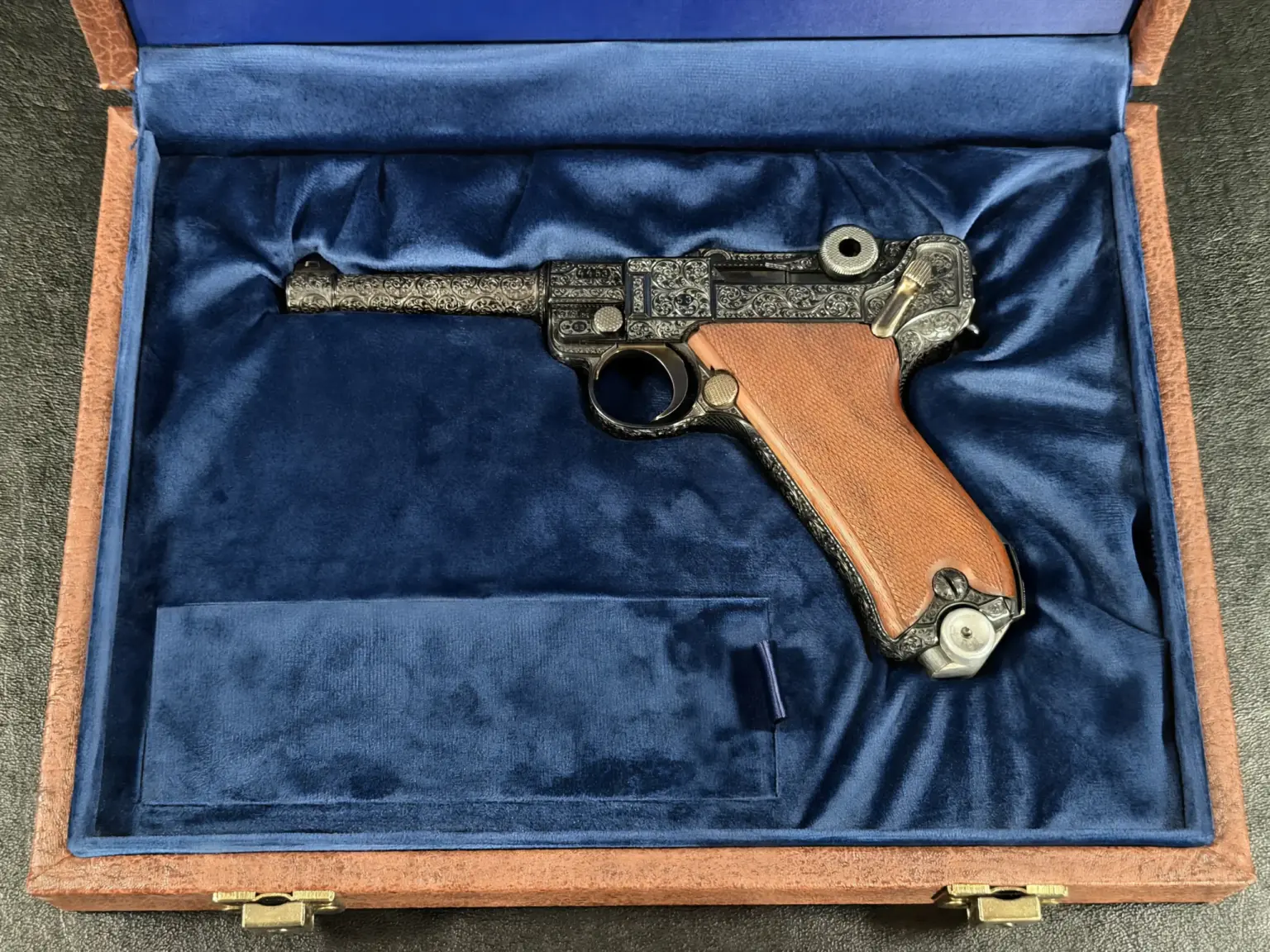
The best Luger I ever bought started with a no. It was at a small-town show, three P.08s lined up like a row of sparrows, each with a tag that wanted to be your friend. The seller caught me peeking under the grips and asked, So, what do you think? I told him the truth. The toggle was saying one thing, the chamber another, and the suffix letter was the tie-breaker. He blinked, took a breath, and said, All right, tell me what I’m missing. That’s how a maybe turned into a yes. If you know how to read a Luger, it starts talking to you fast.
This guide is about teaching your eyes to listen. We’ll keep it practical, centered on the DWM-to-Mauser years, and walk through the clues that matter most to buyers and collectors: toggle details, chamber dates, suffix letters, matching parts and magazines, era-correct finishes and grips, and the traps that have emptied many a wallet.
Before we start sorting marks and parts, a refresher helps. The Luger is a toggle-locked, short-recoil semi-automatic designed by Georg Luger as an evolution of the Borchardt C-93. Production ran broadly from 1900 into the early 1950s with multiple makers along the way. Standard P.08 pistols generally have a 100 mm barrel and were most commonly chambered in 9×19, with earlier and commercial examples also in 7.65×21. Total production across all models and nations reached into the millions over that half-century span.
If you want a broad primer on the family, the Luger pistol overview is a helpful satellite image to help us zoom in.
The roll call of manufacturers tells you a lot about the era, the finish, and often the markings. It begins with Deutsche Waffen- und Munitionsfabriken (DWM), which brought the Parabellum pistol to market and supplied the early military and commercial variants. The Imperial arsenals of Erfurt also built them, and later the line was produced by Simson, Heinrich Krieghoff, Mauser, and others in smaller or specialized roles. A Swiss line was produced by Waffenfabrik Bern, and Vickers handled final assembly on some contracts. That’s a broad arc, but for the P.08 buyer today, the DWM and Mauser chapters are where most of the marketplace action is.
Mauser takes center stage in 1930, assuming production of the P.08 as Germany rearmed and standardized. Many P.08 pistols served throughout the Second World War, and Mauser’s wartime changes to markings and finishes are a big part of how we sort out originality today.
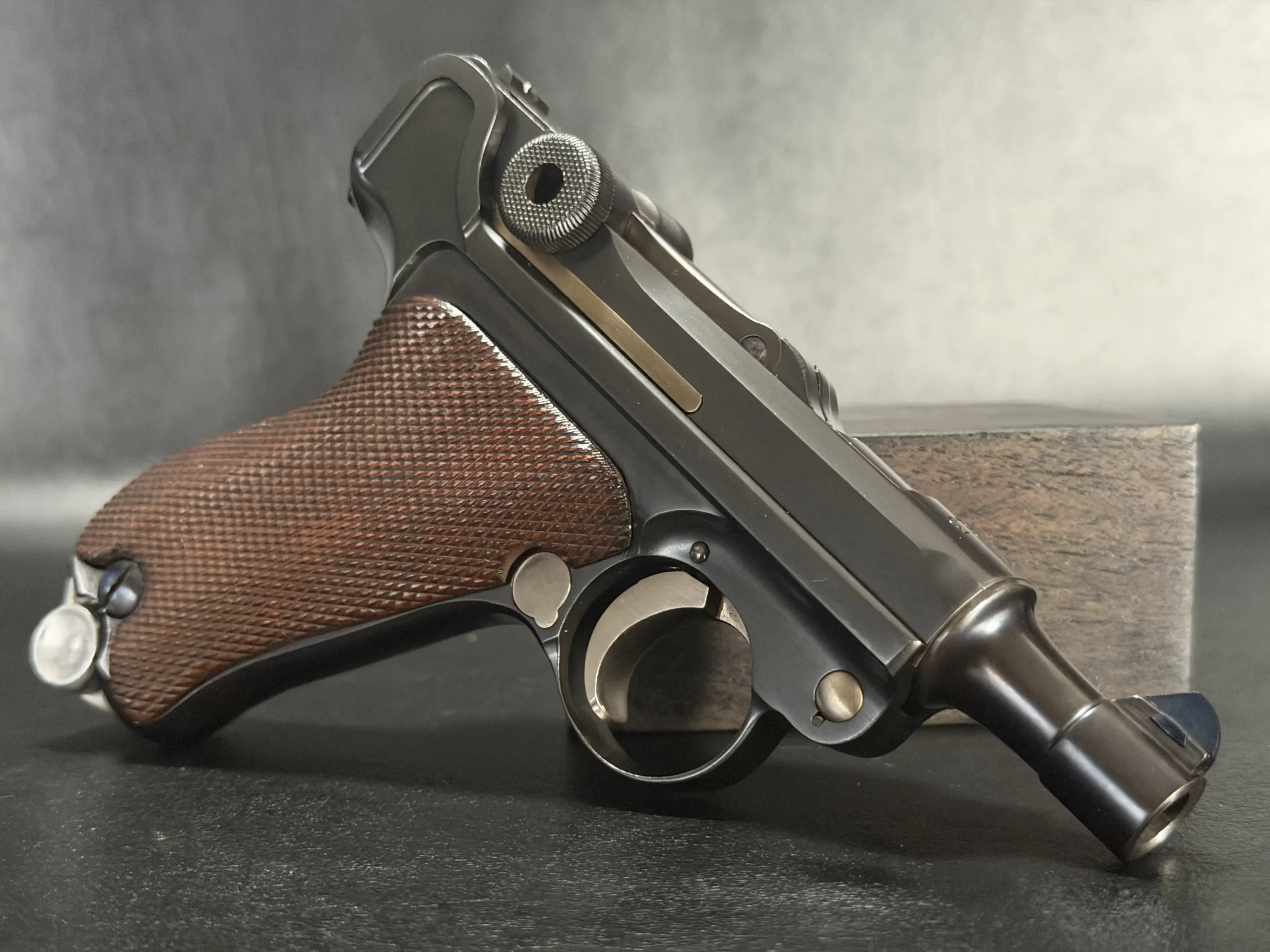
The toggle plate is the Luger’s signature and its name tag. On DWM-made pistols, you’ll see the familiar DWM monogram on the top of the forward toggle link. That flowing logo is like a lighthouse from across a table. When the guns moved to Mauser, the company used letter-number codes instead of a spelled-out logo. One common wartime mark you’ll encounter is S/42, stamped on the top of the toggle on Mauser-built military pistols of the period.
A couple of era markers help when the toggle alone won’t seal the deal. Toward the end of 1937, Mauser transitioned away from the older rust-blue processes and the bright, yellow-hued straw finish on small parts. From then on, they salt blued all the parts in a single go. That shift shows up in the way the toggle and its pins and levers look under good light. If you’re holding a pistol that otherwise reads late-1930s Mauser, yet the small parts are the old straw color, that discord should nudge you to ask more questions.
Stand over the pistol with the toggle closed, and look at the top of the chamber area. Many Lugers have a year stamped there. It’s one of the simplest starting points for era, but it can also mislead a newcomer. That year is often the proof date, tied to when the barrel passed its proof test, rather than a precise assembly completion date. This is a small distinction that keeps you from arguing with a perfectly honest seller who knows how these were marked. As one practical summary notes, the chamber date is primarily a proof year and a helpful anchor when it matches the maker and other features on the gun.
When the chamber date, toggle code or logo, and finish style all sing the same song, you’re in safer waters. When they don’t, slow down and check two more areas: the serial sequence with its suffix letter, and the acceptance marks.
On a P.08, the main serial number lives on the front of the frame under the barrel, just above the trigger guard. Below that number there’s often a cursive-letter suffix. That letter is not a stray workshop scribble. It’s part of the full serial, which was how the factory walked through numerical blocks without running out of digits. Understanding that the suffix is tied to the production run will keep you from calling a mismatch where there isn’t one.
The last two digits of the serial number were typically repeated on the major components. You’ll see those short numbers on the sideplate, takedown lever, toggle links, receiver, and other core parts. This is where a P.08 can be merciless. A pistol can look sharp and still be a mixed-parts gun if the two-digit suffixes don’t line up from piece to piece. If you see a modern-looking stamp style, or a number that slices across old finish instead of sitting down into it, that should raise a brow. Period fonts and light wear inside the stampings are your friends.
Magazines are their own sub-plot. On many Lugers, the magazine base was numbered to the pistol, sometimes including the full serial and even the suffix. On others, numbering practices varied by contract or era, and you’ll see unnumbered or differently marked bases. Don’t assume every single P.08 must have a numbered magazine to be legitimate. That said, a magazine that matches the gun can be a meaningful plus for a collector, and it’s one of the first things people chase.
Be alert for force-matched magazine bases. Tell-tales include digits that don’t match period style, numbers cut over sanded wood or fresh alloy, or two different hands at work between the mag and the pistol’s other parts. A believable matching magazine will have the right wear, period character, and stamp depth that makes sense with the rest of the gun. If it looks like a brand-new license plate bolted to a barn-find truck, walk away or price it as a non-matching mag.
Finish and grips can confirm the bigger picture. Up through the late 1930s, many small controls on Lugers wore a yellowed straw color against a blued frame and barrel. As mentioned earlier, late 1937 saw Mauser phase out the old rust blue and straw-finished small parts in favor of salt bluing everything together. If you’re holding a pistol whose toggle indicates a Mauser military build from after that change, the presence of bright straw parts is a potential red flag.
During the war, production pressures also nudged grip material. In 1941, some pistols received black Bakelite grip panels, a time-saving, cost-cutting move. You’ll often hear people call these Black Widow Lugers. That name wasn’t used by the factory; it was a postwar marketing nickname that stuck because it sounds cool. The important part for you is to recognize that black plastic grips and full salt blue are consistent with wartime production, but the nickname alone shouldn’t add zeros to a tag.
The P.08’s little stamps can be a rabbit hole, but a couple of broad patterns help. On WWII-era German military Lugers, you’ll often find small acceptance marks that feature an eagle over a swastika with a tiny two- or three-digit inspector number beneath. These are commonly on the frame and under the barrel. They’re a quick way to spot a service pistol of the period, as opposed to a commercial or foreign-contract gun.
On Mauser-built wartime pistols, that S/42 toggle mark mentioned earlier is a strong military tell from the mid-1930s. When you see that on the toggle, then find the expected acceptance marks in the usual places, and the finish and small parts line up with the late-1930s changeover, you’re starting to build a believable picture.
Most bad P.08 buys fall into a few familiar buckets. Here’s how they look in the wild.
Refinishes that don’t match the era: The most common is a late pistol wearing old-style, small, strawed parts, or a pre-1937 gun with a uniform, flat, glassy salt-blue look and rounded, buffed edges. Over-polishing before blue washes out the crispness of stamps and proof marks. On a Luger, those sharp edges and proud markings are part of its face. If they look soft, the pistol likely went back to the spa.
Toggle and chamber that disagree: A DWM toggle with late-war grip panels and all-over salt blue deserves a long look, as does a Mauser military toggle paired with features that whisper early commercial production. It’s possible for parts to have been replaced during service, but claims like that need to be supported by wear, finish tone, and consistent stamp style, not just a story.
Forced matching numbers: Fresh-looking two-digit stamps on a well-worn sideplate or safety lever are a classic warning sign. Compare the font and depth to the last two digits on the receiver or other known-original parts. If the small parts look like they were numbered yesterday, they probably were.
Magazine bases with modern marks: The rush to have a matching mag spawned a cottage industry in fantasy numbers. Numbers that don’t sit down into the material, or that look too perfect next to an otherwise 80-year-old pistol, should be treated as fantasy until proven otherwise.
Paying a premium for a nickname: Black Widow is a catchy label for a wartime pistol with black Bakelite grips, but it isn’t a factory model designation. A sound price should be driven by condition, originality, and correct features for the date and maker, not by a name that came later.
When time is short and the table is crowded, run this simple loop.
That ten-point walkaround catches most of what separates a sharp, honest Luger from an expensive project.
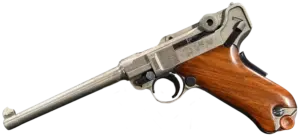
While we’re here, you’ll occasionally see the long-barreled variant with the fine rear sight and shoulder stock hardware. That model, often called the Artillery Luger, represents an early military push into the pistol-carbine concept, pairing a long 200 mm barrel with the toggle system. If the long-barrel branch of the family interests you, this overview of the Artillery Luger’s background is a quick way to understand what you’re looking at across a crowded rack.
The more Lugers you handle, the more your pace changes. You start top-down: toggle, chamber, finish. Then around the nose: serial and suffix, fonts, proof style. Slide to the right: sideplate numbers, takedown lever digits, toggle links. Flip, glance inside, check the mag, then step back and let the whole pistol sit on your eyes. Most honest guns carry their age across every surface the same way. They look like a life lived in one piece.
Cross-training helps too. If you’ve ever assessed a classic auto-pistol like the Broomhandle, you know how much originality is carried in finish tone, numbers, and the way the little parts talk to each other. The same instincts apply here. If you want a refresher on that thought process, our piece on assessing condition and originality on a Mauser C96 walks through methods that transfer nicely to the P.08.
A few anchor facts can steady your hand. The P.08 family spans decades and multiple factories. It’s normal for markings, finishes, and grip materials to evolve over those years. You’ll find service pistols with acceptance eagles common to the WWII period, and you’ll encounter black plastic grips on some 1941-era guns because that sped up production. You’ll see straws on small parts on earlier guns because that was the finishing practice at the time. And you’ll see a uniform salt blue on later Mauser builds because the factory changed the process toward the end of 1937.
What you shouldn’t see, without a very persuasive and well-documented reason, is a mashup that crosses those lines with no logic. A gun that has a Mauser wartime toggle, a pre-1937 small-parts palette, and the heavy buff of a postwar refinish is asking you to be generous. It’s better to be patient instead.
It’s tempting to let the artistry of the Luger carry the day. They are elegant pistols, and the action is a miniature machine show every time you run it. But the market doesn’t pay for poetry. It pays for originality, condition, and correct parts. That little suffix letter below the main serial is the guardrail that keeps you from taking a scenic detour into heartbreak. Because it’s part of the number, it affects whether all those repeated two-digit stamps actually match your pistol or a different block entirely. When the suffix is right, the whole gun can click into place.
Back at that show, the pistol with the loudest tag turned out to be the quietest gun on the table. DWM on the toggle. A chamber year that made sense for the style of the proofs. Straw on the small bits where it should be, and the right depth to the blue. The two-digit parts stamps matched in wear and font, and the suffix letter told the same story as the rest of the gun. The magazine wasn’t numbered, which kept the price honest. No fancy nickname on the tag, just a well-kept service pistol that had lived a consistent life.
That’s the goal. Not chasing the rarest mark, not paying a premium for a moniker, but finding the pistol that adds up line by line. When a Luger’s toggle, chamber, suffix, finish, and proofs all read in concert, you can shake the seller’s hand without worrying that the gun will start disagreeing with itself once you get it home.
If you remember nothing else, remember this: the Luger rewards steady eyes. Read the top. Read the front. Read the little numbers and the way they sit. Trust the finish and the fonts more than a story. The pistol will tell you what it is, and what it isn’t, if you give it a minute and a little good light.
And if you hear a firm no in your head when the pieces don’t fit, listen to it. The next table may have the one who sings.
Available
View Item
Available
View Item
Available
View Item
Available
View Item
Available
View Item
Available
View ItemA practical, collector-minded look at Remington’s Model 8 and 81. Calibers, long recoil explained, police conversions, and what to check before you buy.
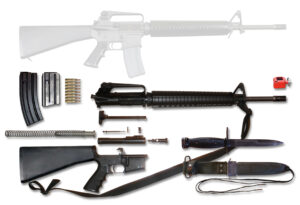
A collector’s look at Colt’s SP1 and early Sporters, from slickside uppers and pencil barrels to the rollmarks and small changes that hinted at the A2 era.
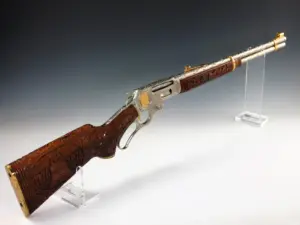
A practical, story-driven guide to reading JM vs REP barrel marks, understanding pre-safety 336s, Micro-Groove and Ballard-style rifling, and the smart checks to make before you buy.