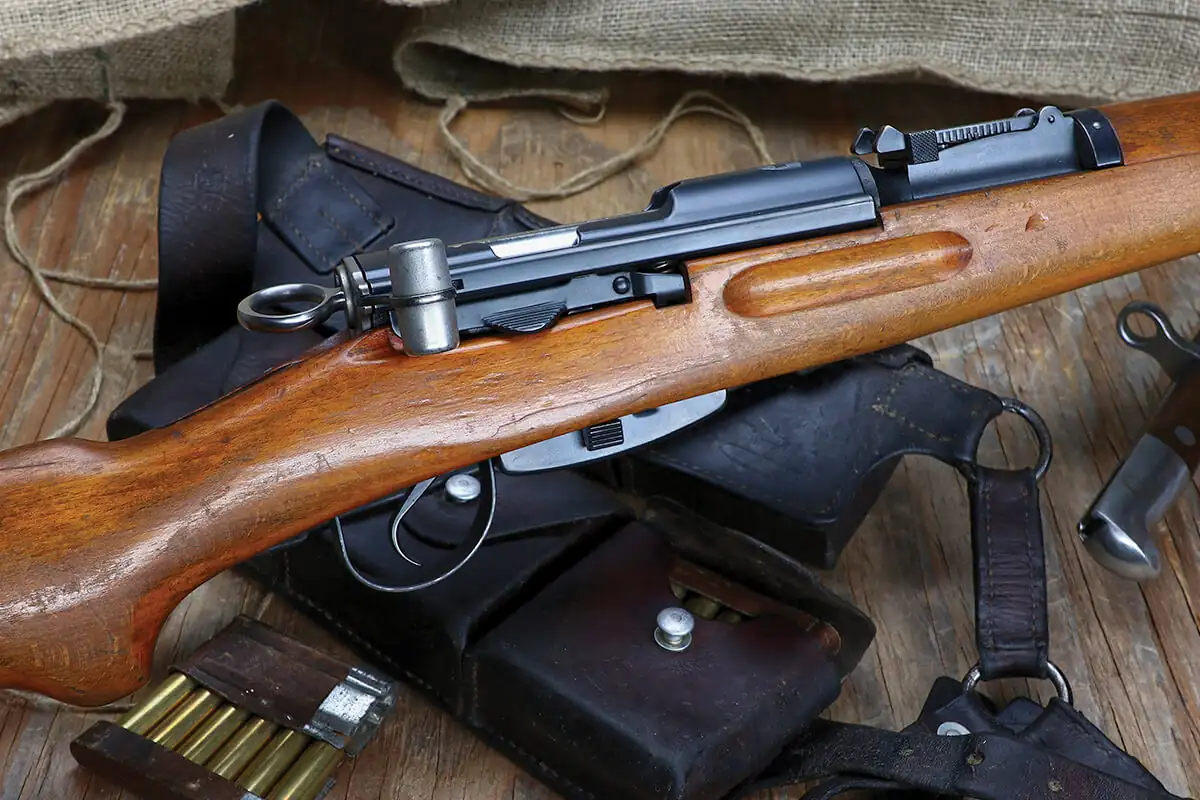
I still remember the first time I slid the buttplate off a Swiss K31 and found a small tag tucked away like a secret note in a library book. A name, a unit, an address. No mystery trench art, no talisman from the front. Just a clean slip of paper, quietly Swiss, saying: this rifle had a person. For collectors and shooters, that little tag ties the engineering to the human story in a way few surplus rifles can match.
Pull the bolt, and the other half of the story clicks into place. A straight tug, a mechanical ballet, and a spent casing fly out. Push forward, and you’re closed and ready. It’s not just fast. It’s neat, and very Swiss. But that action didn’t arrive fully formed with the K31. It took decades of careful, conservative change to get there. If you’re looking to buy, or you’re sorting out what you’ve already got, it helps to walk the lineage with a clear map: 1889 to 1896 to 1911 and its 96/11 conversions, then finally to the K31.
What makes a Schmidt-Rubin a Schmidt-Rubin
The name pairs the action and the ammunition. Colonel Rudolf Schmidt laid out the straight-pull system that lets you swap a lift-and-rotate bolt for a simple back-and-forth stroke. Colonel Eduard Rubin designed the 7.5 mm cartridge these rifles use. That pairing first appeared in the long Model 1889 and remained with Swiss service arms through the mid-20th century. The straight-pull part is the headline feature: you yank back to extract and cock, you push forward to chamber and lock. No lifting the bolt handle. Simple to run fast, and surprisingly precise to shoot.
The 1889: long rifle, semi-smokeless GP90, and a big magazine
The Model 1889 was Switzerland’s leap from black-powder Vetterlis to a new smokeless era. It used the GP90 cartridge and a round-nose 7.5 mm bullet at a modest velocity by later standards. The rifle itself was long and steady, with a free-floating barrel and a wood stock running nearly to the muzzle. The magazine was a generous 12 rounds and permanently attached, with a clever lever to drop it just below the bolt line for a single-shot routine under field conditions. That was a very 1890s way of controlling ammunition use and keeping a reserve ready.
As a first crack at a national smokeless rifle, the 1889 is fascinating. As a shooter, it’s pleasant. But its bolt-locking system placed the lugs at the rear, which limited how far the Swiss could push the cartridge’s pressure. That reality would drive the next changes.
1896 and the 1889/96 update: stronger lugs, smarter receiver
By the mid-1890s, Swiss ordnance wanted greater strength and a shorter receiver. The 1896 update responded by moving the locking lugs forward in the bolt sleeve, which helped the rifle withstand higher pressures and trimmed the overall length. The result showed up as the Model 1896 and the related 1889/96 pattern. It was still very much a Schmidt straight-pull, still firing GP90, but now on a sturdier foundation.
It’s easy to lose sight of why this detail matters when you’re at the gun counter. But forward lugs and reinforced geometry are the reasons the later GP11 cartridge could exist. You’ll run into two names a lot with these rifles around this point: 1896/11 and 1911. There’s a reason for the slash, and we’ll get there.
Shorter Swiss arms before 1911: cadet, short rifle, and cavalry carbine
Before the big ammunition switch in 1911, the Swiss spun out several shorter variants that you’ll see listed in catalogs and on auction tags. There was a single-shot Cadet rifle in 1898 to train young shooters. A 1900 short rifle. A 1905 cavalry carbine. These were not wholesale design resets, just tailored formats for specific roles, built around the same basic straight-pull DNA and GP90-era thinking. They are less common in the wild than the big service rifles, but they sketch out how Switzerland liked to solve problems: iteration, not revolution.
1911 changes everything: GP11, a stronger action, and the 96/11 conversions
Now comes the crucial turn. In 1911, the Swiss adopted a hotter, spitzer-bullet load called GP11. It was a higher-pressure, smokeless round that gave the 7.5 mm its modern reputation, broadly comparable in ballistics to 7.62 NATO. The new cartridge demanded a tougher action, and the Swiss answered with the Model 1911 rifle, specifically strengthened to safely run the GP11.
But they didn’t just shelve the earlier guns. Instead, many rifles built on the 1896 system were upgraded to shoot GP11. Those conversions are the 96/11 rifles. They typically received a new barrel, a 6-round detachable magazine, a semi-pistol grip grafted into or built into the stock, and new sights set up for the faster cartridge. Think of the 96/11 as a thoughtful bridge between the early straight-pulls and the K31 generation. For a shooter, it’s a sweet spot: classic long rifle feel, GP11 compatibility, and often excellent barrels.
If you’re looking at a pre-K31 Swiss rifle and wondering what you have, ask these questions. Does it wear a 6-round detachable box magazine instead of the 1889’s fixed 12? Does the stock have a semi-pistol grip rather than a straight wrist? Are the sights graduated for the faster GP11 trajectory rather than the slow GP90? A 96/11 will usually hit those notes. The purpose-built 1911 rifle shares a similar general look, with the built-for-GP11 action and those modern sight graduations. One quick tell on the 1911 pattern versus earlier types is that many 1911-family rifles use a tangent rear sight that starts at a longer initial setting typical of the era.
From 1911 carbine to K31: the straight-pull grows up
The Swiss also produced a Model 1911 carbine. It kept the 6-round detachable magazine, the GP11 chambering, and trimmed overall length for cavalry and support roles. It carried forward the 1911 pattern’s sight ideas and field handling. For many Swiss soldiers, this format felt handier in alpine terrain and around kit.
Then in 1931, the story jumps again. The K31, more formally the Karabiner 31, arrived as a new design from the federal arsenal at Bern under Colonel Adolf Furrer. It is still a straight-pull, still chambered for GP11, and still Swiss to the core. But internally, it’s a different animal from the earlier Schmidt patterns. The locking lugs were placed at the very front of the bolt, and the overall bolt body was shortened dramatically. That change alone made the carbine shorter in action yet capable of using a longer barrel within the same overall-length envelope as the 1911 carbine. Stronger and more economical to build was the bonus, and Switzerland is fond of bonuses that look like they came from a slide rule.
K31 mechanics and manners
The K31 kept the 6-round detachable magazine and charger loading through the top of the receiver. It added a rear sight that scales down to 100 meters, reflecting a more modern sense of practical engagement distances. The first production batch went out in 1931 for troop trials. Swiss service adoption followed in the early 1930s, with the carbine carrying the nation’s standard until 1958, and examples lingering in reserve and second-line roles into the 1970s.
If you sit the K31 bolt next to a 1911 family bolt, the difference is striking. According to first-hand testing and handling notes from experienced shooters, the K31’s bolt is almost half the overall length of the 1911 pattern, which helped keep the carbine compact while stretching its barrel several inches longer than the older carbine. The change also made the action feel stiffer and more direct under your hand. Not every shooter prefers the K31’s ergonomics over a well-sorted 96/11 for slow-fire precision, but there is no denying that the K31 is a modern-feeling straight-pull with real field speed. For a thoughtful overview of this evolution, with photos, see Forgotten Weapons’ impressions in their piece on Swiss straight-pulls.
Service life and the Swiss way of care
These rifles were used in both world wars, but Switzerland maintained armed neutrality. That meant mobilization, training, and guard duty rather than large-scale combat use. The upside for collectors is obvious. Swiss rifles tend to show stock wear from drill halls and troop racks, but the metalwork and bores are famously clean. The country issued non-corrosive ammunition and a thick grease called Waffenfett for storage, and that has done wonders for the condition of surviving rifles.
It’s also why you still find little paper or plasticized troop tags under the buttplates of many K31S. Those tags usually list the soldier’s name, unit, and address. They are part of the rifle’s story. Many collectors leave them in place as a matter of respect. If you do examine one, tuck it back carefully and keep personal details private if you choose to share a photo online.
GP90 and GP11: ammo basics and safety notes
This part matters for buyers and shooters. The Swiss started with GP90 in 1889 and its immediate successors. That cartridge used a round-nose 7.5 mm bullet at a lower pressure. In 1911, they introduced GP11, a higher-pressure Spitzer-bullet load that gives the cartridge family its well-known flat performance. GP11’s ballistics are broadly similar to 7.62×51 NATO or 308 Winchester, though the dimensions are not interchangeable.
Only the 1911 family actions and converted rifles were intended for GP11. In practice, that means the Model 1911, the 1911 carbine, the 96/11 conversions, and the K31. Do not use GP11 in an original 1889 or in an unconverted 1896. Many 1896-series rifles were converted and rebarreled to the 96/11 pattern specifically to run GP11 safely. If you have doubts, have a qualified gunsmith confirm exactly what you own before shooting.
The detachable 6-round magazine on the 96/11, 1911, and K31 can be charged from the top with stripper clips. Original Swiss magazines are often serial-numbered to their rifles. As a rule of thumb, stick with standard GP11 or commercial 7.5×55 loads from reputable makers. Non-corrosive is the norm with Swiss surplus GP11, one reason so many bores are crisp.
Buying smart: quick tells and practical checks
Here are the things I actually check when one of these shows up on a counter or a table.
- Confirm the model and cartridge compatibility. The receiver and barrel shank markings will tell you if it’s 1889, 1896, 96/11, 1911, or K31. Only 96/11, 1911, and K31 are meant for GP11.
- Look at the magazine type. A fixed 12-rounder points to the 1889 family. A detachable 6-rounder is 96/11, 1911, or K31.
- Check the sights. 1911 pattern rifles often start at a higher minimum range on the tangent, while the K31’s rear sight drops to 100 meters. It’s a quick visual clue.
- Handle the bolt. The K31’s bolt travel is short and stiff compared to the long 1911 pattern. On a 96/11 or 1911, you’ll feel more rear overtravel.
- Open the buttplate carefully. If you see a troop tag, photograph it for your records and return it as found. It adds character and a story to the rifle.
- Check for a matching magazine. Many Swiss magazines are serial-numbered to the rifle. A matching mag is a nice plus, though not a requirement for a good shooter.
- Inspect the bore and crown. Swiss bores are often excellent thanks to non-corrosive ammo and grease, but check anyway. Pay attention to the crown on K31 carbines that have seen extensive drill or cleaning rod use.
- Study the stock. Swiss stocks typically show rack dings and finish wear rather than combat damage. Cracks around the tang, handguard nose, or barrel channel are worth noting.
- Mind import marks and past work. Importers marked many K31S on the barrel or receiver. That is fine, just record what you see. Any non-arsenal modifications should be weighed against your goals as a collector or shooter.
If you want a quick mental sorting: 1889 is long and fixed-mag with GP90 roots. 96/11 is a conversion with a detachable 6-rounder and GP11-friendly features. 1911 is purpose-built for GP11 in rifle and carbine forms. K31 is the compact, modern-feeling straight-pull with front locking lugs and a short bolt throw.
Why these rifles still matter on the rack and at the range
Part of the appeal is that they are distinct. The straight-pull action is quick without being gimmicky. The Swiss blend of old-world wood and carefully machined steel never went out of style. And there is a real throughline from Schmidt’s first ideas to Furrer’s K31 that makes sense in the hands. You can feel that the 1889 chased consistency, that the 1896 solved a strength problem, that 1911 brought a cartridge that finally made the most of the platform, and that the K31 finished the job with a compact, stronger bolt and sighting that matches real ranges.
If you are drawn to the arc of a design, the 96/11 and the K31 are the two that best tell the story in contrast. Put them side by side on a bench and run the bolts. Feel the throw. Check the sight ladders. Load two chargers and see what your hands do on reloads. The rifles explain themselves. Ian McCollum captured that feel nicely when he photographed and shot examples spanning 1889 to K31 in his field notes on Swiss straight-pulls, and his takeaway about the K31’s different character compared to the 96/11 echoes what many shooters sense on the line.
For a deeper background timeline and variant list compiled by longtime enthusiasts, the Schmidt-Rubin FAQ at SwissRifles lays out the steps from 1889 through the short rifles and carbines, then into 1911 and the K31. One important point you’ll see reinforced there: while the K31 is a straight-pull like the earlier rifles, it is not a Schmidt action. It’s a shorter, stronger design that happens to run the same way.
Service history gives these rifles a quiet kind of credibility. They stood guard over a country that spent the first half of the 20th century preparing for wars it never entered. They were issued to citizen-soldiers who took them home, maintained them, and sometimes tucked their names under the buttplates. Today, that shows up as clean bores, honest stock wear, and the occasional slip of paper that feels like a handshake across time. If you’re hunting the right example, pick the model that fits your range plans, confirm it’s right for GP11 if you intend to shoot that load, and enjoy the kind of mechanical character that doesn’t need marketing gloss to stand out.